Walk into any group of institutions today, and the same refrain comes from leadership: clarity on paper, uncertainty on the ground. A Chairperson may see consolidated numbers clearly, yet have little insight into what's happening at a campus a few kilometres away.
This is a consequence of scale, not leadership. India has 1,168 universities and 45,473 colleges under the AISHE 2021-22 survey. And over 14.72 lakh schools under UDISE+, most operate within trusts & societies managing multiple campuses under one governing body. Each campus runs its own admissions, fee cycles, and staffing.
For a chairperson or trustee above this structure, growth doesn't automatically strengthen operations. It fragments information, duplicates effort across teams, and widens the distance between decisions made at the top and their execution on the ground.
Closing this gap is what a group institution management platform is built for. This guide covers the leading platforms for GOIs in India, operational gaps that widen without one, and an evaluation framework to help choose the right fit.
TL;DR
A group institution management platform gives a GOI one system of record across every campus. Instead of a patchwork of spreadsheets and disconnected software running at each institution separately.
Without one, groups face delayed consolidated reporting, fee leakage, compliance risk and duplicated staff effort across campuses running the same processes on their own.
Choosing the right platform means matching features to role based priorities. While avoiding the selection mistakes GOIs repeat most often.
edumergeOS brings School ERP, College ERP, HRMS and Finance & Control onto one platform. Giving GOIs consolidated governance and audit-ready finance across every campus.
Why Schools and Colleges Need a Group Institution Management Platform
A single school or college can often get by on basic accounting software and a spreadsheet or two. That stops working the moment it scales to 5, 10 or 30 campuses under the same trust or society. Following realities show up first once a group crosses that line:
- Consolidated visibility becomes non-negotiable: Trustees need real time group health without waiting for monthly reports compiled from each campus.
- Compliance multiplies with every new campus: Each state, board and regulator adds its own filing, audit & reporting requirement.
- Staff and student data fragments: The same admission, attendance and HR processes get repeated at every campus in different formats. Making transfers and comparisons difficult.
- Financial consolidation gets error-prone manually: Excel based consolidation across campuses is slow and carries real risk ahead of board or statutory audits.
- Growth outpaces manual oversight: With 341 new universities established since 2014-15 as per AISHE 2021-22, the pace of expansion in Indian education means legacy, single-campus systems cannot keep up.
For a closer look at why board-ready governance now depends on traceable AI decisions, not just dashboards. See why AI needs an audit trail in regulated education.
Key Features to Look for in a Group Institution Management Platform for Schools and Colleges in India
On paper, single-campus software and a real group-wide platform can look almost identical. The difference only shows up once you ask a platform to hold up across many campuses at the same time, not just one. Here's what's actually worth checking closely.
| Key Features to look for | How it impacts schools & colleges |
|---|---|
| Multi-campus, multi-entity architecture | One deployment where each campus keeps its own configuration while contributing to group-level reporting. |
| Role-based access control | Ensures data stays in the right hands, from campus admin staff up to group-level trustees. |
| Trustee and board-ready dashboards | Real-time group health without waiting for monthly reports from each campus. |
| Consolidated financial workflows | Sanction-to-settlement processes, approval chains and budget vs actual tracking across campuses. |
| End-to-end student lifecycle management | From admission to alumni, the process should be standardised across every institution in the group. |
| Unified staff and HR lifecycle tools | Onboarding to retirement, with inter-campus transfers that are handled within the same system. |
| Cloud-based deployment | No on-premise server hardware required at every campus. |
| Audit-ready reporting and compliance tracking | Built-in audit trails that keep the group ready for scrutiny at any time. |
The first payoff a Principal notices often isn't financial at all. The real ROI of edumerge is on the timetable, not on the balance sheet first.
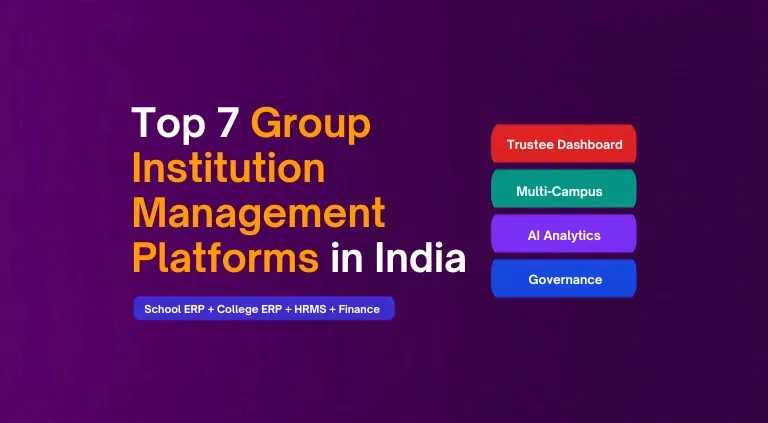
Top 7 Group Institution Management Platforms in India
1. edumergeOS
edumergeOS is an unified operating system that runs an entire group of institutions, schools, colleges, or both; on one codebase and one database. It scales from 3-campus groups to 50+ campus networks, with a named implementation and support team. Moreover it is trusted by 800+ institutions managing 500,000+ students across India since 2012.
Key strengths:
- One codebase, one database across every campus: School ERP, College ERP, HRMS, and Finance & Control share a single data layer. So an action in one module updates every related record everywhere else instantly.
- Centralised governance with campus-level autonomy: The group office sets and enforces fee structures, approval chains, and academic calendars, while each campus principal still runs their own full ERP within those guardrails.
- Mixed-type group support on one platform: A trust running both schools & colleges operates School ERP and College ERP together, with no separate products or manual data bridges.
- GOI Command Center inside Finance & Control gives CFOs and trustees consolidated cross-entity financial reporting, fund flow tracking, and budget vs actual across every entity.
- Real-time trustee and director dashboards showing live enrollment, fee collection, staff strength, budget variance, and academic performance across all campuses. Without waiting on monthly reports.
- New campus rollout in a day using group templates that replicate fee structures, HR policies, approval chains, and academic calendars automatically.
- Group-wide HRMS handles inter-campus staff transfers, biometric & geo-fencing attendance, and statutory payroll (PF, ESI, TDS) centrally across every institution.
- College ERP layer adds OBE (CO-PO, PEO, PSO mapping) and NAAC, NBA, NIRF accreditation management.
- School ERP layer adds AI timetabling, GPS-tracked transport, and hostel management.
2. MasterSoft ERP
Established Indian college ERP with strong examination and accreditation management, deployable across multiple campuses.
Key strengths:
- Strong examination and result management across affiliated and autonomous colleges.
- NAAC and NBA compliance reporting and data management.
- Multi-campus data sharing lets college groups view admissions, fees, and hostel data across locations.
What to note:
- School ERP and College ERP are separate products rather than a single unified operating system for mixed groups.
- Group HRMS and institutional finance require integration with external tools, and the trustee-level governance dashboard is limited.
Take a look at how edumerge compares with MasterSoft Education ERP.
3. Entab CampusCare
School ERP built for premium school chains that need multi-campus oversight.
Key strengths:
- NEP 2020-aligned academic tools built into the core for school groups.
- Multi-campus school chain management with centralised governance and GST-compliant fee receipts.
- GPS bus tracking, biometric attendance, and hostel management natively, established in premium schools.
What to note:
- Designed primarily for K-12 schools; college ERP is outside scope, so mixed groups running both cannot operate on one platform.
- Trust accounting and group-wide HRMS need separate tools, and implementation is at the premium end of pricing.
You might also like our comparison between edumerge vs Entab School ERP in detail.
4. Fedena
Modular, plugin-based ERP with a multi-school dashboard and an open-source community edition.
Key strengths:
- Multi-school management dashboard for basic group-level oversight.
- Open-source community edition with no licensing cost and a large global user base.
What to note:
- Group governance depth is limited
- Multi-entity trust accounting, inter-campus HRMS transfers, and real-time trustee dashboards need heavy custom development.
- OBE and accreditation workflows are not core, and the setup is IT-intensive to maintain.
Discover how edumerge compares with Fedena over different features.
5. TCS iON Education
Enterprise-grade digital campus platform backed by Tata Consultancy Services, aimed at large university systems.
Key strengths:
- Student lifecycle management from admission through alumni, with integrated digital learning and assessment.
- Strong presence in government-linked and large autonomous universities.
What to note:
- Not designed for the mixed-type Indian group model; K-12 school ERP and a trust-level governance layer are outside scope.
- Implementation cost and timeline are prohibitive for most mid-size education groups, and inter-campus HRMS is limited compared to a purpose-built group OS.
6. VAPS Group (i-Vidyalaya)
Long-established Indian ERP covering K-12 schools through postgraduate institutions under one vendor.
Key strengths:
- Covers K-12 through postgraduate colleges, supporting CBSE, ICSE, state board, and international affiliations.
- Decades of experience and strong presence across India, including tier-2 and tier-3 cities.
- Comprehensive modules for admissions, fees, attendance, exams, and communication.
What to note:
- A unified codebase for mixed groups (schools and colleges on one database) requires verification with the vendor.
- Group governance dashboards for trustees and multi-entity trust accounting depth are less documented compared to purpose-built group platforms.
Read more about the top ERP for university groups in India.
7. Classter
Global SIS, ERP, and LMS platform on Microsoft Azure, used across institutions worldwide.
Key strengths:
- Multi-campus support with campus-level and group-level access control.
- GDPR compliance and Microsoft Azure infrastructure for institutions with international operations.
What to note:
- Not built for the Indian regulatory context
- NAAC, NBA, FCRA, and PF, ESI, TDS payroll compliance require custom configuration.
- Indian academic structures such as affiliated colleges and CISCE board requirements are not natively supported, and the support model leans international.
For a closer look at platforms built specifically for operators running multiple branches under one name, read centralized school chain management software.
How to Choose the Right Group Institution Management Platform: Evaluation Checklist
Once the feature list is clear, the harder part is testing whether a vendor actually delivers it at group scale. This checklist covers the criteria that matter most during evaluation.
| Evaluation Criteria | What to Check |
|---|---|
| Multi-campus architecture | Can one deployment serve every campus while keeping campus-level configuration intact? |
| Governance and reporting | Does it offer a Trustee or board-level dashboard with real-time, consolidated data? |
| Financial control | Does it support approval chains, Budget vs Actual tracking and audit trails across entities? |
| Implementation timeline | How long does onboarding take for a group with multiple campuses, and what does the vendor's track record show? |
| Data security and access | Is role-based access control available down to the campus and department level? |
| Integration capability | Can it connect with existing systems, such as payment gateways or biometric attendance, without a full replacement? |
| Vendor track record in education | Has the vendor worked specifically with schools, colleges or GOIs in India, rather than generic ERP deployments? |
| Support and SLAs | What is the vendor's response commitment for issues raised from any single campus? |
| Pricing structure | Is pricing per campus, per user or per module, and does it scale predictably as the group adds institutions? |
If your primary focus is schools, read our comparison on top 10 school ERP software for group schools in India.
Conclusion
Choosing among the top group institution management platforms in India comes down to one question. "Can it give your trust or society one honest, real-time view of every campus, without adding complexity at each one?"
edumergeOS answers that question with a single data architecture across School ERP, College ERP, HRMS and Finance & Control, built specifically for Indian GOIs rather than adapted from generic software.
For a group weighing the checklist in this guide, edumergeOS is built to meet it. Consolidated governance, audit-ready finance and role-based visibility for every stakeholder who needs it.
Frequently Asked Questions (FAQs)
1. Who uses a Group Institution Management Platform?
Trustees, Chancellors, Principals, IT Heads, Finance Heads and Operations Heads across schools, colleges and universities that belong to the same group.
2. Does a Group Institution Management Platform support campuses on different boards or curricula?
Yes, a properly built platform lets each campus keep its own board, curriculum or affiliation while still feeding group-level reporting.
3. How long does it take to implement a Group Institution Management Platform across a GOI?
Timelines vary by group size, but a phased rollout starting with one or two campuses before group-wide adoption is the most reliable approach.
4. Can a Group Institution Management Platform handle both school and college operations?
Yes, platforms built for GOIs typically combine School ERP and College ERP modules on one shared data architecture.
5. Is a Group Institution Management Platform cloud-based?
Most modern platforms are cloud-based, which removes the need for on-premise servers at every campus.
6. What financial capabilities should a Group Institution Management Platform have?
Look for sanction-to-settlement workflow, approval chains, Budget vs Actual tracking and a Trustee dashboard.
7. How is data kept secure across campuses?
Role-based access control ensures each user, from campus staff to group trustees, sees only what they are authorised to see.
8. What is the difference between a School ERP and a Group Institution Management Platform?
A School ERP manages one institution's operations. While a Group Institution Management Platform consolidates multiple schools, colleges or campuses under one trust or society.
9. What mistakes should a GOI avoid when selecting a platform?
Common mistakes include picking a single-institution tool, skipping a pilot rollout and leaving Finance or IT Heads out of the evaluation.
10. Does edumerge offer a Group Institution Management Platform?
Yes, edumergeOS is edumerge's Group Institution Management Platform, built for trusts and societies running multiple schools, colleges or universities in India.