State Board schools account for the largest share of school enrollment in India, spread across cities, small towns and rural blocks. Of India's roughly 14.9 lakh schools, only about 28,000 are affiliated with CBSE and 2,400 with CISCE. This ensures that a vast majority runs under state boards. But many still track admissions, fees & report cards through registers and spreadsheets.
Choosing an ERP is not the same exercise for a State Board school as it is for a CBSE or ICSE institution. Syllabi, grading formats & reporting requirements vary by state. So a platform built for one board rarely fits another well. Hence this guide looks at what State Board schools actually need.
We cover why these platforms matter uniquely for India's State Board schools, challenges faced without one, and the evaluation criteria school management should apply before signing a contract.
TL;DR
State Board schools form the bulk of India's ~14.9 lakh schools, yet most still run admissions, fees and report cards manually. With 30+ state boards each having different grading formats, generic CBSE/ICSE ERPs don't fit, and compliance load, budgets & regional-language needs add further constraints.
Without dedicated software, schools face enrollment errors, fee delays, poor attendance visibility, and missed UDISE+/RTE deadlines. The blog ranks 10 platforms: edumerge, Fedena, Entab, Next Education, VAPS, MyClassboard, ProSchool360, EduGradUP, Camu and Schoolites.
edumerge School ERP ranks #1, purpose-built for Indian State Board needs with a configurable grading engine, UDISE+ fields, and dual fee structures, serving 800+ institutions since 2012.
Why School Management Platforms Matter Uniquely for State Board Schools in India
India has more than 30 state education boards, each with its own grading structure, examination pattern and report card format. A system which is specifically built only for CBSE or ICSE rarely maps onto these requirements.
So State Board schools end up adapting a mismatched tool instead of using one designed for how they actually work. These schools also carry a heavier reporting load.
UDISE+ submissions, RTE audits and state inspections all need data that is accurate, current & easy to export, not compiled by hand at the last minute.
Budgets and infrastructure add another layer. Nationally, only 63.5% of schools had internet connectivity and 64.7% had computer access as of the UDISE+ 2024-25 report, and State Board schools make up a large share of that gap. The software has to work well at a fair cost, without assuming unlimited bandwidth or a large IT team.
Communication is different too. State Board schools typically reach parents in the regional language, many of whom are new to digital tools. The platform needs to be simple enough for front-office staff and teachers to pick up fast, without months of training.
Ways School Management Software Helps State Board Schools in India
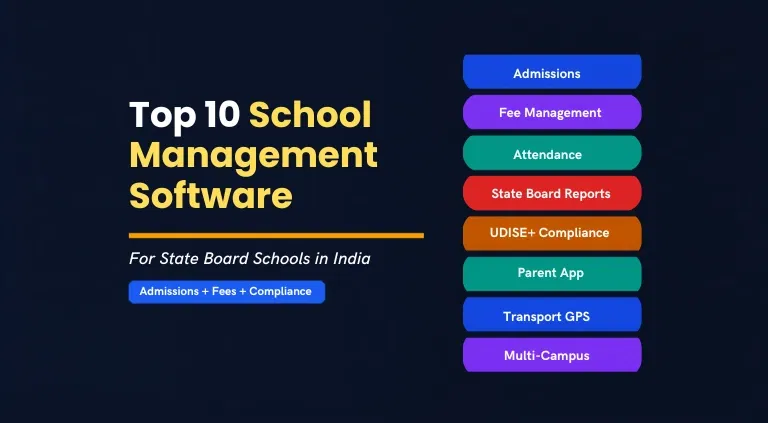
- Admissions: Enquiry to enrollment in one workflow, cutting down manual data entry during the peak admission season.
- Fee management: UPI, net banking and card payments with automatic reconciliation and reminders sent in the parent's preferred language.
- Attendance: Biometric or RFID attendance with automatic absence alerts sent to parents by SMS or WhatsApp.
- Academics and report cards: State Board-aligned mark sheets and progress cards, with automated result processing.
- Compliance reporting: Ready data for UDISE+, RTE audits and state education department inspections, without manual compilation.
- Communication: WhatsApp, SMS and app notifications for circulars, PTMs and fee reminders in one workflow.
- Governance: Trustees get one dashboard across campuses instead of waiting on monthly reports from each school.
If your evaluation extends beyond State Board-specific needs, our top school ERP software for K-12 schools in India roundup compares platforms across CBSE, ICSE and State Board schools. So you can see how the criteria in this guide hold up against a wider set of options.
Challenges Faced by State Board Schools Without the Right School Management Software
Schools that continue to run on manual or disconnected systems tend to run into the same operational problems, regardless of size. The table below maps common challenges to their real effect on the institution.
| Challenge | Effect on the School |
|---|---|
| Manual admissions and paper forms | Enrollment errors, lost applications and slow parent onboarding during peak season |
| Fee collection through cash and manual receipts | Reconciliation delays, revenue leakage and disputes with parents over pending dues |
| Attendance recorded on paper registers | No real-time visibility for principals and delayed absence alerts to parents |
| Report cards prepared in spreadsheets | Hours of teacher time spent on formatting and a higher risk of calculation errors |
| No consolidated data for UDISE+ or RTE reporting | Compliance deadlines missed or data compiled under pressure at the last minute |
| Communication scattered across WhatsApp groups and phone calls | Missed circulars, parent complaints and no audit trail of communication |
| No group-level view for multi-campus trusts | Trustees wait weeks for consolidated financial and enrollment reports |
Many of the challenges above trace back to a single habit: running core school operations on spreadsheets. Our blog on the hidden cost of spreadsheet administration breaks down what these manual, spreadsheet-driven habits actually cost schools in time, accuracy and revenue.
Top 10 School Management Software for State Board Schools in India
1. edumerge School ERP
edumerge School ERP stands apart as the only school management platform engineered specifically around India's State Board framework, rather than retrofitted from a CBSE or ICSE base.
From one State Board school to a trust running 50+campuses, the same underlying system scales without modification, giving school admins & management a live view of compliance and finances at every level. Since 2012, more than 800 institutions and 500,000 students are running on it.
School ERP, HRMS and Finance & Control share a single data layer. So every UDISE+ and RTE submission updates automatically, and AI analytics catch the reconciliation gaps that fragmented, multi-vendor setups tend to miss.
Key strengths:
- Configurable exam and grading engine that adapts to any state board's specific pattern (half-yearly/annual weightages, CCE-style continuous assessment, state-specific report card formats) without hardcoded logic.
- Built-in UDISE+ compliant data fields (category, gender, Aadhaar, disability status, enrolment) with direct export generation, cutting the manual 2-3 day UDISE submission cycle down significantly.
- Dual fee-structure management for government-aided schools, handling government-prescribed fee heads and school-specific optional fees (activity, transport) in parallel ledgers.
- RTE compliance tracking built into the admissions and student-records workflow, alongside Samagra Shiksha and state-scheme reporting support.
- Single data layer across admissions, attendance, examinations, fees, HR, and communication. So UDISE, RTE, and state-board reports pull from one source instead of being reconciled across separate tools.
- Backed by 800+ institutions and 500,000+ students across India, with a track record specifically in government, aided, and state board private school segments alongside CBSE/ICSE schools.
- 50+ Karnataka state board schools live & running on edumerge School ERP.
2. Fedena
Plugin-based, modular school & college ERP used by institutions globally, including many state board schools.
Key strengths:
- Customisable modules with an open-source community edition, giving budget-conscious state board schools a lower-cost entry point.
- RTE and UDISE reporting built into the compliance module alongside standard admissions, attendance, and fee management.
What to note:
- Deeper trust-level or multi-branch consolidated reporting requires custom development rather than coming standard.
- Advanced analytics and reporting are comparatively basic next to enterprise-tier platforms.
Take a look at our comparison edumerge School ERP vs Fedena.
3. Entab CampusCare
Enterprise-grade school ERP with strong presence across large state boards and multi-branch school networks.
Key strengths:
- Multi-branch management giving centralised visibility across large school chains, common in state board trust-run networks.
- AI-driven analytics for attendance, fee collection, and academic performance dashboards.
- Strong data-security and cloud-backup practices.
What to note:
- Positioned at the premium end of pricing, which may be a consideration for smaller state board schools with tighter budgets.
- Rich module depth can extend implementation and training timelines.
You might also find this comparison helpful on edumerge School ERP vs Entab School ERP.
4. Next Education (NextERP)
Integrated ERP and digital-content ecosystem used by schools across boards, including state boards.
Key strengths:
- Tally-synced financial tracking and geo-facial recognition attendance, useful for state board schools needing auditable fee and attendance records.
- Double-encrypted data storage for student, staff, and parent records.
- Tight integration between the ERP and learning platform, linking attendance and academic performance data directly.
What to note:
- Reporting and scheduling modules are rated lower by some users compared to student-records and content modules.
- Full value depends on adopting the paired learning platform, which may add cost for schools wanting ERP-only functionality.
5. VAPS i-Vidyalaya
Long-standing ERP built for schools from Kindergarten through postgraduate levels, with strong presence in regional state board networks.
Key strengths:
- Multi-organisation deployment model supporting trusts running clusters of state board schools under one management.
- Compatible with regional hardware integrations (biometric, RFID, smart cards), common in government and aided school infrastructure.
What to note:
- Some customisation may be required to match specific state-level examination or grading formats.
- Interface and workflow depth may need dedicated onboarding time for staff less familiar with digital systems.
Also explore this comparison on edumerge School ERP vs generic school ERPs.
6. MyClassboard
Cloud-based school ERP trusted by institutions across K-12 public and private schools.
Key strengths:
- User-friendly, SaaS-based design with a well-rated parent-facing mobile app for real-time communication.
- Customisable report cards, including support for state board-style grading in addition to CBSE-standard formats.
- Covers both academic and non-academic staff functions in one unified platform.
What to note:
- Customisation follows more standard configuration options rather than deep code-level flexibility.
- Multi-entity or trust-level consolidated reporting for larger state board school groups is not a primary stated strength.
7. ProSchool360
State board-focused ERP built specifically around Indian state education board configurability.
Key strengths:
- UDISE-compatible data storage for every required field (category, gender, age, Aadhaar, disability status) with direct export generation for state UDISE portals.
- Flexible exam-weightage engine supporting any number of exams per year with custom weightage formulas, matching common state board Half-Yearly/Annual structures.
- Dual fee-management design separating government-prescribed fees from school-specific optional fees, addressing a common state board and government-aided school need.
What to note:
- As a more specialised, state-board-first platform, breadth of modules outside core academic/compliance workflows should be evaluated against larger general-purpose ERPs.
- Scaling to very large multi-branch trusts may need direct confirmation of consolidated group-level reporting capability.
8. EduGradUP
Budget-focused school ERP built for small and mid-sized Indian schools, including state board and regional-language schools.
Key strengths:
- WhatsApp-native communication and low-bandwidth optimisation, useful for schools in areas with limited internet infrastructure.
- Flat, low-cost annual pricing with all modules included, positioned specifically against higher-priced competitors for budget-constrained schools.
What to note:
- Being a newer, low-cost entrant, larger state board school groups should validate depth of compliance and reporting modules against more established vendors before scaling.
- Support and implementation infrastructure may be less extensive than long-established enterprise vendors.
9. Camu
Integrated SIS and LMS platform with growing presence in K-12 school and higher-education segments.
Key strengths:
- Combines student information management with a built-in LMS, supporting hybrid and digital learning delivery alongside administrative functions.
- Deployed across institutions in multiple countries with mobile-first access for staff and students.
- Outcome-based tracking capabilities that can extend into state board schools moving toward competency-based assessment models.
What to note:
- Primary design strength has historically leaned toward higher education and OBE-driven institutions, so state board K-12 compliance depth (UDISE, RTE) should be directly confirmed.
- Some users report occasional glitches in report generation, worth validating during a pilot for high-volume state board data needs.
Explore how edumerge compares with Camu.
10. Schoolites
School management system with a dedicated UDISE+ compliance module, aimed at government, aided, and private state board schools.
Key strengths:
- Built-in UDISE+ automation designed to eliminate manual annual data-entry cycles for enrolment, teacher, and infrastructure data.
- Positioned for schools with large student or staff records needing structured compliance reporting.
- Comparison-driven approach to UDISE+ software, giving schools visibility into feature trade-offs before adoption.
What to note:
- As UDISE+ requirements change yearly, schools should confirm the vendor's update cadence and support commitment before long-term adoption.
- Broader ERP capabilities (finance, HR, multi-branch consolidation) should be evaluated separately from its UDISE-specific strength.
Also check our blog on the best school ERPs in India.
Evaluation Criteria for Choosing School Management Software for State Board Schools in India
Trustees & administrators evaluating school management software for a State Board school or trust should judge vendors against a consistent set of criteria, not a feature checklist alone.
These 10 criteria cover the areas that matter most when the software has to serve State Board grading rules, government reporting, and multi-campus governance.
| Criteria | What to Look For |
|---|---|
| 1. State Board and NEP alignment | Report card templates and assessment structures matching your state board and the NEP 5+3+3+4 structure. |
| 2. UDISE+ and compliance reporting | Built-in exports for UDISE+, RTE audits and state education department formats. |
| 3. Fee management and reconciliation | UPI, net banking and card support with automatic reconciliation and concession handling. |
| 4. Attendance and safety | Biometric, RFID or app-based attendance with real-time parent alerts. |
| 5. Multi-language communication | WhatsApp, SMS and app notifications available in regional languages. |
| 6. Multi-campus and trust governance | A single dashboard for trustees across every campus, with consolidated enrollment and financial reporting instead of separate per-school logins. |
| 7. Data security and access control | Role-based access so data is visible only to the people who need it. |
| 8. Ease of use for non-technical staff | A simple interface that front-office and teaching staff can adopt without heavy training. |
| 9. Implementation and support | A clear onboarding timeline, data migration support and an Indian education-sector track record. |
| 10. Total cost of ownership | Pricing tied to modules the school will actually use, not a generic ERP retrofitted for India. |
You might also like this guide for school principals on digitizing school operations.
Conclusion
Choosing school management software for State Board schools in India is not about picking the platform with the longest feature list. It's about finding a system built for state-specific grading, government reporting and the budget realities of the schools that serve the largest share of India's students.
The right platform turns admissions, fees, attendance & compliance reporting into a single, real-time view for admins & principals. Instead of a set of disconnected tasks handled in different formats. It also gives parents a simpler, faster way to stay informed in the language they prefer.
edumerge was built for exactly this context, supporting State Board schools across India since 2012. If you are evaluating an ERP for your educational society or trust, the criteria in this guide are a practical starting point for that decision.
Frequently Asked Questions
1. Does school management software support different state board grading formats?
A platform built for the Indian market should support multiple state board grading structures and report card formats, not just CBSE or ICSE templates.
2. Can the software help with UDISE+ and RTE reporting?
Yes. A well-built school ERP keeps admission, attendance and academic data ready for export in UDISE+ and RTE audit formats, reducing manual compilation.
3. Is school management software useful for a single school or only large groups?
Both. A single State Board school benefits from automated admissions, fees and attendance, while a group of institutions also gets consolidated, trust-level reporting.
4. How does fee management software help State Board schools collect fees?
It accepts UPI, net banking and card payments, reconciles receipts automatically and sends reminders to parents, reducing manual collection and follow-up.
5. Does edumerge support multiple campuses under one trust?
Yes. edumerge gives trustees a single, group-level dashboard across every campus, alongside trust and society accounting for consolidated financial reporting.
6. Is school management software available in regional languages?
Leading platforms send WhatsApp, SMS and app notifications in the parent's preferred regional language, which matters for State Board school communities.
7. How long does implementation typically take?
Timelines vary with school size and data migration needs, but a vendor with an established Indian education-sector track record should provide a clear, upfront onboarding timeline.
8. Who is edumerge school management software built for?
edumerge is built for trustees, principals, academic heads, finance heads and IT administrators at State Board, CBSE and ICSE schools across India.