On 10 February 2025, NAAC announced it would launch basic (binary) accreditation, followed by maturity-based graded levels (MBGL), replacing letter grades with a single outcome: accredited or not accredited.
For IQAC teams, the bigger change is how evidence will be verified, which makes NAAC SSR data automation a practical necessity.
NAAC had indicated an April to May 2025 rollout, but reports through mid-2026 confirmed the binary portal had still not launched, with no revised date announced. Many colleges with expiring grades are now preparing without a confirmed timeline.
Once the portal opens, the self-assessment is expected to typically cover 3 academic years of data, and those years are already under way. Every attendance register, marks sheet and approval note created this semester will become evidence under review.
This blog explains what NAAC SSR data automation means, why SSR preparation still takes months and how colleges can build evidence across all 7 criteria as the work happens.
TL;DR
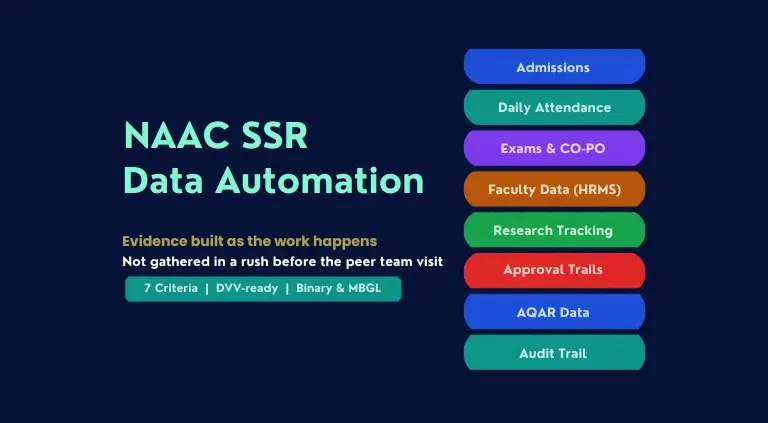
NAAC SSR data automation simply means capturing accreditation evidence inside everyday college work, with dates, owners and source records attached. So instead of chasing departments before submission, the evidence is already there.
With the Binary portal still pending and a three-year look-back expected, the data your college creates today shapes how ready your SSR will be. Waiting for a launch date leaves little time to rebuild records.
edumerge College ERP helps build NAAC evidence as the work happens. Admissions, attendance, exams, CO-PO attainment, faculty records and approvals all feed one criterion-wise dashboard, so the SSR grows out of daily records.
What is NAAC SSR Data Automation?
NAAC SSR data automation is the practice of capturing accreditation evidence at the moment college work happens, so that every SSR metric draws on dated, verifiable records.
It replaces last-minute evidence gathering, where IQAC teams chase departments for spreadsheets, certificates and signatures just weeks before submission.
Think of it this way:
- A class marked in the attendance module,
- An internal assessment entered by a faculty member,
- A budget approved by the principal becomes a source record the moment it is saved.
Later, the SSR simply reads from those records instead of starting a fresh round of data collection.
- For a principal, that means fewer late nights before a deadline.
- While for an IQAC coordinator, it means one place to look for everything.
To see how continuous evidence capture works inside a single platform, explore edumerge's NAAC & NBA accreditation management.
Why SSR Preparation Still Takes Months in Most Colleges
Most colleges do not actually lack evidence. What they lack is evidence that is connected, dated and consistent. And when you look closely, the same 6 problems show up across every college:
- Data is spread across autonomous departments. Each department follows its own formats and filing habits. So before the IQAC can compare anything, it first has to collect the same data in several different ways.
- Evidence is pulled from scattered spreadsheets. Student lists, event reports and publication records are often stored in personal drives and email threads. So nobody can say for certain which version is final.
- Figures do not match across criteria: For example, enrolment in Criterion 2 may differ from scholarship counts in Criterion 5, or the faculty count may change from one table to the next. Each mismatch invites a clarification.
- Faculty records are kept separately. Qualifications, appointments, development programmes and publications live with HR, the department and the faculty member. Unsurprisingly, the 3 rarely agree.
- Date-stamped proof is missing. A certificate without a date, a circular without a reference number or a photo without context cannot prove that an activity happened within the assessment years.
- Everything is rushed before submission. When collection only starts after registration, teaching staff have to pause teaching to compile files. As a result, both the teaching and the SSR suffer.
The common thread is clear. These are not effort problems; they are system problems.
On top of that, they grow worse over a multi-year look-back.
What Changes Under NAAC's Binary and MBGL Framework?
The reform follows the recommendations of the Dr Radhakrishnan Committee.
Once institutions are accredited, MBGL allows them to move up through levels 1 to 5 as they mature. Similarly, published reform material and sector briefings also point to a shift toward digital, data-based verification with fewer physical visits.
According to the published reform documents, assessment will be organised around 10 attributes, grouped as input, process & outcome. While the familiar seven 7 criteria remain the broad structure. With that said, exact weights and final manuals are still to be confirmed by NAAC.
On the portal, sector reports from August 2026 mention a basic accreditation portal page and new terms such as ISAR (institutional self-assessment report) in place of SSR. Even so, only notices on naac.gov.in should be treated as final.
This is why the look-back period deserves attention now. Records that were never captured cannot be created later without raising questions during validation.
What's more, many quantitative metrics in the current framework already ask for 5 years of data, so continuous capture pays off whichever route your college takes.
NAAC's accreditation reforms are part of a wider set of changes under NEP 2020. Our article on NEP 2020 language policy explained covers another change that affects how colleges teach.
How to Automate SSR Data Across the 7 Criteria?
For most IQAC teams, the 7 criteria remain the working map. With that in mind, here is who owns each criterion, what data it needs and how a connected college ERP captures that data as a natural part of daily work.
1. Curricular Aspects
- Owner: Academic Council, HoDs, IQAC
- Data it needs: Programmes & courses offered, value-added courses, structured curriculum feedback & action taken
- Captured automatically from: Programme & course setup, credit system records & student feedback surveys
- Outcome: Feedback analysis and action-taken reports ready every semester
2. Teaching-Learning and Evaluation
- Owner: HoDs, faculty, Exam Cell
- Data it needs: Enrolment, student-teacher ratio, attendance, results, CO-PO attainment
- Captured automatically from: Admissions, daily attendance, marks entry, examination management and CO-PO attainment
- Outcome: Attainment and result figures calculated once and consistent across every table
3. Research, Innovations and Extension
- Owner: Research cell, faculty, extension coordinators
- Data it needs: Publications, projects, extension and outreach activities
- Captured automatically from: Research and publication records, plus tagged extension activities logged on the day
- Outcome: Faculty-wise research lists with dates, ready without a year-end hunt
4. Infrastructure and Learning Resources
- Owner: Administration, Librarian, Finance
- Data it needs: Infrastructure spend, library holdings and usage, IT facilities
- Captured automatically from: Library management records and budget vs actual figures for infrastructure heads
- Outcome: Spend and usage figures that trace back to approved records
5. Student Support and Progression
- Owner: Placement cell, student welfare, mentors
- Data it needs: Scholarships, placements, progression, mentoring, grievance redressal
- Captured automatically from: Fee and scholarship records, placement and alumni modules, mentor-mentee and grievance logs
- Outcome: Placement and progression counts backed by named student lists
6. Governance, Leadership and Management
- Owner: Principal, registrar, trustees, finance head, HR head
- Data it needs: Decisions, budgets, faculty development, e-governance, appraisals
- Captured automatically from: Approval trails, budget records with budget vs actual, HRMS staff profiles and appraisals
- Outcome: A dated decision trail the peer team can follow end to end
7. Institutional Values and Best Practices
- Owner: IQAC, committees
- Data it needs: Gender equity, environment, inclusion and best-practice events
- Captured automatically from: Calendar of events, activity tags and dated photo records captured as events happen
- Outcome: Event evidence filed on the day, not reconstructed months later
In most colleges, Criterion 2 is where automation pays back fastest. Once marks entry and CO-PO attainment run in the same system, attainment reports stop being a separate project.
Also, Criterion 6 follows close behind, because approval trails and budget records already exist the moment a decision is made.
For a closer look at how each criterion maps to evidence, owners and gap analysis, visit edumerge's accreditation management.
How Daily Records Reduce DVV Clarifications
Data Validation and Verification (DVV) is the stage where NAAC checks the quantitative metrics in an SSR against the supporting documents a college uploads.
Whenever a number cannot be traced to its evidence, a clarification is raised. And then the college has to respond within the given deadline.
Clarifications tend to pile up for predictable reasons:
- A total might not match the list behind it.
- Documents might lack dates or signatures
- The same figure might appear differently in two criteria
- Evidence might fall outside the assessment years.
In each case, someone usually has to reopen old files under time pressure.
| Common DVV query | How a dated daily record answers it |
|---|---|
| The total in the SSR does not match the list uploaded | Every figure is generated from the same list, so the count and the names always agree |
| The document has no date, signature or reference | Each record carries its creation date, owner and module automatically |
| The same figure differs between two criteria | Shared records feed every criterion, so enrolment or faculty counts are reported once |
| Evidence falls outside the assessment years | Records are filtered by academic year, so only in-window evidence is pulled |
This is where daily records make a real difference. When every entry shows who created it, when and in which module, any SSR figure opens straight into its underlying list.
So instead of rebuilding evidence from memory, an IQAC coordinator can respond with the source record and its change log.
We explore why audit trails matter in regulated education in more depth.
How edumerge College ERP Builds NAAC Evidence as the Work Happens
What colleges really want is simple: an SSR that is mostly written before registration even opens. edumerge College ERP makes that possible by treating accreditation as a result of running the college well, rather than a separate project.
Here is what that looks like day to day.
- Admissions that already count: Enrolment, category-wise intake and scholarship records are captured at the point of admission. As a result, student strength & diversity figures stay consistent across the SSR.
- Attendance that proves teaching happened: Daily attendance, lesson plans and work diaries create dated records of every class held, so there is no need for parallel registers.
- Examinations that produce attainment: Marks entry flows directly into CO-PO attainment. In other words, Criterion 2 outcome data is calculated, not compiled.
- Faculty records from one source: Staff profiles, appointments and appraisals sit in edumerge HRMS & feed faculty metrics, which removes the usual mismatch between HR and department records. Our guide to faculty appraisal systems explains this in detail.
- AQAR data from the same records: Annual quality reports draw on the year's records, so the AQAR and the SSR always tell the same story.
All this comes together on one criterion-wise dashboard. The IQAC coordinator can see documentation progress and pending items by department. Meanwhile, the principal & registrar see the same numbers, and trustees can check readiness without waiting for a monthly report.
Evaluation Checklist: 5 Things to Verify in Any NAAC-ready College ERP
Before you choose a system, it helps to know what to look for. These 5 points separate an ERP that stores data from one that keeps you accreditation-ready.
| Checklist point | What good looks like |
|---|---|
| 1. Criterion-wise data mapping | Each module maps its records to the NAAC criterion and metric it supports, with a named owner per criterion, so gaps surface months before submission. |
| 2. A complete audit trail | Every entry and evidence upload is tracked by criterion, date and source, with a change log the IQAC can show a validator. |
| 3. AQAR report generation | Annual AQAR data is compiled from the same records as the SSR, so the two never contradict each other. |
| 4. Faculty data from HRMS | Qualifications, appointments, appraisals and workload come from the HR system of record, not from lists re-typed by departments. |
| 5. Secure multi-department access | Role-based access lets HoDs, the Exam Cell and Finance enter their own data while IQAC and leadership see everything, with every action logged. |
edumerge College ERP is built to meet all five. On top of that, it brings OBE, research tracking, placement and alumni records together on the same platform.
Make NAAC Readiness a Daily Habit
NAAC's move to Binary Accreditation and MBGL changes what a good SSR looks like. It is no longer about how well a college can write up its achievements. It is about whether every claim can be traced back to a real record. NAAC SSR data automation makes that possible by capturing each record once, where the work happens, with a date and a name attached.
It is tempting to wait for the Binary portal to open before getting started. That wait is the best time to prepare. The academic years the new self-assessment will look back on are happening right now, and every class, exam and approval is either being recorded properly or slipping through the gaps.
edumerge College ERP helps colleges make that shift for good. NAAC preparation stops being a stressful race before the deadline and becomes a steady, well-governed part of everyday work. Principals, IQAC coordinators, Registrars and Trustees all see the same picture of readiness, every day.
Frequently Asked Questions (FAQs)
1. What is NAAC SSR data automation?
NAAC SSR data automation means capturing accreditation evidence inside daily college workflows. Including admissions, attendance, examinations & approvals, so every SSR metric is backed by a dated source record. It replaces the practice of collecting spreadsheets and certificates from departments in the weeks before submission or the peer team visit.
2. Has the NAAC Binary accreditation portal launched yet?
NAAC indicated an April to May 2025 rollout when it announced the reform on 10 February 2025. Through mid-2026, the Binary portal had not launched and no revised official date was confirmed. Sector reports from August 2026 mention a Basic Accreditation portal page, so check the official NAAC website for the current status.
3. How many years of data does the NAAC SSR require?
Under the Binary framework, the self-assessment is expected to typically look back across 3 academic years of institutional data. Many quantitative metrics in the current framework ask for 5 years. Either way, the records a college creates during the current and previous academic years form the evidence that will be validated.
4. How can colleges reduce DVV clarifications in NAAC?
Colleges reduce DVV clarifications by making every SSR figure traceable to a dated source record. When totals match the underlying lists, documents carry dates & signatures, and the same figure is reported consistently across criteria, validators have fewer reasons to query. A college ERP with an audit trail makes this the default.
5. Can a college ERP prepare AQAR & SSR data from the same records?
Yes. When admissions, examinations, faculty, research & approval data sit in one college ERP, the annual AQAR & the SSR draw on the same records. This keeps figures consistent from year to year, so the SSR becomes a summary of AQARs already filed rather than a fresh data collection exercise.
6. Who should own NAAC data in a college?
Each department should own the data it creates. The Exam Cell owns results, HoDs own teaching records, HR owns faculty files and Finance owns budgets. The IQAC coordinates, assigns criterion owners and reviews gaps, while the Principal, Registrar & Trustees monitor readiness. Role-based access in an ERP keeps this division clear.