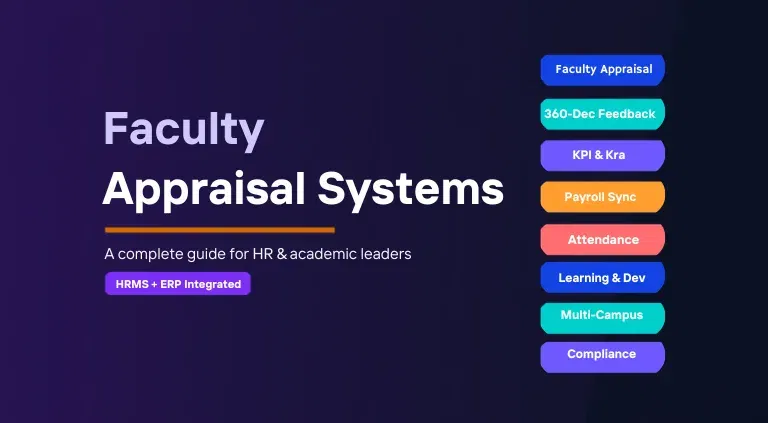
Faculty appraisal systems for educational institutions have moved from an annual paperwork exercise to a strategic function that shapes teaching quality, institutional reputation, and long-term growth.
As NAAC, NBA & UGC scrutiny intensifies and parents choose institutions based on outcomes rather than brand name alone; how an institution evaluates, develops & retains its faculty has become a governance question, not just an HR task.
Trustees ask for evidence of teaching quality during board reviews. Principals need appraisal data that stands up during accreditation visits. HR heads are expected to run consistent, defensible appraisal cycles across every campus in the group, not just the flagship campus. In this blog, we'll explore this in depth.
TL;DR
Faculty appraisal for educational institutions runs on 6 core evaluation parameters: teaching effectiveness, research & publications, student feedback, professional development, institutional contribution, and administrative compliance.
Faculty appraisal has shifted from an annual paperwork exercise to a governance signal that trustees, accreditation bodies, and parents now expect documented, criteria-based evidence for.
Four forces are pushing faculty appraisal higher up the leadership agenda:
- Teaching quality: Parents & ranking bodies increasingly judge institutions on learning outcomes, which start with how well faculty are evaluated and coached.
- Accreditation: NAAC, NBA & university affiliation reviews expect documented, criteria-based faculty appraisal records, not informal notes.
- Faculty development: Appraisal data that feeds directly into training and career growth keeps good teachers engaged & reduces attrition.
- Institutional performance: Trustees & directors want real-time visibility into workforce quality across every campus, not a summary once a year.
The most effective way to run appraisal fairly across every campus is through a purpose-built HRMS. An integrated platform that connects attendance, workload, payroll, and 360-degree feedback into one auditable appraisal record.
What is a Faculty Appraisal System?
A faculty appraisal system exists to give HR, principals & trustees a fair, repeatable way to answer one question: is this faculty member performing well against the role they were hired for?
Done properly, it serves 3 purposes at once.
- It gives faculty structured feedback on their own performance.
- It gives the institution defensible evidence for promotion, increment, and renewal decisions.
- It gives leadership aggregated data on where teaching quality is strong and where it needs support.
Most institutions build faculty performance appraisal system parameters around a mix of teaching, research & service, weighted differently depending on whether the role is teaching-focused, research-focused, or administrative. The table below shows the parameters most commonly used across Indian schools, colleges, and universities.
| Evaluation Parameter | What It Measures | Example Indicator |
|---|---|---|
| Teaching Effectiveness | Classroom delivery and student learning outcomes | Student feedback scores, course completion rates |
| Research and Publications | Scholarly output and contribution to the field | Papers published, citations, funded projects |
| Student Feedback | Direct learner perception of the faculty member | Semester-end survey ratings |
| Professional Development | Ongoing skill and qualification growth | Workshops attended, certifications earned |
| Institutional Contribution | Service beyond the classroom | Committee work, mentoring, extension activities |
| Administrative Compliance | Adherence to institutional processes | Attendance, punctuality, timely documentation |
Common Challenges of Traditional Appraisal Methods
Most institutions do not lack the intent to appraise faculty fairly. They struggle with the process. A few patterns show up again & again once an institution grows past a single campus:
- Manual, paper-based forms: Appraisal forms travel between department, HR & the principal's office, often losing time & sometimes losing the form itself.
- Subjective evaluation: Without a shared rating scale, a 4/5 rating from one head of department can mean something entirely different from a four given by another.
- Fragmented records: Appraisal history sits in spreadsheets, email threads & physical files, making it hard to see a faculty member's full trajectory over several years.
- Disconnected from payroll and growth: Appraisal outcomes rarely link automatically to increments, promotions, or training plans, so the exercise feels like paperwork rather than a growth process.
- Delayed cycles: HR has to chase every department head individually, and appraisal season stretches on for months instead of weeks.
Take a closer look at staff management challenges in education, of which fragmented appraisal is just one piece.
How an Integrated ERP and HRMS Solves These Challenges
An integrated ERP & HRMS, like edumerge, for faculty appraisal removes the manual chase and the guesswork by putting the entire cycle, from form->feedback->payroll impact, on one digital workflow. The table below maps each traditional challenge to how a connected system addresses it.
| Traditional Challenge | How Integrated ERP and HRMS Solves It |
|---|---|
| Manual paper forms slow down every appraisal cycle | Digital workflows route forms directly to reviewers with automated reminders and escalation |
| Subjective, inconsistent ratings across departments | Configurable rating scales and weighted criteria apply uniformly across the institution |
| Appraisal records scattered across files and spreadsheets | Centralised faculty records linked to attendance, KPIs, and payroll in one HRMS |
| No visibility for leadership until appraisal season ends | Real-time dashboards show appraisal status and completion across every campus |
| Appraisal outcomes disconnected from growth plans | Appraisal data feeds directly into learning and development recommendations |
Essential Features to Look for in Faculty Appraisal Software
When evaluating faculty appraisal software or a broader HRMS for higher education, look for these capabilities before signing a contract:
- Configurable evaluation parameters & weightings, so teaching-focused and research-focused roles are assessed differently.
- Multi-rater support with 360-degree faculty feedback, covering self-assessment, peer review, head of department, and student input.
- Automated appraisal cycles with reminders & escalation, so HR is not manually chasing every reviewer.
- Centralised faculty performance history across campuses, visible in one place instead of scattered files.
- Direct linkage to payroll, increments, and promotion workflows, so appraisal outcomes are actionable, not archived.
- Role-based access control, so sensitive ratings stay with authorised reviewers only.
- Real-time dashboards for HR heads and academic leadership to track completion & quality trends.
- A complete audit trail, so appraisal records hold up during NAAC, NBA, or affiliation reviews.
How edumerge ERP & HRMS Work Together on Faculty Appraisal
edumerge brings faculty appraisal into the same platform that already holds attendance, workload, and payroll data, rather than treating it as a standalone form.
- Workload & attendance data captured through the ERP feed directly into the appraisal record. So reviewers are not asking faculty to self-report information the system already has.
- Inside edumerge HRMS, appraisal cycles run against configurable KPIs & KRAs, with support for self-assessment, peer input, and head of department review as part of a structured 360-degree feedback workflow.
- Once an appraisal cycle closes, outcomes connect directly to increment recommendations, promotion workflows, and learning & development plans. All without HR re-entering data into a second system.
Because School ERP, College ERP, HRMS, and Finance & Control share a single data architecture. Appraisal decisions across a group of institutions are backed by real classroom & workload data rather than isolated forms sitting in a department drawer.
Why Choose edumerge HRMS for Faculty Appraisal
edumerge HRMS is built specifically for the education sector, not adapted from a generic corporate HR tool. Each capability is paired with the institutional impact it delivers for institutions running faculty appraisal at scale:
- Education-specific design. Appraisal parameters are pre-aligned to teaching, research, and service categories that Indian schools, colleges & universities actually use. Covering classroom delivery, publication output, mentoring, and extension activity as standard. Not as custom add-ons.
Institutional impact: HR & academic heads skip months of framework building. Faculty are judged against criteria that genuinely reflect their role, which improves buy-in and reduces disputes during review cycles.
- Configurable workflows. Appraisal criteria, weightings & review cycles can be set differently for schools, colleges & research faculty within the same group. With separate cycles for probationary staff, tenured faculty, and visiting or adjunct roles.
Institutional impact: A K-12 campus and an affiliated college in the same trust can each run appraisals suited to their faculty. Without separate software, separate logins, or separate implementation projects.
- Centralised records. Every faculty appraisal, across every campus in the group, sits in one system instead of one spreadsheet per campus. With each record linked to the faculty member's attendance, workload, and prior appraisal cycles.
Institutional impact: Promotion committees, NBA review teams & HR heads pull a faculty member's complete multi-year performance trail in minutes, instead of chasing files across department offices.
- Multi-rater 360-degree feedback. Self-assessment, peer review, head of department evaluation, and student feedback all feed into a single appraisal record, weighted according to institutional policy.
Institutional impact: Ratings reflect a rounded view of performance rather than one supervisor's opinion, which reduces bias & makes outcomes easier to defend if a faculty member contests a rating.
- Data-driven reporting. Trustees & academic leadership get real-time dashboards on appraisal completion & teaching quality trends. Without waiting for a manual roll-up, broken down by campus, department, and faculty grade.
Institutional impact: Leadership spots lagging departments or declining teaching quality scores early enough to intervene, rather than discovering gaps during an accreditation visit.
- Built-in accreditation readiness. Every appraisal record is timestamped, criteria-linked, and stored centrally, with export formats aligned to common accreditation documentation requirements.
Institutional impact: Institutions walk into NAAC, NBA, or university affiliation reviews with exportable, audit-ready faculty performance data, instead of assembling evidence under deadline pressure.
- Role-based access and audit trail. Appraisal ratings, reviewer comments, and rating history are visible only to authorised reviewers, with every edit and approval logged.
Institutional impact: Sensitive performance data stays protected, and any past appraisal decision can be traced back to who approved it and when. This matters during grievance handling or board inquiries.
- Connected to the full staff lifecycle. Attendance, workload, payroll, and learning & development records already live in the same HRMS as appraisal data.
Institutional impact: Appraisal outcomes convert directly into increment decisions & training recommendations. With no duplicate data entry & no gap between evaluation and action.
- Scales with group growth. New campuses joining the group inherit the same appraisal framework, rating scales, and reporting structure from day one.
Institutional impact: Groups of institutions expanding to new campuses maintain consistent faculty evaluation standards. Without rebuilding the appraisal process each time a new campus comes online.
Conclusion
Faculty appraisal is no longer a once-a-year form. It is a governance signal that trustees, accreditation bodies, and faculty themselves are watching closely.
Manual, fragmented appraisal processes cannot keep pace with the governance & reporting demands that trustees, NAAC & NBA reviewers, and academic leadership now expect. A digital, education-specific appraisal framework closes that gap, turning appraisal from a compliance exercise into a genuine lever for institutional growth.
Choosing the right faculty appraisal systems for educational institutions is no longer optional for groups serious about teaching quality, accreditation readiness, and faculty retention.
Institutions that move to a structured, digital appraisal process inside their edumerge HRMS get consistent evaluation, centralised records, and appraisal outcomes that actually feed growth, not just a filed form.
Frequently Asked Questions (FAQs)
1. Why is faculty appraisal important for NAAC and NBA accreditation?
NAAC & NBA reviews expect documented, criteria-based evidence of teaching quality and faculty development. A structured appraisal system provides that evidence in a consistent, auditable format.
2. What parameters are used in faculty performance appraisal?
Common parameters include teaching effectiveness, research and publications, student feedback, professional development, institutional contribution, and administrative compliance, weighted according to the role.
3. Does faculty appraisal software support 360-degree feedback?
Yes, most modern faculty appraisal software, including edumerge HRMS, supports multi-rater input covering self-assessment, peer review, head of department evaluation, and student feedback.
4. Can a faculty appraisal system integrate with payroll and HRMS?
Yes, in an integrated ERP and HRMS, appraisal outcomes flow directly into increment recommendations, promotion workflows, and payroll, without HR re-entering data manually.
5. How often should faculty appraisals be conducted?
Most institutions run a formal appraisal cycle once or twice a year, supported by ongoing informal check-ins, attendance tracking, and workload data captured continuously through the HRMS.
6. What is the role of KPIs and KRAs in faculty evaluation?
KPIs and KRAs give each faculty role clear, measurable targets, such as research output or student outcomes, so appraisal ratings are tied to defined expectations rather than general impressions.
7. Is faculty appraisal software suitable for multi-campus institution groups?
Yes, purpose-built HRMS platforms allow group-wide institutions to standardise appraisal criteria while giving leadership a consolidated view of teaching quality across every campus.
8. How long does it take to implement a faculty appraisal system?
A pilot with one department or campus can typically go live within a few weeks, with a group-wide rollout following once the workflow, rating scale, and reminders are validated.
9. Who should have access to faculty appraisal records?
Access should be role-based, limited to the faculty member, their direct reviewer, HR, and academic leadership, with sensitive ratings protected from general visibility.
10. Does edumerge HRMS support faculty appraisal for both teaching and non-teaching staff?
Yes, edumerge HRMS covers the complete staff lifecycle for teaching and non-teaching roles, with appraisal parameters configurable separately for each category.