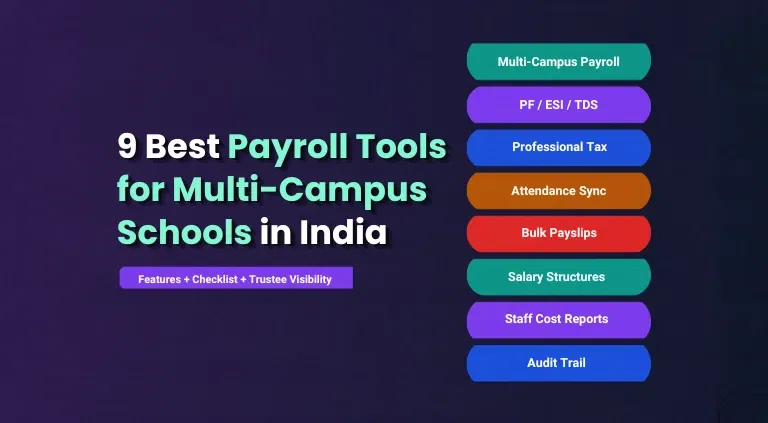
Payroll is among the most critical responsibilities a school group manages. As per UDISE+ 2024-25, India now has 14.71 lakh schools and, for the first time, more than 1 crore teachers. Many of them working in trusts that run several campuses across cities and states.
For these groups, choosing the best payroll tool for multi-campus schools in India is a governance decision, not merely an HR one.
The risk of error is also higher than many institutions realise. An EY survey of 508 payroll decision-makers found that 1 in 5 payrolls contains errors. Across multiple campuses with separate registers & spreadsheets, these errors multiply into delayed salaries and compliance gaps.
Meanwhile, India's four Labour Codes, in force since 21 November 2025, and professional tax rules that vary across around 20 states have made compliance even more demanding.
This guide explains why multi-campus schools need a dedicated payroll tool with the features that matter most. And how the best 9 platforms compare, along with a checklist to help you choose.
TL;DR
The best payroll tool for multi-campus schools runs every campus from one system. All while respecting each campus's salary structures, state taxes & approval rules, and giving trustees one consolidated view of staff costs.
edumerge Payroll, part of edumerge HRMS, is the most comprehensive option. Mainly because it brings payroll, attendance, leave, compliance filings, and staff records for every campus onto one platform with campus-level control and group-level visibility.
Use the feature table and 5-point evaluation checklist in this guide to compare options. Remember, the right tool cuts month-end effort, keeps PF, ESI, TDS & PT filings on time, and pays every staff correctly.
Why Multi-Campus Schools in India Need a Dedicated Payroll Tool
A payroll process that works well for a single school often struggles once a group adds more campuses. This is mainly because generic payroll tools are rarely designed around how school groups and wider groups institutions pay their staff.
Below are 6 reasons why multi-campus schools need payroll software built for the way they operate.
1. Different Salary Structures on Every Campus
A school group may operate a CBSE school, a state board school, an ICSE school and a pre-primary wing. Each with its own pay scales, allowances, and increment cycles.
In addition, teaching, non-teaching, contract & guest staff add further variations to this mix. As a result, managing these structures across campuses on spreadsheets makes it difficult to ensure every staff member is paid accurately.
2. Multi-State Statutory Compliance
PF, ESI & TDS apply uniformly across India, but professional tax slabs & labour welfare fund rules differ from state to state. For example, a campus in Karnataka and another in Tamil Nadu cannot follow the same deduction logic.
That is why a payroll system must apply the correct state rules to each campus automatically.
Explore more in this list of top ESI & EPF Payroll Software for Schools in India.
3. Labour Code Changes on Every Payslip
Under the Labour Codes, basic pay and DA together must make up at least 50% of total pay for statutory calculations. This means every campus's salary structure needs to be reviewed and, where required, restructured.
When this is handled manually, it is easy for one or more campuses to remain non-compliant without anyone noticing.
4. Scattered Attendance and Leave Data
Each campus often relies on its own biometric device, leave register, or spreadsheet. At the same time, EY identified time and attendance errors as the most common type of payroll error, which shows how closely the two are linked. So, when attendance data is disconnected from payroll, incorrect salaries become far more likely.
Read about the best payroll software for educational institutions in India.
5. Slow Month-End Consolidation
HR teams often spend the last week of every month collecting inputs from each campus and reconciling the totals. Consequently, trustees and finance heads see the group's total staff cost only after the books are closed. By then, it is too late to act on any issues the numbers reveal.
6. Audit Risk and Teacher Trust
Salary data shared over email and pen drives is difficult to secure and even harder to audit. Beyond the compliance risk, late or incorrect salaries erode trust among staff. Over time, this can lead experienced teachers to look for opportunities elsewhere.
Payroll is only one part of the wider people's challenge. Our guide on HR challenges in educational institutions explores the staff management issues school groups face across campuses.
Manual Payroll vs Automated Payroll for Multi-Campus Schools
The gap between the two approaches is widest at month-end. Here is how manual payroll compares with an automated, multi-branch school payroll software for a typical school group.
| Area | Manual payroll | Automated payroll tool |
|---|---|---|
| Processing time | Several days per campus, then a separate consolidation | One payroll run for all campuses, with campus-level checks |
| Attendance and leave | Entered by hand from registers and devices | Synced automatically from biometric and leave records |
| Statutory deductions | Calculated on spreadsheets; slab changes often missed | PF, ESI, TDS and PT rules applied by campus and state |
| Labour Code readiness | Each campus restructures salaries on its own | Wage rules configured once and applied to every campus |
| Payslips and bank transfers | Prepared separately for each branch | Generated in bulk with bank-ready salary files |
| Trustee reporting | Monthly spreadsheets, often late | Consolidated, campus-wise reports on demand |
| Audit trail | Changes rarely recorded | Every change logged with user and time |
| Data security | Files on email and shared drives | Role-based access in one secure system |
To see how these features come together in a monthly cycle, read our step-by-step guide on how to automate payroll for schools & colleges in India.
Must-Have Features in a Payroll Tool for Multi-Campus Schools
A payroll tool for a school group has to do far more than just calculate salaries. To put this in perspective, EY estimates that an average 1,000-employee organisation spends about 29 workweeks a year fixing common payroll errors.
Notably, a group of 10 campuses with 100 staff each already reaches that size. So every manual step adds up quickly.
On top of this, professional tax is capped at Rs. 2,500 per employee per year but is structured differently in each state, and new wage rules have been in force since November 2025.
For these reasons, the best payroll software for schools in India must handle these rules by design. With this in mind, the features below separate a true multi-campus payroll tool from a basic one.
| Feature | What it does | Positive outcome |
|---|---|---|
| Multi-campus, multi-entity setup | Runs payroll for several campuses and trusts in one system, with campus-level settings | One source of truth for every branch, with no separate logins |
| Flexible salary structures | Supports different pay scales, grades, allowances and staff categories per campus | Each campus pays correctly without workarounds |
| Statutory compliance engine | Calculates PF, ESI, TDS, PT and LWF using the right state rules and prepares challans and returns | On-time filings and lower penalty risk |
| Attendance and leave integration | Brings biometric attendance and approved leave straight into payroll | Fewer salary corrections and disputes |
| Increments, arrears and LOP | Handles academic-year increments, arrears and loss of pay automatically | Accurate pay during revisions with no manual recalculation |
| Bulk payslips and bank files | Generates payslips and bank-ready salary files for all campuses at once | Teachers get paid on time, every month |
| Employee self-service | Lets staff view payslips, tax declarations and leave balances online | Fewer HR queries and higher staff trust |
| Approval workflows | Routes payroll to campus heads and finance for review before release | Clear accountability before money leaves the account |
| Consolidated dashboards | Shows staff cost by campus, department and staff category | Trustees see group staff costs in real time |
| Role-based access and audit trail | Limits who can see salary data and logs every change | Audit-ready records and protected staff data |
If you're evaluating the wider HR platform beyond payroll, compare options in our list of the top staff management software for schools in India.
9 Best Payroll Tools for Multi-Campus Schools in India (2026)
1. edumerge HRMS Payroll
edumerge Payroll is a core module of edumerge HRMS, which is part of edumerge's governed education operating system. It is purpose-built for K-12 schools and multi-campus school groups across India, managing the complete salary cycle for teaching & non-teaching staff across every campus.
It covers every step from salary structure setup and LOP management to TDS, PF, ESI & PT computation, Form 16 generation, bank transfer files, and full and final settlements.
As part of edumerge HRMS, payroll connects directly with recruitment, onboarding, attendance, leave, appraisals, and exit. So every staff record that affects pay already sits in the same system. It also runs on the same unified data layer as the School ERP and Finance & Control.
This means attendance and leave data flow straight into each campus's payroll run. And payroll costs reach finance by department and cost centre without manual reconciliation.
edumerge has supported 800+ Indian institutions for over 14 years. Payroll scales from a single school to a multi-campus Group of Institutions, with consistent salary structures and statutory compliance across every campus. Backed by a named Customer Engagement Manager and a 96% CSAT score.
Key strengths:
- Consistent salary structures and statutory compliance apply across all campuses, so every school in the group follows the same pay rules without separate setups.
- The Payroll Structure Builder creates multiple salary structures assigned to grades or roles, covering teaching, non-teaching, and administrative staff across campuses.
- The Payroll Cost Centre View breaks down salary costs by department and cost centre, giving finance a clear allocation of payroll expenditure for each campus.
- PF, ESI, and PT are computed for each employee based on eligibility thresholds and applicable state rules, which matters for school groups with campuses in more than one state.
- TDS is auto-computed using each staff member's chosen tax regime (old or new) and declared investments, with Form 16 generated at year-end in the same module.
- PF ECR, ESI, and TDS return-ready reports are generated directly, removing manual compilation at every filing cycle.
- LOP days come straight from HRMS attendance with biometric & geo-fencing and staff leave data, and are confirmed by the admin before the payroll run.
- A three-stage run (initiate, lock, finalise) keeps every payroll cycle controlled and auditable, with a time-stamped taxation audit log.
- Bulk uploads of salary structures and bank details via Excel speed up setup for large headcounts and academic-year restructures.
- A bank-format salary transfer file is generated on finalisation for NEFT or RTGS upload, with disbursement tracking after upload.
- The Staff Portal lets teachers & staff view payslips, select tax regimes, declare investments, claim reimbursements, manage bank details, and track institutional loans without raising HR requests.
- Full and final settlements run inside the same payroll workflow, with staff able to track status from their portal.
- The Finance Portal shows total salary outflow, statutory liabilities, and net disbursement, scoped to each user's visibility level.
- Payroll sits within the full edumerge HRMS, connected to recruitment, onboarding, appraisals, and exit management on one data layer.
- Through edumergeOS, monthly payroll across campuses generates journal entries for the group automatically, giving trustees a consolidated view of staff costs.
2. greytHR
A widely used Indian HR and payroll platform popular with small and mid-sized organisations, including many schools.
Key strengths:
- Mature statutory compliance for PF, ESI, PT, TDS, and Form 16.
- Employee self-service portal and mobile app for payslips and declarations.
What to note:
- Built for general businesses, so school-specific structures like teaching and non-teaching grades or academic-year restructures need manual configuration.
- Not connected to a school ERP, so attendance and campus data must be synced or imported.
You might also like our comparison on edumerge HRMS vs greytHR.
3. Keka HR
A modern Indian HRMS with strong payroll, attendance, and performance modules, popular with growing organisations.
Key strengths:
- Automated payroll with statutory compliance and multi-location support.
- Integrated attendance, leave, and performance management.
What to note:
- Designed for corporate teams, so campus-wise cost reporting for school groups needs custom setup.
- No link to student or academic systems, so trustees still need separate tools for a full group view.
Also explore how edumerge HRMS compares with Keka HR.
4. Zoho Payroll
A cloud payroll tool within the Zoho ecosystem, suited to organisations already using Zoho Books or Zoho People.
Key strengths:
- Statutory compliance for PF, ESI, PT, and TDS, with direct bank transfer support.
- Tight integration with Zoho Books for payroll accounting.
What to note:
- Works best inside the Zoho stack; schools on other ERPs face integration effort.
- Multi-campus school groups may find education-specific reporting and structures limited.
Also read our comparison on edumerge HRMS vs. Zoho People.
5. Paybooks
A Bengaluru-based payroll and HR platform focused on statutory compliance for Indian organisations.
Key strengths:
- Automated payroll processing with PF, ESI, PT, TDS, and Form 16 compliance.
- Employee self-service for payslips, tax declarations, and reimbursements.
What to note:
- Built for general businesses, so school-specific roles, grades, and academic-year restructures need manual configuration.
- Not linked to school ERP or student systems, so attendance data and group-level staff cost views require separate integration.
6. Darwinbox
An enterprise HCM platform used by Indian organisations, with payroll as part of a broader HR suite.
Key strengths:
- Handles large, distributed workforces across multiple locations and entities.
- Comprehensive HR suite covering talent, performance, and engagement.
What to note:
- Enterprise pricing and implementation are heavier than most school groups need.
- Built for corporations, so academic calendars and school staff structures require custom mapping.
Discover how edumerge HRMS compares with Darwinbox over features.
7. HROne
An Indian HRMS with payroll, attendance, and workflow automation aimed at mid-sized organisations.
Key strengths:
- Automated payroll with statutory compliance and multi-location support.
- Workflow automation for approvals, leave, and reimbursements.
What to note:
- General-purpose design means school-specific roles and campus-wise reporting need configuration.
- Separate from school ERP systems, so data must flow in from other tools.
8. Saral PayPack
A long-standing Indian payroll software known for statutory compliance and TDS processing.
Key strengths:
- Deep statutory compliance, particularly for TDS and Form 16.
- Familiar to accountants and payroll teams across India.
What to note:
- Interface and self-service features are dated compared with newer cloud platforms.
- Consolidating payroll across multiple campuses can be manual and fragmented.
9. SAP SuccessFactors Employee Central Payroll
A global enterprise payroll and HCM platform used by large multinational organisations.
Key strengths:
- Handles very large, multi-entity workforces with sophisticated payroll rules.
- Strong integration with SAP finance systems.
What to note:
- Pricing and implementation are enterprise-grade, far heavier than most school groups need.
- Education-specific structures and Indian school workflows require significant customisation.
See how edumerge and SAP SuccessFactors stack up on HR & payroll for institutions.
How a Centralised Payroll Tool Gives Trustees Real-Time Visibility Into Staff Costs Across Campuses
Staff salaries are usually the largest recurring expense for a school group. Yet many trustees see these numbers only as a monthly spreadsheet, compiled from several campuses and reconciled days after salaries are paid.
Centralised payroll software for school chains changes this. Because every campus runs on the same system, trustees and finance heads can see consolidated staff costs without waiting for monthly reports from each campus. With a centralised tool, trustees can track:
- Total staff cost by campus, department and staff category
- Month-on-month changes in headcount and salary spend
- Statutory liabilities due for PF, ESI, TDS and PT
- The cost impact of increments and new hires before they are approved
- Campus-wise comparisons that show where staffing costs are rising faster than enrolment
This visibility supports better decisions on hiring, fee planning & budgets, and keeps the board audit-ready at any time.
A strong payroll tool should also close the visibility gap at the top, which we explore in what trustees can't see about staff across campuses.
Evaluation Checklist: How to Choose the Best Payroll Tool for Your Multi-Campus School
Before you sign, test every shortlisted vendor against this school payroll software checklist. If a tool fails any of these 5 points, it will likely cost you more time than it saves.
| Checkpoint | What to ask the vendor | Why it matters |
|---|---|---|
| 1. Built for school groups | Can it run all our campuses and trusts in one system, each with its own salary structures and rules? | Avoids separate payroll setups for every branch |
| 2. India compliance depth | Does it handle PF, ESI, TDS, state-wise PT, LWF and the Labour Code wage rules, with updates when rules change? | Protects the group from penalties and back-payments |
| 3. Connected HR data | Does payroll pull attendance, leave and staff records from the same platform, including biometric devices? | Removes the main source of salary errors |
| 4. Governance and visibility | Can trustees see consolidated, campus-wise staff costs, with approval workflows and a full audit trail? | Gives the board control without manual reports |
| 5. Implementation and support | What is the rollout plan for multiple campuses, how is data migrated, and what support follows go-live? | Decides how quickly you see value |
Since appraisal outcomes drive annual increments, plan your rollout alongside your review cycle. Explained in-depth in our guide to faculty appraisal systems for educational institutions.
Conclusion
Payroll in a school group is about more than paying salaries on time. It determines whether every campus stays compliant, whether teachers trust the institution, and whether trustees can see where the money goes.
The best payroll tool for multi-campus schools in India brings every campus, salary structure, and statutory rule onto one platform. Attendance & leave flow in automatically, TDS, PF, ESI, & PT are computed for each campus, and consolidated reports flow up to the board.
edumerge Payroll, part of edumerge HRMS, does exactly this for schools and school groups. From salary structure setup & statutory compliance to bank transfer files & staff self-service, it gives every campus local control and the group complete visibility on one connected platform.
Explore edumerge Payroll and see how simple multi-campus payroll can be.
Frequently Asked Questions (FAQs)
1. Can one payroll system handle different salary structures across campuses?
Yes. A multi-campus payroll tool lets each campus define its own pay scales, allowances and staff categories while payroll still runs from a single system.
2. How does payroll software handle professional tax in different states?
It applies professional tax slabs based on the state where each employee works. Around 20 states levy professional tax, each with its own slabs, capped at Rs. 2,500 per employee per year.
3. How do the new Labour Codes affect school payroll?
Since 21 November 2025, basic pay plus DA must be at least 50% of total remuneration for statutory calculations. Excess allowances are added back to wages, which changes PF, gratuity and leave encashment amounts.
4. What is the difference between HRMS and payroll software for schools?
Payroll software calculates and pays salaries. An HRMS with payroll also manages recruitment, attendance, leave, appraisals and compliance in one place, so payroll always runs on accurate staff data.
5. Does school payroll software integrate with biometric attendance?
Most modern school payroll tools, including edumerge HRMS, integrate with biometric attendance so days worked and approved leave flow into salary calculations automatically.
6. How long does it take to implement payroll software across multiple campuses?
Payroll go-live in India commonly takes about 3 to 12 weeks, covering data audit, configuration, migration and at least one parallel payroll run. Starting with pilot campuses reduces risk.
7. Is cloud payroll software safe for schools?
Yes, when it offers role-based access, encrypted storage and a full audit trail. Ask vendors where data is hosted and who can view salary information.
8. How can trustees see staff costs across all campuses?
A centralized payroll tool with consolidated dashboards shows staff cost by campus, department and category in real time, without waiting for monthly reports.
9. Which statutory deductions should school payroll software in India support?
It should support PF, ESI, TDS, professional tax and labour welfare fund where applicable, along with gratuity calculations, challans and returns.
10. How do I choose payroll software for schools?
Check five points: support for multiple campuses, India compliance depth, connected attendance and HR data, trustee-level visibility with audit trails, and a clear implementation plan.