Educational groups in India today often govern a mix of schools, colleges and university campuses across several cities. As they grow, each institution adopts its own systems, and the group's overall position becomes harder to see.
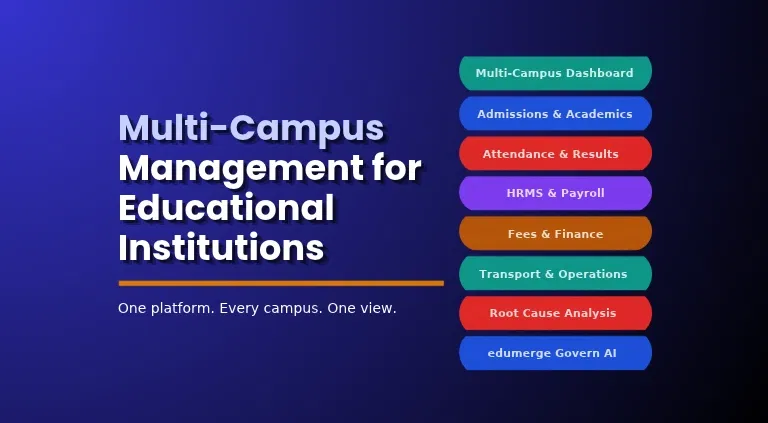
edumerge's multi-campus management for educational institutions brings every school, college and campus in a group onto one governed platform. Giving leadership a consolidated, real-time view of academics, students, staff, finances and operations.
Without it, group reports are compiled manually, reach trustees late, and let issues such as falling attendance, faculty vacancies or pending fees grow unnoticed.
This guide explains what multi-campus management means, the challenges groups face without it, and how edumerge resolves each of them.
TL;DR
Educational groups running several schools, colleges or university campuses often rely on separate systems at each institution. The result is manual reporting, disconnected tools, little transparency and scattered data that slows leadership decisions.
edumerge multi-campus management brings every campus onto one platform:
- Automated group reporting replaces spreadsheets compiled at the head office
- One integrated platform covers academics, HR, finance and operations
- Real-time visibility gives each role the right view, with early warnings on attendance, results, attrition and fee defaults
- A consolidated view compares every campus on the same basis
- Root cause analysis drills from the group down to a single class, teacher or fee head
- Central rollout applies new policies to every campus and tracks adoption
edumerge serves groups of 2 to 200 campuses, from K-12 school chains to multi-campus universities. It is multi-campus by design, balances campus autonomy with group control, and works alongside existing accounting.
Implementation moves campus by campus through a pilot campus to a phased rollout, and most institutions go live within hours of setup. Role-based access and audit trails protect data. edumerge is trusted by 800+ institutions and 500K+ students across 50+ cities in India.
What is Multi-Campus Management for Educational Institutions?
Multi-campus management is the practice of running several schools, colleges or campuses as one connected organisation. Every campus works on the same system and follows the same data standards, so information flows to the group level automatically.
Alongside this, campus teams run their daily operations as before. And the main difference is for leadership, who no longer need to wait for campuses to send reports.
Why it matters:
- One source of truth: Fees, admissions, attendance and all other data come from the same platform for every campus, so numbers match across reports.
- Faster, better decisions: Trustees see the group as it stands today, not as it stood when the last report was compiled.
- Consistent standards: Fee rules, approval limits and academic processes are set once and applied to every campus.
- Clear accountability: Each campus is visible & comparable on the same basis, so gaps surface early.
- Growth without chaos: A new campus joins the platform instead of adding another set of spreadsheets to consolidate.
Challenges of Managing Multiple Campuses Without a Central System
Most groups added campuses one at a time, and their systems grew the same way. Four problems follow almost every multi-campus group that lacks a central platform.
| Challenge | What it looks like |
|---|---|
| 1. Manual work that multiplies with every campus | Attendance, timetables, results, staff leave and fee summaries are compiled in spreadsheets and re-typed at the head office. Beside this every new campus adds more files and more errors. |
| 2. Disconnected tools used for different purposes | Fees, attendance, exams, HR, transport and the library each run on separate apps that cannot connect. As a result, the same student or staff record exists in several places with different details. |
| 3. No transparency across campuses | Leadership sees only what each campus reports, and only when it reports. So falling attendance, weak results, staff attrition, parent complaints and rising dues stay hidden until they grow. |
| 4. Scattered data leaves leadership in the dark | Simple questions, such as which campus has the lowest attendance or highest pending fees, need data gathered from several campuses and tools, so answers take days. |
How edumerge Multi-Campus Management Solves These Challenges
edumerge replaces disparate campus-level tools and manual consolidation with a single governed platform for the entire group. Hence, each challenge outlined above has a clear and direct answer, presented below in the same order.
1. Automated Group Reporting Replaces Manual Work
Campus data flows into group dashboards and reports as staff work. This ensures attendance, timetables, exam results, staff leave and fee reports are no longer compiled in spreadsheets, emailed or re-typed at the head office.
Therefore adding a new campus simply adds data, not workload. And errors from manual handovers disappear.
2. One Integrated Platform Replaces Disconnected Tools
The market offers many tools for individual tasks, but they rarely connect with one another. In edumerge, every function across every campus sits on one platform:
- Academics and students: Admissions, attendance, timetables, exams and results through School ERP and College ERP
- People: Recruitment, attendance, leave, payroll and appraisals through HRMS
- Finance: Fee collection, approval chains and budget vs actual through Finance & Control
- Operations and parents: Transport, hostel, library, front office and parent communication
A student, staff member or transaction is recorded once and seen everywhere it matters.
3. Real-time Visibility Replaces Waiting for Reports
Dashboards update as each campus works, so the figures a trustee sees in the morning reflect that same morning's activity. In the same way, early warnings also flag issues such as attendance drops, weak results, staff attrition, unresolved parent complaints and fee defaults before they become serious.
Most importantly, each person sees only what their role requires. For example: A principal sees their own campus, while a trustee sees the entire group.
4. Consolidated Multi-campus View Replaces Scattered Data
Questions that once took days are now answered from a single screen. For example, leadership can instantly find out:
- Which campus has the lowest attendance?
- Where are staff vacancies highest?
- Which campus has the most pending fees?
Furthermore, this consolidated view does more than collect data in one place. It puts every campus on a common scale, so leadership can:
- Compare campuses side by side using the same definitions and measures, without adjusting for different formats
- Benchmark each campus against the group average to see which campuses lead and which need support
- Track trends over time by term, month or academic year, rather than relying on a single snapshot
- Spot outliers quickly, as campuses that fall below agreed thresholds are highlighted automatically
- Share board-ready reports prepared directly from live data, with no manual consolidation
As a result, the group is managed as one organisation, and every campus is measured on a fair and consistent basis.
5. Root Cause Analysis, Down to a Single Class
A dashboard that highlights a problem is useful, but one that explains its cause is far more valuable. Leadership can move from the group view to an individual campus, and then down to a specific class, section, subject, teacher, department, fee head or approval stage, to trace any gap to its origin.
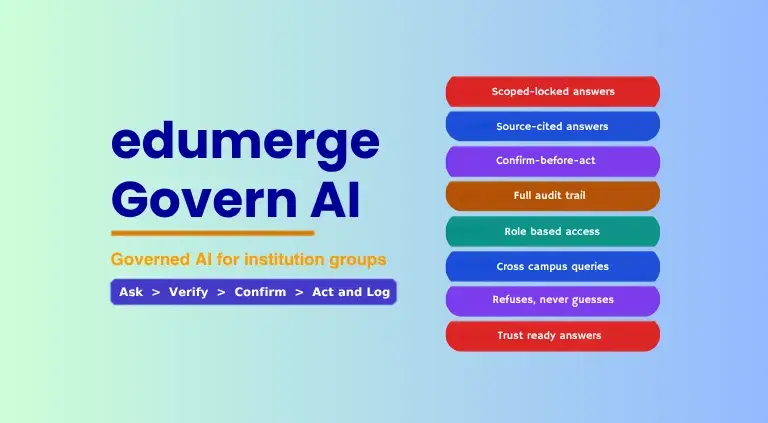
With edumerge Govern AI, leaders can also ask questions in plain language and receive answers limited to their role, along with the source data behind each answer.
These two examples show how it works across finance and academics:
| Stage | School A: Fees not collected | School C: Grade 9 results falling |
|---|---|---|
| What the dashboard showed | 4 of 5 schools have collected most term fees; School A is well behind. | Grade 9 maths results dropped at School C while other campuses held steady. |
| What the drill-down found | The shortfall sits in two classes, mostly with families promised a concession. | Attendance is normal, but the timetable shows substitute teachers covering most of the term. |
| Root cause | Concession approvals stuck in the approval chain, not unwilling parents. | HRMS shows the regular maths teacher resigned 2 months ago and the post is still vacant. |
| Action taken | Pending approvals cleared; a time limit set for concession requests across all five schools. | Hiring fast-tracked; a teacher from a nearby campus covers the gap in the meantime. |
| Data used | Fees and approval chain | Results, timetable and HRMS together |
In both cases, leadership tracks the campus from the same dashboard until the gap closes, without a single phone call or spreadsheet.
6. Informed Decisions & Faster Rollout of New Plans
With accurate, comparable data, leadership can make decisions based on evidence. They can decide where to open new sections and where to hire. They can also identify which campus needs academic support and which practices to copy across the group.
Decisions rest on facts, not on the loudest report in the room.
Once a decision is made, it is configured centrally and applied to every campus. That could be a common academic calendar, a new assessment pattern, a leave or appraisal policy, or a revised fee rule. Also, adoption is visible from the same dashboard, so leaders know whether it is being followed at each campus.
Explore more about the top group institution management platforms in India.
Who is edumerge Multi-Campus Management Built For?
edumerge is purpose-built for organisations where one leadership team governs more than one institution, from groups of 2 campuses to 200.
- Multi campus school management software for K-12 groups: School chains, trusts & societies running several K-12 campuses use edumerge School ERP to manage admissions, fees, attendance, exams, transport and parent communication for every campus, with a group dashboard on top.
- Multi-campus college management software for colleges & universities: Groups of colleges and multi-campus universities use edumerge College ERP to run the student lifecycle from admission to alumni, examinations, OBE and accreditation across campuses, with consolidated MIS for management.
- Groups running both schools and colleges: Education trusts that run schools and colleges together use edumergeOS to see every institution in one view.
Read more about edumerge for groups of institutions.
Why Groups of Institutions Choose edumerge for Multi-Campus Management
Most education software is built for one campus and later stretched to fit a group. edumerge is built the other way round.
When groups evaluate multi-campus management software, these factors set edumerge apart:
| What to look for | How edumerge delivers |
|---|---|
| Built for groups, not adapted | Multi-campus by design from day one, not a single-campus product extended to handle campuses. |
| Campus autonomy with group control | Each campus keeps its own fee structures, calendars and workflows, while the group sees standardised, consolidated data. |
| Every function on one platform | Academics, HR, finance and operations for schools & colleges in one system, not separate products stitched together. |
| A live trustee and board view | A built-in, role-based group dashboard, not custom reports compiled by hand before every board meeting. |
| AI that follows your rules | edumerge Govern AI answers only from your verified data, is scoped to the asker's role, shows its sources and confirms before it acts. |
| Works with your existing accounting | Finance & Control sits alongside your current books, so the group gains control without a forced migration. |
| Fast time to value | Configurable per campus, with most institutions going live within hours of setup rather than months. |
| Support that knows Indian education | India-built and India-supported, with one onboarding team, one support team and one SLA across the entire group. |
Trusted across India's education sector:
- 800+ institutions across 50+ cities
- 500K+ students
- 14+ years in Indian education
- 4.8/5 rating on G2
- 96%+ customer satisfaction
Proven Results: What Education Leaders Say About edumerge
Institutions that move to edumerge consistently report less manual work, faster board reporting and visibility into problems they could not see before.
Results at a glance:
- 60% less admin workload and paperwork
- 96%+ customer satisfaction
- 4.8/5 rating on G2
- 800+ institutions across 50+ cities in India
Here is what leaders across trusteeship, finance, academics, operations and IT say about the change.
Across every role, the outcome is the same: less time spent gathering data and more time spent acting on it. To see what these results could look like for your group, book a free demo with the edumerge team.
Conclusion
Managing a group of schools, colleges or university campuses should not mean managing a group of disconnected systems. As educational groups grow, manual reporting, scattered data and limited visibility make it harder for leadership to act at the right time.
edumerge multi-campus management for educational institutions brings every campus onto one governed platform. Leadership gets a consolidated, real-time view of academics, students, staff, finances and operations.
Similarly, root cause analysis helps trace any gap to its origin, while central rollout keeps every campus aligned with group-wide decisions. Each campus also retains the flexibility it needs, and role-based access keeps data secure.
Whether your group runs 2 campuses or 200, edumerge helps you govern the entire group from a single screen.
Frequently Asked Questions (FAQs)
1. What is edumerge Multi-Campus Management for Educational Institutions?
It is edumerge's way of running every school, college or campus in a group on one platform. Giving leadership a consolidated, real-time view of students, staff and finances across all campuses while each campus keeps its own setup.
2. Can one trust manage both schools and colleges on edumerge?
Yes. edumergeOS brings School ERP, College ERP, HRMS and Finance & Control together. So a trust running schools and colleges sees all of them in one consolidated view.
3. How does edumerge help find the root cause of a problem at one campus?
Leadership starts at the group dashboard, spots the campus that is off track, and drills down by class, subject, teacher, department, fee head or approval stage. To see where and why the gap exists, whether the issue is academic, staff-related or financial.
4. Does edumerge replace our existing accounting software?
No. edumerge Finance & Control works alongside your existing books, adding group-level control through approval chains, Budget vs Actual and a trustee dashboard.
5. How is data access controlled across campuses?
edumerge uses role-based access with an audit trail. A principal sees their campus, a group director or CFO sees the whole group, and every action is recorded.
6. How many campuses can edumerge manage?
edumerge is built for groups from 2 campuses to 200, and supports 50+ campuses managed simultaneously on the platform.
7. How long does it take to implement edumerge across multiple campuses?
Most institutions go live within hours of setup. Larger groups, or those with significant data to migrate, roll out campus by campus starting with a pilot campus, following a plan shared during discovery.
8. Is our group's data secure on edumerge?
edumerge secures data with role-based access control, campus-level permissions and a full audit trail of every action. So each user sees only what their role allows and every change is traceable.
9. Is edumerge cloud-based and mobile friendly?
Yes. edumerge is a cloud platform with a mobile-first design, so leaders, staff and parents can access the views their role allows from anywhere.