AI Finance Insights
Data-Backed Finance Decisions for Educational Institutions
Queries answered instantly. Spending patterns surfaced before they become problems.
- AI-assisted expense categorization
- Reduced manual classification effort; Improved cost centre accuracy
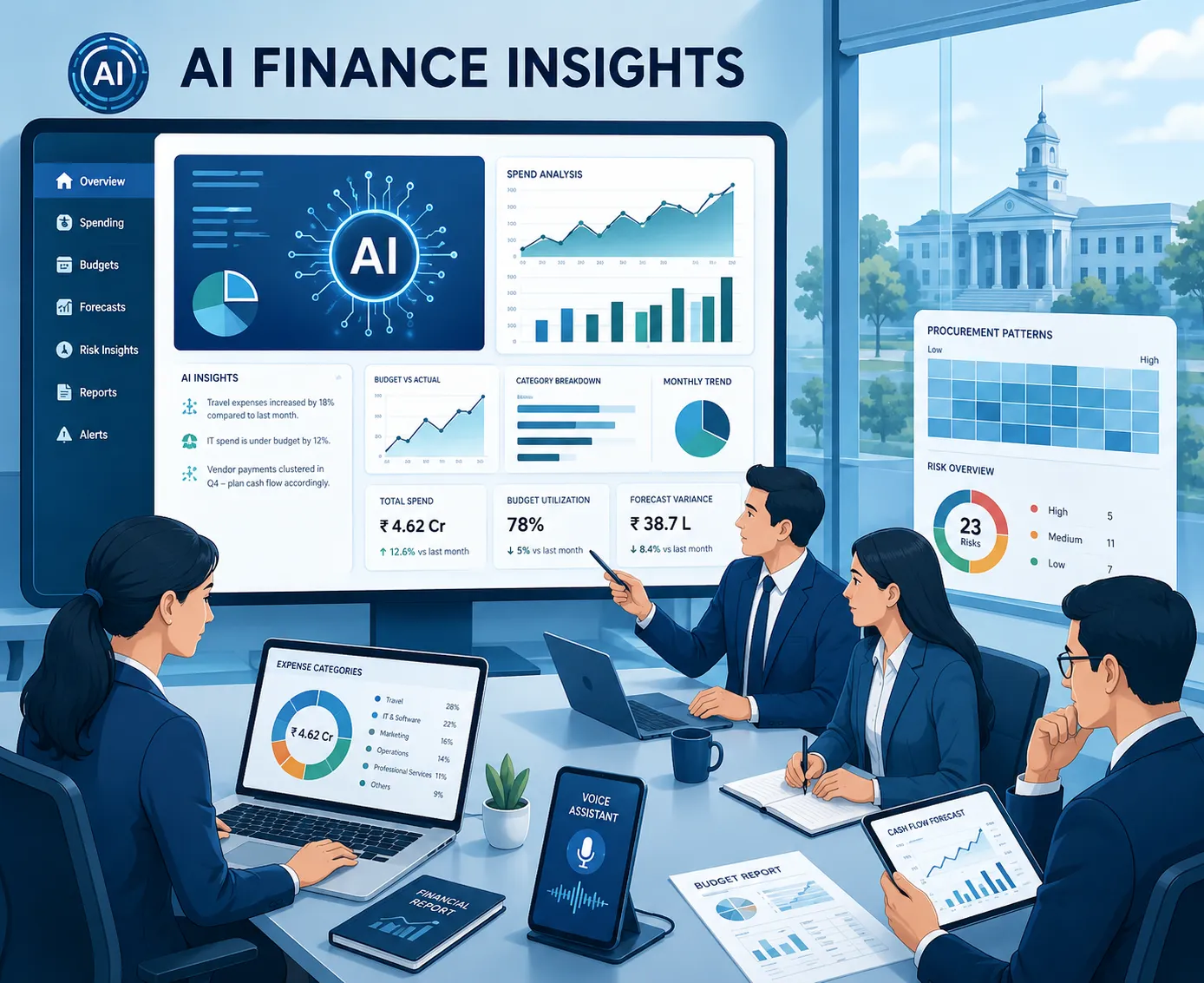
- Predictive analytics surface spending trends, budget risks & procurement patterns
- Voice assistant for finance queries
Overview
What Does AI Finance Insights Do?
AI Finance Insights is the intelligence layer within edumerge's Finance & Control module. It applies AI to three areas where finance teams in educational institutions spend disproportionate time: classifying expenses correctly, spotting patterns in spending data, and retrieving information from the finance system. The result is a finance function that makes fewer manual decisions on routine classification, gets early signals on where budgets are at risk, and answers stakeholder queries without generating a new report for every question.
P2P Lifecycle
The Full Procure-to-Pay Lifecycle at a Glance
Seven connected stages; all managed within a single Finance & Control module
AI Categorisation
Automatic expense classification
Accuracy Improves
Model learns from confirmations
Spending Trends
Patterns are identified
Budget Signals
Risk alerts are triggered
Procurement Insights
Pattern analysis is done
Voice Queries
Natural language questions
Benefits
How Does it Help Institutions?
Less Manual Classification, More Accuracy
AI-assisted categorization auto-handles routine cases, flagging only ambiguous ones for human review. Result: faster processing & consistent cost centre allocation.
Budget Risk Visible Before Period End
Predictive analytics surface signals that departments are trending toward overspend before period closes. Helps in timely intervention/reallocation.
Accessible Finance Information
Principals, HODs & management need financial information without training on the full module. The voice assistant makes this accessible through plain language queries.
Spending Patterns -> Planning Decisions
Predictive analytics reveal patterns not visible in period-end reports: seasonal procurement spikes, high-consumption categories, vendor concentration risk.
AI That Works
AI Finance Insights works on the institution's own finance data. Outputs are grounded in the institution's actual transaction history, making them relevant and actionable.
Natural Language Finance Access
The voice assistant is designed for the full range of stakeholders who need financial information. Non-finance staff access data without module training or dashboard navigation.
Who Uses It
Designed for Every Stakeholder in Your Institution
Finance Admin / Accounts Team
- Use AI-assisted categorisation to reduce manual classification of transactions
- Review flagged transactions requiring human judgement without processing every record
- Access budget risk signals before period-end review
Finance Leadership / CFO
- Review predictive spending analytics & budget risk signals across departments
- Use procurement pattern insights to inform annual budget planning & vendor strategy
- Query finance data through voice assistant
Principals, HODs, Management
- Ask plain-language questions about departmental spend & budget status
- Access financial information needed without relying on finance team for reports
- Monitor vendor payments & budget consumption
Trustees / Governing Body
- Access finance insights without navigating the full module
- Receive budget risk signals & spending trend summaries on demand
- Query financial data through voice assistant for governance review
Scale
Designed for Scale
As institutional finance data grows, AI Finance Insights becomes more valuable, not less:
Categorisation accuracy improves with each confirmed & corrected classification
Predictive analytics surface more reliable signals as more historical transaction data accumulates
Voice assistant queries become more precise as the underlying finance data grows richer
Group institutions benefit from pattern insights across campuses; identifying spending behaviour
From Department Need to Vendor Payment. Every Step Controlled & Connected.
See how edumerge's AI Finance Insights module reduces manual classification effort, surfaces budget risk signals earlier, and gives every stakeholder access to financial information through a plain-language voice assistant.
Frequently Asked Questions
Common questions about AI-assisted expense categorization, predictive spending analytics, and the finance voice assistant
How does AI-assisted expense categorization work?+
AI Finance Insights automatically classifies incoming expenses against cost centres based on transaction details. Routine, unambiguous entries are categorized without manual intervention; only ambiguous cases are flagged for the finance team to review and confirm. This reduces manual classification effort while keeping cost centre allocation consistent.
Does the categorization accuracy improve over time?+
Yes. Each confirmed or corrected classification feeds back into the model, so accuracy improves with use. Institutions with more historical transaction data see more reliable categorization and predictive signals as the finance data set grows richer.
What can the finance voice assistant answer?+
The voice assistant lets finance admins, CFOs, principals, HODs, and trustees ask plain-language questions about departmental spend, budget status, and vendor payments. It is built for stakeholders who need financial information but have not been trained on the full Finance & Control module, so they get answers without a new report being generated or a dashboard being navigated.
How do predictive spending analytics flag budget risk before period end?+
Predictive analytics continuously read spending patterns against department budgets and surface a signal when a department is trending toward overspend, before the period closes. This gives finance leadership time to intervene or reallocate funds instead of discovering the overspend only in a period-end report. The same analytics surface seasonal procurement spikes, high-consumption categories, and vendor concentration risk.
Is AI Finance Insights based on our institution's own data or generic industry benchmarks?+
AI Finance Insights runs on the institution's own finance data, not generic industry benchmarks. Categorization, predictive signals, and voice assistant answers are all grounded in the institution's actual transaction history, so outputs stay relevant to how that specific institution spends. For groups of institutions, pattern insights can also be viewed across campuses to identify shared spending behaviour.