Choosing among the top 7 college ERP platforms for engineering colleges in India is no longer a back-office decision. This is because AICTE confirmed that 58 engineering and technical colleges were progressively closed during 2025-26, citing low intake, faculty shortages & infrastructure non-compliance.
As a result, systems that run admissions, attendance & compliance now sit close to survival, not just convenience. Behind these closures, the numbers tell a similar story.
Engineering seat vacancy has hovered between 30% and 44% in recent years. And at the same time the India skills report put graduate employability at only around 47%. So colleges that cannot track enrollment, attendance and placements in one place find it hard to fix either problem.
With this in mind, this guide shows how to get that control. Explaining why engineering colleges need a purpose-built ERP and what goes wrong without having one.
TL;DR
Engineering colleges face operational pressures, such as recurring accreditation cycles, lab-heavy timetables, and placement tracking. Generic ERPs were never built to handle these.
A purpose-built platform automates admissions, attendance, fees, exams, and compliance reporting on one system. Cutting manual errors and giving trustees real-time visibility across departments & campuses.
edumerge College ERP leads this list, with native OBE, NBA, NAAC & NIRF management, placement tracking, and governing body dashboards on a single data layer.
Use the 6-point evaluation checklist later in this guide to shortlist platforms, and prioritise vendors built for technical education over repurposed school ERP systems.
Why Engineering Colleges Need an ERP Platform
Engineering colleges run academic and administrative operations that generic education software was never designed for. Below are the 5 reasons that stand out.
- Recurring accreditation cycles: NBA & NAAC assessments need outcome-based education (OBE) data from several academic years. And that data must be easy to find & well organised. When records are kept manually, colleges end up searching through files & spreadsheets each time a review comes around. An ERP keeps this data in one place all year, so accreditation preparation becomes routine rather than a last-minute rush.
- Lab, workshop and elective-heavy academics: An engineering timetable is far more complex than a school one. A single department can have several sections, lab batches, electives & honours tracks running at the same time. If the college uses a generic timetable tool, it cannot schedule all of this without clashes. An ERP built for engineering colleges can handle every one of these combinations in a single timetable. So faculty, labs & classrooms are never double-booked.
- Placement and industry-readiness tracking: Only around 47% of engineering graduates are considered employable. So colleges need to know where their own students stand. An ERP that records placement and internship data department by department shows where the skill gaps are. That lets the college act early, before those gaps affect placements.
- Enrolment and seat-fill pressure: With seat vacancy running between 30-44% nationally, every applicant counts. Admissions move quickly across counselling rounds, and spreadsheets cannot keep up. While using the right ERP lets the admissions team track each applicant from enquiry to enrolment, so fewer seats go empty.
- Multi-campus, trust-wide governance: Many engineering colleges are part of a larger group, and trustees want one clear picture of all campuses. Without an ERP, they wait for monthly reports from each campus. With one, they see consolidated numbers in real time and can decide sooner.
Fee collection is one of the first areas where these pressures show up. Read our guide on automating fee collection in engineering colleges while removing manual reconciliation and delayed receipts.
Must-Have Features in an Engineering College ERP Platform
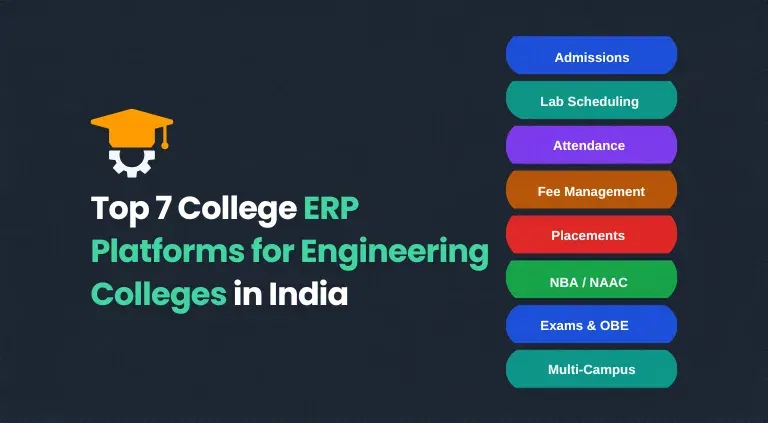
Engineering colleges run complex academic and administrative operations. So the right features decide how smoothly the institution works. These seven have the clearest impact.
1. Automated admission and counselling workflow
Every enquiry, application and counselling-round allotment is tracked in one place, with automatic follow-ups for pending applicants.
Outcome: Fewer applicants slip through between enquiry and enrolment, which matters when national seat vacancy runs between 30% and 44%.
2. Lab, workshop and elective batch scheduling
The system builds timetables around sections, lab batches, open electives and honours tracks, and checks faculty, lab and room availability as it goes.
Outcome: No timetable clashes and no double-booked labs or faculty, so teaching time is not lost to rescheduling.
3. NBA and NAAC-ready outcome-based education (OBE) reporting
Course outcomes, programme outcomes and assessment data are recorded through the year, not collected when a review is announced.
Outcome: Audit-ready documentation on demand, and far less last-minute compilation before every accreditation cycle.
4. Integrated fee management with real-time reconciliation
Fee collection, receipts and bank reconciliation sit in one system, with automated reminders for pending dues.
Outcome: Fewer reconciliation errors, a clear defaulter list at any time, and a cleaner audit trail for Finance Heads.
5. Placement and internship tracking
Offers, internships and student skill records are captured department by department.
Outcome: Leadership can see which departments need support early. This helps when only around 47% of engineering graduates are considered employable.
6. Mobile access for students, faculty and parents
Attendance, timetables, results, announcements, fee dues and circulars are available on the phone, with notifications.
Outcome: Faster, more consistent communication, and fewer queries reaching the front office.
7. Role-based access with a multi-campus, trust-wide dashboard
Each user sees only what their role allows, while trustees and directors get consolidated numbers across all campuses.
Outcome: Real-time group visibility for trustees, who no longer wait for monthly reports from each campus, along with better data security.
Many of these are shared across higher education institutions. Have a look at more roadblocks for colleges in our guide to the 10 challenges faced by college administration in India.
Top 7 College ERP Platforms for Engineering Colleges in India
1. edumerge College ERP
A purpose-built higher education ERP with native OBE, NBA, NAAC, and NIRF management. Covering the full engineering college lifecycle from admission to alumni on one platform.
edumerge College ERP is built for affiliated colleges, autonomous colleges, college groups, and universities. It runs on one codebase and one database.
Over the years, 800+ Indian institutions have used edumerge for over 14+ years. And for engineering colleges, that single data layer means academics, compliance, and governance never sit in separate tools.
Key strengths:
- The OBE module handles CO-PO mapping, PEO & PSO definition, CO & PO attainment calculation, and gap analysis for every engineering programme. Inside the core academic and assessment workflow rather than as a plugin.
- Accreditation management compiles NBA evidence programme by programme, alongside NAAC & NIRF. With department-wise progress tracking, so each branch knows exactly where it stands before an NBA visit.
- CO-PO attainment data flows directly into accreditation reports, keeping programme outcomes and criterion-wise documentation in sync across every department.
- Examination management with credit system management supports both autonomous engineering colleges running their own exams and affiliated colleges following university schedules, with result finalisation triggering degree eligibility checks and certificates.
- Placement management tracks campus drives, offers, and placement gaps by branch, giving placement officers and principals the outcome data that NBA and NIRF both assess.
- Research & publication management records faculty papers, funded projects, and patents, feeding the research metrics engineering colleges report for NBA, NAAC, and NIRF.
- Lesson planning and work diary capture course delivery against planned outcomes, giving NBA reviewers a clear evidence trail for teaching-learning processes.
- Mentor-mentee management and student performance analytics flag students at risk of backlogs early, helping departments protect pass rates and programme results.
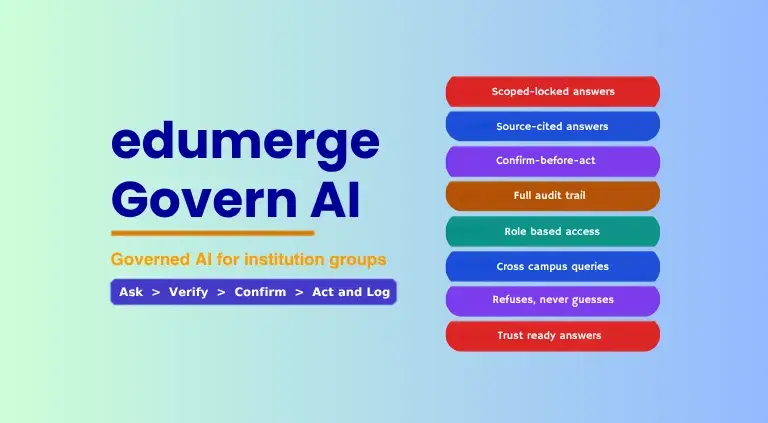
- edumerge Govern (AI) answers questions such as "Which departments have pending accreditation items?" with item counts by department, and asks for confirmation before assigning follow-ups.
- Fee management handles programme-wise fees across government and management quota seats and scholarship slabs, the fee complexity typical of engineering admissions, with enrollment auto-generating the fee structure and first invoice.
- Governing Body dashboards and Institutional KPI Tracking give principals, deans, and trustees live views of branch-wise enrollment, results, placements, and accreditation status.
- Role-based access with audit trail, hostel, transport with GPS tracking, library, and grievance management run on the same data layer.
- Initial setup takes 1 to 2 weeks, with department-by-department or full go-live, and the platform scales from a single engineering college to a multi-campus group through edumergeOS.
2. Contineo
A Bengaluru-based higher education ERP with a strong following among autonomous engineering colleges.
Key strengths:
- Mature OBE and CO-PO attainment tracking geared to NBA requirements.
- Well-developed examination workflows for autonomous colleges.
What to note:
- Strongest in academics and exams; finance, HR, and group-level governance depth is lighter.
- Groups running schools alongside engineering colleges need a separate system for the K-12 side.
3. Linways
A Kerala-based academic management platform focused on OBE and accreditation for higher education.
Key strengths:
- Dedicated OBE and accreditation tooling for NBA and NAAC documentation.
- Academic workflows such as attendance, assessments, and faculty records support attainment data.
What to note:
- Positioned more as an academic and accreditation platform than a full institutional ERP, so fee, HR, and finance may need other tools.
- Multi-campus group consolidation is limited.
4. MasterSoft ERP
A long-established higher education ERP used by universities and colleges across India.
Key strengths:
- Broad coverage across admissions, examinations, fees, and administration.
- NAAC and NIRF reporting support, with OBE capabilities for engineering programmes.
What to note:
- Multi-campus deployments often run as separate instances, making a consolidated group view harder.
- Implementations can be heavier and slower for a single engineering college.
You might also like our deeper comparison on edumerge vs MasterSoft Education ERP.
5. Camu
A cloud campus management platform for colleges and universities with a modern, mobile-first interface.
Key strengths:
- OBE attainment tracking supports engineering colleges preparing programmes for NBA.
- Covers attendance, assessments, fees, and communication in one system.
What to note:
- Designed for individual institutions, so trust-level consolidation across multiple colleges is limited.
- Finance and HRMS depth for group governance needs separate systems.
See how edumerge compares with Camu across key features.
6. Digiicampus
A Bengaluru-based campus management and LMS platform used by engineering and professional colleges.
Key strengths:
- Combines ERP functions with a learning management system and online assessments.
- OBE mapping and attainment reporting for NBA-track programmes.
What to note:
- The LMS-led design suits academics best; trust-level finance and HR need other tools.
- Group-wide governance dashboards across multiple institutions are limited.
7. Heraizen DHI ERP
A Karnataka-based ERP used by engineering colleges, particularly those affiliated with VTU.
Key strengths:
- Engineering-focused academic workflows, including OBE and CO-PO attainment.
- Covers admissions, fees, attendance, and examinations.
What to note:
- Regional focus means less proven fit outside Karnataka's affiliation and exam structures.
- Multi-campus group consolidation and governance features are limited.
If your group also runs colleges beyond engineering, compare a wider set of options. Refer to our guide on the top 10 higher education management software for colleges in India.
How to Choose the Right ERP for Engineering Colleges in India
Choosing the wrong ERP platform is expensive to reverse. Institutions that pick software built for schools, or systems without genuine engineering-education depth, often end up running parallel spreadsheets within a year.
Use this 6-point checklist to evaluate any college ERP platform for engineering colleges before signing a contract.
- Built for technical education, not adapted from a school ERP: Confirm the platform natively supports engineering-specific academic structures, not just school-style class and section models.
- NBA, NAAC and AICTE compliance reporting built in: Ask for a live demo of outcome-based education (OBE) reports, not a roadmap promise.
- Native support for lab batches, electives and OBE: The platform should handle multi-section, multi-batch academic structures without heavy customisation.
- Single database architecture across admissions, academics, fees and placements: Disconnected modules recreate the same data silos the ERP is meant to remove.
- A proven implementation track record with engineering institutions: Ask for reference checks with similarly sized technical colleges, not general education clients.
- Ability to scale across multiple campuses or a trust, with role-based governance: Confirm the platform supports group-wide dashboards from day one, not as a future add-on.
If your engineering college runs its own examinations & curriculum, the platform you choose must also support autonomy-specific workflows. As explained in our guide on how to manage autonomous college operations.
Conclusion
Engineering colleges operate under accreditation cycles, seat-fill pressure and placement scrutiny that generic systems were not designed to handle.
The right college ERP platform for engineering colleges turns these pressures into structured, retrievable data that supports trustees, principals and finance teams alike.
edumerge College ERP is purpose-built for this context, giving engineering institutions one system for academics, compliance and governance instead of ten disconnected tools.
Frequently Asked Questions (FAQs)
1. Why do engineering colleges need a different ERP than schools?
Engineering programmes run lab batches, electives and outcome-based education records that generic school ERP systems are not built to schedule or report on.
2. Does a college ERP platform help with NBA or NAAC accreditation?
Yes. A platform built for engineering education keeps outcome-based education (OBE) data structured and retrievable, which reduces manual work during accreditation cycles.
3. Can a college ERP platform reduce seat vacancy problems?
An automated admission and counselling workflow helps colleges track applicants and fill seats faster across counselling rounds, particularly where vacancy rates run high.
4. Does edumerge College ERP support multiple campuses?
Yes. edumerge College ERP includes role-based access and a group-wide dashboard so trustees get real-time visibility across every campus in a trust.
5. Is a College ERP platform cloud-based?
Most modern college ERP platforms for engineering colleges, including edumerge College ERP, are cloud-based with mobile access for students, faculty and parents.
6. How does an ERP platform help engineering college placements?
A placement and internship tracking module gives department-wise employability data, helping institutions identify and close skill gaps earlier.
7. What should be on an evaluation checklist for engineering college ERP software?
Look for technical-education depth, built-in accreditation reporting, native lab and elective scheduling, a single database architecture, a proven implementation track record, and multi-campus scalability.
8. How long does it take to implement a college ERP platform?
Implementation timelines vary by institution size and data migration scope. Ask any vendor for reference timelines from similarly sized engineering colleges before signing.
9. Who should be involved in choosing an engineering college ERP platform?
Trustees, the Principal or Academic Head, the IT Head and the Finance Head should all evaluate the platform against their respective concerns before a final decision.
10. Does edumerge College ERP handle fee management?
Yes. It includes real-time fee reconciliation and defaulter visibility, reducing the manual reconciliation work Finance Heads otherwise carry.