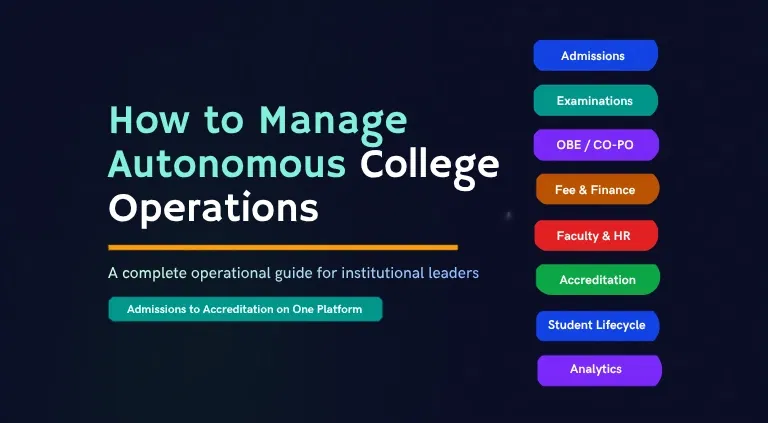
Learning how to manage autonomous college operations starts with understanding one thing. That they have more academic & administrative freedom than an affiliated college. And with this comes direct responsibility for curriculum design, examinations & accreditation evidence that used to sit with the affiliating university.
India currently has 1200+ autonomous colleges, a figure that represents only about 2.6% of the country's roughly 47,000 colleges, according to UGC data reported by EducationWorld.
As more colleges pursue autonomy & move toward outcome-based education under the NEP, the operational load on registrars, IQAC coordinators, deans & finance heads grows heavier. Manual processes that worked for a university-affiliated college rarely scale once a college owns its own curriculum, exam cycle, and compliance documentation.
TL;DR
Managing autonomous college operations in India requires a structured approach across 10 core areas: admissions, academics, curriculum, examination & result management, student lifecycle, fee & finance, faculty & HR, compliance & accreditation, communication, and analytics.
Autonomous colleges carry their full academic & administrative accountability that used to sit with the affiliating university.
The most effective way to manage all 10 areas simultaneously is through a purpose-built college ERP built for autonomous institutions. An integrated platform that connects accreditation, examinations, fee management & governance from a single system.
Core Operational Areas Autonomous Colleges Manage
Autonomous colleges are responsible for 10 interconnected operational areas. Each needs its own process discipline & each performs better when it shares data with the others.
| Operational Area | What Needs to Be Managed | Best Practices |
|---|---|---|
| Admissions | Applications, eligibility checks, programme allotment, seat matrix, quota tracking | Digitise the full applicant journey and link admitted student data directly into academic & fee records |
| Academic Administration | Timetabling, attendance, faculty workload, department coordination | Centralise scheduling & attendance so registrars see conflicts before they disrupt classes |
| Curriculum Management | Syllabus design, credit structure, Board of Studies approvals, revision cycles | Maintain version-controlled curriculum records with clear approval trails for every revision |
| Examination & Result Management | Question papers, internal assessments, moderation, grading, result publication | Standardise examination workflows across departments to reduce delays and result errors |
| Student Lifecycle | Enrolment through alumni, performance tracking, mentoring, feedback | Track the full student journey on one record so no data is lost at transition points |
| Fee & Finance | Programme-wise fee structures, scholarships, quotas, reconciliation | Automate fee generation at enrolment and reconcile collections in real time |
| Faculty & HR | Recruitment, workload allocation, appraisals, payroll | Link teaching workload data directly into appraisal and payroll calculations |
| Compliance & Accreditation | NAAC, NBA, NIRF documentation, CO-PO & PEO mapping, audit trails | Capture accreditation evidence continuously through the year, not before a visit |
| Communication | Notices, parent and student outreach, staff coordination | Use a single channel for announcements so information reaches every stakeholder without gaps |
| Analytics | Enrollment trends, financial summaries, academic outcomes, governance KPIs | Give leadership live dashboards instead of outdated monthly reports |
Challenges Faced By Autonomous Colleges in Managing Operations
Even well-run autonomous colleges run into the same recurring operational friction, regardless of how long they have held autonomous status. Here are the challenges that surface most often, and the effect each one has on daily operations:
1. Departmental Silos
Challenge:
- The registrar's office, exam cell, and accounts department each keep their own spreadsheets and rarely share data in real time.
- Student records get re-entered manually at every transition point, from admission to examination to fee collection.
- Departments use different formats & naming conventions, making it hard to reconcile data even when someone tries to combine it.
Operational Impact:
- This causes duplicate data entry & delays admissions, examination results, and fee reconciliation across departments.
- Errors introduced in one department's spreadsheet often go unnoticed until they surface downstream, sometimes weeks later.
- Staff spend hours each week manually cross-checking records instead of focusing on academic or student-facing work.
A college ERP purposefully-built for autonomous colleges operates as one integrated system, instead of creating data silos across departments.
2. Complex Fee Structures
Challenge:
- Multiple programmes, credit loads, scholarship slabs & quota categories overwhelm generic fee tools.
- Fee revisions mid-year, such as new scholarship slabs or government quota changes, require manual updates across every affected student record.
- Refunds, part-payments & installment plans are tracked outside the main system, often in separate registers.
Operational Impact:
- This leads to fee calculation errors & manual rework by the finance team at the start of every semester.
- Parents & students raise repeated queries over incorrect fee amounts, adding to front-office workload.
- Reconciliation with the trust or society's central accounts takes longer, delaying audit readiness.
Explore the complex fee management capabilities of edumerge college ERP.
3. Accreditation Scrambles
Challenge:
- NAAC & NBA visits trigger a frantic effort to pull outcome mapping, CO-PO attainment & faculty records from scattered sources.
- Departments maintain accreditation evidence differently, so IQAC coordinators must standardise formats right before submission.
- Historical data from previous accreditation cycles is often incomplete or stored with staff who have since left.
Operational Impact:
- This consumes months of faculty & IQAC time, and raises the risk of incomplete evidence during the actual visit.
- Weak or missing documentation directly affects NAAC grades & NBA outcomes, with consequences for the institution's reputation and funding eligibility.
- The scramble pulls faculty away from teaching & research responsibilities during the run-up to a visit.
Read in-detail about how you can simplify the evidence collection & tracking process required for NAAC & NBA accreditation cycles. edumerge's Tag Management module is what keeps this evidence standardised across departments year-round, so nothing needs to be reformatted right before a visit.
4. Limited Governance Visibility
Challenge:
- Deans & directors rely on monthly reports that are already outdated by the time they arrive.
- Reports are often compiled manually by each department before being sent up, introducing further delay & inconsistency.
- There is no single dashboard that shows enrollment, finance & academic outcomes together.
Operational Impact:
- This delays decisions on enrollment, resourcing & student interventions by weeks at a time.
- Leadership ends up reacting to problems, such as a drop in attendance or a fee shortfall, after they have already escalated.
- Trustees & governing bodies lack the real-time data needed to hold departments accountable between formal review cycles.
5. Underused Alumni Networks
Challenge:
- Alumni data often sits as a static list rather than an active engagement & placement resource.
- Contact details go stale quickly since there is no ongoing mechanism to keep records updated.
- Alumni achievements & career progress are rarely captured, so the college cannot showcase outcomes to prospective students.
Operational Impact:
- This means placement cells miss recruiter connections and the college loses a channel for mentorship & reputation building.
- Fundraising & donation opportunities go untapped because there is no structured way to reach engaged alumni.
- NAAC & NBA documentation on alumni engagement, which increasingly carries weight in evaluations, remains thin.
Explore the alumni management capabilities of edumerge college ERP.
6. Untracked Progress Toward the Next Stage
Challenge:
- Colleges moving from affiliated to autonomous status, or autonomous colleges working toward university status, often lose track of readiness because operations are not connected.
- Eligibility criteria, such as faculty qualifications, research output & infrastructure benchmarks, are tracked manually & inconsistently across departments.
- No single team owns the full readiness picture, so gaps are discovered late.
Operational Impact:
- This risks missed eligibility windows & incomplete applications, pushing the transition back by a full academic cycle.
- Institutions may invest in the wrong areas because they lack visibility into which readiness criteria are already met and which are not.
- Leadership loses credibility with the governing body & regulators when applications are rejected or delayed for avoidable reasons.
How edumerge's College ERP Solves It
edumerge College ERP is built for the depth of autonomous college operations rather than adapted from a school management tool. Here is how it addresses the operational friction covered above.
- Unifies departmental data on one shared layer. Admissions, academics, examinations & finance sit on a single database with role-based access & audit trails, so an action in one department, such as a result being finalised, automatically triggers the right response in another, like a certificate or degree eligibility check. Departments stop maintaining parallel versions of the same student record.
- Automates fee complexity instead of patching it manually. The fee management module generates invoices at enrollment based on programme, credit load, scholarship slab, or quota category, and reconciles collections in real time against the trust or society's books. Mid-year fee revisions apply system-wide instead of being updated student by student.
- Keeps accreditation evidence current all year, not just before a visit. The OBE framework (CO-PO, PEO, PSO mapping) & accreditation management module capture outcome attainment and documentation continuously, and this evidence maps directly into criterion-wise NAAC, NBA & NIRF data. IQAC coordinators walk into a visit reviewing evidence that already exists, rather than assembling it from scratch.
- Gives leadership numbers they can act on, not just read. Governance dashboards and the MIS report builder give deans, registrars & trustees the same live view of enrollment, finance & academic outcomes. Institutions using this shared data layer have reported cross-department efficiency gains of 40-60%, since decisions no longer wait on the next monthly report.
- Turns alumni into a working asset, not a static list. The alumni management module keeps contact & career data current and links it to placement workflows, so recruiter relationships & mentorship opportunities are built into daily operations rather than revived once a year for an event.
- Tracks institutional readiness as a continuous status, not a last-minute audit. Institutional KPI tracking & governing body dashboards show exactly which eligibility criteria are already met for the next stage. Such as faculty qualifications, research output, or infrastructure benchmarks. Whether that is autonomy or university status, gaps surface early enough to close them, not after an application is rejected.
Key Outcomes: Before & After edumerge
| Operational Area | Before edumerge | After edumerge |
|---|---|---|
| Operational Efficiency | Departments coordinate manually through email & spreadsheets | Cross-department efficiency gains of 40-60% through a shared data layer |
| Examination Processing | Result compilation & moderation handled department by department | Result finalisation, degree eligibility checks, and certificate workflows run automatically |
| Compliance Readiness | Accreditation evidence gathered in a six-month scramble before a NAAC or NBA visit | Documentation stays continuously current, with criterion-wise readiness visible at any time |
| Data Management | Student, finance & academic data scattered across disconnected tools | One unified database across departments, programmes & campuses |
| Approvals | Manual sign-offs delay fee waivers, curriculum changes & staff actions | Structured approval chains move decisions through the right stakeholders without delay |
| Reporting | Deans & directors rely on outdated monthly reports | Live governance dashboards show enrollment, revenue & outcomes as they happen |
| Decision-Making | Leadership reacts to information that is already weeks old | Decisions are backed by real-time data across the institution |
Why edumerge is the Ideal College ERP for Autonomous Colleges in India
Autonomous status gives a college academic freedom, but it also puts full operational accountability on the institution itself. Learning how to manage autonomous college operations well means connecting admissions, academics, examinations, student lifecycle, fee & finance, faculty & HR, compliance, communication, and analytics on one platform instead of running them as 10 separate efforts.
edumerge College ERP was built for exactly this. Its OBE & accreditation management modules keep NAAC, NBA & NIRF evidence current throughout the year. Its examination & academic modules share one data layer with finance & HR. And its governance dashboards give trustees & directors real-time visibility instead of outdated reports.
For institutions working to strengthen academic excellence & support long-term growth, a single connected system replaces the operational guesswork that autonomy without the right tools can create. As a result, managing autonomous college operations becomes less about juggling 10 separate efforts and more about running one connected institution.
Fee & finance is one of the ten areas covered above, and often the one with the most operational complexity. How to Manage College Finances Effectively goes deeper into what that looks like for finance heads and admins specifically.
For a ranked comparison of platforms built for this exact operating model, see our guide to the top 10 College ERP software for autonomous colleges in India.
Frequently Asked Questions
1. What is the biggest operational risk for a newly autonomous college?
Departments continue to work in spreadsheets & disconnected tools once autonomy is granted. This causes accreditation evidence, examination records, and fee data to scatter across teams with no single source of truth.
2. Does a college ERP help with NAAC and NBA accreditation?
Yes. A college ERP with built-in accreditation management maps CO-PO & PEO data, tracks criterion-wise documentation, and compiles evidence continuously instead of during a pre-visit scramble.
3. What is OBE and why does it matter for autonomous colleges?
Outcome-Based Education (OBE) is the UGC & NAAC mandated framework for defining & measuring course, programme, and educational outcomes. Autonomous colleges must track CO-PO & PSO attainment natively since they set their own curriculum.
4. Can one system manage examinations end to end for an autonomous college?
A purpose-built examination management module can handle question paper workflows, internal assessments, grading, moderation & result publication within the same platform used for admissions and academics.
5. Is edumerge College ERP suitable for a single autonomous college or only college groups?
It works for a single autonomous college as well as for trusts & societies running multiple colleges. With each institution operating independently while leadership gets a consolidated view across campuses.
6. How long does it take to implement a college ERP?
edumerge Implementation is typically structured over 1-2 weeks for initial setup, followed by historical data migration & role-specific training. With rollout available department by department or as a single go-live.
7. What operational outcomes can autonomous colleges expect after moving to a unified ERP?
Institutions typically see faster approvals, continuous accreditation readiness, centralised data instead of departmental silos, and governance dashboards that replace outdated monthly reports.
8. Does a college ERP reduce the workload during a NAAC or NBA visit?
Yes. When CO-PO attainment, faculty records & departmental evidence are captured throughout the year, the pre-visit effort shifts from a 6 month document hunt to a final review of already compiled data.
On the communication side specifically, edumerge Chat & Content Sharing replaces the informal WhatsApp groups that departments tend to fall back on, with a platform-native messaging & material-sharing layer.