India now runs close to 14.67 lakh schools, and a growing number of them belong to trusts & societies managing 3, 5, or more campuses under one roof. For these groups, the search for the right school ERP software rarely goes smoothly.
Most platforms which have the "top 10" list were built specifically for a single campus, rather than a group of schools. Also, the cost of that mismatch shows up fast.
Administrative staff already lose an estimated 30 to 40% of their time to repetitive manual work. These include data entry, fee reminders, attendance compilation, etc. The inefficiency arises as manual effort does not stay flat as a group grows. It multiplies with every campus added, turning a manageable workload into a genuine drag on the whole trust.
Meanwhile, NEP 2020 raises the bar further. Pushing schools toward standardised, competency-based reporting across CBSE, ICSE, and state boards. For a group, this is not just about finding software that works well for one school. It's about finding governance, consolidation, and control that hold together across every campus at once.
TL;DR
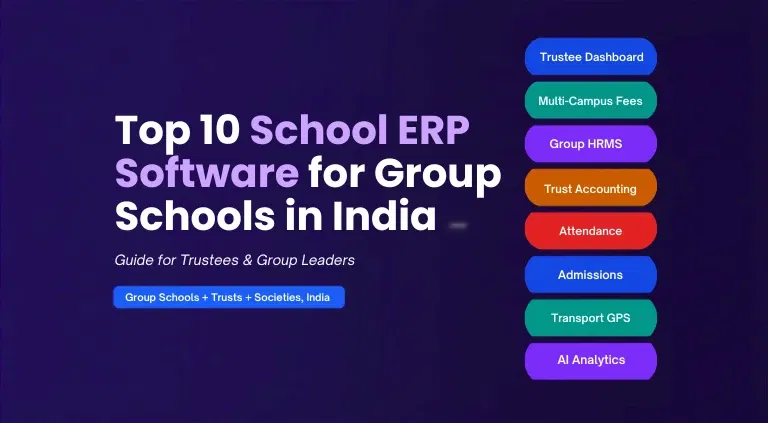
This guide ranks the top 10 school ERP platforms for group schools in India. Weighing unified data architecture, trust & society accounting, and NEP 2020-aligned reporting against tools built for a single campus.
It sets out evaluation criteria, alongside key challenges groups face without consolidated systems. Right from manual reporting to disconnected HR & fee policies.
edumerge School ERP tops the list as it's built to give every campus one consolidated dashboard, one data layer, and same-codebase for adding new campuses/branches.
Why Group Schools Need Specialized School ERP Software?
A school ERP built for one campus assumes there is only a single admin office, one fee structure, and one academic calendar. A group of schools operates in a way where nothing is singular.
That difference is exactly why conventional, single-school software breaks down once a trust crosses 2 or 3 campuses:
- Multi-entity architecture on one data layer: Every campus needs its own operational identity, but it should still feed into one group database, not sit as a separate installation stitched together with the rest.
- Group-level consolidated reporting: Trustees need one real-time number across all campuses. Waiting for each school office to send its own report defeats the purpose.
- Standardised policy enforcement with local flexibility: Fee structures, leave policies, appraisal cycles, and academic calendars should be set once at the group level and applied consistently, not configured separately at every campus.
- Inter-campus HR mobility: Staff transfers, group-wide appraisal cycles, and consolidated payroll with PF & ESI compliance across entities simply cannot run on a tool built for one campus at a time.
- Trust or society level accounting: Sanction-to-settlement workflows, fund transfers between campuses, and multi-entity consolidation all need a financial architecture that single-school ERP was never built to provide.
- Fast, low-friction campus onboarding: Adding a new campus to the group should take a day of configuration, not months of running a separate implementation from scratch.
- Group-wide analytics and benchmarking: Leadership needs to compare academic and operational performance across campuses on the same metrics. Not reconcile 5 different formats coming in from five different schools.
Group leadership evaluating school ERP for the first time can also start with a broader look at how to digitize school operations.
Key Challenges Group Schools in India Face Without the Right School ERP Software
Without a platform built for groups, the same problems keep showing up, campus after campus, trust after trust. They don't announce themselves. They just quietly cost leadership time, money, and visibility until someone finally notices.
Here's what tends to break first, and what it costs.
- Reports get assembled by hand from each campus
The operational effect: Trustees end up waiting days for a single consolidated number before every board meeting, when they should be able to see it in real time. - Administrative staff lose 30-40% of their time to repetitive tasks
The operational effect: Across a group, that inefficiency doesn't just add up, it compounds. Pulling people away from admissions, parent communication, and academic support at every single campus. - Each campus keeps its own accounting setup or spreadsheet
The operational effect: The group never has a real-time, audit-ready number to work with. Instead, the finance team becomes the manual glue holding disconnected campuses together. - Fee structures, leave policies, and academic calendars get configured separately at each campus
The operational effect: Policy enforcement breaks down as the group scales. Exceptions start piling up quietly, often without anyone at the group level even noticing. - HR runs independently at every school
The operational effect: Staff transfers, group-wide appraisal cycles, and consolidated payroll, including PF & ESI compliance, become a genuine operational headache across entities. - New campuses get onboarded onto disconnected systems
The operational effect: What should be a day of configuration turns into months of parallel implementation, plus IT costs that didn't need to exist. - Academic reporting isn't standardised across CBSE, ICSE, and state boards
The operational effect: The group struggles to keep up with NEP 2020's competency-based, multi-board reporting expectations consistently, campus by campus.
Much of this manual reporting burden traces back to a single root cause, spreadsheets doing a job they were never built for. See the hidden cost of spreadsheet administration for a closer look at what that actually costs a school.
Top 10 School ERP Software for Group Schools in India
1. edumerge School ERP
edumerge School ERP is a purpose-built school management platform for K-12 schools and school groups. Bringing together admissions, attendance, fees, timetable, transport, and parent communication together on one system.
It's trusted by 800+ institutions across India, from single-campus schools to 50-campus groups. With the same codebase and database powering every deployment size.
Key strengths:
- Built for school groups managing multiple campuses under a single trust or society. With centralised governance at group level and full operational autonomy for each campus.
- Consists of one student record, one fee ledger, and one attendance log flow across every module. So an action in one area, like a fee default, automatically triggers the right response elsewhere, such as blocking exam hall ticket generation.
- Group-wide consolidation gives trustees & management a real-time, single dashboard view of enrollment, fee collection, attendance, and compliance across every school in the group. Instead of chasing individual campus reports.
- Configurable per campus, so each school retains its own processes, academic calendar, board format (CBSE, ICSE, IGCSE, or state board), and policies while still rolling up into one group view.
- Provides guided onboarding letting a school go live in under 7 hours, with dedicated staff training and same-week historical data migration, a meaningful advantage when rolling out across many campuses at once.
- Built-in, workflow-integrated communication across WhatsApp, SMS, email, and in-app messaging keeps parents connected without relying on untraceable WhatsApp groups.
- Helps groups of institutions bring down operational costs by replacing duplicated licensing, manual reconciliation, and repeated admin effort with one shared system across campuses.
- Backed by edumerge's dedicated support, with account managers and structured escalation to keep every campus running through exam, admission, and fee cycles.
2. Entab CampusCare
A school ERP which is widely used by traditional, CBSE-affiliated Indian schools for structured academic administration.
Key strengths:
- Strong tracking of records with schools giving it a deep familiarity with CBSE workflows and conventional school administration.
- Comprehensive coverage of admissions, attendance, examinations, fees, and library management in one suite.
- Established brand recognition and support infrastructure across Indian schools.
What to note:
- Positioned as an enterprise-grade, higher-cost option, which can be heavier than what a mid-size school group needs for group-level consolidation.
- Multi-branch governance and cross-campus dashboards are less central to the product than single-school academic administration.
You might also take a deeper look at how edumerge School ERP compares with Entab.
3. PowerSchool
A global student information system with a presence in Indian schools, often chosen by larger institutions wanting an internationally established platform.
Key strengths:
- Established global SIS with a broad academic and administrative feature set.
- Strong reporting and data management capabilities refined across large international deployments.
- Familiar to schools with international curricula or global school networks.
What to note:
- Built around a global product architecture, so Indian-specific needs like CBSE or ICSE report card formats, GST-linked fee receipts, and trust or society consolidation often need local customisation.
- Implementation and licensing are typically priced for larger institutions rather than mid-size Indian school groups.
4. MyClassboard
Cloud-based school ERP focused on user experience and parent engagement. It is majorly popular with small to mid-sized Indian private schools.
Key strengths:
- Strong parent engagement tools, including digital diary, parent-teacher appointment scheduling, and real-time homework tracking.
- Competitive per-student pricing suited to smaller school budgets.
What to note:
- Feature depth leans toward communication and engagement rather than deep group-level financial consolidation.
- Multi-campus governance and trust or society-level reporting are not the platform's primary strength compared with group-first ERPs.
5. Next Education (Next Learning Platform)
SaaS-based school ERP and content platform from a large Hyderabad-based EdTech company, serving Indian schools.
Key strengths:
- Large scale, serving partner schools and students across India and the Middle East.
- Combines ERP with digital content, assessments, and LMS in a single integrated platform.
What to note:
- Product breadth spans content and pedagogy alongside ERP, which can mean administrative and financial consolidation features are less specialised than a group-first school ERP.
- Group-level trust or society accounting is not a core focus area of the platform.
6. LEAD Group's School ERP
A school ERP bundled with LEAD's academic transformation programme, delivering a standardised curriculum alongside administrative tools.
Key strengths:
- ERP is tied to a structured, standardised curriculum delivery model, useful for groups prioritising academic consistency across campuses.
- Combines academic content and school operations in one relationship.
What to note:
- The ERP is positioned around LEAD's curriculum programme rather than as a standalone, flexible school ERP, so schools not on the LEAD academic model may find it less suited to their needs.
- Group-level financial governance and multi-trust consolidation are not the primary design focus.
7. VAPS Group (i-Vidyalaya)
Veteran Indian school ERP provider with cloud-based solutions built for large-scale, multi-branch institutions across CBSE and ICSE boards.
Key strengths:
- Advanced automation for examinations and multi-branch management, aimed at large-scale school networks.
- AI-powered reporting and 24x7 dedicated support for complex educational operations.
What to note:
- Focus is primarily academic and examination administration; group-level trust or society financial consolidation is not a stated core capability.
- Best suited to institutions needing scale and support depth rather than a unified finance-and-HR-linked group operating system.
8. Vidyalaya School ERP
A comprehensive school ERP offering 30+ plus specialised modules, positioned for large-scale campuses and multi-branch school organisations.
Key strengths:
- Deep module coverage extends into complex campus logistics such as infirmary management and cashless cafeteria systems, useful for large residential school groups.
- Modular architecture lets schools customize the platform to their specific operational needs rather than adopting a fixed configuration.
What to note:
- Depth of modules can mean a longer implementation and configuration cycle compared with platforms designed for fast, guided go-live.
- Group-level financial governance and trust or society-level consolidated dashboards are not highlighted as a core strength, with the focus centred more on campus operations.
9. Fedena
Cloud-based, modular school ERP offering 50-plus integrated modules, including a multi-institution dashboard for managing several schools.
Key strengths:
- Broad module coverage across attendance, examinations, gradebook, transport, and hostel management.
- Multi-institution dashboard allows managing more than one school from a single login.
What to note:
- Initial setup requires significant IT involvement and is not the fastest to go live compared with guided-onboarding platforms.
- Group-level trust or society accounting and finance-linked governance are limited compared with school ERPs built specifically for institution groups.
Also discover how edumerge School ERP compares with Fedena over different features.
10. Campus365
Digital-first school ERP focused on learning management and student engagement for schools prioritising a modern digital classroom experience.
Key strengths:
- Strong emphasis on digital classrooms and learning engagement alongside core administrative functions.
- Modern, engagement-first interface suited to schools wanting a contemporary digital presence.
What to note:
- Administrative depth for large, multi-campus financial and HR consolidation is lighter than group-first ERPs built around trust or society governance.
- Best suited to single schools or small groups prioritising digital learning over group-wide operational control.
IT heads specifically evaluating deployment models should also review this breakdown of cloud-based school ERP software for schools in India. Covering what to check before moving off on-premise infrastructure.
Evaluation Criteria for Choosing the Right School ERP Software for Group Schools in India
Below is a checklist built specifically for how groups operate, not adapted from a single-school feature list:
| Evaluation Criteria | What Group Leadership Should Check |
|---|---|
| Unified data architecture | One database across every campus, not separate installations connected by integrations. |
| Group-level consolidated reporting | Real-time trustee dashboard covering academics, finance and operations across all campuses. |
| Trust or society accounting | Native sanction-to-settlement workflow, approval chains, Budget vs Actual and multi-entity consolidation. |
| Standardised policy enforcement | Fee structures, leave policies and academic calendars set once at group level, applied consistently. |
| Group-wide HRMS | Inter-campus staff transfers, consolidated payroll, PF and ESI compliance across entities. |
| Campus onboarding speed | A new campus was added to the group in days, on the same codebase, not a fresh implementation. |
| Multi-board and NEP 2020 alignment | Supports CBSE, ICSE and state board reporting formats with NEP-aligned assessment structures. |
| Cloud-based deployment | No on-premise server hardware, uninterrupted access even during emergencies or remote operations. |
| Role-based access control | Trustees, principals, finance and IT each see only the data relevant to their role and campus. |
| Vendor track record with groups | Built for groups from the start, not a single-school tool adapted after the fact. |
For a foundational primer before diving into group-specific criteria, this guide answers what is a school management system in detail. But for a broader look at what "unified" should actually mean in practice, see this guide to a smarter way to manage your school.
Conclusion
For group schools in India, the real question behind any top 10 school ERP software list isn't which vendor scores highest on a features chart. It's which one was actually designed for groups from the start.
The right platform gives trustees one consolidated number, principals one academic standard, and IT heads one system to manage, instead of a different tool for every campus.
It also shapes how fast a group can grow. Onboarding a new campus should take days on a shared codebase, not a fresh implementation cycle every single time. Compliance works the same way.
Even cost follows the same logic. A single unified platform across School ERP, HRMS, and Finance & Control almost always costs a group less to run and audit than 5 or 10 disconnected, campus-level tools stitched together over the years.
edumerge School ERP is built on exactly this premise. Unified across every campus in the group, so leadership spends less time reconciling and more time on outcomes.
Frequently Asked Questions (FAQs)
1. Can School ERP software handle multiple boards like CBSE, ICSE and state boards?
A group-ready School ERP supports academic and assessment formats across CBSE, ICSE and state boards, and aligns reporting with NEP 2020's competency-based structure.
2. Does School ERP support trust and society level accounting?
Yes, a group-built platform includes sanction-to-settlement workflows, approval chains, Budget vs Actual tracking and multi-entity consolidation for trusts and societies.
3. How long does it take to add a new campus to a group ERP?
On a platform built for groups, a new campus can be onboarded in days on the existing codebase, compared to months for a separate single-school implementation.
4. Is cloud-based School ERP secure for multiple campuses?
Cloud-based School ERP uses role-based access control so each campus, trustee and department sees only the data relevant to them, with no on-premise server hardware to secure separately.
5. What should a trustee look for in group School ERP software?
Trustees should look for a real-time, group-wide financial and academic dashboard, consolidated financials across the trust, and audit-ready reporting.
6. Does School ERP integrate with biometric attendance and transport GPS?
Group-ready School ERP platforms typically integrate biometric or RFID attendance and GPS-based transport tracking, visible at the group level, not just per campus.
7. How does School ERP help with NEP 2020 compliance?
It standardises competency-based assessment, grading and reporting formats across every campus in the group, so compliance does not depend on each school configuring it separately.
8. What is a trustee dashboard in School ERP software?
A trustee dashboard is a real-time, group-wide view of academic, financial and operational performance across every campus, replacing manually assembled monthly reports.
9. How much does School ERP software cost for a group of schools in India?
Pricing depends on the number of campuses, students and modules required. Group leadership should evaluate total cost against consolidation and governance value, not license price alone.