For CBSE-affiliated schools, every academic year brings affiliation renewal cycles through the OASIS & SARAS portals. It also brings CCE & NEP-aligned assessment patterns. Also, result data must eventually align with digital repositories such as Parinam Manjusha and reporting tools like Saransh.
A basic administrative tool that only tracks attendance & fees cannot keep pace with this. Today's CBSE schools need a school management software that connects academics, compliance, fee collection, and parent communication on one platform.
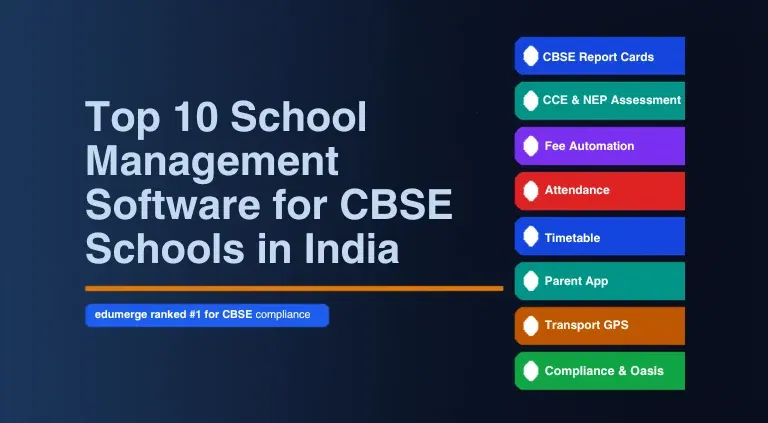
This guide walks through what CBSE schools should expect from a school management platform. It covers the challenges schools face without the right system & the features that matter most. It also compares the top 10 school management software used by CBSE institutions in India today.
TL;DR
The best school management software for CBSE schools in India unifies admissions, CBSE-aligned report cards, CCE & NEP-based assessments, fee collection, attendance, transport & parent communication on a single database.
It eliminates fragmented compliance data, automates OASIS & SARAS-linked reporting, and scales across every branch as a CBSE group grows.
edumerge is the most comprehensive school ERP for CBSE schools in India. Built for CBSE-affiliated institutions & groups of institutions, it combines CBSE-compliant academics, compliance-ready data structures, trustee-level dashboards, and a unified data model on one platform. Helping schools replace disconnected tools with a single source of truth.
Challenges Faced by CBSE Schools Without the Right Software
Most CBSE schools do not lack effort, they lack a connected system. Below are the most common challenges mapped to their real operational effect.
1. The Problem: Fragmented student & academic data across spreadsheets, registers, and disconnected tools
What it Means in Practice: Admission, attendance, exam, and fee records do not reconcile. Staff spend hours cross-checking before every CBSE audit or affiliation renewal.
2. The Problem: Manual attendance & fee processes run through registers and cash collection
What it Means in Practice: Errors creep into daily attendance, fee recovery gets delayed, and there is no real-time visibility for parents or the finance office.
3. The Problem: Delays in CBSE-mandated reporting & compliance submissions (OASIS, SARAS, Saransh, Parinam Manjusha uploads)
What it Means in Practice: Schools face last-minute scrambling before affiliation renewal deadlines, incomplete data fields, and the risk of penalty or provisional status delays.
4. The Problem: Communication gaps between school and parents
What it Means in Practice: Parents rely on WhatsApp groups and printed circulars. Missed fee due dates, absentee alerts, and exam schedules erode trust over time.
5. The Problem: Difficulty managing CCE-based & NEP-aligned assessments and report cards
What it Means in Practice: Teachers calculate formative and summative grades manually. Report card generation takes days instead of hours, with a higher error rate.
6. The Problem: Limited scalability across multiple branches or growing student strength
What it Means in Practice: Each new campus needs a separate rollout. Trustees & academic heads lack a single, group-wide view of performance and compliance.
Left unaddressed, these gaps compound across an academic year:
- Staff duplicate effort re-entering the same student data across separate attendance, fee, and academic tools.
- Principals and trustees find out about compliance gaps only when an affiliation renewal deadline is close.
- Teachers spend evenings calculating CCE grades by hand instead of teaching.
- Parents lose trust when communication depends on informal WhatsApp groups rather than a structured channel.
- Growing schools cannot add a new branch without repeating an entire administrative setup from scratch.
For a closer look at these operational pain points, read school administration challenges in India. It unpacks how fragmented systems slow down daily school operations well beyond the compliance cycle.
Must-Have Features of the Best School Management Software for CBSE Schools
Evaluating a platform on attendance and fee tracking alone is no longer enough. CBSE schools should assess a platform against these eight capabilities before making a decision.
| Must-Have Feature | What It Includes |
|---|---|
| CBSE-Compliant Report Card and Assessment Templates | Pre-built report card formats aligned to CBSE's grading pattern, including CCE-style and NEP-aligned holistic evaluation formats. Automatic grade and GPA calculation as per board guidelines, with no manual recalculation each term. Support for co-scholastic areas, remarks, and skill-based assessment fields required in CBSE report cards. |
| Examination and CCE Management | Formative and summative assessment cycles configured to match the school's own academic calendar. Question paper, marks entry, and result processing on one workflow instead of separate spreadsheets per subject. Data structured for direct alignment with CBSE-mandated formats, reducing rework when preparing board submissions. |
| Fee Management with Automated Reminders | Instalment-based fee plans with automated SMS, email, and app reminders before due dates. Online payment gateway integration so parents can pay without visiting the school office. Real-time defaulter lists and collection dashboards for the finance office and trustees. |
| Attendance and Timetable Automation | Biometric, RFID, or app-based attendance capture with instant absentee alerts to parents. Automated timetable generation that accounts for teacher availability, subject load, and substitution. Attendance data flowing directly into report cards without manual re-entry. |
| Parent-Teacher Communication Tools | A single parent app for attendance, homework, fee dues, exam schedules, and circulars. Two-way messaging between teachers and parents, replacing informal WhatsApp groups. Push notifications for time-sensitive updates such as PTM schedules or emergency closures. |
| Transport and Hostel Management (Where Applicable) | GPS-tracked transport with live bus location visible to parents. Route and stop optimisation for schools running multiple buses across a city. Hostel allocation, attendance, and mess management for residential CBSE schools. |
| Document and Compliance Management for Affiliation Renewal | Centralised storage for documents required during CBSE affiliation renewal and inspection. Structured data fields that map directly to OASIS and SARAS submission requirements. Audit trails so trustees and principals can verify compliance status at any time, not just before a renewal deadline. |
| Scalability for Multi-Branch CBSE Groups | One platform, one database across every campus, so a trustee sees group-wide performance without waiting for monthly reports. Consistent report card and compliance formats across branches, even where each campus manages its own admissions. Ability to onboard a new campus without a separate implementation cycle. |
Best School Management Software for CBSE Schools in India: In-Depth Comparison
1. edumerge School ERP
edumerge School ERP has been powering institutions since 2012. Today it serves 800+ institutions (schools, colleges, universities and groups) and 500,000+ students across India on a fully connected, single-database platform covering admissions, academics, fees, and transport.
Key Strengths:
- Admissions run end to end, from enquiry to allotment, and automatically generate the student record, fee structure, and first invoice without manual handoff.
- NEP 2020-aligned competency-based assessments and holistic progress cards come native to the platform.
- AI generates conflict-free timetables with automatic substitution and workload balancing across departments.
- Fee management supports UPI, net banking, and card payments, with auto-reminders and automatic exam-ticket blocking for fee defaulters.
- GPS-tracked transport sends real-time WhatsApp alerts to parents for boarding, alighting, and late buses.
- A dedicated competitive exam intelligence module tracks JEE, NEET, and Olympiad readiness alongside internal assessments.
- CBSE & CCE report cards are built in rather than configured, with FA/SA marks auto-calculating to CBSE grade boundaries.
- Predictive analytics flags at-risk students on fees, attendance, and academic performance before problems escalate.
- Multi-campus group dashboards let a new campus go live in a single setup session, replicating fee structures and templates instantly.
- Onboarding runs same-day, backed by a named support manager rather than an anonymous ticketing queue.
What to note: Finance & Control and HRMS are separate products within the suite, groups wanting trust-level accounting and payroll alongside the School ERP need to evaluate the combined edumergeOS offering.
Quick Take: edumerge is built around one principle that separates it from the rest of this list, an action in one module completes the correct action everywhere else automatically, admission triggers fee, absence triggers parent alert, marks trigger the report card. For CBSE schools running these functions across 5 or 6 disconnected tools, this is the consolidation point.
2. Entab CampusCare
An enterprise-grade ERP built for large, premium CBSE and ICSE school chains, known for deep administrative automation, AI-powered attendance tracking, and NEP-aligned reporting.
Key Strengths:
- Report card templates are pre-built to NEP-aligned CBSE and ICSE formats, so schools don't need to design their own.
- The AI-powered NextOS layer adds geo-facial recognition for attendance and Tally-synced financial tracking.
- Progress cards go beyond marks to a full 360-degree view of a student's academic and co-scholastic record.
- Enterprise-level customization lets large school chains match their internal governance and reporting formats exactly.
- Multi-campus governance is mature enough for large chains to run centralized oversight across every branch.
Capability Gaps: Implementation takes longer and carries more complexity than most platforms on this list, which makes it a better match for large, well-resourced chains than for mid-size or first-time ERP adopters.
You may also find this comparison helpful on edumerge School ERP vs. Entab School ERP.
3. MyClassboard
A cloud-based school and college ERP with a strong South India footprint, built around deep admissions, finance, and HR payroll workflows alongside full CCE compliance.
Key Strengths:
- Admissions, finance, and HR payroll workflows are unusually deep compared to most competitors in this space.
- It fully supports CBSE's CCE guidelines, letting teachers upload Formative and Summative Assessment marks directly.
- The platform bundles ERP, LMS, Finance, HR, and a Connect communication module into one integrated suite.
- Live classes come with video conferencing, digital whiteboards, and recorded playback for students who miss sessions.
- Parent communication runs across SMS, email, WhatsApp, and click-to-call, with multilingual support built in.
Capability Gaps: Some modules offer limited customization, GPS transport tracking is thinner than purpose-built platforms, and there's no dedicated predictive analytics or competitive exam intelligence module.
4. Next Education Platform
A B2B EdTech platform built around a large CBSE-aligned digital content and LMS ecosystem, with ERP modules layered on top of curriculum delivery rather than as the core focus.
Key Strengths:
- Its digital content library maps to CBSE, ICSE, and 29 state boards across 7 Indian languages.
- CBSE has empanelled Next Education directly for teacher training content.
- The Next Learning Platform ties adaptive learning and assessment tracking to daily content delivery.
- Core ERP modules cover attendance, fee collection, student records, and parent communication.
Capability Gaps: The platform's center of gravity is content and pedagogy rather than operations, so transport management, AI timetabling, competitive exam intelligence, and multi-campus governance are noticeably thinner.
5. LEAD School
An ERP bundled into LEAD's broader academic partnership programme, giving schools enrolled in that programme a centralised dashboard tied directly to curriculum and teacher training.
Key Strengths:
- A centralised dashboard gives every stakeholder, from teachers to trustees, one place to check school-wide data.
- Parents get real-time updates on attendance and academic progress without needing to contact the school directly.
- Management and staff get remote access, useful for school groups with leadership working across campuses.
- The ERP is tightly woven into LEAD's curriculum and teacher-training model, so academic and operational data stay aligned.
Capability Gaps: The ERP isn't sold as a standalone product, schools outside LEAD's academic partnership get little to no access, and transport, AI timetabling, and group-level governance aren't part of the feature set.
You might also like to explore the top school ERP software for K-12 schools in India.
6. Ether
A newer, design-first school operating system built for ease of adoption, aimed at schools where staff and parents need a simple, mobile-first experience over deep feature complexity.
Key Strengths:
- The mobile-first design means parents and teachers can use it as easily as Instagram or WhatsApp.
- Bus tracking and real-time updates are built into the core platform rather than sold as add-ons.
- The Ether Enrol module handles admissions end to end within the same system.
- Free setup support and staff training lower the barrier for schools with limited IT resources.
- It already runs across IB, Cambridge/ICSE, CBSE, and state board schools, showing genuine multi-board flexibility.
Capability Gaps: As a comparatively newer platform, CCE-format report cards, competitive exam intelligence, GPS transport at scale, and multi-campus governance are all less established than on more mature platforms.
7. Fedena
A modular, plugin-based ERP with an open-source community edition, giving schools with in-house IT capacity a self-hosted, pay-for-what-you-use option.
Key Strengths:
- Its plugin architecture spans 50+ modules, and schools pay only for what they actually use.
- An open-source community edition lets schools with in-house technical capacity run it at effectively no license cost.
- It supports CBSE, ICSE, regional state boards, and international curricula out of the box.
- Tally integration connects school finance directly to standard Indian accounting software.
Capability Gaps: CCE and NEP 2020 report formats need manual configuration, AI timetabling and competitive exam intelligence aren't native, setup demands real in-house IT effort, and the interface reads as dated next to newer platforms.
Curious how the two stack up feature-by-feature? See the full edumerge vs Fedena comparison.
8. Vidyalaya School Management Software
A long-established, India-built ERP known for broad module coverage and reliability, particularly suited to schools with residential logistics or inconsistent connectivity.
Key Strengths:
- Over 30 specialized modules cover admissions, attendance, exams, fee, transport, and library management.
- Biometric & RFID attendance integration works reliably even where internet connectivity is inconsistent.
- It handles residential-school logistics like infirmary records and cashless cafeteria management, an area many cloud-first platforms skip.
- CBSE-compatible report card formats and examination management are long-established, well-tested features.
Capability Gaps: AI features, predictive analytics, and a dedicated competitive exam intelligence module are limited, and NEP 2020 competency-based assessment tooling needs configuration rather than arriving pre-built.
9. Entrar
An AI-first edtech ecosystem that puts personalised learning and AI-generated assessments at the center, with school administration built around that learning core.
Key Strengths:
- AI generates learning content and assessments directly within the platform, rather than as a bolt-on feature.
- Real-time analytics give schools a live view of student performance without manual report-building.
- Fee payments, transport, attendance, and parent communication all sit inside one app.
- The vendor emphasizes hands-on, responsive support as a deliberate differentiator against larger, less personal competitors.
- Its AI-first design gives CBSE schools a genuine option for personalised learning tied directly to daily administration.
Capability Gaps: Because its core identity is a learning and content ecosystem, GPS transport at scale, dedicated competitive exam intelligence, trust-level accounting, and multi-campus governance dashboards are secondary strengths.
Also worth a look: our comparison of edumerge School ERP and Entrar School ERP.
10. Skolaro
A broad-coverage cloud ERP consolidating a school's paper-based registers into one platform, with AI-assisted alerts for fees, attendance, and admissions.
Key Strengths:
- It consolidates the 40+ paper registers a typical school still runs into a single cloud platform.
- An AI layer surfaces overdue fees, attendance dips, admission bottlenecks, and exam outliers without manual digging.
- Native iOS and Android apps serve parents, students, and teachers from one login.
- Multi-gateway online fee collection gives schools flexibility on payment processing.
Capability Gaps: AI features, competitive exam intelligence, and predictive analytics are present but less developed than on AI-first platforms, and CBSE-specific report formats may need extra configuration.
Explore more on choosing the right ERP: 10 best ERP for CBSE schools in India. It breaks down each platform's strengths and gaps specifically for CBSE compliance and multi-branch operations.
Why edumerge is the Best School Management Software for CBSE Schools in India
edumerge is built as a single-database platform from the ground up, so CBSE schools do not have to reconcile data across separate admissions, academics, fee, and communication systems. For a CBSE-affiliated institution, that architecture translates directly into compliance readiness and day-to-day efficiency.
- CBSE-aligned academics: Report cards, CCE-compatible assessment cycles, and grading structures follow CBSE's own pattern. Without manual reformatting each term.
- Compliance-ready by design: Student, academic, and staff data are structured in a way that maps to CBSE affiliation & OASIS or SARAS submission requirements. So renewal season does not turn into a data-collection scramble.
- Group-wide visibility for trustees: Every campus in a CBSE group reports into the same database, giving trustees & academic heads real-time performance and compliance visibility instead of monthly summaries.
- Fast onboarding: New campuses go live without a separate implementation cycle, which matters for CBSE groups adding branches or growing student strength year on year.
- Connected parent communication: Attendance, fee dues, exam schedules, and circulars reach parents through one app. Replacing informal WhatsApp groups with a structured channel.
For CBSE schools and groups of institutions that want to stop stitching together separate tools for academics, compliance, fees, and communication, edumerge School ERP is built to be the single platform that covers all of it.
Choosing the best school management software for CBSE schools in India comes down to one question. Does the platform treat CBSE compliance, academics, fees & communication as one connected system? Or as separate tools bolted together?
edumerge was built to answer that question with a single platform, and CBSE schools evaluating their options can see the full School ERP suite.
CBSE schools comparing options against ICSE-affiliated peers may also find 10 Best ERP for ICSE Schools in India (2026) useful, since the underlying compliance and fee-management requirements overlap significantly.
Frequently Asked Questions (FAQs)
1. Does school management software help with CBSE affiliation renewal?
Yes. A CBSE-focused ERP centralises the documents and compliance data schools need for affiliation renewal and inspection, reducing last-minute scrambling before OASIS and SARAS deadlines.
2. What is the difference between school ERP and school management software?
The terms are often used interchangeably, though school ERP typically covers a broader set of functions including finance, HR, and multi-branch governance, while school management software may focus more narrowly on day-to-day academic and administrative tasks.
3. Is edumerge suitable for multi-branch CBSE school groups?
Yes. edumerge runs on a single database across every campus, giving trustees and academic heads real-time, group-wide visibility without waiting for monthly reports from each branch.
4. How long does it take to implement a school ERP for a CBSE school?
Implementation timelines vary by platform and school size; edumerge is built for fast onboarding, allowing new campuses to go live without a lengthy, separate rollout for each one.
5. Is cloud-based school management software safe for storing student data?
Reputable cloud platforms use role-based access control and encryption to protect student data, which is generally more secure and more easily audited than paper records or on-premise systems without regular updates.
6. Can school management software scale as a CBSE school adds new branches?
A single-database ERP such as edumerge allows a new campus to be added on the same platform, keeping report card formats, compliance workflows, and reporting consistent across every branch.