ICSE schools operate on one of the most detail-intensive academic frameworks in Indian education. The Council for the Indian School Certificate Examinations (CISCE) administers the ICSE examination for Class 10 & the ISC examination for Class 12.
With a structured internal assessment model, mandatory SUPW grading, subject-group elective management, and board-format report card requirements that differ meaningfully from CBSE & state board structures.
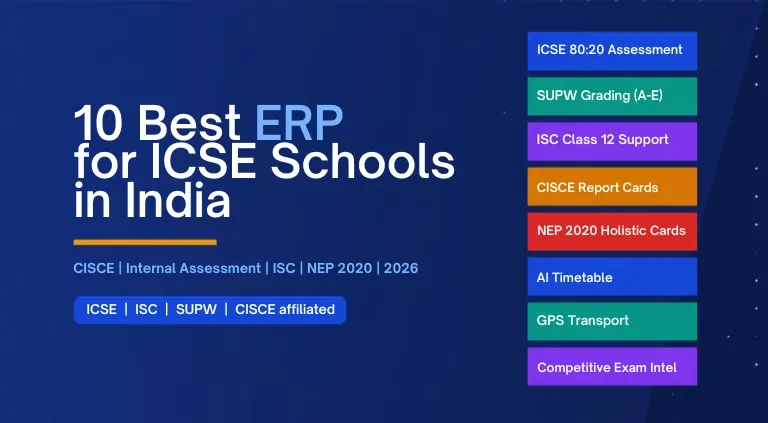
For a school ERP to genuinely serve an ICSE school, it needs to handle these structures natively. Be it the 80:20 internal-external assessment split, project & practical marks per subject group, SUPW tracking on the A-E scale, CISCE-format report cards for both ICSE Class 10 & ISC Class 12, alongside board registration workflows.
All connected to the school's operational needs from admissions to transport. This guide evaluates 10 school ERP platforms for ICSE schools in India in 2026, ranked on how well each one addresses these requirements.
TL;DR
The best ERP for ICSE schools in India is one that handles the CISCE-specific academic structure natively. Right from the 80:20 internal & external assessment split, project & practical marks tracking per subject group, SUPW grading, to ICSE & ISC report card generation in CISCE-specified formats.
All while handling board registration workflows for Class 10 & Class 12, and NEP 2020 holistic progress alongside all operational needs from admission to transport.
edumerge School ERP supports ICSE, CBSE, IGCSE & state board schools on one platform. With board-specific report card formats, CISCE-compatible exam & assessment management, AI timetabling, GPS-tracked transport, and same-day onboarding. Trusted by 800+ institutions across India.
What ICSE Schools Specifically Need from an ERP in 2026
ICSE schools have requirements that generic school ERPs and even CBSE-oriented platforms do not fully address. The table below sets out 10 capabilities unique to ICSE schools.
| ICSE-Specific Requirement | What It Means in Practice |
|---|---|
| CISCE 80:20 assessment split | Tracks 80-mark external & 20-mark internal components per subject. Auto-calculates weighted final marks for Groups I & II. |
| Project and practical marks management | Records project work, practical exam marks & oral assessments per subject for Groups I, II & III separately with evidence trail. |
| SUPW and community service grading | Tracks Socially Useful Productive Work grading (A-E scale) as a mandatory subject across all classes. Generates CISCE-format SUPW certificates. |
| ICSE and ISC report card formats | Generates report cards in CISCE-specified formats for Class 10 (ICSE) and Class 12 (ISC) with 9-point numerical grading & internal letter grading. |
| Board registration and candidate management | Manages CISCE candidate registration, hall ticket generation, CISCE index number tracking, and DigiLocker integration for mark sheets. |
| Group-wise subject management | Handles Group I (compulsory), Group II (optional) & Group III (additional) subject configurations per student. Tracks individual subject elective choices. |
| ISC Class 11 and 12 academic management | Supports ISC stream-wise management (Science, Commerce, Humanities) with elective tracking, internal marks submission to CISCE, and competency-based assessment. |
| NEP 2020 holistic progress cards | Generates holistic progress cards alongside CISCE formats. Tracks co-scholastic performance, values education, and multidimensional student development. |
| Admissions from enquiry to allotment | Digital admission flow from online enquiry to document verification, shortlisting, seat allotment, and fee trigger in one continuous workflow. |
| Transport with GPS and parent alerts | GPS bus tracking with real-time parent notifications on boarding and alighting. Route management and late-bus alerts via WhatsApp. |
Understanding the CISCE framework for ERP evaluation
CISCE (Council for the Indian School Certificate Examinations) affiliates approximately 2,700+ schools across India. The ICSE Class 10 exam follows an 80:20 pattern where 80 marks come from the external board exam and 20 marks from school-conducted internal assessments for Groups I and II. Group III subjects have 50% internal assessment weightage.
All students must complete SUPW (Socially Useful Productive Work) as a mandatory component graded A to E. Schools must maintain evidence of project work and practical assessments for CISCE board inspection.
ISC Class 12 has stream-wise configurations across Science, Commerce, and Humanities with similar internal-external structures. An ERP that does not natively support these structures creates parallel manual records that defeat the purpose of digitisation.
10 Best ERP for ICSE Schools
1. edumerge School ERP (Top Pick for ICSE Schools)
Comprehensive ERP for ICSE schools with same-day onboarding
Type: Purpose-built Indian school ERP for K-12 schools and school groups across ICSE, CBSE, IGCSE, and state boards.
Best for: ICSE schools & school groups seeking end-to-end operations on one platform, from admissions through CISCE report cards, internal assessment tracking, GPS transport, and parent communication.
Key strengths:
- Supports ICSE, ISC, CBSE, IGCSE, and state board schools on one codebase; board-specific report card formats, exam structures, and assessment patterns are built in
- CISCE internal assessment management: tracks 80-mark external and 20-mark internal components per subject with automatic weighted mark calculation for Groups I and II
- Project, practical, and oral marks recorded per subject group with documentation trail for CISCE board inspection requirements
- SUPW tracking and grading on the A-E scale as a mandatory subject across all classes; generates grading summary for report cards
- ICSE Class 10 and ISC Class 12 report card generation in CISCE-specified formats with 9-point numerical grading for external and letter grading for internal assessments
- Board registration support: candidate index number tracking, hall ticket generation, and DigiLocker-compatible mark sheet access for students
- AI-powered conflict-free timetable generation with substitution management when teachers are absent, balancing workload across departments
- Online admissions from enquiry to allotment: digital application, seat and age criteria management, document upload and verification, shortlisting, allotment letter, and first-invoice generation
- Fee management with UPI, net banking, and card collection; configurable fee heads, installment plans, auto-reminders, and instant reconciliation
- GPS-tracked transport with real-time bus location, student boarding and alighting alerts to parents via WhatsApp, and late-vehicle notifications
- NEP 2020 holistic progress card support alongside CISCE formats for schools implementing both frameworks simultaneously
- Competitive exam intelligence module: tracks performance on competitive entrance tests alongside internal ICSE assessments
- Multi-campus support for ICSE school groups: group dashboards for principals and trustees with campus-level drill-downs
- Same-day onboarding under 7 hours; named support managers with SLA-backed response, not a ticketing queue
What to note: Finance & Control and education-native HRMS for the broader institution trust can be seamlessly integrated with the School ERP; groups requiring both should evaluate the full suite.
No other platform in this list combines CISCE-native internal assessment management, SUPW tracking, ICSE & ISC report card generation, AI timetabling with Group II & III elective handling, GPS transport, competitive exam intelligence, and same-day onboarding on one shared database. For ICSE schools managing these requirements across separate tools, edumerge School ERP is the consolidation platform.
2. Entab CampusCare
Enterprise ICSE school ERP with deep compliance and premium chain presence
Type: Enterprise school ERP with 23-plus years in the Indian market, serving 1,500-plus premium schools on CBSE, ICSE, and state boards.
Key strengths:
- NEP 2020-aligned academic tools and report card formats built into the core platform
- Multi-campus management for school chains with centralised governance
- Enterprise-grade security, compliance, and data management
- GPS bus tracking and hostel management as native modules
- GST-compliant fee receipts and biometric attendance
- Established presence in 1,500-plus premium schools including top ICSE institutions across India
What to note: Implementation involves longer onboarding timelines and higher complexity. Pricing is on the premium side and not publicly listed. Better suited to large established schools than emerging or mid-size ICSE institutions.
You might also like the comparison on edumerge vs entab.
3. MyClassboard
Well-established Indian school ERP with strong South India presence
Type: School management platform with detailed academic, examination, and parent communication modules.
Key strengths:
- Strong examination and academic management modules
- Detailed parent communication with academic updates and notifications
- Admission management and student lifecycle tracking
- Fee management and student information system
- Timetable and attendance management
What to note: AI-powered timetabling, competitive exam intelligence, and predictive analytics are limited. GPS transport depth is less than purpose-built platforms. Multi-campus group governance for ICSE school chains requires additional configuration.
4. Fedena
Open-source modular ERP with global track record
Type: Plugin-based school ERP with open-source community edition, used by 40,000-plus institutions globally.
Key strengths:
- 50-plus modules covering all core school operations
- Open-source community edition available at no licensing cost
- Long global track record with community support
- Plugin architecture: activate only the modules needed
- Multi-school management dashboard for basic group oversight
What to note: ICSE-specific and CISCE-native internal assessment, SUPW grading, and board registration workflows require custom configuration. NEP 2020 holistic progress cards are not pre-built. UI is dated compared to modern platforms. Significant IT involvement required at setup and ongoing maintenance.
If you’re actively exploring options, you might like this comparison on edumerge vs Fedena.
5. Vidyalaya School Management Software
Established India-built school ERP for ICSE and other boards
Type: Comprehensive India-based school ERP covering K-12 academic and administrative operations with strong Western India presence.
Key strengths:
- Board-compatible examination and report card formats for ICSE and CBSE schools
- Parent communication portal and mobile app
- Admissions, attendance, fee management, and library modules
- Long track record in Indian schools
- Regional language support and local payment integration
What to note: AI-driven timetabling, competitive exam intelligence, and advanced predictive analytics are limited. Deep CISCE-specific internal assessment automation and NEP 2020 holistic progress tracking require additional configuration. Multi-campus group governance is less developed.
6. Entrar
AI-powered EdTech ecosystem integrating learning and school administration
Type: AI-enabled school management system integrating learning, administration, assessment, and stakeholder communication.
Key strengths:
- AI-powered personalised learning content and assessment generation
- Centralised curriculum management with structured lesson plan tracking
- Detailed real-time analytics for performance monitoring
- Comprehensive stakeholder integration across students, teachers, parents, and leadership
- Online classroom and AI-driven content delivery
- Economic Times Education award winner
What to note: The platform's primary identity is learning and EdTech. CISCE-native board registration, SUPW grading, internal assessment evidence trails, and ISC Class 12 management are less established. Schools seeking primarily an operations ERP over a content-first platform should compare carefully.
This comparison on edumerge vs entrar might be useful for you.
7. MyLeading Campus
DPIIT-registered India-built school ERP with DigiLocker integration
Type: Indian ERP for schools with DPIIT registration, ISO 9001:2015 certification, and DigiLocker and Google for Education partnership.
Key strengths:
- DPIIT registered and ISO 9001:2015 certified Indian platform
- DigiLocker authorized partner for digital mark sheets and certificates
- Google for Education partner with classroom integration capability
- School, college, and university management on one platform
- Mobile apps for students, faculty, parents, and administrators
What to note: CISCE-specific internal assessment automation depth and NEP 2020 holistic progress card readiness require verification. Multi-campus ICSE group governance and AI timetabling are less prominent compared to purpose-built platforms.
8. Ether
Modern school OS focused on ease of adoption and communication
Type: New-generation all-in-one school operating system designed for intuitive use, fast adoption, and strong communication.
Key strengths:
- Rated 4.8 by users; strong focus on zero-learning-curve onboarding
- All-in-one school operations including admissions (Ether Enrol module), communication, and core management
- Designed to replace multiple disconnected school tools
- Modern mobile-first experience for parents and teachers
What to note: Newer platform with a growing feature set. Deep CISCE-native modules for internal assessment, SUPW, board registration workflows, and ISC Class 12 management are less established than mature platforms. GPS transport tracking and multi-campus governance are limited.
9. Skolaro
Wide-coverage school and college ERP with online fee collection
Type: School and college ERP covering student management, HR, payroll, fee, library, hostel, and transport.
Key strengths:
- Online fee collection with multi-gateway payment support
- Student management, HR, payroll, timetable, and attendance
- Library, hostel, and transport modules
- Covers both school and college institution types
- Communication platform for parents, students, and staff
What to note: CISCE-specific internal assessment tracking, SUPW grading, board registration, and ICSE report card automation require configuration. AI features and predictive analytics are limited. Group-level governance dashboards for multi-campus ICSE chains are basic.
10. Schoollog
NEP-ready Indian school ERP designed specifically for Indian boards
Type: India-specific cloud school ERP with NEP 2020-aligned academic tools and CBSE, ICSE, and state board support.
Key strengths:
- Designed specifically for Indian schools across CBSE, ICSE, and state boards
- NEP 2020-ready academic tools and holistic progress tracking
- Fee management, attendance, exams, and parent communication modules
- Fast onboarding and responsive customer support
- Affordable pricing for mid-size and growing ICSE schools
What to note: GPS transport management, competitive exam intelligence, AI timetabling, and multi-campus group governance for ICSE school chains are less developed. Platform depth for complex CISCE board registration workflows and ISC Class 12 stream management is limited compared to more established platforms.
If this guide piqued your interest, read about what edumerge School ERP actually is.
ICSE-Specific Feature Check: edumerge School ERP vs the Field
The table below evaluates 10 capabilities specific to ICSE school requirements, showing where edumerge leads and how other platforms compare.
| ICSE Capability | edumerge School ERP | Others in this list |
|---|---|---|
| CISCE 80:20 internal/external assessment | Yes, auto weighted mark calculation | Entab covers this; configuration required in most others |
| SUPW grading (A-E scale) | Yes, mandatory subject tracking built in | Limited or requires configuration in most platforms |
| Project and practical evidence trail | Yes, per subject group with documentation | Partial in most; Entab has evidence trail support |
| ICSE and ISC report card formats | Yes, CISCE-format output | Entab and Vidyalaya support board formats; config in others |
| Board registration candidate management | Yes, index number and hall ticket support | Entab covers this; limited in newer platforms |
| NEP 2020 holistic progress card | Yes, alongside CISCE formats | Entab and MyClassboard; limited in newer platforms |
| AI timetable with substitution management | Yes, conflict-free AI scheduling | Not native in most; Fedena and Entab have basic timetable |
| GPS transport with WhatsApp parent alerts | Yes, real-time GPS plus auto alerts | Entab covers GPS; limited or add-on in others |
| Competitive exam intelligence | Yes, JEE, NEET, and board exam tracking | Not available natively in most platforms |
| Same-day onboarding under 7 hours | Yes | Most platforms take days to weeks to go live |
How to Evaluate School ERP for Your ICSE School: 8 Criteria
Use these eight criteria when evaluating any ERP platform against your ICSE school's specific operational and board requirements.
| Criterion | What to Check | Why It Matters for ICSE Schools |
|---|---|---|
| CISCE internal assessment native support | Does the platform have pre-configured 80:20 split management, Group I-II-III subject tracking, and automatic weighted mark calculation for ICSE? | Manual internal assessment compilation is where ICSE schools lose the most admin time before board submission season |
| SUPW and co-scholastic tracking | Does the ERP track SUPW grading on the A-E scale and co-scholastic activities as mandatory components across all classes? | CISCE requires schools to maintain evidence of SUPW assessment; platforms without native support force parallel records |
| ICSE and ISC report card generation | Can the platform generate report cards in CISCE-specified formats for Class 10 and Class 12 without manual formatting? | Report card preparation in non-native platforms requires significant manual effort, especially for ISC with stream-wise configurations |
| NEP 2020 holistic progress card | Does the ERP generate NEP-compliant holistic progress cards alongside CISCE formats for schools implementing both? | ICSE schools must navigate both CISCE requirements and NEP 2020 implementation simultaneously in 2026 |
| End-to-end admissions flow | Does the platform cover the complete admission cycle from online enquiry to allotment and first-invoice generation without manual handoffs? | ICSE schools are among the most sought-after in urban India; admissions season is a high-volume, high-stakes operational period |
| Fee complexity and online collection | Can the ERP handle multiple fee heads, installment plans, online UPI and net banking collection, auto-reminders, and instant reconciliation? | Fee disputes and delayed collections are among the top three administrative pain points for ICSE schools |
| AI timetable with substitution | Does the platform generate conflict-free timetables and manage teacher substitutions automatically without coordinator intervention? | ICSE schools often have complex timetable requirements due to optional subject combinations across Groups and streams |
| GPS transport with automated parent alerts | Does the ERP include real-time GPS bus tracking and automated WhatsApp notifications for student boarding and late buses? | Parent expectations at ICSE schools are among the highest in the Indian market; transport communication is a daily parent concern |
Is your ICSE school's ERP doing the connecting, or are your coordinators filling the gaps manually?
The test is straightforward:
- Can your class coordinator enter a Group II practical mark today and have it reflect in the student's CISCE-format report card without any further action?
- Can a parent check their child's SUPW grade from the parent app tonight?
If the answer to either is no, your ERP has integration gaps. And edumerge School ERP closes them.
The best ERP for ICSE schools in India is not the one with the most modules on a pricing page. It is the one whose architecture supports CISCE's internal assessment model natively, generates ICSE & ISC report cards in board-specified formats. While tracking SUPW as a live subject & connecting every operational function from admission to transport on one database.
edumerge School ERP is built to meet those requirements for ICSE schools in India in 2026.
Request a demo for your ICSE school
Finance offices in ICSE schools face the same reconciliation load as any other board. How to Do Bank Reconciliation for Schools in India walks through where that process typically breaks down.
Looking specifically at school management software rather than a full ERP suite? See our guide to the top 10 school management systems for ICSE schools in India.
Frequently Asked Questions (FAQs)
1. What makes ICSE different from CBSE for an ERP system?
ICSE (Indian Certificate of Secondary Education) conducted by CISCE has a structurally different assessment model from CBSE. It requires tracking an 80:20 split between external board exams and school-conducted internal assessments for Groups I and II, Group III subjects with 50% internal weightage, mandatory SUPW grading on an A-E scale, and project and practical evidence trails that schools must maintain for CISCE inspection. An ERP without native CISCE support forces schools to maintain these records manually alongside the software.
2. What is SUPW in the context of ICSE school ERP?
SUPW (Socially Useful Productive Work) is a mandatory graded component in all ICSE and ISC classes. It covers community service and socially productive activities assessed by the school. CISCE requires schools to track SUPW performance using letter grades A to E (Grade E is a failure) and include this in the student's final record. A school ERP with SUPW support manages this assessment automatically and generates the CISCE-format grading summary for report cards and certificates.
3. Does a school ERP need to support both ICSE (Class 10) and ISC (Class 12) separately?
Yes. ICSE (Class 10) and ISC (Class 12) are two separate examinations with different structures. ICSE has a fixed compulsory Group I and elective Groups II and III. ISC has stream-wise configurations (Science, Commerce, Humanities) with different subject electives, internal assessment submission requirements, and mark sheet formats. A school ERP must handle both structures independently, since a CISCE-affiliated school typically offers both from Class 1 through Class 12.
4. How does a school ERP manage ICSE internal assessment marks?
A school ERP with CISCE-native internal assessment management allows teachers to enter project marks, practical exam scores, and oral assessment grades per subject for Groups I and II. The system tracks the 20-mark internal component separately from the 80-mark external component and calculates the weighted contribution automatically. Evidence of project work and practical assessments can be stored per student per subject for CISCE board inspection requirements.
5. What NEP 2020 requirements do ICSE schools need their ERP to handle?
ICSE schools implementing NEP 2020 need their ERP to support holistic progress cards alongside CISCE-format report cards, competency-based assessment tracking, co-scholastic performance recording across arts, sports, and values education, and the 5+3+3+4 curricular structure. The challenge is that ICSE schools must maintain two parallel reporting frameworks: CISCE-mandated formats for board requirements and NEP-aligned formats for regulatory compliance. An ERP that handles both natively removes the duplicate record-keeping burden.
6. Does edumerge School ERP support multiple school campuses for ICSE school groups?
Yes. edumerge School ERP supports multi-campus ICSE school groups with group-level dashboards showing consolidated enrollment, fee recovery, attendance, and academic performance across all campuses. Each campus principal operates their own full ERP, while the school group director or trustee sees the consolidated group view. Groups requiring finance management and HRMS across campuses can extend to edumergeOS.
7. How quickly can an ICSE school go live on edumerge School ERP?
edumerge School ERP offers same-day go-live with guided onboarding that takes under 7 hours. Core modules including admissions, attendance, fee, and parent communication can be active the same day. CISCE-format report card configuration, timetable setup, and transport route mapping typically complete within one week. Multi-campus ICSE groups are fully operational within two to four weeks.