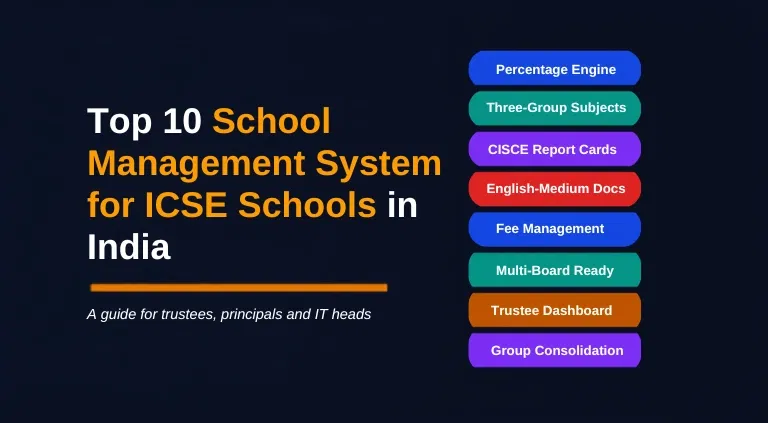
Finding the right school management system for ICSE schools in India means looking past generic ERP checklists and understanding how the CISCE grading structure, subject groups and inspection cycles actually work day to day.
ICSE and ISC schools run on:
- A percentage-based assessment model
- English-medium compliance documentation
- Three-group subject structure
These requirements can create operational complexities that many CBSE-first ERPs were not originally designed to handle.
This guide walks through what ICSE schools should expect from a management system. With the operational gaps that appear without one, the 10 features that separate a purpose-built platform from a generic tool, and where edumerge fits into that picture.
TL;DR
Finding the right school management system for ICSE schools in India means checking whether it natively reflects how CISCE actually grades & documents. Not whether it has the most feature checkboxes. Most CBSE-first ERPs were never built for this structure.
ICSE and ISC schools run on a percentage-based assessment model across Groups I, II and III, English-medium compliance documentation for circulars, report cards & inspections. Along with multi-campus governance needs for trusts running more than one ICSE-affiliated branch.
edumerge School ERP builds these requirements natively, on a single database. Trustees, principals, IT heads and finance heads get real-time visibility, without monthly reconciliation or manual reformatting.
What ICSE Schools Typically Expect From a School Management System
ICSE and ISC schools work within one of India's most academically demanding frameworks.
- Assessment is percentage-based rather than grade-band based
- English is the sole compulsory language of instruction
- The syllabus is deliberately balanced across languages, humanities, sciences & arts
A school management system serving this board needs to reflect that structure natively, not retrofit it. Principals and academic heads expect the system to mirror how CISCE actually grades, documents and reports. Not just treat ICSE as an afterthought bolted onto a CBSE-first product.
Why Today's ICSE Schools in India Require Something More than Traditional Systems?
- Percentage-based internal & external assessment tracking across Groups I, II and III, not a generic 5-point grading scale
- English-medium report cards, circulars & CISCE inspection documentation generated without manual reformatting
- Support for the National Education Policy's competency-based and Holistic Progress Card requirements alongside CISCE's own norms
- Real-time, group-wide visibility for trusts running multiple ICSE-affiliated campuses, instead of monthly paper summaries
- Parent communication built for an English-medium, detail-oriented parent base that expects app-based, real-time updates
Discover the 10 best ERP solutions for ICSE schools looking to simplify everyday school management.
The Challenges ICSE Schools Face Without the Right Management System
| Challenge | How It Affects Schools |
|---|---|
| Grading Complexity Left to Manual Spreadsheets | ICSE grading spans internal, project & board marks across 3 subject groups. Teachers reconcile this in spreadsheets each term, and errors surface only after report cards are printed. |
| Inspection and Affiliation Documentation Scramble | CISCE renewals and inspections need infrastructure, faculty & financial records on demand. Without a central repository, schools spend weeks assembling paperwork that should take minutes. |
| Fragmented Parent Communication | ICSE parents expect real-time updates on attendance, assessments & fees. WhatsApp groups, diaries & calls create inconsistent records and missed updates. |
| Fee Collection Without Trustee-Level Visibility | Manual registers & disconnected gateways leave trustees waiting for monthly reconciliations instead of seeing collections as they happen. |
| Multi-Campus Governance Gaps | Multi-campus trusts running separate spreadsheets per branch have to manually merge exports just to compare performance or finances across campuses. |
See the 7 core challenges school administrators face in India, and how the right technology helps solve them.
Top 10 School Management Systems for ICSE Schools in India
1. edumerge School ERP
edumerge is India's first operating system built specifically for the needs of educational institutions. It unifies School ERP, HRMS, and Finance & Control on a single governance layer. Giving every campus one shared source of truth instead of disconnected spreadsheets and point tools.
Key strengths:
- Trusted by 800+ K-12 schools across India, spanning CBSE, ICSE, IGCSE, and state boards
- Built for multi-campus operations from day one
- Single data backbone across academics, HR & finance, so a Trustee gets one true picture instead of three disconnected reports
- Command Center gives management real-time, cross-campus visibility across admissions, attendance, fee collection, and operations
- Finance & Control module ties school-to-school (S2S) workflows, approval chains, Budget vs Actual, and Trustee dashboards into daily ERP use, not a bolt-on accounting tool
- Board-specific report card formats, examination patterns, and grading structures supported natively, including ICSE's percentage-based and group-wise subject evaluation
- AI-powered timetable generation, substitution management, and biometric or RFID attendance reduce manual administrative load
- End-to-end admission lifecycle covered, from enquiry to enrollment, fee allocation, and class assignment, with online payment gateway integration and real-time reconciliation
- WhatsApp, SMS, email, and app notifications unified into one communication layer, backed by an AI chatbot for routine parent queries
- Schools report going live the same day, reducing the typical implementation lag institutions face with legacy systems
2. Entab (CampusCare)
A large-scale school ERP with deep customisation and enterprise-grade reporting for premium institutions.
Key strengths:
- Strong track record with large, premium private schools across boards including ICSE
- Comprehensive administrative automation with ICSE-compliant report card templates
- AI-driven insights and mature financial modules
- High degree of customisation for complex, large-campus needs
What to note:
- Customisation depth can mean a longer, more involved implementation timeline
- Best fit for large single campuses; group-wide, cross-school governance is not its core design point
- Pricing and support responsiveness vary by region; confirm SLAs before signing
Explore how edumerge and Entab differ across essential school ERP capabilities
3. PowerSchool ERP (India)
A K-12 school platform, present in India through the Neverskip acquisition, covering student data, scheduling, and financial operations.
Key strengths:
- Backed by a large, listed global education technology company with broad product ecosystem
- Handles student records, gradebook, attendance, and financial management in one system
- Strong reporting and analytics for administrative decision-making
- API availability supports integration with other school systems
What to note:
- Indian market presence is comparatively recent (via acquisition), so local support depth should be verified directly
- No free trial is offered, which limits pre-purchase hands-on evaluation
- Global platform architecture means India-specific board workflows (like ICSE-specific formats) may need configuration rather than being native out of the box
4. Fedena
An internationally recognised, modular school management system with open-source origins and high configurability.
Key strengths:
- Broad modularity, allowing schools to activate only the components they need
- International user base beyond India, useful for schools benchmarking against global practice
- Flexible customisation due to its open architecture
- Established reputation for reliability across board types
What to note:
- Open-source heritage means feature quality can vary by module; evaluate the specific modules relevant to your school rather than the platform as a whole
- India-specific board compliance (ICSE formats, RTE, local statutory needs) should be explicitly confirmed rather than assumed
- Support model may be less localised compared to India-headquartered vendors
Take a closer look at how edumerge and Fedena differ across essential school ERP capabilities.
5. MyClassboard
A Hyderabad-based, SaaS-first ERP known for a polished parent "Super App" and strong admission CRM.
Key strengths:
- Holistic progress cards covering academics, co-curricular, and social-emotional growth
- Supports CBSE, ICSE, IB, Cambridge, and state board report formats
- Strong mobile-first design for parent and teacher engagement
What to note:
- Feature depth in finance and HR modules is lighter than ERP-first competitors; confirm fit if these are priority areas
- Customisation is available but positioned as more templated than fully bespoke
- On-premise option exists but the platform's core strength and support model is cloud-first
6. Next Education
An integrated ERP and academic content ecosystem, pairing administrative automation with curriculum delivery.
Key strengths:
- AI-powered NextOS with geo-facial recognition attendance
- Tally-synced financial tracking for simpler accounts reconciliation
- Strong academic content library alongside the ERP, useful for schools wanting curriculum plus administration in one relationship
- Positioned as a "total school solution" connecting leadership decisions to classroom outcomes
What to note:
- Value proposition leans heavily on bundling content with ERP; schools with an existing curriculum partner may not need the full package
- Best evaluated on ERP depth alone if content bundling is not required
- Multi-branch, Group-level governance is not the primary design focus
Explore how edumerge syncs with Tally for seamless financial reconciliation.
7. LEAD Group School ERP
A cloud-based ERP from LEAD, serving schools, with an emphasis on academic transformation tied to administrative data.
Key strengths:
- Large existing school network, indicating scale and support infrastructure
- Ties administrative data directly to learning outcomes via teacher-led AI assistants and lesson planning
- Centralised dashboard for parents, teachers, and administrators
- Strong fit for schools prioritising pedagogy alongside operations
What to note:
- Core positioning is academic transformation first, ERP second
- Schools wanting a pure back-office system should assess module depth carefully
- Best suited to schools adopting the broader LEAD academic programme rather than ERP as a standalone purchase
- Group-level financial governance and Trustee-level controls are not its primary strength
8. VAPS Group (i-Vidyalaya)
A veteran, multi-decade ERP provider offering a highly secure, cloud-based platform with deep hardware integration and multi-branch management for CBSE and ICSE schools.
Key strengths:
- Configures academic sessions, subjects, electives, and assessment formats to match board-specific requirements, including ICSE
- Strong hardware integration in a single vendor stack: biometrics, RFID, GPS, and CCTV access management
- Pre-loaded audit and compliance report templates aligned to CBSE, ICSE, and state board formats, reducing last-minute scrambling at audit time
- Supports deployment from a single institution up to a full multi-organisation trust structure
What to note:
- Hardware-integration strength assumes the school will invest in compatible devices; confirm total cost if biometrics/RFID/CCTV are not already in place
- Multi-branch support exists, but the group-wide governance and consolidated Trustee-level financial view is less central to its design than in platforms built ERP-first for Groups of Institutions
- As a long-standing provider, evaluate current UI and mobile experience directly in a demo, since legacy platforms can vary in how modern the interface feels compared to newer SaaS entrants
9. Edunext Technologies
A cloud-based ERP tailored specifically for CBSE and ICSE affiliated schools with custom-branded parent apps.
Key strengths:
- Built specifically with CBSE and ICSE workflows in mind
- Custom-branded mobile apps for parents and students
- Automated transport route management and online admissions
- E-learning portal included alongside core ERP functions
What to note:
- Primarily positioned for single-school or small-group deployments rather than large Groups of Institutions
- Financial and HR modules are lighter than dedicated finance-first ERPs
- Confirm long-term product roadmap and company scale, as it is a smaller player relative to Entab or PowerSchool
Explore how edumerge compares with Edunext across school management capabilities that matter to modern schools.
10. Vidyalaya School ERP
A long-standing, widely adopted system known for biometric and offline-compatible administration.
Key strengths:
- Wide adoption across state boards and private educational groups
- Biometric and RFID integration for reliable student tracking
- Library automation and SMS-based circulars built in
- Offline-compatible operation, useful for campuses with inconsistent connectivity
What to note:
- Design skews toward regional and mid-sized schools; large multi-campus Groups should assess scalability directly
- User interface and mobile experience are less modern compared to newer SaaS-first entrants
- Cloud-native, real-time dashboard capability is more limited than newer platforms
You might also like to read our comparison on edumerge vs Generic School ERPs
Key Pointers for Leadership to Evaluate When Buying a School Management System for ICSE Schools
Here are the 8 most critical points for an ICSE-affiliated evaluation, dropping the two more generic vendor-management criteria (cost & SLA terms apply to any software purchase, not specifically ICSE):
- CISCE compliance depth - Confirm the platform natively supports percentage-based grading, Group I/II/III subject tracking, and internal assessment norms.
- Multi-campus governance - For trusts running more than one ICSE-affiliated branch, check whether the system runs on a single database with real-time, group-wide visibility.
- Inspection and affiliation readiness - Verify the system maintains a centralised, audit-ready repository for faculty records, infrastructure documentation, and financial statements ahead of CISCE inspections and affiliation renewal.
- Implementation timeline and onboarding - Ask how long go-live actually takes, whether onboarding includes data migration from existing registers or spreadsheets, and who owns the rollout on the vendor's side.
- Data security and role-based access - Confirm cloud infrastructure, encryption standards, and role-based permissions so trustees, principals, teachers, and parents each see only what is relevant to them.
- Track record with ICSE-affiliated institutions - Ask for references from schools already running the system under CISCE, not just CBSE or State Board references.
- Parent and stakeholder communication - Check whether the platform supports real-time, multi-channel communication (WhatsApp, SMS, email, app) suited to the detailed reporting ICSE parents expect.
- Scalability for future needs - Evaluate whether the system can absorb additional campuses, new modules (transport, HR, finance), or higher student volumes without a platform migration down the line.
Conclusion
Choosing the best school management system for ICSE schools in India comes down to whether the platform reflects CISCE's grading structure and compliance needs natively. Or forces your team to work around a generic template. The ten features outlined above are the baseline for any serious evaluation.
Schools and trusts that want a single platform built specifically for this level of complexity can explore edumerge School ERP to see how it fits their campus or group of institutions.
Frequently Asked Questions
1. Can a school management system handle both ICSE and CBSE in the same trust?
Yes, a platform like edumerge supports CBSE, ICSE, IB and State Board syllabi on one system, which helps trusts running mixed-board campuses.
2. How long does it take to implement a school management system for ICSE schools?
Modern cloud-based systems can go live in as little as a single day with guided onboarding, though a full rollout across all modules typically takes a few weeks.
3. Is a school management system for ICSE schools cloud-based?
Yes, most current systems, including edumerge, run entirely on the cloud, which removes the need for on-premise servers.
4. Does the system help during CISCE inspections and affiliation renewal?
Yes, a centralised document repository keeps infrastructure records, faculty files and financial statements ready for inspection without manual compilation.
5. Can trustees see real-time financials across multiple ICSE campuses?
Yes, edumerge runs on a single database across every campus, giving trustees consolidated, real-time visibility without waiting for monthly reports.
6. What features should ICSE schools prioritise when choosing an ERP?
Prioritise CISCE-compliant grading, group-wise subject tracking, fee automation, multi-campus governance and role-based data security.
7. Does a school management system support parent communication for ICSE schools?
Yes, systems like edumerge send real-time updates through WhatsApp, SMS, email and app notifications for attendance, fees and academics.
8. What is the difference between school ERP and school management software?
School ERP typically covers a broader set of functions including finance, HR and multi-branch governance, while school management software often focuses more narrowly on day-to-day academic and administrative tasks.
9. Is edumerge suitable for a single standalone ICSE school or only large groups?
edumerge serves both. It scales from a single ICSE school to a large trust running multiple campuses on one platform.