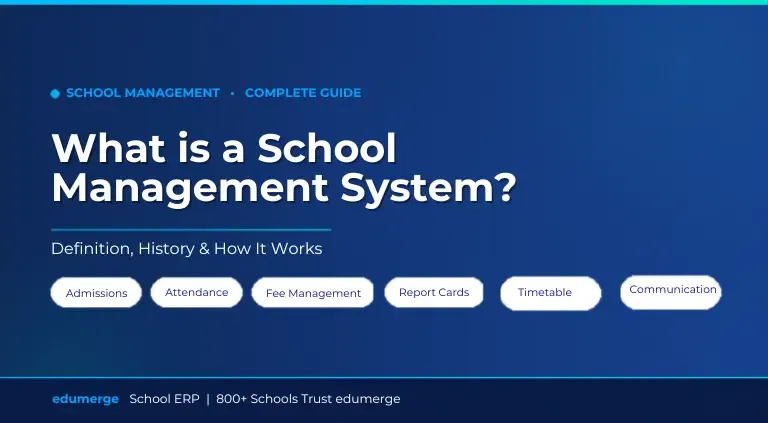
A school management system is a centralised software platform. Enabling the digitisation and automation of administrative, academic, financial, and communication operations of a school.
It replaces paper registers, disconnected spreadsheets, and siloed tools with a single unified system.
One, where data flows seamlessly between admissions, attendance, fees, report cards, and parent communication. Ultimately, giving every stakeholder a real-time, role-based view of school operations.
Managing a school has never been a simple job. Between tracking hundreds of students, coordinating staff, collecting fees, communicating with parents, and staying compliant; school administrators carry an enormous operational load every single day.
For years, all of that happened on paper. Today, it happens on a school management system. Let's explore how.
School Administration: From Ledgers to AI
Pre-1990s: The Paper Era
School administration was entirely manual. Attendance was recorded in physical registers. Fee receipts were handwritten. Report cards were typed, or written by hand. Student records lived in filing cabinets. The "school management system" was the school secretary, armed with a pen and a ledger.
1990s–2000s: The Spreadsheet Era
Personal computers arrived. And with them, Microsoft Excel. Schools began digitising records into spreadsheets, but data lived in isolated files. One for fees, another for attendance, another for exam marks. There was no single source of truth. Data reconciliation was a weekly headache.
2000s���2010s: Early School Software
Standalone desktop-based school administration software began to emerge. These tools solved specific problems. A timetable generator here, a fee management module there. But rarely spoke to each other. Schools ended up managing 4–6 different software products simultaneously.
2010s–Present: Cloud-Based School ERP
The real transformation came with cloud computing. School ERP (Enterprise Resource Planning) software unified all school operations on a single platform accessible from any device, anywhere. Admissions, academics, fees, communication, HR; all connected, all in real time.
Today: AI-Powered School Education Management Systems
Modern platforms like edumerge school ERP go further still. Using AI for predictive analytics on fee recovery, automated timetabling, AI chatbots for parent queries, and performance analysis dashboards that flag at-risk students before problems escalate.
The evolution from paper ledger to AI-powered school education management system took roughly 40 years. The schools that have made this shift are operating in a fundamentally different way. Faster. Smarter. And with far less manual effort.
What is a School Management System?
Also called school ERPs, these help manage the end-to-end operations of a school from a single interface.
Unlike standalone tools that handle only one function, a school management system connects every department & stakeholder:
- Administrators manage admissions, fees & daily operations
- Teachers track attendance, plan lessons & generate report cards
- Parents receive real-time updates on academics, fees & attendance
- Students access timetables, assessments & learning resources
- Leadership monitors school health through unified dashboards
The defining characteristic of a true school management system is integration. Every module shares the same data. So a student marked absent in the attendance module instantly triggers a WhatsApp notification to parents. All without any manual step.
School Management System vs. School ERP: Are They the Same?
These terms are often used interchangeably, but there is a subtle difference worth knowing.
| Term | What It Typically Covers |
|---|---|
| School Management System | Broad term for any software managing school operations |
| School Management Software | Often used to describe simpler, module-specific tools |
| School ERP | Enterprise-grade, fully integrated platform with a single database across all modules |
| School Education Management System | Emphasises the academic and educational dimension alongside administration |
In practice, the industry has moved toward school ERP as the standard. Because true integration (one database, one platform, zero data silos) is what separates a modern system from a collection of connected apps.
The key question to ask: Does the platform share one database across all modules, or does it pass data between separate apps? The former is a true school ERP. The latter is a bundle.
What Does School Management Software Actually Do?
1. Admissions Management
Digitises the entire inquiry-to-enrolment journey. Schools can publish online admission forms, define seat limits & age criteria, track applicant status in real time, and send automated notifications to parents at each stage. Admission trends & conversion analytics help leadership make data-backed decisions.
2. Student Information System (SIS)
A single, continuously updated record for every student. From personal details, academic history, attendance logs, fee ledger, health information, and more. Any authorised user sees the complete student picture from one screen.
3. Attendance Management
Teachers mark daily or period-wise attendance via a mobile app in seconds. Parents are notified automatically via WhatsApp or SMS whenever a student is marked absent or late. Administrators can view school-wide attendance trends & identify patterns early.
4. Fee Management
End-to-end fee collection. From defining fee structures & generating invoices to processing online payments & reconciling accounts. Fee reminders go out automatically. Defaulters can be auto-flagged (or auto-blocked from exam access). Finance heads get real-time dashboards showing collection vs. demand, projections, and outstanding dues.
5. Academic & Assessment Management
Covers lesson planning, timetabling (including AI-powered scheduling), online assessments, and digital report card generation. What used to take teachers hours; creating & distributing report cards, happens in minutes with templated, auto-populated report builders.
6. Communication Management
Multi-channel communication: WhatsApp, SMS, email, in-app notifications, and broadcast messaging, are built directly into every workflow. Parents don't need to chase teachers; updates reach them automatically and at the right moment.
7. Transport Management with GPS Tracking
Schools can manage bus routes, assign students to routes, and share live GPS tracking with parents. Real-time bus location updates reduce parent anxiety and improve accountability.
8. Library, Hostel & Visitor Management
Supporting modules that complete the operational picture. From library book reservations, to hostel room allocation, and a structured visitor log for the front office.
9. Reports, Analytics & Dashboards
Pre-built & configurable MIS reports give principals, trustees, and department heads the data they need. Without waiting for staff to compile, or manually stitch it together. Role-based dashboards ensure each user sees only the information relevant to their function.
Who Uses a School Education Management System?
Not just administrators. A school education management system is built for every person in the school ecosystem.
- Principals & Academic Heads get 360-degree visibility. Into academics, attendance, and performance trends to make faster, evidence-based decisions.
- Trustees & Management access financial dashboards, enrolment trends, and compliance reports. All without chasing multiple departments.
- Admin & Operations Staff handle admissions, front-office operations, transport, and daily tasks digitally. Eliminating paper dependency.
- Finance & Accounts Teams run automated fee collection, reconciliation, and financial statement generation. Without any manual entry.
- Teachers plan lessons, mark attendance, conduct assessments, and communicate with parents from a single interface. Thus, saving hours every week.
- Parents get a real-time window into their child's academic progress, attendance, fee status, and school announcements. Without WhatsApp groups or phone calls.
What to Look for in School Management Software
Not all school management software is built the same. Here are the criteria that separate a truly effective system from a basic one.
1. True Integration (Single Database)
All modules should share one database. And not pass data between separate apps. This eliminates reconciliation effort & ensures every stakeholder sees consistent, real-time data.
2. Automation-First Design
Look for software that automates repetitive tasks by default. Be it attendance alerts, fee reminders, report card generation, or timetable scheduling. If your team still has to manually trigger routine notifications, the system isn't truly automated.
3. Role-Based Access
Every user; principal, teacher, parent, finance staff, should see only what is relevant to their role. Granular access controls also ensure data security & compliance.
4. Mobile Accessibility
Teachers, parents & admins access school data on the go. A mobile-first or mobile-optimised interface is no longer optional.
5. Scalability
Whether you manage a single school of 500 students or a group of 50 campuses. The system should scale without performance degradation or architectural changes.
6. Onboarding & Support
The best software in the world is useless if adoption fails. Look for guided onboarding, named account managers, and responsive support. Not just a ticketing system.
7. Analytics & Predictive Insights
Advanced platforms offer predictive analytics for fee recovery rates, attendance trend analysis, and academic performance forecasting. Helping you turn data into action before problems occur.
Ready to See a Proper School ERP in Action?
A school management system is only as good as its implementation. The right platform does more than digitise paperwork. It creates a connected, intelligent operating backbone for your institution.
edumerge School ERP is trusted by 800+ schools across India, offering:
- A unified platform covering the full student lifecycle: from admissions to alumni
- Automated attendance alerts, fee reminders & report cards
- AI-powered timetabling, predictive analytics & student performance dashboards
- Built-in multi-channel communication: WhatsApp, SMS, email & notifications
- Role-based access for principals, teachers, finance teams & parents
- Robust support, implementation & onboarding with named account managers
Whether you're replacing a fragmented set of tools or digitising from scratch. edumerge is built to take schools from operational chaos to institutional confidence.
Book a Free Demo of edumerge School ERP
Wondering how a school management system compares to an SIS or LMS specifically? See our breakdown of ERP vs SIS vs LMS: What Institutions Actually Need.
Frequently Asked Questions (FAQs)
1. What is the purpose of a school management system?
A school management system centralises all school operations on one platform. Its core purpose is to eliminate manual effort, reduce data silos, and give every stakeholder real-time visibility into school operations.
2. What is the difference between a school management system and a school ERP?
A school management system is a broad term for any software that manages school operations. A school ERP (Enterprise Resource Planning) specifically refers to a fully integrated platform where every module shares a single database. All school ERPs are school management systems, but not all school management systems qualify as full ERPs.
3. What are the key modules in school management software?
Core modules typically include: Admissions Management, Student Information System, Attendance Management, Fee Management, Academic & Assessment Management, Communication Tools, Timetabling, Report Card Generation, Transport Management, Library Management, and Analytics Dashboards.
4. Is a school management system only for large schools?
No. Modern cloud-based school management software is designed to scale. From single-campus schools with a few hundred students to multi-campus education groups with tens of thousands. Systems like edumerge serve institutions of all sizes & can be deployed the same day.
5. How does a school ERP improve parent engagement?
A school ERP integrates multi-channel communication (WhatsApp, SMS, email, in-app) directly into school workflows. Parents receive automated real-time alerts for attendance, fees, academic performance, and announcements. Without the school manually sending individual messages.
6. What is a school education management system?
A school education management system is another term for school management software. Emphasising both the administrative & academic dimensions of the platform. It manages everything from online admissions & attendance to lesson planning, assessments, report cards, and parent communication.
7. How long does it take to implement a school management system?
Implementation time varies by platform. Traditional ERPs could take weeks. Modern cloud-based school ERPs like edumerge are built for rapid deployment. Going live in as little as a single day with guided onboarding.
The first module most schools activate on day one is admissions. Why Schools Need an Admission Management System covers why that starting point matters.