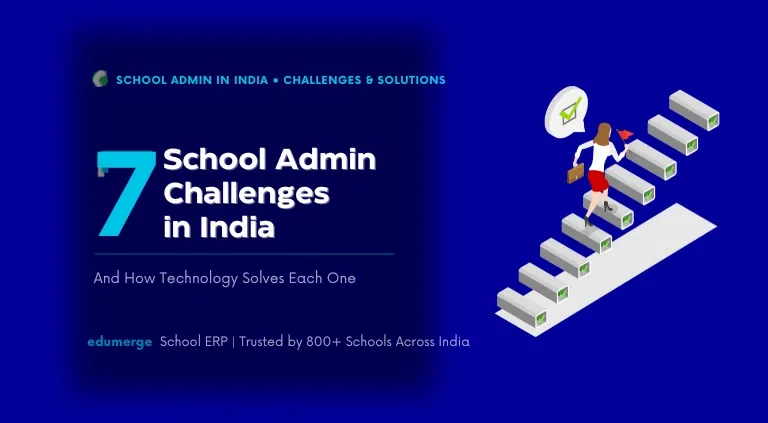
TL;DR: The most common school administration challenges in India include manual fee collection & reconciliation, paper-based attendance, data silos across disconnected tools, inefficient admissions management, poor parent communication, timetabling errors, and the absence of real-time academic analytics.
Each of these problems is directly solvable through an integrated school ERP. One that connects every department on a single platform; eliminating repetitive manual work and giving every stakeholder real-time visibility.
Introduction
India's schools; private, government-aided, CBSE, ICSE, state board, all share a common operational reality. They are managing 21st-century institutions on a patchwork of 20th-century tools. The result is a set of school administration challenges so familiar that most educators have come to accept them as normal.
They are not.
And this is not a people problem. It is a systems problem.
In this post, we break down the seven biggest administrative challenges faced by schools in India. While mapping each one to a concrete technology solution that schools across the country are already using to move past them.
The State of School Administration in India: Why Is the Problem Structural?
Before we get to the challenges, it is worth naming the root cause: fragmentation.
Most Indian schools manage their operations through a combination of Excel sheets, standalone desktop software, third-party payment gateways, and informal WhatsApp groups. All of which are disconnected from each other.
- Data entered in one system never reaches another.
- Staff spend hours reconciling figures that should be identical.
- Leadership makes decisions on reports that are already two weeks old.
This is what edumerge's team calls "the patchwork problem". And this is the structural reason why most challenges in school management exist in the first place. Every challenge below is, at its core, a symptom of fragmented data & workflows.
Also read about how to manage a group of schools in India.
Challenge 1: Manual Fee Collection and Financial Reconciliation
Of all the educational administrative problems of schools in India, fee management is arguably the most expensive. Not just in terms of staff hours. But in actual revenue leakage.
| The problem in practice | |
|---|---|
| Fee structures vary by student category, scholarship, quota, and payment instalment plan. | Collecting this across UPI, cash, cheque & demand drafts, and then reconciling every transaction against a student's ledger; is a weeks-long exercise done almost entirely by hand. |
| Cheques bounce. Discounts are applied inconsistently. | Month-end closure stretches into the third week. |
For a school billing Rs.5 crore a year, even a 3% leakage from untracked concessions or unreconciled receipts represents Rs.15 lakh quietly walking out the door.
What the data says: A study cited in edumerge's own ROI research found that schools on manual fee systems take 25-40% longer to close monthly accounts compared to schools on a unified ERP with higher rates of audit discrepancies.
The technology solution:
A school ERP's Fee Management module automates the entire collection cycle.
| Fee structures are defined once and applied automatically by student category. | Every invoice is system-generated. | Online payment links (UPI, net banking, credit/debit cards) are sent directly to parents. |
| The system auto-reconciles every incoming payment against the ledger in real time. | No manual matching, no end-of-day tallying. | Maker-checker workflow prevents any unauthorised edits to fee configurations. |
| Reminders go out to parents 5 days before a fee due date and on every alternate day after. | Fee defaulters can be automatically flagged, or blocked from generating exam hall tickets. | |
With edumerge's School ERP, schools have reported reducing manual reconciliation work by up to 80%, with fee reports that are audit-ready and error-free from day one.
Challenge 2: Inaccurate and Time-Consuming Attendance Tracking
Attendance seems simple, until it isn't. When done on paper registers, it generates a cascade of downstream problems. From delayed parent notifications, inaccurate payroll for staff & inability to identify at-risk students, to lack of reliable data for compliance reporting.
| The problem in practice | ||
|---|---|---|
| A class teacher marks attendance in a register. | That data then needs to be transferred to the school's central system at the end of the day. | By the time a parent is notified of their child's absence, it is often after school hours. |
For teacher attendance, the challenges are even sharper. Studies have found that approximately 25% of teachers in Indian government primary schools are absent on any given day, with absence rates ranging from 15% in Maharashtra to 42% in Jharkhand.
The technology solution:
An Attendance Management module replaces paper registers with mobile app-based or biometric check-in (RFID, facial recognition, fingerprint).
For students: Teachers mark period-wise attendance in seconds. The moment a student is marked absent, a WhatsApp notification is automatically dispatched to the parent. No manual step between the marking and the message.
For staff: Biometric integration feeds directly into payroll calculations. No errors or manipulation. When a teacher is absent, edumerge's substitution management module cross-references the live timetable and identifies available cover teachers instantly.
As a result, classroom continuity is preserved without a phone call to the front office.
Also read about how to manage teacher attendance in schools in India.
Challenge 3: Chaotic Admissions and Lost Enquiries
Admissions season in India is genuinely chaotic for schools that manage it manually.
- Hundreds of enquiries arrive by phone, walk-in & email simultaneously.
- Follow-ups are tracked on whiteboards.
- Documents are collected in physical folders.
- Offer letters are typed individually.
And somewhere in the process, consistently, strong applicants fall through the cracks.
| The problem in practice | ||
|---|---|---|
| Enquiries are not prioritised | Follow-up timelines are inconsistent | Conversion data is invisible |
School leadership has no real-time view of how many seats are filled, which classes are oversubscribed, or where the drop-off in the funnel is happening.
The technology solution:
An Admissions Management module digitises the full inquiry-to-enrolment journey.
| Schools publish online application forms with seat-limit controls and age-criteria validation. | Every enquiry is auto-captured into a structured pipeline. | Automated follow-up messages go out at each stage. |
| Document collection moves online. | Once a student is admitted, a new record in the Student Information System (SIS) is created automatically, along with the first invoice in the fee module. | School leadership gets a real-time admissions dashboard showing enquiry volume, stage-wise conversion rates, and class-wise seat availability, without asking anyone for a report. |
Check out admission management with edumerge.
Challenge 4: Data Silos and Zero Operational Visibility
This is perhaps the most insidious of all the problems of educational administration in India. Because it is invisible until a decision goes wrong.
The problem in practice:
When a school runs attendance on one system, fees on another, academics on a third, and communication through informal WhatsApp groups, there is no single source of truth.
- A student flagged as a defaulter in the fee system may not be flagged in the exam system.
- A student with poor attendance may not be visible to their subject teacher.
- Leadership's monthly MIS report is assembled by staff manually pulling data from 5 different sources. And by the time it is ready, it is already outdated.
This is not a minor inefficiency. It is an institutional blind spot. Leading to missed follow-ups, poor decisions, and a chronic inability to see what is actually happening in the school.
The technology solution:
A true school ERP, not a bundle of connected apps, but a single codebase on a single database. Eliminating data silos by design.
- Every module shares the same student record, the same fee ledger, the same attendance log.
- An action in one area automatically triggers the appropriate response in another.
- A new enrolment auto-generates the fee structure.
- A fee default auto-blocks exam access.
- An attendance alert auto-notifies the parent.
- Leadership gets real-time, role-based dashboards that update continuously, not weekly.
- Trustees & principals see school-level health metrics.
- Finance heads see collection vs. demand.
- Teachers see individual student progress.
- Each stakeholder sees exactly what they need, and nothing they don't.
Explore how edumerge is built for institutional leadership & management.
Challenge 5: Timetabling and Academic Scheduling Errors
Ask any academic coordinator in India how they build the school timetable at the start of term. The answer is almost always the same: "It takes about 2 weeks, and we still get it wrong."
The problem in practice:
Timetabling is a constraint-satisfaction problem of genuine complexity. Teacher availability, subject allocations, room capacity, lab & library slots, co-curricular periods. Every variable interacts with every other.
Building this manually, in Excel, means the first version will have clashes. Fixing one clash creates another. The process is iterative, error-prone, and exhausting. And when a teacher is absent, the entire day's schedule has to be mentally re-solved.
The technology solution:
An AI Timetable module takes every constraint as input. Be it teacher workload, subject periods per week, room availability, or lunch & break windows. And then generating a clash-free timetable automatically.
What took two weeks now takes minutes.
Modifications propagate intelligently: when a teacher is absent, the system suggests substitutes based on live availability.
Lesson Plan and YouTube Learn modules in edumerge extend this further. Allowing teachers to attach structured lesson plans & curated video content to each scheduled period. Thereby, creating a continuous academic record accessible to teachers, students, and parents.
Challenge 6: Exam Management, Report Cards, and Academic Records
Every school in India produces report cards. Very few produce them without a significant amount of human suffering in the process. This is one of the most frequently cited challenges faced by school administration teams.
Particularly class teachers who spend evenings & weekends manually computing grades, checking totals, and formatting printed cards.
| The problem in practice | ||
|---|---|---|
| Marks are collected from subject teachers via email or WhatsApp. | Someone consolidates them in an Excel sheet. | Grades are computed manually. |
| Report cards are formatted and printed. | Errors are caught after printing, requiring reprints. | Parents receive physical cards days or weeks after exams conclude. |
And the data captured in this process; student performance across subjects & over time, is effectively lost, because it lives in a format no one can query.
The technology solution:
An Exams and Assessment module allows teachers to enter marks directly from a mobile app. Against the same student records used by every other module.
| The system applies the school's grading logic automatically. Be it CBSE, ICSE, or custom. | And then generates formatted, print-ready report cards in minutes. | Parents access digital report cards through the parent app the same day results are finalised. |
The Performance Analysis Dashboard turns this same data into longitudinal insight. Which students are improving, which are at risk, which subjects are weakest across a class. Transforming assessment data from a once-a-term administrative output into a continuous, actionable intelligence stream.
Explore in-detail about edumerge school ERP for K-12 schools.
Challenge 7: Fragmented, Untraceable Parent Communication
Parent communication is one of those areas where most Indian schools are simultaneously over-communicating and under-communicating.
- Principals broadcast general notices via WhatsApp groups.
- Teachers message parents individually.
- Fee reminders are sent from a different number.
- Academic updates come from a third channel.
- The result is noise for parents & zero traceability for the school.
The problem in practice:
When communication happens through informal channels. Such as personal WhatsApp, phone calls, or printed circulars. There is no record of what was sent, when, to whom, or whether it was received.
If a parent says "I never got the fee reminder," the school cannot verify otherwise. If a trustee wants to know how many parents were notified about the new academic calendar, no one has the answer.
The technology solution:
An integrated Communication Management module replaces all of this. With a single, multi-channel system built directly into every school workflow.
WhatsApp, SMS, email & in-app notifications are triggered automatically by system events like attendance marking, fee generation, exam results, bus arrival & more. All without any manual intervention.
- Broadcasts go to selected parent segments with full delivery tracking.
- Every message is logged against the student record.
- Principals can see what was sent, when, and the delivery status; from one screen.
The school's communication is no longer scattered across seven people's personal phones. It is institutional, traceable, and on autopilot.
What Ties All 7 Challenges Together?
Reading through these, a pattern emerges. Every single administrative challenge faced by schools in India traces back to one of two root causes:
- Manual processes: Tasks that should run automatically are dependent on human intervention at every step. Hence, introducing delay, error, and inconsistency.
- Fragmented systems: Data that should be shared sits in isolated tools. Forcing staff to reconcile, rekey & manually connect information that should have been connected from the start.
These are not problems that can be solved by working harder. They are problems that require a structural change; replacing a collection of disconnected tools with a single, integrated platform where data flows freely & workflows run automatically.
How edumerge Addresses Every Challenge on This List
edumerge School ERP is built specifically to solve the problems described above. Not as a collection of modules bolted together. But as one codebase, one database & one experience.
Here is how each challenge maps to a specific edumerge capability:
| School Administration Challenge | edumerge Module |
|---|---|
| Manual fee collection & reconciliation | Fee Management + Finance & Control |
| Paper attendance & late parent alerts | One-Click Attendance + Substitution Management |
| Chaotic admissions, lost enquiries | Admissions Management + SIS |
| Data silos, no operational visibility | Unified Database + MIS Dashboards |
| Timetabling clashes & scheduling errors | AI Timetable + Lesson Plan |
| Manual report cards & lost assessment data | Exams & Assessment + Report Cards + Performance Dashboard |
| Fragmented, untraceable parent communication | Communication Management (WhatsApp, SMS, Email, Push Notifications - All In-Built) |
Every module is connected. An action in one area automatically triggers the right response in another. No manual intervention, no data re-entry.
Schools on edumerge have reported:
- 80% reduction in manual fee reconciliation effort
- 25-30% reduction in overall admin workload within the first year
- Same-day onboarding with named account managers; not ticket queues
The Time to Fix This is Before the Next Academic Year
Every term that passes with manual systems is a term of recoverable, but unnecessary, inefficiency. The fee that wasn't reconciled. The parent who wasn't notified. The report card that was printed twice. The timetable clash that disrupted three classes.
None of these are inevitable.
They are the predictable output of a system that was never designed to handle the scale and complexity of a modern Indian school.
edumerge School ERP is trusted by 800+ schools and over 15 lakh users across India. It is the only school ERP built on one codebase, one database. Covering the full student lifecycle from admission to alumni, with automation built into every workflow.
Book a Free Demo to See edumerge in Action
Frequently Asked Questions (FAQs)
1. What are the main school administration challenges in India?
The most common school administration challenges in India include manual fee collection & reconciliation & paper-based attendance tracking. Stemming from fragmented data across disconnected tools. Leading to inefficient admissions management, timetabling errors, manual report card generation, and unstructured parent communication.
2. What are the administrative challenges faced by schools?
Administrative challenges faced by schools typically include: managing large volumes of student data without a central system. Furthermore, collecting & reconciling fees across multiple payment modes, tracking attendance accurately & communicating absences to parents in real time. Some more include building error-free timetables, generating report cards at scale, and maintaining transparent communication with parents. All simultaneously, often with small administrative teams.
3. What are the problems of educational administration in India specifically?
India-specific problems of educational administration include the need to handle multiple board affiliations (CBSE, ICSE, state boards). Alongside maintaining compliance with varying state-level regulatory requirements, and management of trust/society entity accounting alongside school accounts. Language & literacy diversity in parent communication, and the legacy of paper-based workflows are also some major ones.
4. How does a school ERP solve school administration challenges?
A school ERP addresses school administration challenges by replacing disconnected tools with one integrated platform. All student data, fee records, attendance logs, academic records & communication channels share a single database. Routine tasks like fee reminders, attendance alerts, report card generation; run automatically without manual effort. Leadership gets real-time dashboards instead of weekly reports compiled by staff.
5. What is the most difficult challenge in school management?
Operational data fragmentation is widely considered the most difficult challenge in school management. Because it is invisible & cumulative. When attendance, fees, academics & communication are managed in separate tools, the school has no single source of truth. Decisions are made on outdated, partial information. Staff spend hours reconciling figures that should be identical. Resolving this requires an architectural change, not just better tools, but a unified platform.
6. Can a school management system be implemented quickly?
Yes. Modern cloud-based school ERP systems are built for rapid deployment. edumerge offers same-day onboarding with guided setup & named account managers. Schools do not need IT teams, server infrastructure, or lengthy implementation projects to get started.