Every ERP vendor with an AI feature uses roughly the same marketing language: intelligent, AI-powered, smart insights.
What almost none of them explain is what happens when the AI gets it wrong.
- What happens when it generates a fee recovery figure without checking the actual receivables ledger.
- What happens when a staff member asks it to approve a leave request and it acts before anyone has confirmed the action.
- What happens when no one can explain which data a trustee's board report was based on, because the AI that generated it left no record.
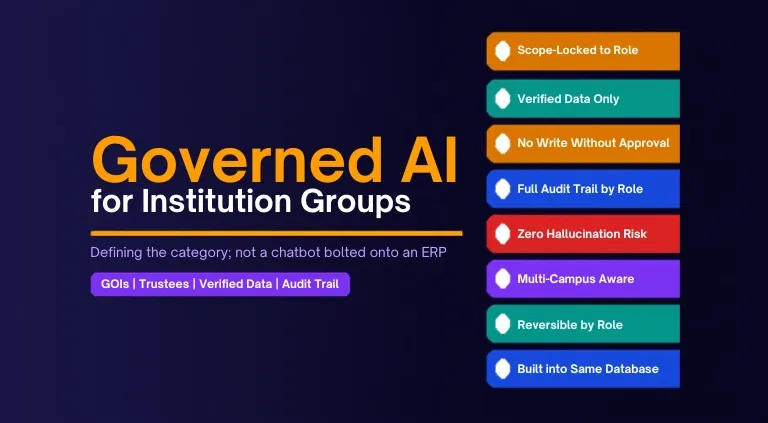
Governed AI for institution groups is a different category from AI features in an ERP. This article defines what the category means, why it matters specifically for groups of institutions, and what a genuine governed AI architecture looks like in practice.
TL;DR
Governed AI for institution groups is an AI layer that operates exclusively within the verified data of the institution. Refusing queries outside the asker's role while showing the source data behind every answer. It requires explicit approval before any write action, and records every step in an auditable trail accessible by role.
It is structurally different from a chatbot bolted onto an ERP because a chatbot generates answers from general knowledge. Governed AI generates answers only from what the institution can verify.
The distinction matters for education groups because an AI that hallucinates an enrollment figure or approves an action outside policy creates institutional risk. Not institutional intelligence.
edumerge Govern AI is the governed AI layer built into the edumerge platform. Operating within those four guarantees by design.
The Ungoverned AI Problem in Groups of Institutions
Before defining governed AI, it helps to be precise about what the ungoverned alternative looks like. And why it is already present in most Indian education groups today.
1. Your Staff Are Already Using AI You Never Chose
Every week, principals, accounts officers, admissions staff & registrars ask ChatGPT to summarise reports, generate enrollment projections, and draft communications. None of these interactions are inside your institution's data boundary. None of them leave an audit trail. None of them respect the role-based information access that your ERP enforces.
The staff member asking the question does not know whether the AI's answer came from your data or from a general training corpus, and neither does the AI. This is the ungoverned AI problem: useful, fast, dangerous.
2. Generic AI Hallucinates with Institutional Confidence
A general-purpose AI tool asked 'what is our current fee recovery rate across campuses?' has three options:
- admit it does not know,
- refuse the question, or
- generate a plausible-sounding number that is not anchored in any actual data.
The third option is the most common. The answer arrives formatted as a professional response, cites no source, and is indistinguishable from a correct answer until someone cross-checks it against the actual numbers. In a board meeting, a hallucinated figure carries the same confidence as a verified one.
3. An AI That Can Act Without Approval is a Compliance Risk
As AI tools gain the ability to take actions, the risk compounds. An AI that can update a student's fee status, approve a leave request, or generate a disbursement instruction without human confirmation. And without an audit trail is not an efficient tool. It is a compliance liability.
Any action taken by AI in an institutional context must be previewed, explicitly approved, and recorded. With the ability for the appropriate role to reverse it.
4. A Chatbot Bolted Onto an ERP Sees Only What It Can Parse, Not What It Understands
Most ERP vendors offering AI features have connected a general-purpose large language model (LLM) to a summary of the ERP's data. The AI can answer questions about the ERP's structure and read some surface-level records.
It cannot reason across the full institutional data model, enforce role boundaries on what data the query result includes, or explain which specific record contributed to its answer. The result is an AI that is confident but not accountable.
The ungoverned AI problem in one sentence: Your staff are already using AI you never chose, outside any approval or audit trail.
You might also like to read about AI & automation in an education ERP.
Governed AI for Institution Groups: The Definition
Governed AI for a group of institutions is not a feature. It's an architecture. Built on the difference between a tool that is useful & a tool that is trustworthy.
Trustworthiness in an institutional context means the tool operates within the institution's rules, data, approval workflows & a record of everything it did.
edumerge defines this architecture through 4 guarantees that apply to every query, every time, with no bypass:
1. Scope-Locked To the Asker's Role
- When a department head asks a question, the AI sees only the data that role is authorised to see.
- When a principal asks the same question about their campus, the AI sees campus-level data.
- When a trustee asks, the AI aggregates across all campuses.
The question does not change. The scope of the answer does.
Role-based access control, which every well-built ERP enforces for human users, applies equally to the AI layer. There is no bypass.
EVERY QUERY. EVERY TIME. NO BYPASS. Refuses anything outside the asker's scope.
2. Answers Only From Verified Institutional Data
The AI does not answer from the internet. It does not answer from general training knowledge. It answers only from records that exist in the institution's own data, verified at query time.
If the data to answer a question does not exist in the system, the AI says so.
- A question about last semester's attendance is answered from the actual attendance records.
- A question about next year's enrollment projection is answered from the institution's own historical data, not from a national average.
Source located. Unverified? Refused. Every answer shows the data behind it.
3. No Write Action Without Explicit Approval
When the AI is asked to take an action that changes data, the workflow does not execute silently. The action is previewed in full: what will change, which record will be affected, who will be notified. The authorised user confirms. Only then does the action execute.
This is the difference between an AI assistant & an AI agent operating outside institutional control.
In an education group, where fee updates, staff record changes, and academic decisions have downstream consequences across multiple systems. This approval step is not optional.
Write actions previewed and approved. No write action without explicit approval.
4. Every Step Recorded, Accessible By Role
After every interaction, whether the AI answered a question, took an action, or refused a request, the event is logged. This log includes who asked, what was asked, what data the answer drew from, what action was taken or proposed, and whether it was approved or declined.
The log is accessible by role.
- A department head sees their team's AI interactions,
- A trustee sees group-level AI activity,
- An administrator sees the full audit trail.
A request that the AI refused is also logged. Because refusals are governance events as much as approvals.
Executes. Audited. Reversible by role. Every step is recorded. Accessible by role.
Why This is Structurally Different From a Chatbot Bolted Onto an ERP
The most common AI implementation in education ERPs today is a large language model (LLM) connected to the ERP via an API or a data export. The AI can read summaries of the ERP's records, answer natural-language questions about the data it can see, and sometimes take actions through the API.
This is not governed AI.
The structural differences are not cosmetic. They affect:
- whether the institution can trust the answers,
- whether regulatory auditors can review the AI's activity, and
- whether a write action taken by the AI is reversible if it was made in error.
| Dimension | Chatbot Bolted Onto an ERP | edumerge Govern AI (Governed AI) |
|---|---|---|
| Data source | Internet, training data, or ERP summaries | Only verified institutional data; unverified sources refused |
| Role awareness | No concept of institutional roles; answers to anyone with access | Scope-locked to the asker's role; different roles see different answers to the same question |
| Source transparency | Answer presented without data attribution | Every answer shows the source records it drew from |
| Write actions | May execute changes without preview or approval | No write action without explicit approval; actions are previewed before execution |
| Audit trail | No log of questions asked or answers given | Every interaction logged: query, source, action, approval, refusal; accessible by role |
| Reversibility | Actions, once taken, are not reversible by design | Write actions are reversible by the appropriate role |
| Hallucination risk | High; generates plausible answers when data is absent | Refuses to answer when verified data is unavailable; never fabricates |
| Campus scope | Cannot distinguish between campuses or enforce campus-level data boundaries | Multi-campus aware; group trustee sees consolidated; campus principal sees campus-only |
| Integration depth | Sits on top of the ERP via API; limited operational context | Built into the same database as ERP; sees the full institutional data model |
| Compliance posture | Ungoverned AI use by staff outside any audit trail | All AI activity inside institutional governance; loggable for regulatory review |
The column on the left describes most AI features available in enterprise ERP platforms today, including education ERPs. The column on the right describes what edumerge Govern is designed to be.
The difference is not that one is more intelligent than the other. The difference is that one is inside the institution's governance and the other is outside it.
You might also like to read about how AI can fix a broken education system.
edumerge Govern AI: The Governed AI Layer Built for Indian Education Groups
edumerge Govern is the governed AI layer built into the edumerge platform. It is not an AI feature added to the ERP. It operates on the same database as the School ERP, College ERP, HRMS, and Finance & Control modules. Which means it has the full institutional data model, not a feed or a summary.
- edumerge Govern answers only what it can verify. It shows you the data behind every answer. It confirms before it acts, and records every step. Scope-locked to the asker's role. Always inside your rules.
- Query arrives. Role is checked first. Source located. Unverified? Refused. Write actions previewed & approved. Executes. Audited. Reversible by role.
The 4-step query lifecycle in edumerge Govern:
- Role check. Before the query is processed, the system identifies the asker's role & the scope of data they are authorised to access. This check runs on every query.
- Source verification. The AI locates the institutional data required to answer the query. If the required data does not exist in the verified institutional database, the query is refused rather than answered from general knowledge.
- Answer with source. The answer is generated with the source records displayed. So the asker can see exactly which data the answer is based on.
- Action approval and audit. If the query involves a write action, the action is previewed in full for approval before execution. After execution, the interaction is recorded in the audit trail, accessible by role.
The Question Every Trustee Should Ask Before Adopting AI in Their Institution Group
- When your AI gives you a number, can you see which data it came from?
- When your AI takes an action, did an authorised person approve it?
- When something goes wrong, is there a record of what the AI did and who approved it?
These are governance questions, not technology questions.
Governed AI answers all three. A chatbot bolted onto an ERP answers none of them.
Governed AI for institution groups is not a feature category that will sort itself out in the next product release cycle. It is a structural decision about whether the AI your institution uses is inside your governance or outside it.
A chatbot bolted onto an ERP is outside it. edumerge Govern is built inside it, from the same database, with the same role structure. Operating within the same approval & audit framework that governs every other action in the platform.
The question is not whether your institution will use AI. Your staff are already using it.
The question is whether the AI they use is governed.
Request a demo of edumerge Govern AI
Frequently Asked Questions (FAQs)
1. What is governed AI for institution groups?
Governed AI for institution groups is an AI layer that operates within 4 non-negotiable constraints. It answers only from verified institutional data. It is scope-locked to the asker's role. It requires explicit approval before any write action. And it logs every interaction in an auditable trail. This distinguishes it from general-purpose AI tools that answer from internet knowledge; without role boundaries, source attribution, or action controls.
2. Why is a chatbot bolted onto an ERP not governed AI?
A chatbot connected to an ERP via API can read some surface-level records & answer questions about the ERP's structure. It is not governed because it does not enforce role-based data boundaries at query time. It also does not show which specific records its answer drew from. And it may answer from general training knowledge when the data is not available. Additionally, it has no approval workflow or audit trail for actions it takes.
3. What does it mean for AI to be scope-locked to the asker's role?
Scope-locked means the AI sees only the data that the person's role is authorised to access. A department head asking about attendance sees their department's data. A principal asking the same question sees their campus data. A trustee sees group-level data. The same question produces different answers based on who asks it.
4. What is the hallucination risk for institution groups using general AI tools?
Hallucination means the AI generates a plausible-sounding answer that is not grounded in actual data. For institution groups, this risk is severe. An AI that generates a confident enrollment figure or fee recovery rate without sourcing it from institutional records creates decisions based on invented numbers.
5. Why do write actions need explicit approval in governed AI?
In an education group, AI actions that change data, have downstream consequences across multiple modules & campuses. Ranging from updating a fee status, approving a leave request, or generating a disbursement instruction. An AI that executes these changes silently, without a human reviewing & confirming the specific action, is a compliance risk. Governed AI previews every write action in full before execution and logs the approval.
6. How is edumerge Govern AI different from adding ChatGPT to the school ERP?
edumerge Govern is built into the same database as the edumerge platform. It has the full institutional data model, not a summary or API feed. It enforces role-based access at query time without any configuration. It refuses to answer from unverified sources. It previews every write action for approval. It logs every interaction accessibly by role. Adding ChatGPT to an ERP gives staff a general intelligence tool with an ERP connection. edumerge Govern gives the institution a governed intelligence layer where every interaction is inside institutional rules.
7. What is the staff-are-already-using-AI problem for institution groups?
Most school & college staff already use general-purpose AI tools such as ChatGPT for summarising reports, drafting communications, and answering data questions. These interactions happen outside the institution's data boundary, outside any audit trail, and outside any role-based access control. The institution has no visibility into what questions were asked, what answers were received, or what actions were taken based on those answers. Governed AI replaces this shadow usage with an institutional AI layer that is auditable, scoped, and source-verified.
8. Can governed AI work for multi-campus institution groups with different campus types?
Yes. edumerge Govern is aware of the group architecture. A trustee asking for fee recovery sees consolidated group data. A principal asking the same question sees only their campus. For groups managing both schools & colleges, the AI understands the different data models and can answer questions that span institution types. Without blending data inappropriately. The role & campus context are resolved at query time, not at configuration time.
9. What makes edumerge Govern AI appropriate for a trustee or board member?
A trustee or board member using edumerge Govern gets:
- consolidated group-level answers without waiting for a staff-compiled report,
- source attribution on every figure so they know which data the answer is based on,
- no risk of a hallucinated number presented with the same confidence as a real one,
- an audit trail of all AI activity conducted in their name or on their behalf, and
- the guarantee that no AI action affected institutional data without their explicit approval.
Governed AI sits on top of the same core administrative data that a school runs on day to day. For a look at what that foundation itself needs to cover, see What is a School Management System? A Complete Guide.
This governed layer is only possible because of how edumerge itself was built for education from day one. Learn more about edumerge and the experience behind that architecture.