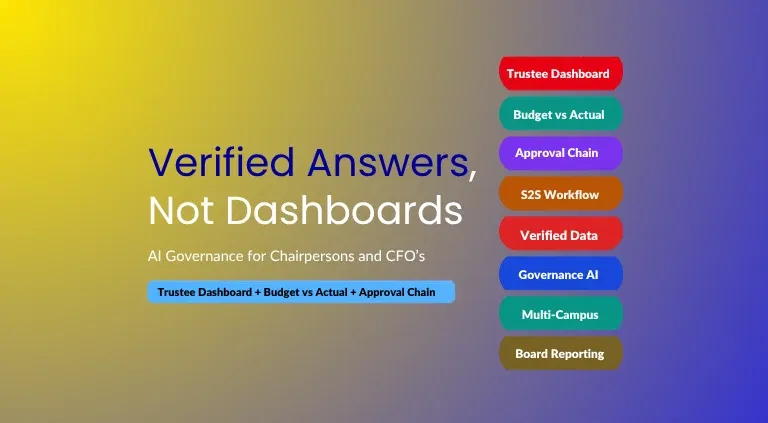
Your CFO has re-checked the same fee collection number 3 times tonight, and the board meeting is tomorrow morning. Last time a figure was wrong, you were the one explaining it to the trustees.
These circumstances arise frequently and that is why leadership needs AI that hands over verified answers, not more dashboards. Also more than half of finance and IT executives, 47%, of them have made a major call last year on data that turned out wrong.
That kind of gap does not stay contained to one bad meeting. Poor data quality costs the average enterprise more than Rs.107 crore a year, according to Gartner.
If you multiply it across a group of institutions running multiple campuses, trusts, and cost centres, the exposure only grows.
Trustees are not asking for a nicer chart. They only want to know if the number in front of them is actually right. Whether anyone has checked it, or will it hold up if someone asks a hard question. Dashboards were never built to answer that but AI can.
TL;DR
Dashboards tell you what happened. They rarely tell you if the number is right, current, or ready for an audit, and that is the question that actually matters in a trustee meeting.
An unverified number costs more than it looks like on the surface. Delayed decisions, repeated reconciliation, and a slow erosion of trust between campuses and the trust office.
edumerge Govern AI checks the number before you see it, so you are not making a follow up call to finance every time something looks off.
Why Dashboards Answer "What Happened," Not "What's True"?
A dashboard is a rear-view mirror. It shows you data someone typed in days or weeks ago, dresses it up as a chart, and calls it current.
When you're reviewing fee collection or checking a budget variance, you're not looking at proof that a number is right. You're looking at proof that someone typed it in.
- It shows you what was entered, not what actually happened. Nobody checked it against the transaction behind it.
- A number can look perfectly steady for months and still be wrong from day one.
- A typo, a late reconciliation or a duplicate entry shows up as a red flag. It just sits there, looking like every other number on the page.
- Dashboards refresh on a schedule. A mistake does not wait politely for that schedule to catch up.
- By the time anyone notices a number is wrong, it has already been copied into 3 or 4 other reports, and now you have 4 things to fix instead of one.
The Hidden Cost of Unverified Numbers in Board and Trustee Meetings
A wrong number is never caught in the meeting itself. It surfaces weeks later. In an audit query or a trustee's follow-up email, after it has already shaped a decision that is hard to reverse. Here is what that delay actually costs.
| What Happens | The Effect on Governance |
|---|---|
| A fee collection figure is presented without reconciliation against the bank feed. | Trustees approve a budget assumption that is later revised, undermining confidence in future reports. |
| 72% of organisations that acted on bad data report losses of Rs. 4 crore or more. | Financial credibility takes months to rebuild after a single flagged error reaches the board. |
| Multi-campus data is consolidated manually before a board meeting. | Reports arrive late, and last minute changes go unverified under time pressure. |
| A variance number is repeated across the trustee dashboard, an MIS report, and a CFO deck without one source of truth. | Three versions of the same fact circulate, and no one is certain which one is current. |
| 40% of enterprise data is inaccurate, incomplete, or duplicated at any given time, per Gartner data quality research. | Every board decision built on that data carries a hidden margin of error. |
| An approval chain is followed on paper but not cross-checked against actual spend. | Budget vs actual reviews catch the gap only after the funds are already committed. |
How AI Can Verify the Numbers Before You Act?
Fixing this is not about working harder or waiting longer for reports. It is about moving the check earlier, to the moment a number is created, not the moment it lands on your desk.
Here is exactly what that shift looks like in practice, from the source check to what finally reaches you.
- It checks the source, automatically. AI compares fee collection, payroll, and procurement entries against bank feeds and vendor invoices before a number reaches a report. By the time you see it, it has already been reconciled.
- It flags a problem before approval, not after. Budget vs actual reviews run continuously instead of once a quarter. So a CFO sees a deviation while there is still time to do something about it.
- It shows you where a number came from. Every figure on a trustee dashboard links back to the transaction or entry that produced it. If someone asks a question in the meeting, you have the answer on the spot.
- It holds every campus to the same standard. The same approval chain and S2S workflow apply everywhere. So a number from one campus means the same thing as a number from another.
- It shows you less, not more. Instead of scrolling through another dashboard, you see the exceptions that actually need a decision. The verification work is already done.
Read more about this in our blog on scope-locked AI.
Leadership Checklist: Questions to Ask Before Trusting Any Number
Here are the questions worth asking. None of them are meant to put anyone on the spot. They just catch the ordinary ways a figure goes wrong: nobody reconciles it, someone skipped a sign-off, or 3 teams are quietly looking at 3 different versions of the same fact.
Asking them out loud does two quiet but useful things.
- It tells you, right there in the room, whether the number can actually be trusted.
- And it tells your team, without anyone having to say it directly, that a number does not get to sail through anymore just because it looks fine on the page.
Now, onto the questions to ask before trusting any number:
- Has this number been verified against a source record, or only against last month's report? A repeated figure is not the same as a checked one.
- If I ask for the same figure at the next board meeting, will it match without adjustment? A number that shifts later was never solid to begin with.
- Which campus or department does this number roll up from, and can that be traced in one click? An untraceable number cannot be defended under a hard question.
- What was flagged and corrected before this number reached me? A clean-looking number does not mean nothing went wrong upstream.
- Does this Budget vs actual variance reflect committed spend or only invoiced spend? The two tell very different stories about your real exposure.
- Has the approval chain been followed for every transaction behind this total, or only spot checked? One skipped approval can sit inside a total that still looks fine.
- Is this the same number finance, audit, and the trustee dashboard are all looking at right now? Three versions of one fact usually means nobody is certain which is current.
- If this number were wrong, how long before anyone would have caught it? That gap is exactly where governance risk lives.
This is what we've built edumerge Govern AI exactly for. Read about how we're defining the category with it.
From Reporting Tool to Decision Partner: What edumerge Govern AI Changes
edumerge Govern AI exists to fix one problem that quietly costs institutions their credibility. A number changes hands too many times before it reaches the person who has to answer for it.
Every handoff, from the campus office to trust finance to the board pack, is another chance for that number to drift from where it started. And yet another chance for you to be the one caught explaining it.
edumerge Govern AI closes that distance. So the number you sign-off on, is the number that was actually true from the start.
| What Changes | What It Means for You |
|---|---|
| Every figure on the Trustee dashboard traces back to a verified source transaction. | Not a static export somebody pulled last week. You can click into any number and see the invoice, receipt, or entry behind it. |
| Budget vs actual updates as spend moves through the S2S workflow. | Not just once a month. A variance shows up the day it happens, not 4 weeks later in a review meeting. |
| The same approval chain applies across every campus. | A trustee looking at three institutions is looking at numbers built on one standard, not 3 different interpretations of what counts as approved. |
| You get one verified view. | Instead of 5 separate exports from 5 separate campus offices, each with its own version of the truth. |
| Every approval step is logged against the transaction it belongs to. | If a payment skipped a sign-off, that gap is visible before the number reaches a report, not after an auditor finds it. |
| The Trustee dashboard and the CFO's Budget vs actual report pull from the same verified layer. | Nobody in the room is working off a number that quietly differs from what someone else is holding. |
| Discrepancies are flagged as exceptions, not buried inside a total. | You see the one figure that needs a decision, instead of scanning an entire report to find it yourself. |
| The verification happens continuously, as transactions are approved. | You are not waiting for a quarter-end close to find out something was wrong three months ago. |
- You walk into the board meeting with numbers that have already been checked, not numbers you are hoping will hold up.
- Your CFO gets a budget vs actual view that reflects committed spend as it happens, with the approval trail already attached.
- Neither of you has to make a follow up call to confirm what the report is supposedly showing.
You might like to read more about this in our piece on AI governance software for Indian education groups.
Conclusion
What leadership actually needs from AI is not one more screen to check. It is confidence that the number on the screen is true.
Dashboards will keep showing you what happened. The real question for every chairperson & CFO is whether that number can be trusted before it reaches the board.
Verification does that work, not visualisation. When every figure on a Trustee dashboard or Budget vs Actual review is tied back to its source, leadership stops managing uncertainty and starts managing outcomes.
edumerge Govern AI was built for exactly this shift, turning institutional reporting from a static export into a verified decision partner for groups of institutions.
For a deeper look at why every AI answer and action needs a verifiable record, see our piece on why AI needs an audit trail in regulated education.
Frequently Asked Questions (FAQs)
1. What does "verified answers, not more dashboards" mean for institutional leadership?
It means AI should confirm that a number is accurate before it reaches a chairperson or CFO. Rather than simply displaying the number faster on a screen.
2. Why do dashboards fail to show what is actually true?
Dashboards display data as it was recorded, without checking it against the source transaction. So an error entered at the campus level can still appear correct on a chart.
3. How does AI verify institutional data before it reaches leadership?
AI cross checks fee collections, payroll & procurement entries against bank feeds, invoices & the approval chain. Flagging any mismatch before the number is presented.
4. What should a CFO check on a budget vs actual report?
A CFO should confirm whether the variance reflects committed or only invoiced spend. And whether the same approval chain was followed for every transaction behind the total.
5. Does edumerge Govern AI work across multiple campuses in a group of institutions?
Yes, it applies the same approval chain and verification standard across every campus in the group. So a trustee reviewing several institutions sees numbers built on one standard.
6. How is edumerge Govern AI different from a traditional finance dashboard?
A traditional dashboard shows what was recorded. edumerge Govern AI confirms whether what was recorded is accurate, current, and traceable back to its source.
7. Who should use edumerge Govern AI within an institution group?
Chairpersons, CFOs, trustees, and finance heads overseeing multi-campus operations are the primary users. Since they are accountable for the numbers presented at board level.
8. How quickly can a chairperson or CFO see the benefit of verified reporting?
Because verification happens as transactions are approved through the S2S workflow. Leadership sees corrected, audit ready numbers from the first Budget vs Actual cycle after setup.