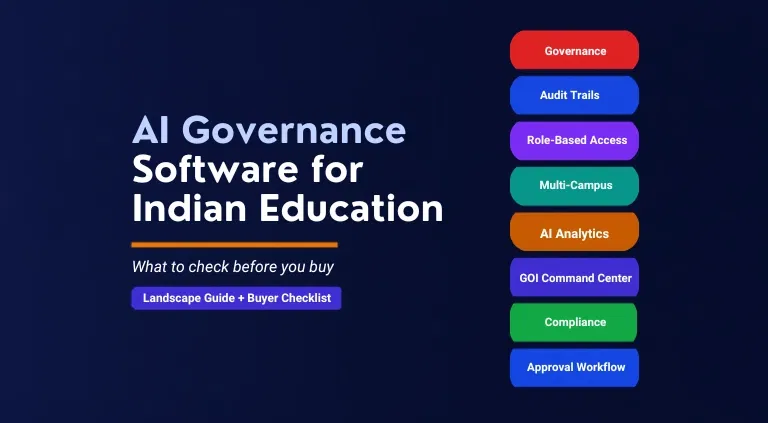
Most large Indian education groups are already running AI somewhere, whether or not anyone approved it. Staff use it to draft admission letters, summarise fee recovery, and flag at-risk students.
AI governance software is what institutions adopt, once that oversight becomes a board-level question instead of an IT afterthought. It decides what the AI can see, what it can act on, and who is accountable when it gets something wrong.
This piece maps what that landscape looks like across Indian education groups today. It also lays out a due-diligence checklist for anyone evaluating AI governance software for Indian education groups before signing with a vendor.
TL;DR
AI is already active across admissions, fees, academics, and staffing in most Indian education groups, but rarely inside a formal approval chain. This has turned AI oversight into a board-level concern, not just an IT task. Institutions that cannot explain an AI decision are already behind on compliance.
A genuine AI governance layer gives role-scoped access, source-verified answers, approval before any action, and a full audit trail. Buying one means involving trustees, IT, finance & academic heads together. The checklist covers access control, source attribution, approval workflows, and DPDP Act alignment.
edumerge Govern AI is built to inherit existing role structures & approval chains rather than running separately. It gives trustees source-traceable answers, enforces campus-level scoping automatically, and logs every action for audit. The choice for any GOI is whether AI operates inside its governance, or outside it.
Why AI Governance is Suddenly a Board-Level Conversation in Indian GOIs
AI adoption inside Indian education groups did not wait for a formal buying process.
- Registrars use general AI tools to draft communications.
- Finance teams use them to summarise recovery reports.
None of this sits inside an approval chain any trustee has actually signed off on.
Regulatory attention has started catching up with this reality. India's 2026 AI governance guidelines and the IT Act amendments on AI-generated content both push institutions toward documented, accountable AI use, not just adoption for its own sake. For a group of institutions, that shifts AI oversight from a technology decision to a governance one.
- Admissions scoring: AI now shortlists and ranks applicants, often before a human reviews the underlying logic.
Consequence: If a parent asks why their child was rejected, most institutions cannot yet produce a clear answer. - Fee waiver and default flags: Automated rules are recommending or approving concessions, not just human discretion.
Consequence: Without an approval step, a waiver can go out before a finance head has even seen the request. - Staff allocation: Workload distribution and scheduling increasingly runs through AI-assisted tools.
Consequence: Errors here affect payroll, compliance filings, and staff trust, not just convenience. - Academic risk flags: Predictive models flag at-risk students with limited explanation of why.
Consequence: Teachers acting on an unexplained flag risk making the wrong intervention for the wrong reason. - Regulatory expectations: India's 2026 AI governance guidelines & IT Act amendments expect institutions to show how AI-assisted decisions were made.
Consequence: An institution that cannot produce this trail on request is already out of step with where compliance is heading.
Read more about governed AI for educational group institutions.
The AI Governance Landscape in Indian Education Groups Today
Across Indian GOIs, AI has entered through operational side channels well before anyone built a governance layer around it. The table below maps where this is already happening, and the specific gap each function is carrying.
| Function | Where AI Is Already Involved | Governance Gap |
|---|---|---|
| Admissions | Eligibility scoring, application screening, shortlisting | No record of why an applicant was scored a certain way, and no consistent human review step |
| Fee Management | Waiver flagging, default prediction, reminder drafting | Recommendations sometimes acted on directly, with no approval trail |
| Finance | Report summarisation, recovery forecasting, expense tagging | Figures presented with confidence but no link back to the source ledger |
| Academics | At-risk student flagging, performance prediction, report drafting | Predictions shared with staff or parents without explaining the underlying data |
| HR & Staffing | Resume screening, workload allocation, attendance anomaly detection | Role-based access rarely extends to the AI layer itself |
| Communication | Drafting notices and parent messages using general AI tools | Interactions happen entirely outside the institution's data boundary, with no audit trail |
Take a deeper look at our blog on AI & automation in education ERP to see how AI can streamline everyday institutional operations.
What an AI Governance Software Actually Looks Like in Practice
Regardless of vendor, a genuine AI governance layer for education groups tends to share the same core capabilities.
1. Role-scoped access
The AI answers only with data the asker's role is authorised to see. So a department head & a trustee get different depth on the same question.
Example: A department head asking about attendance sees only their department's numbers, while a trustee asking the same question sees the consolidated group figure.
Operational Impact: No single login can pull group-wide data it was never meant to access, which keeps the AI layer inside the same boundaries as the rest of the ERP.
2. Source-verified answers
Every response is grounded in the institution's own verified records, and the system says so when the data does not exist rather than generating a plausible guess.
Example: Asked for last year's fee recovery rate, the AI cites the actual ledger entries rather than estimating from a general pattern.
Operational Impact: Board reports stop carrying numbers that look authoritative but cannot be traced back to a real record.
3. Approval before any write action
If the AI suggests updating a fee status or approving a request, that action is previewed and needs explicit human sign-off before it executes.
Example: An AI-suggested fee waiver is shown to the finance head for confirmation before it is applied, not after.
Operational Impact: AI-driven actions stay inside the institution's existing sign-off chain instead of bypassing it.
4. Full audit trail
Every question asked, answer given, and action taken or refused is logged and accessible by role, including refusals.
Example: A refused query, such as a staff member asking for data outside their role, is logged with the same detail as an approved one.
The operational Impact: Auditors and regulators get a complete record to review, not just a log of successful actions.
5. Explainability layer
Outputs carry a visible trace back to the data or rule that produced them. So a decision can be defended to an auditor or a parent.
Example: An at-risk student flag comes with the specific attendance & score thresholds that triggered it, not just a label.
Operational Impact: Staff can explain & defend a decision instead of relying on "the system flagged it."
All these 5 capabilities are exactly what edumerge Govern AI is built upon.
Who Should Be Involved, and What to Check Before You Buy: A Due-Diligence Checklist
AI governance software rarely fails on the demo. It fails when the wrong stakeholders were left out of the buying decision. These are the roles that should be in the room.
- Trustee / Chairperson: A Trustee or a Chairperson who owns the governance risk if AI acts outside policy, and needs visibility into group-level AI activity, not just campus-level reports.
- IT Head: An IT head has to confirm the AI sits inside existing role-based access control rather than running as a separate system with its own permissions.
- Finance Head: A Finance head needs assurance that any AI-suggested fee or budget action goes through the same approval chain as a human-initiated one.
- Academic Head: Has to check that predictive flags on students come with enough explanation to act on responsibly, not just a score.
Once the right people are in the room, this is the checklist to work through with any vendor.
| Checklist Item | Why It Matters | Questions to Ask the Vendor |
|---|---|---|
| Role-based access to the AI layer | Prevents a single login from seeing group-wide data it should not | Does the AI enforce the same role permissions as the rest of the ERP, or does it use separate access rules? |
| Source attribution on every answer | Stops a hallucinated figure from reaching a board report | Can every number the AI gives me be traced to a specific record in our data? |
| Approval workflow for write actions | Keeps AI actions inside the institution's existing sign-off chain | If the AI suggests a fee waiver, does it execute automatically or wait for approval? |
| Audit trail accessible by role | Gives auditors and regulators a record to review | Can a trustee see AI activity across all campuses, while a department head sees only their own? |
| Refusal behaviour when data is missing | Reduces confident, wrong answers | What does the AI do when it does not have the data to answer a question? |
| Data residency and DPDP Act alignment | Keeps student and staff data handling compliant with Indian law | Where is our data stored, and how does the platform handle DPDP Act obligations? |
| Reversibility of AI-driven actions | Limits damage if an action was approved in error | Can an AI-initiated action be reversed, and by which role? |
| Multi-campus scope handling | Ensures consolidated and campus-level views do not blend inappropriately | How does the AI distinguish between campus-level and group-level questions? |
Where edumerge Govern AI Fits in This Landscape
edumergeOS brings the operational and governance layer onto a single database. So the platform already carries the role structure, approval chains, and audit logs that a governance layer needs to plug into.
edumerge Govern AI is built directly into this foundation as the governed AI layer. It answers only from verified institutional data, stays scope-locked to the asker's role, and requires explicit approval before any action executes.
- For a trustee, edumerge Govern AI means group-level answers without waiting for a compiled report, along with a visible source behind every figure it presents.
- For an IT head, it means edumerge Govern AI inherits the same role-based access control already enforced across the ERP. Instead of introducing a second permission system to maintain and audit separately.
Evaluated against the checklist above, edumerge Govern AI is built to sit inside a group's existing governance, not alongside it as a separate AI tool with its own rules and its own blind spots.
edumerge Govern AI specifically delivers:
- Group-wide visibility for trustees, with every figure traceable to its source. No more board reports built on numbers no one can verify after the meeting ends.
- Campus-level scoping is enforced automatically, with zero manual configuration. A principal cannot see another campus's data by accident, and an IT head never has to build a second permission system to prevent it.
- A complete approval-and-audit trail, with nothing executed and nothing hidden. Every action is previewed before it runs, and every refusal is logged exactly like every approval.
Conclusion
AI is already inside every Indian education group, whether it was formally bought or not. The open question is no longer whether staff will use AI. But whether that use sits inside institutional governance or outside it.
AI governance software for Indian education groups exists to make that an intentional decision. Backed by role-based access, verified data, approval workflows, and a full audit trail, rather than something a trustee discovers after the fact.
Groups that get this checklist right before they buy will spend far less time explaining AI decisions after the fact, and far more time trusting the ones AI helps them make.
Frequently Asked Questions
1. Is AI governance software the same as data privacy compliance?
They are related but not the same. Governance software also covers action approval and audit trails, not just where and how data is stored.
2. What does scope-locked AI access mean?
It means the AI only answers with data the asker's role is authorised to see, so the same question returns different depth for a department head versus a trustee.
3. Can AI governance software prevent hallucinated numbers in board reports?
Yes, if the software is built to refuse a question rather than generate an answer when it cannot verify the underlying data.
4. Does AI governance software require IT to configure separate permissions?
Not if it is built to inherit the same role-based access control already set up in the ERP, rather than running its own permission layer.
5. What happens if an AI-suggested action turns out to be wrong?
In a properly governed system, the action should be reversible by the appropriate role, and the reversal is also logged in the audit trail.
6. How does audit trail access work by role in AI governance software?
A department head typically sees their team's AI interactions, a trustee sees group-level activity, and an administrator sees the full log.
7. Does the DPDP Act apply to AI used in Indian schools?
Any AI handling student or staff personal data falls under the DPDP Act's obligations for data processing and storage, so this should be part of vendor due diligence.
8. Can one AI governance layer work across a multi-campus group with both schools and colleges?
Yes, provided the platform is built to resolve role and campus scope at the time of each query, rather than through fixed configuration.
9. How is edumerge Govern AI different from connecting a general AI tool to an ERP?
edumerge Govern AI runs on the same database as the ERP, enforces role scope automatically, requires approval before write actions, and logs every interaction, rather than sitting on top as a separate connected tool.