India now has close to 2,000 law colleges recognised by the Bar Council of India (BCI) and teaches roughly 4-5 lakh students across 3 year & 5 year LLB programmes. Universities have been told to verify faculty qualifications, attendance, and salary records in person, since courts have repeatedly found colleges producing documents on inspection day rather than maintaining them year-round.
That scale changes what law colleges need in their administrative systems. With weak compliance records, scattered moot court data, and internship hours tracked on paper, an institution can no longer grow sustainably. What regulators are now enforcing is continuous evidence, not a system built to survive one inspection.
This guide covers what makes an ERP genuinely suited to a law college. Along with the features & modules that matter most, its implementation, and the questions your institution should ask before signing a vendor.
TL;DR
Generic school or college ERPs were not built for legal education. They miss moot court scheduling, internship & clinical hour tracking, and Bar Council specific compliance reporting that law colleges are assessed on.
The right ERP for a law college combines standard academic & fee administration with law specific modules. Added to that is cloud delivery for multi campus visibility, and reporting that maps directly to Bar Council and university requirements.
Evaluate any ERP on 5 things: coverage of law specific workflows, cloud vs. on premise fit, implementation timeline, integration with existing systems, and the vendor's understanding of Indian legal education. This is what edumerge College ERP is built to meet from day one.
What Makes a Specialized ERP Software Essential for Law Colleges in India?
Law colleges run on a more layered academic model than a typical arts or science college would have. A single student's record spans classroom attendance, internal marks, moot court participation, internship hours, legal aid work, and university examination schedules set outside the college's control.
Furthermore, a lot of errors tend to arise when institutions track all this on spreadsheets or a generic student information system. These errors usually stay unnoticed, but break out during a Bar Council inspection or in the university audit.
An ERP built to solve these gaps keeps every one of these records in one place. It is then updated exactly as events happened, rather than reconstructing them later.
This matters more as the Bar Council and affiliating universities increasingly expect institutions to produce continuous evidence of teaching hours, faculty qualifications, moot court exposure, and internship completion. Rather than a summary prepared the week before a visit.
Why Generic College ERPs Fail Law Colleges Specifically
- No moot court workflow: Generic college ERPs cannot schedule, score, or record participation in moot court rounds, which are a mandatory part of most LLB curricula.
- No internship or clinical hour ledger: Law students must log internship and legal aid clinic hours against Bar Council norms. But a generic college ERP does not have a dedicated field built for this.
- Compliance reports built for the wrong regulator: College ERPs are built to report to UGC and NAAC, and neither of these format maps to Bar Council of India documentation requirements.
- Attendance rules that do not match legal education: Law courses often carry stricter attendance thresholds tied to Bar Council enrolment eligibility, which a generic college ERP's attendance module is not configured to enforce.
- No case library or legal research tracking: Law colleges need to log student access to case law databases and legal journals as academic evidence. A generic college ERP has no equivalent module for this.
For a wider view of how these platforms compare across the sector, see our roundup of the top 10 higher education management software for colleges in India.
Key Features to Look for in a Law College ERP
Below is a checklist of the necessary features every law college should confirm before signing. It also provides the operational effect each one has once it is switched on.
| Feature | Operational Effect |
|---|---|
| Admissions management | Converts enquiries to enrolled students with document verification, cutting manual data entry at intake. |
| Attendance tracking | Enforces Bar Council attendance thresholds automatically, flagging shortfall before eligibility is affected. |
| Fee management | Automates installment schedules, receipts and reconciliation, reducing manual follow-up on defaulters. |
| Library management | Tracks issue, return and case-law resource usage, supporting research evidence for accreditation. |
| Placement tracking | Records recruiter visits, offers and internship-to-placement conversion by batch and department. |
| Compliance reporting | Generates Bar Council and university-ready reports on demand instead of manual compilation before a visit. |
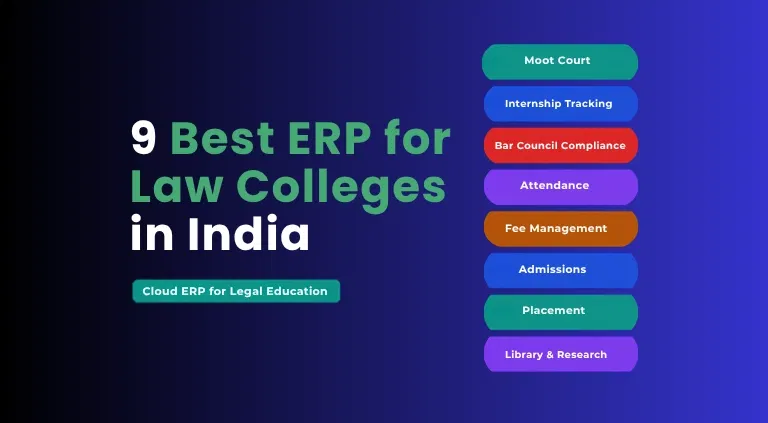
9 Best ERP for Law Colleges in India
1. edumerge College ERP
edumerge College ERP is part of edumerge's governed education operating system. Purpose-built for colleges, universities, and law schools across India, with dedicated support for NAAC, NBA, and OBE accreditation. It runs on the same unified data layer as edumerge's broader suite, and has supported 800+ Indian institutions and 500,000+ students for over 14 years. The platform scales from a single law college to a multi-campus Group of Institutions, backed by a named customer engagement manager and a 96% CSAT score.
Key strengths:
- Outcome-Based Education (OBE) administration with CO-PO, PEO, and PSO mapping: Law faculties can map course outcomes to programme outcomes without manual spreadsheets. This is also one of the growing requirements for BCI and UGC-recognised law programmes.
- NAAC & NBA accreditation workflows built into the platform: Law colleges which are preparing self-study reports get compliance-ready data on demand. This replaces compiling records by hand every accreditation cycle.
- Multi-campus governance through the edumergeOS suite, with a live trustee dashboard: An educational trust or society running a law college alongside engineering, arts, or management institutions gets one consolidated view across every campus. This is a structural advantage over single-campus ERPs, which force separate systems to be reconciled manually.
- Alumni management, placement tracking, and research administration: Covers the career-outcome and placement data that law schools report as part of NAAC, NBA, and NIRF cycles. Research & publication management enables tracking & organizing of every input until approval & publishing,
- Full student lifecycle coverage beyond accreditation: Includes admissions, attendance, timetables, academic records, and assessments. Fee collection is integrated with payment gateways, alongside communication tools for students and faculty.
- Finance & Control capability with configurable fee heads: Majorly useful for law colleges billing separately for moot court participation, bar association dues, or case-law database subscriptions, alongside standard tuition. It also provides budget vs. actual reporting, as well as a trustee dashboard for governance visibility.
- HRMS with biometric & geo-fenced staff attendance, payroll, leave, and appraisals: The system is flexible enough to handle visiting faculty from the judiciary or practicing bar who do not keep a standard teaching schedule.
2. MasterSoft ERP
Higher-education ERP with dedicated NAAC and NEP-compliant modules, already in use at several law colleges in India.
Key strengths:
- Accreditation Data Management System (ADMS) automates data collection and generates NAAC & NBA-ready SSR reports, reducing the manual compilation load ahead of accreditation visits.
- NEP-compliant features including Academic Bank of Credit support and transparent transcript generation aligned with the National Academic Depository.
What to note:
- MasterSoft's core strength is broad higher-education compliance rather than law-specific workflows such as moot court or clinical legal education tracking, so those areas typically need custom configuration.
- With 30+ modules across its suite, smaller standalone law colleges may only need a fraction of the platform, which is worth scoping carefully during pricing discussions.
Take a deeper look into how edumerge compares with MasterSoft Education ERP.
3. Digiicampus
A cloud-based ERP built around student and campus engagement for Indian higher education institutions.
Key strengths:
- Workflow automation for gate passes, hostel & visitor approvals, and grievance handling. Useful for strict campus and disciplinary processes many law schools maintain.
- Campus collaboration tools including clubs, chapters, events, and a faculty-mentor console, relevant to law schools with active moot court societies and student bodies.
What to note:
- Digiicampus positions itself as an engagement platform layered over ERP functions, so law colleges wanting deep financial accounting or trust-level consolidation may need to evaluate that module depth separately.
- Its most detailed public case study is a National Law University
- Standalone or affiliated law colleges should ask for references closer to their own scale.
4. Academia ERP (Serosoft)
A highly configurable education ERP for colleges and universities across India and abroad.
Key strengths:
- Modules spanning admissions, examinations, fees & placement. With dedicated portals and mobile apps for students, faculty, and administrators.
- OBE module designed to align with NAAC & NBA accreditation requirements, including automated CO-PO mapping and attainment calculations.
- Multi-centre & multi-location design, suited to law universities running undergraduate, postgraduate, and distance programmes together.
What to note:
- Academia ERP serves a very broad range of institution types globally, so law-specific configuration (BCI norms, clinical course credits) is typically a customisation request rather than an out-of-the-box feature.
- As a globally deployed platform with offices across continents, support responsiveness for smaller Indian law colleges is worth verifying against references of similar size.
5. Camu (Octoze Technologies)
An outcome-based education-focused campus ERP used by NAAC-accredited autonomous colleges, with a dedicated OBE and CBCS module.
Key strengths:
- OBE module with computation of attainment levels
- Choice Based Credit System (CBCS) support, allowing learner-centric academic planning and automated course registration, relevant to law programmes with elective-heavy curricula.
- Combined SIS & LMS approach, covering academic planning, attendance, virtual classrooms, and remote proctored exams.
What to note:
- Camu's strongest public references are largely autonomous arts & science colleges rather than law colleges specifically, so BCI-specific reporting needs should be confirmed directly.
- Institutions accustomed to a separate LMS & ERP should evaluate whether Camu's combined approach fits existing faculty workflows before switching.
You might also like our comparison on edumerge vs Camu, or explore the differences between an ERP vs SIS vs LMS.
6. Heraizen (DHI ERP)
An ed-tech company focused specifically on automating accreditation, academics, and administration for higher-education institutions.
Key strengths:
- Built around accreditation automation as a core function rather than an add-on, useful for law colleges under continuous NAAC, NBA, or BCI review pressure.
- Covers academics, administration, examination, and learning management within one integrated platform.
- A focused, higher-education-only product line, meaning less generic K-12 baggage in its workflows compared to vendors serving both schools and colleges.
What to note:
- As a smaller, seed-stage company founded in 2017, law colleges should check implementation capacity and long-term support commitments before a multi-year rollout.
- Public documentation on law-college-specific deployments is limited, so requesting references from comparable institutions is advisable.
7. TCS iON
Tata Consultancy Services' education technology unit, offering a cloud-based ERP with strong strength in large-scale digital examinations.
Key strengths:
- The Digital Assessment product has enabled secure, large-scale examinations for hundreds of millions of students, relevant to law entrance tests and semester exams needing tamper-proof processes.
- Backed by TCS's broader cloud, AI, and analytics capabilities, useful for law universities wanting deeper data analytics beyond core ERP functions.
What to note:
- TCS iON's education practice serves manufacturing SMBs and institutions broadly, so law-specific features are generally built through custom engagement rather than an out-of-the-box law-college template.
- As a large enterprise vendor, implementation timelines and support structures are typically heavier than what a single, standalone law college may need; it tends to suit larger universities and examination boards.
If you run a university, our comparison on campus management systems for deemed universities in India is worth the read.
8. Contineo
A Bengaluru-based campus management ERP for schools & colleges, covering admissions-to-alumni operations under one system.
Key strengths:
- Unified platform approach consolidating admissions, academics, fees, and alumni management into a single system rather than disconnected point tools.
- Customisable modules that can be adapted to an individual institution's processes rather than forcing a rigid workflow.
- Real-time data access aimed at improving transparency for management and IQAC teams during audits.
What to note:
- Publicly available detail on Contineo's specific deployments at law colleges is limited, so institutions should request references and a proof-of-concept demo scoped to legal education before committing.
- As with most generalist campus ERPs, BCI-specific reporting and clinical legal education tracking would likely need custom configuration.
9. Kalvisalai College ERP
An India-focused college ERP built specifically around UGC, AICTE & NAAC compliance reporting for affiliated and autonomous institutions.
Key strengths:
- Accreditation Data Management with advanced NAAC and UGC/AICTE reporting tools, helping colleges stay audit-ready year-round rather than scrambling before an inspection.
- Government roster options built into the admission module, useful for law colleges following reservation-based admission norms.
What to note:
- Kalvisalai is positioned for a broad higher-education audience rather than law colleges specifically, so BCI-specific fields would need to be configured rather than expected out of the box.
- Serving over fifty colleges daily by its own account, it sits at a more modest scale than some larger vendors, worth weighing against a law college's own growth plans.
Autonomous law colleges weighing this decision should also look at how deeper operational control plays out day to day. Our guide on how to manage autonomous college operations covers this in detail.
Real Implementation Timelines and What to Expect
Implementation timelines vary by how many campuses are involved and how much legacy data needs to be migrated. The table below reflects the typical ranges for law colleges moving from spreadsheets or an outdated system.
| Implementation Phase | Typical Timeline |
|---|---|
| Requirement mapping and data audit | 1 to 2 weeks |
| Data migration (students, faculty, fee records) | 2 to 3 weeks |
| Configuration of law-specific modules | 1 to 2 weeks |
| Staff and faculty training | 1 to 2 weeks |
| Parallel run alongside existing system | 1 to 2 weeks |
| Single campus law college: total | 6 to 10 weeks |
| Multi-campus Group of Institutions: total | 10 to 16 weeks |
Institutions that keep clean digital records of admissions and fee history tend to move through migration faster. Colleges still relying heavily on paper files should budget extra time at the data audit stage rather than compressing the training or parallel run phases.
Affiliated law colleges in particular should factor in university-driven dependencies during rollout. We break this down further in how to manage affiliated college operations.
How to Choose the Right ERP for Your Law College
If you want to choose the right ERP, then use these 6 questions as a decision framework before shortlisting or signing with any vendor.
- How many students and campuses does the ERP need to support today, and in 3 years?
- Is the institution a single law college, or part of a Group of Institutions needing consolidated, cross-campus visibility?
- Does the college prefer a subscription based budget model, or a one-time licence with in-house IT ownership?
- What existing systems, such as the university's examination portal or a payment gateway, does the ERP need to integrate with?
- Does the vendor's platform already include moot court, internship and Bar Council compliance workflows, or would these need custom development?
- What is the vendor's track record implementing ERP specifically for legal education, not just schools or general degree colleges?
If you're still clarifying what this category of software actually covers before evaluating vendors, start with what is a college management system.
Conclusion
Law colleges in India are being held to a higher standard of continuous compliance, not just periodic reporting. And the right ERP is what makes that possible without adding administrative burden.
A platform that natively handles moot court scheduling, internship tracking & Bar Council reporting alongside standard academic & fee administration removes the manual scramble before every inspection.
edumerge College ERP brings all of this onto one cloud platform. Built for the realities of Indian legal education rather than adapted from a generic college system.
Frequently Asked Questions (FAQs)
1. Why can't law colleges use a regular college ERP?
Regular college ERPs are built for UGC and NAAC reporting, not Bar Council of India requirements. They have no fields for moot court participation, internship or clinical legal aid hours, which are core parts of the LLB curriculum.
2. Is cloud-based ERP suitable for law colleges with limited IT staff?
Yes. Cloud-based ERP removes the need for in-house servers & dedicated IT staff, since the vendor manages hosting, updates and backups. Making it a practical fit for law colleges with lean administrative teams.
3. Does a law college ERP support Bar Council of India compliance reporting?
A purpose-built law college ERP maintains continuous records of faculty qualifications, teaching hours, attendance and internship completion. So compliance reports can be generated on demand rather than compiled manually before an inspection.
4. How long does it take to implement an ERP in a law college?
Implementation for a single law college typically takes 6-10 weeks from data migration to go-live. While multi-campus Groups of Institutions should plan for 10-16 weeks depending on the number of campuses and legacy data volume.
5. Can an ERP track moot court participation and scoring?
A law-college-specific ERP can schedule moot court rounds, record judge scores and maintain a participation history for each student, which generic school or college ERPs cannot do.
6. What is the difference between cloud-based and on-premise ERP for law colleges?
Cloud-based ERPs are subscription-priced, vendor-maintained and accessible from any campus in real time. While on-premise ERP requires upfront server investment and in-house IT staff to maintain & secure the system.
7. Does edumerge College ERP support law colleges specifically?
edumerge College ERP is built for affiliated & autonomous colleges, including law colleges. Covering admissions, attendance, fee management, accreditation reporting and compliance workflows on a single cloud platform.
8. What should a Group of Institutions running multiple law colleges look for in an ERP?
A Group of Institutions should prioritise a single-codebase platform that consolidates data across campuses, gives trustees a live dashboard, and applies compliance reporting formats uniformly across every affiliated law college in the group.
9. How does an ERP help with internship and clinical legal aid tracking?
An ERP built for legal education lets students log internship and clinical hours against Bar Council norms. With faculty verification built into the workflow, replacing manual certificates and spreadsheet tracking.