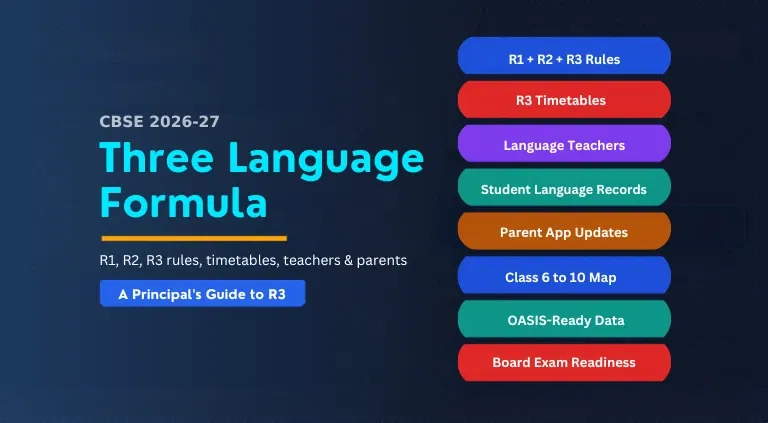
Every CBSE classroom now has a new language to make room for. The three language formula 2026-27 is officially in force, and CBSE Circular Acad-49/2026, issued on 10 July 2026, confirms that it applies from this academic session.
Under the new rule, two of the three languages every student studies must be Bhartiya Bhashas, or native Indian languages.
What makes this change different is that it grows every year. The third language, known as R3, begins in Class 6 this session.
From there, it moves up one class each year. The 2026-27 Class 6 batch, and every batch after it, will take a CBSE board exam in R3 on reaching Class 10.
For principals, putting this into practice is where the real work begins. Be it fitting R3 into an already full timetable, finding qualified language teachers, recording each student's choice accurately, or explaining the change clearly to parents. This guide walks you through each step, so your school is ready well ahead of time.
TL;DR
CBSE students now study three languages, R1, R2 and R3, with at least two of them Bhartiya Bhashas. R3 starts in Class 6 from 2026-27, and that batch will write an R3 board exam in Class 10.
Classes 7, 8 and 9 follow the scheme with transitional relaxations and school-based R3 assessment. Students in Class 10 during 2026-27 stay on the earlier two-language system.
edumerge School ERP is the comprehensive way to manage the rollout. Plan clash-free R3 timetables, allocate language teachers fairly, record each student's language combination & keep parents informed, all from one platform.
What is the Three Language Formula for 2026-27?
The three language formula 2026-27 is CBSE's rule that every student must study three languages, called R1, R2 and R3. Of these, at least two must be Bhartiya Bhashas, or native Indian languages.
The third can be a non-native language such as English or French, but only if R1 & R2 are both Indian languages.
This scheme is based on the NEP 2020 three language formula and the language framework set out in NCF-SE 2023. To understand the policy in more detail, read our explainer on the NEP 2020 language policy for educators.
The table below explains what R1, R2 and R3 mean and the rules for each.
| Language | What it is | Key rule |
|---|---|---|
| R1 | The student's first language, studied to the highest level of proficiency | Any language offered by CBSE |
| R2 | The second language, studied alongside R1 | Must be different from R1 |
| R3 | The third language, introduced from Class 6 and built up year by year | Must differ from R1 & R2. A non-native language is allowed only if R1 & R2 are both Bhartiya Bhashas |
Two simple examples show how the R3 or third language CBSE rule works.
- Hindi, Kannada & English is a valid combination, because Hindi & Kannada are both Bhartiya Bhashas.
- Kannada & English with French as R3 is not, because only one of the three is a native Indian language.
Which Classes Does the Three Language Formula Apply to in 2026-27?
The three language formula doesn't affect every class in the same way. In academic year 2026-27, it applies to Classes 6 to 9, and each of these groups follows its own transition rules. Class 10 stays on the earlier two-language system for this session. Here's a class-by-class breakdown so you know exactly what applies where.
Class 6: CBSE Third Language from 2026-27
Class 6 starts R3 in 2026-27 and is the first batch that will take an R3 board exam in Class 10.
Under the CBSE third language Class 6 rule, 2 of the 3 languages must be Bhartiya Bhashas. This applies to the current Class 6 batch and every batch after it.
Unlike Classes 7 to 9, this batch does not get any transitional relaxation. To support this, NCERT is releasing dedicated Class 6 R3 textbooks in all 22 scheduled Indian languages.
Schools should choose their R3 languages carefully, because this decision has long-term effects.
According to CBSE Circular Acad-17/2026, dated 09 April 2026, only the R3 languages a school introduces in Class 6 can be offered as R3 options in Classes 9 and 10. In other words, the languages you choose today are the ones your students will continue with until 2030-31, when this first batch reaches Class 10.
Classes 7 to 8: Three Languages with a Relaxation
Students in Classes 7 and 8 study three languages, and at least two of them must be Bhartiya Bhashas. They continue with the same three languages until they reach Class 10.
A relaxation applies to students in these classes who had already chosen two non-native languages: they add one Bhartiya Bhasha and continue it until Class 10.
R3 for these batches is assessed only by the school, and there will be no CBSE board examination in R3 when they reach Class 10.
Class 9: School-Based R3 from 1 July 2026
Class 9 studies three languages from 1 July 2026, with R3 assessed by the school rather than the board.
Students continue the three-language combination they studied in Class 8, with one of the three designated as R3.
As a one-time relaxation, a Class 9 student already studying two non-native languages may keep them and add one Bhartiya Bhasha as R3. Until dedicated textbooks arrive, Class 9 students use the 2026-27 Class 6 R3 textbooks, as set out in CBSE Circular Acad-33/2026.
A student who does not qualify in the Class 9 R3 assessment is still promoted to Class 10, but must clear it while in Class 10.
There is no R3 board exam for this batch in 2027-28, though students must clear R3 in the school-based assessment to receive the CBSE Secondary School pass certificate.
Class 10: No Change in 2026-27
Students in Class 10 during 2026-27 continue with the earlier two-language system and do not take R3.
CBSE has also made special provisions for a few groups of students.
- First, Children with Special Needs can receive relaxations or exemptions from the third language requirement under the Rights of Persons with Disabilities Act, 2016.
- Next, CBSE schools located outside India, as well as foreign students returning to India, are exempt from studying a native Indian language as R3.
- Finally, if a student's family moves to another state, the student can continue with the same language combination. In such cases, the new school must provide the support the student needs to carry on with those languages.
| Class in 2026-27 | Three languages? | Two Bhartiya Bhashas? | R3 assessed by | R3 board exam in Class 10? |
|---|---|---|---|---|
| Class 6 | Yes | Yes, no relaxation | School, then board | Yes, in 2030-31 |
| Classes 7 to 8 | Yes | Yes, with a relaxation | School only | No |
| Class 9 | Yes, from 1 July 2026 | Yes, with a one-time relaxation | School only | No |
| Class 10 | No, two languages | Not applicable | Not applicable | No |
Want to understand the policy behind these class-wise rules? Read our guide, NEP 2020 language policy explained.
How to Plan Timetables and Teachers for the Third Language (R3)?
The third language adds new R3 periods, extra teachers & new student groups to a school timetable that is already full. Without a clear plan, this can lead to clashing periods and an uneven workload for teachers.
A well-planned three language timetable avoids both problems. The good news is that it's easier than it sounds. These 6 steps show you how.
1. Decide which R3 languages your school will offer
Start by choosing the Bhartiya Bhashas your school can teach well over the long term, ideally for the next 5 years.
This decision matters because CBSE allows only the R3 languages introduced in Class 6 to be offered later in Classes 9 and 10. A language you skip now cannot be added as an R3 option for these classes later.
2. Count how many students have chosen each language
For each grade, record how many students in every section have picked each R3 language. This number shows how many separate language groups you need.
For instance, if 40 students choose Sanskrit and 25 choose Kannada, you will need at least two groups running at the same time.
3. Schedule one common R3 period for each grade
Place the R3 period at the same time for every section in a grade. During this period, students leave their usual sections and join their language groups.
Because every section has R3 at the same time, no student misses another subject and no timetable clash occurs.
Read more about how edumerge helps manage timetables for schools.
4. Divide a section into language groups when required
A single section may have students learning different languages, such as Sanskrit, Kannada and Tamil. In this case, split the section into smaller groups during the common R3 period. In turn, each group then needs its own teacher and classroom.
5. Distribute the teaching load fairly
Spread R3 periods evenly among your language teachers and set a clear limit on weekly periods. Similarly, try not to give R3 classes to teachers whose timetables are already full with core subjects.
A balanced workload keeps teaching quality steady and helps avoid teacher burnout.
6. Identify gaps in third language teachers early
Compare the number of R3 periods you need with the number of teachers who can take them. If you do not have enough teachers, CBSE allows schools to use:
- existing teachers who are proficient in the language
- retired teachers
- postgraduates in the language
- teachers shared with nearby schools through Sahodaya clusters
- virtual or hybrid classes
Plan for this early. R3 moves up one class every year, so the number of teachers you need will also increase each year.
To learn how automated scheduling can simplify this process, read our guide to smart school timetable management.
How to Record and Track Each Student's Language Choice
A language choice made in Class 6 now stays with the student all the way to the Class 10 board exam. That is why it pays to get the record right from the very beginning. Because a correct entry today saves a lot of corrections later.
- Update the OASIS portal: CBSE requires schools to enter their R3 language offerings for Classes 6 to 9 on the OASIS portal. And Circular Acad-33/2026 set the deadline as 30 June 2026. If your school later adds or changes a language, update it on OASIS and in your own records at the same time. This way, both records always match.
- Keep one record for each student: Store each student's R1, R2 & R3 together in one profile, and note which of these languages are Bhartiya Bhashas. If a student has a relaxation or exemption, record the reason and attach the supporting document. For example, this could be a child with special needs, a foreign student returning to India, or a student who has moved from another state.
- Carry the choice forward every year: The language combination should move with the student from one class to the next, even when they change sections or schools.
- For the 2026-27 Class 6 batch, this record will be used for Class 10 board exam registration in 2030-31.
- For students in Classes 7 to 9, keep track of their school-based R3 results too, since they must clear R3 to receive their pass certificate.
| Record field | Why it matters |
|---|---|
| R1, R2 and R3 language | Confirms the combination meets the two Bhartiya Bhashas rule |
| Relaxation or exemption reason | Explains any combination that differs from the standard rule during an inspection or audit |
| School-based R3 results | Shows which students in Classes 7 to 9 still need to clear R3 before the Class 10 result |
| Class 6 entry year | Identifies students who will write the R3 board exam in Class 10 |
How to Communicate the Three Language Change to Parents
When the three language formula comes up, parents usually ask 3 questions:
- Which languages does the school offer for R3?
- Will R3 add to their child's exam pressure?
- Can their child change the language choice later?
CBSE has also asked schools to explain the new rules to teachers, students and parents in a positive way. So a short message written for each class is the best way to start. It answers most of these questions upfront, before parents need to call or visit the school office.
Sample message schools can adapt:
Dear Parent,
From the 2026-27 academic session, CBSE requires every student to study three languages, called R1, R2 and R3. At least two of these must be Indian languages.
For Class [X], our school offers [Language A], [Language B] and [Language C] as R3.
Your child's language combination is [R1] / [R2] / [R3] and is visible in the parent app under the student profile. R3 for this class is assessed by the school. [Class 6 only: this batch will take a CBSE board exam in R3 in Class 10.]
For any question, please raise a request through the Help Desk in the parent app, and we will respond within two working days.
Regards,
[Principal's name]
The parent app cuts down phone queries in a few practical ways.
- First, notices go only to the affected classes, so a Class 10 parent isn't confused by an update meant for Class 6.
- Next, each parent can see their own child's language combination in the app, so they don't need to call the school to confirm it.
- Finally, any questions come in as tracked Help Desk requests instead of calls to the front desk, which means every query is recorded and answered on time.
For more ideas, see how schools boost parent engagement with superchat & broadcast.
How edumerge School ERP Supports the Three Language Formula
A rollout succeeds when the timetable runs without clashes, teachers carry a fair load, every student's record is correct and parents feel informed.
edumerge School ERP delivers those outcomes from one connected platform, so principals see the whole R3 picture without chasing individual departments.
| Outcome for your school | How edumerge School ERP delivers it |
|---|---|
| R3 periods with no clashes | Timetable & substitution management uses a visual builder with workload rules to set common R3 blocks and language groups |
| Fair, visible teacher allocation | Staff information system and timetable workload views show each language teacher's periods at a glance |
| One correct record per student | Student information system keeps R1, R2, R3 and exemption details in a single profile that carries forward each year |
| Parents informed, fewer calls | Notices & announcements and the parent & staff help desk send class-specific updates and track every query |
| Group-wide view for trustees | Trustees of multi-campus school groups see R3 readiness across every school in one consolidated view |
Before the next term begins, use this 5-point readiness checklist.
- Teachers: Every R3 language group has a named teacher, and gaps for next year are already flagged.
- Timetables: Each grade has a common R3 block, and no teacher or room is double-booked.
- Textbooks: NCERT R3 textbooks for Class 6 are in hand, Class 9 has the interim Class 6 R3 books, and state or SCERT material is arranged for languages outside the 22 scheduled languages.
- Student records: Every student's R1, R2 & R3 is recorded, matches OASIS, and shows any relaxation or exemption.
- Parent communication: Each class has received its own message, and queries are tracked to closure.
Schools already compare platforms on CBSE readiness. Our guide to school management software for CBSE schools in India covers the wider criteria.
Conclusion
The three language formula 2026-27 isn't a one-time change; it unfolds over the next 5 years. R3 begins in Class 6 this session and moves up one class each year. By 2030-31, when this first batch reaches Class 10, R3 will become a full board exam subject.
The schools that start planning today will be the ones that handle this change with ease. Once your R3 languages are confirmed, your timetables are set without conflicts, your teachers are planned in advance and your student records are accurate, each new academic year becomes routine.
Schools that stay on spreadsheets will find themselves rebuilding the same plan every June.
edumerge School ERP brings timetables, teachers, student language records & parent communication onto one platform. So the policy becomes a smooth, well-planned rollout.
Frequently Asked Questions (FAQs)
1. What is the three language formula in CBSE for 2026-27?
It is CBSE's scheme, applicable from the 2026-27 academic session, under which every student studies three languages called R1, R2 and R3. At least two of the three must be Bhartiya Bhashas, or native Indian languages. The third language, R3, begins in Class 6 and moves up one class each year until it reaches Class 10.
2. Is the CBSE third language compulsory for Class 6?
Yes. CBSE has made R3 compulsory in Class 6 from the 2026-27 session. Two of the three languages a Class 6 student studies must be Bhartiya Bhashas. NCERT is making dedicated R3 textbooks available in 22 scheduled Indian languages, and this batch will take a CBSE board examination in R3 when it reaches Class 10.
3. Will Class 10 students write a board exam for the third language?
Only students who were in Class 6 in 2026-27, and later batches, will take an R3 board exam in Class 10. Students in Classes 7, 8 and 9 during 2026-27 are assessed in R3 by their school, with no R3 board exam. Students in Class 10 during 2026-27 continue with two languages.
4. Can English be taken as the third language (R3) in CBSE?
Yes, but only when the other two languages are both Bhartiya Bhashas. A student studying Hindi and Kannada can take English or French as R3. A student studying Kannada and English must choose a native Indian language as R3, because the scheme requires at least two of the three languages to be Indian.
5. Do Class 9 students have to study a third language in 2026-27?
Yes. From 1 July 2026, Class 9 students study three languages, continuing the combination they studied in Class 8, with one designated as R3. R3 is assessed only by the school. Students must clear R3 in the school-based assessment to receive the CBSE Secondary School pass certificate, though there is no R3 board exam.
6. How can schools find third language teachers?
CBSE allows flexible staffing for R3. Schools can engage existing teachers with functional proficiency in the language, retired teachers or postgraduates, share teachers within Sahodaya school clusters, or use virtual and hybrid teaching. Schools should map required R3 periods against available teachers early, because demand grows as R3 moves up a class every year.