Collecting fees at a single school is an operational task. But when fees are collected across 10 campuses under one trust, it becomes a governance responsibility. Every delayed payment, unreconciled entry, or unapproved concession turns into a question for the board.
As per UDISE+ 2024-25, India has 14.71 lakh schools, and private unaided schools. Though only 23.1% of the total, now educate nearly 39% of all students. In addition, higher education adds a further 1,289 universities and 48,246 colleges, according to AISHE 2023-24.
At the same time, parents have already moved to digital payments. UPI processed 24.07 billion transactions worth Rs. 29.37 lakh crore in September 2026 alone, as per NPCI data. Yet many educational groups still reconcile campus collections in spreadsheets at month-end. And this is precisely where delays, revenue leakage, and audit concerns begin.
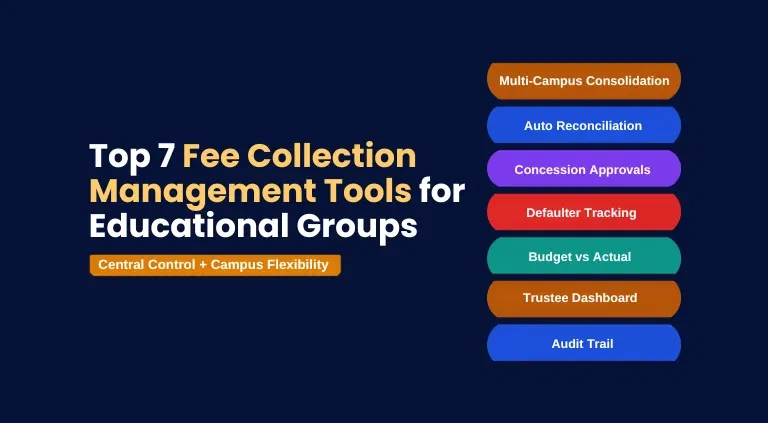
With this in mind, this guide reviews the top 7 fee collection management tools for educational groups in India. Explaining how trustees and finance heads can evaluate them.
TL;DR
Educational groups need more than just a payment link. They need fee collection that runs at campus level but stays reconciled, reported, and controlled at group level, in real time.
The 10 must-have features are central fee structures, multi-channel payments, defaulter tracking, instalment & concession management, auto reconciliation, digital receipts, consolidated collection reporting, Budget vs Actual, audit trails, and a Trustee dashboard.
edumerge fee collection, delivered through School ERP & College ERP, brings all these features into one platform for Groups of Institutions.
Why Do Educational Groups Need More Than a Fee Payment App?
A single school can often manage its fees with a payment app and a careful accountant. A group of institutions cannot, because collecting fees across many campuses is about financial control, not just receiving payments.
Below are the 6 problems trustees and group finance heads raise most often.
- Collections are scattered across campuses and channels: Cash at one counter, UPI on another app, and NEFT into a third bank account mean nobody can say with confidence what the group collected today.
- Trustees see collection numbers weeks late: Each campus sends month-end reports in its own format, and they are already outdated by the time the board meets.
- Concessions quietly leak revenue: Sibling discounts and discretionary waivers granted at campus level, without a defined approval chain, add up to lakhs across a group, which makes fee revenue leakage prevention a board-level concern.
- Defaulter recovery depends on individual effort: Reminders are manual and aging is invisible, so recovery rates vary widely across campuses.
- Every campus collects fees its own way: Different fee heads, receipt formats, and reminder habits make it impossible to compare campuses or apply one group policy.
- Audits and fee regulation demand proof: Statutory auditors, state fee regulation bodies, and accreditation reviews all expect a clean trail for every receipt, reversal, and concession.
Unapproved concessions and missing audit trails are only one part of the wider control challenge. Our guide on maker checker control for schools & colleges explores how a second level of approval protects fees, procurement and academics across campuses.
How Fee Collection Should Work Across a Group of Institutions: Central Control, Campus-Level Flexibility
The model that works for groups is simple. The group office sets the collection rules, each campus runs day-to-day collections, and one system connects the two so nothing falls between them.
| Set centrally by the group office | Managed by each campus |
|---|---|
| Fee policy, fee heads, and approved fee ranges | Class, programme, or batch-level fee structures within that policy |
| Concession & scholarship rules with approval limits | Concession requests for individual students |
| Payment gateways, bank accounts, and settlement rules | Counter collections in cash, cheque, or DD, recorded in the same system |
| Reminder schedules and defaulter escalation policy | Parent conversations & follow-up on flagged cases |
| Group collection dashboards, Budget vs Actual, and audit access | Daily collection reports and campus-level outstanding lists |
In practice, a typical fee collection cycle across a group runs in 5 steps:
- Group finance publishes the fee policy and approved structures for the academic year
- Each campus maps students to structures, and any concession routes through the approval chain
- Parents pay online through UPI, cards, net banking, or auto-debit, or at the campus counter
- Every payment is matched against bank and gateway records, and a receipt goes out instantly
- Collections roll up into consolidated fee reporting across campuses, visible to trustees in real time
This is what centralised fee collection for multiple branches should look like. Campuses keep their autonomy over daily work, and the group never loses sight of the money.
Fee collection is only one part of the wider finance challenge. Our guide on top 9 financial management software for schools in India explores the tools institutions use to manage budgets, expenses and reporting alongside fees.
Must-Have Features in a Fee Collection Tool for Educational Groups
Today, parents pay fees differently than they did even 2 years ago, but most fee processes haven't caught up. In September 2026, Indians made an average of 802 million UPI payments every day, 23% more than the year before (NPCI).
That makes it important to know how parents are paying, what each payment costs & when the money reaches your account, for every campus. The table below lists the 10 features a multi-campus fee collection system needs, and what each one does for your group.
| Feature | What it does for a group | Positive outcome |
|---|---|---|
| 1. Central fee structure builder | Group-level templates for fee heads such as tuition, transport, hostel, and exam, adopted by campuses within approved limits | Consistent pricing across campuses and fewer policy breaches |
| 2. Multi-channel payment collection | UPI, cards, net banking, and NEFT online, plus cash and cheque at the counter, all recorded in one place | Parents pay the way they prefer, with no parallel records |
| 3. Automated reminders and defaulter tracking | Scheduled SMS, app, and email reminders with aging by campus, class, and student | Fewer overdue accounts and more predictable cash flow |
| 4. Installment and concession management | Installment plans, scholarships, and concessions governed by approval chains and limits | Flexibility for families without unapproved waivers |
| 5. Automated reconciliation | Matches every payment with bank statements and gateway settlements | Days of manual matching removed, with mismatches flagged early |
| 6. Instant digital receipts and parent self-service | Receipts, statements, and pending dues visible to parents on the app | Shorter counter queues and fewer receipt disputes |
| 7. Consolidated multi-campus collection dashboard | Real-time roll-up of collections, outstanding dues, and concessions from campus to group | One version of the truth across every campus |
| 8. Budget vs actual on fee revenue | Compares expected fee revenue with actual collections by campus and term | Shortfalls spotted mid-term, not at year-end |
| 9. Role-based access and audit trail | Granular permissions, maker-checker approvals, and logs on every receipt, reversal, and concession | Audit-ready records and lower fraud risk |
| 10. Trustee dashboard | Real-time fee collection visibility for trustees, covering collections, outstanding dues, concessions, and Budget vs Actual | Faster, better-informed board decisions without waiting for campus reports |
Budget vs actual is only one part of the wider planning challenge. Our guide on how to prepare a budget for schools & colleges in India explains how to build the budget your fee revenue is tracked against.
Top 7 Fee Collection Management Tools for Educational Groups in India
1. edumerge
edumerge Fee Collection is part of edumerge's governed education operating system, delivered through School ERP, College ERP, and the Finance & Control. It is purpose-built for schools, colleges, universities, and education trusts across India that collect fees across multiple campuses.
Educational groups can collect fees through two channels, both recorded on one platform:
- Online, through UPI, cards, net banking, and NEFT, with instant digital receipts for parents
- Offline, through cash, cheque, or DD at the campus counter, reconciled in the same system
It runs on the same unified data layer as edumerge's broader suite. So every payment posts directly to the institution's ledger through fee-to-finance integration and stays connected to student records and group-level reporting.
Having supported 800+ Indian institutions and 500,000+ students for over 14 years, the platform scales from a single school to a multi-campus Group of Institutions. It is backed by a named Customer Engagement Manager and a 96% customer satisfaction (CSAT) score.
Key strengths:
- Multi-campus consolidation lets the central office track collections, outstandings, and concessions across every school and college in the group in real time, from a single dashboard.
- The automated reconciliation engine matches every payment against bank statements and gateway records, with customers reporting up to 70% reduction in reconciliation time.
- Dues are scheduled automatically, with reminders sent before and after deadlines, helping institutions achieve 95%+ on-time collection rates.
- Programme-wise, campus-wise, and semester, annual, or term-based fee structures can be set up for schools and colleges, including government & management quotas, and scholarship slabs.
- New admissions auto-generate the fee structure and first invoice, so collection starts the moment a student enrolls.
- Concession controls and structured reversals keep every discount and adjustment documented and approved.
- edumerge Govern (AI) answers questions like "Which fee defaulters haven't been sent a reminder in 15 days?" from live gateway and ledger data, shows the source behind every number, and confirms before any reminder goes out.
- Leadership dashboards show daily collections, outstanding aging, concession impact, and campus-wise collection performance without waiting for month-end reports.
- Role-based access, encrypted data, approval workflows, and transaction logs on every financial action keep collection records audit-ready.
- Collection data feeds the group's budgeting & forecasting and trustee dashboard, so budget vs actual reflects real collections.
- The platform handles 500 to 50,000+ students without performance loss, and extends across a full Group of Institutions through edumergeOS.
2. Entab CampusCare
An Indian school ERP with an online fee collection module widely used by CBSE and ICSE school chains.
Key strengths:
- Online fee payment through gateway integration, with receipts and fee reminders.
- Branch-wise collection and defaulter reports for school chains.
What to note:
- Built for K-12, so groups with colleges need a separate system for higher-education fee collection.
- Collection data typically needs exporting to Tally or other accounting tools, adding a reconciliation step.
Also explore how edumerge School ERP compares with Entab.
3. MyClassboard
A Hyderabad-based cloud school ERP with fee collection features and a strong parent app.
Key strengths:
- Online fee payments, reminders, and receipts through the parent app.
- Fee status visible alongside attendance and academics for parents.
What to note:
- School-focused, so college quotas, semester billing, and scholarship structures are outside its core design.
- Group-level ledger integration and trust consolidation need separate accounting tools.
Explore our guide on how edumerge School ERP compares with MyClassBoard (MCB).
4. Fedena
A widely deployed modular school and college management system with a finance and fee collection module.
Key strengths:
- Configurable fee categories, particulars, discounts, and fines.
- Online payment gateway support with receipts.
What to note:
- Multi-campus groups typically run separate instances, so consolidated group collections are hard to see.
- Advanced reconciliation and ledger posting often depend on plugins or customisation.
You might also like our comparison on edumerge School & College ERP vs Fedena.
5. Jodo
A Bengaluru-based education payments platform focused on fee collection and flexible payment plans for parents.
Key strengths:
- Online fee collection with automated reminders and payment tracking.
- Flexible instalment and EMI options for parents, helping reduce delayed payments.
What to note:
- A payments and fee-financing layer rather than a full ERP, so academics, admissions, and accounting stay in other systems.
- Groups still need a separate system for trust-level consolidation and ledger posting.
6. GrayQuest
A Mumbai-based education fee platform that combines collections with fee financing for parents.
Key strengths:
- Digital fee collection with multiple payment modes.
- Collection reports and payment tracking for institutions.
What to note:
- Focused on payments and financing, not end-to-end fee structures, concessions, and academic linkage.
- Reconciliation with the institution's ledger and campus-wise governance require other tools.
7. Camu
A cloud campus management platform for colleges and universities, with fee collection built into its ERP.
Key strengths:
- Online fee collection with payment gateway integration, receipts, and dues tracking.
- Supports programme-wise and semester-based fee structures typical of higher education.
- Students and parents can view fee status and pay through the mobile app.
What to note:
- Built mainly for individual higher-education institutions, so groups that also run schools need a separate system for K-12 fee collection.
- Trust-level consolidation and direct ledger posting across multiple campuses need additional accounting tools.
Also give a read on how edumerge compares with Camu over features.
Evaluation Checklist: 5 Questions to Ask Before Choosing a Fee Collection Platform for Education Groups
Switching fee software in the middle of an academic year means re-mapping every student, every concession and every pending due. So it pays to get the choice right the first time.
These 5 questions help you tell group-ready fee management software for education groups apart from a single-school payment app. Ask each vendor to answer them in a live demo, not on a slide.
| Checklist question | What a good answer looks like |
|---|---|
| 1. Does it consolidate collections across every campus in real time? | A live group dashboard that drills down to campus, class, and student, with no spreadsheet exports |
| 2. Are concessions and waivers governed by approval chains? | Rules set centrally, requests raised at campus, and every approval logged with who, when, and why |
| 3. Does reconciliation happen automatically across all payment channels? | Bank, gateway, and counter collections matched daily, with exceptions flagged for review |
| 4. Is it audit-ready by default? | Role-based access, maker-checker controls, and a full trail on every receipt, reversal, and concession |
| 5. Will it scale with the group, and how quickly can it go live? | Proven across institutions of different sizes, with structured onboarding and one platform for schools and colleges |
You might also like to read about the top 10 consolidated financial reporting tools for educational groups in India.
Conclusion
Fee collection in an educational group is not a payment problem; it is a visibility and control problem. The top 7 fee collection management tools covered here exist to close that gap, from the campus counter to the trustee boardroom.
edumerge Fee Collection, delivered through School ERP, College ERP, and Finance & Control, gives groups one platform. For multi-channel collection, automatic reconciliation, and consolidated campus reporting.
Concessions follow approval chains, fee revenue is tracked through Budget vs Actual, and trustees get a dashboard that updates in real time.
The result is simple. Campuses keep their flexibility, finance teams stop chasing spreadsheets, and trustees see the full collection picture whenever they need it.
Frequently Asked Questions (FAQs)
1. What are the top fee collection management tools for educational groups in India?
edumerge Fee Collection leads the list as the most comprehensive option, followed by Entab CampusCare, MyClassboard, Fedena, Jodo, GrayQuest, and Camu. Whichever you choose, look for central fee structures, multi-channel payments, defaulter tracking, instalment and concession management, automated reconciliation, digital receipts, consolidated reporting, Budget vs Actual, audit trails, and a Trustee dashboard.
2. Can one platform collect fees across multiple campuses?
Yes. A multi-institution fee management system lets each campus collect fees under group-defined rules. All while the central office sees consolidated collections and outstanding dues in real time.
3. How does online fee collection work for schools?
Parents see their dues on an app or payment link and pay through UPI, cards, net banking, or auto-debit. The system records the payment, issues a receipt instantly, and reconciles it against bank and gateway settlements.
4. How can educational groups reduce fee defaulters?
Groups reduce defaulters with fee defaulter tracking software that sends scheduled reminders, supports installment plans for families who need them, and shows aging reports by campus with clear escalation rules. Group-level visibility keeps every campus accountable for recovery.
5. Is online fee collection safe for parents?
Yes, when payments run through RBI-regulated payment gateways and the institution's system uses encryption, role-based access, and audit logs. Parents also receive an instant digital receipt as proof of payment.
6. What is e-NACH auto-debit for school fees?
e-NACH is an NPCI mandate that lets parents authorise automatic debit of fees from their bank account on due dates. It reduces missed payments for recurring monthly or term fees.
7. How does fee reconciliation work across a group of institutions?
Each payment is matched automatically with bank statements & gateway settlements, and unmatched entries are flagged. Group finance reviews only the exceptions instead of matching every transaction by hand, with a full fee reconciliation and audit trail for every entry.
8. How much does fee collection software cost in India?
Pricing usually depends on student count, number of campuses, and modules included, and is often quoted per student per year. Groups should compare total cost, including onboarding, payment charges, and support, not licence price alone.
9. Should an education group choose an ERP-connected fee collection system or a standalone payment app?
A standalone payment app can handle collections for a single institution. Groups usually need an ERP-connected fee collection system, so payments link to student records, approvals, and group-level reporting in one place.
10. Does edumerge support fee management for trusts and societies?
Yes. edumerge Fee Collection consolidates collections across every school and college in a trust. And Finance & Control adds approval chains, Budget vs Actual tracking, and a Trustee dashboard. So trustees can view collections across the entire trust from one place.