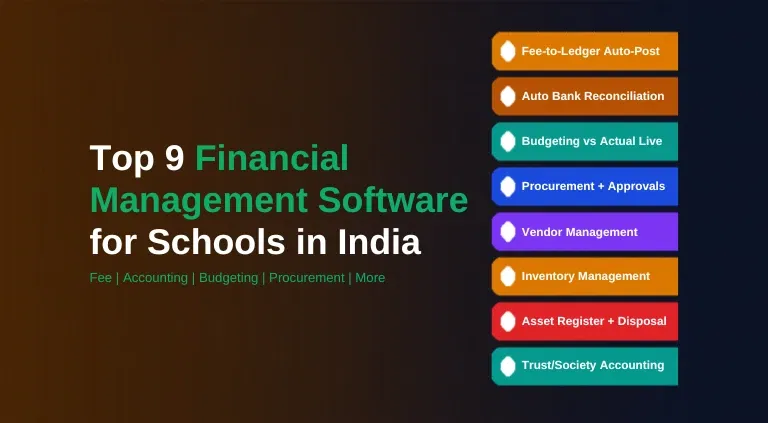
School finance in India runs on a patchwork. Most schools use one tool for fee collection, a separate Tally installation for accounting, a spreadsheet for budgeting, email for procurement approvals, a physical register for inventory, and periodic manual consolidation for trust-level reporting.
Every handoff between these tools is a source of error, delay, and blind spot. This guide evaluates the top 9 financial management software options used by Indian schools.
Covering the full spectrum of school finance functions, from fee collection & bank reconciliation through procurement, inventory, asset management & trust accounting. Helping you identify which platforms handle each function natively versus which require manual bridging.
TL;DR
The best financial management software for schools in India is one that handles the complete institutional finance lifecycle. From fee collection via online gateways & automated reconciliation, double-entry accounting with GST & TDS compliance, to academic-year-aligned budgeting with live Budget vs Actual.
And it doesn't just stop there. Procurement with multi-level approval chains, vendor management, inventory tracking, asset management, and trust or society consolidated accounting, all connected on one platform with no manual bridging between tools.
edumerge Finance & Control is the only platform in this guide built specifically for Indian educational institutions. Covering all of these from fee-to-ledger auto-posting through a live trustee dashboard, with no dependency on a standalone Tally installation.
What Comprehensive Financial Management for a School Actually Covers
Most school finance teams use the term 'financial management software' to describe the tool that handles fee collection. Complete school financial management is a broader set of functions, all of which need to share data to be effective.
| Financial Management Domain | What It Covers in a School Context |
|---|---|
| Fee collection & invoicing | Online & offline collection across UPI, NEFT, cash, cheque, and gateway; program-wise and head-wise invoices; installment schedules; scholarship adjustments |
| Fee reminders and defaulter tracking | Automated SMS and email reminders on due dates; defaulter aging reports; exam hall ticket blocking for outstanding dues |
| Bank reconciliation | Matching bank statement credits against ERP receipts across all payment modes; PDC clearance tracking; gateway settlement auto-matching |
| Accounting and general ledger | Double-entry accounting with GST-compliant vouchers; full Chart of Accounts; bank reconciliation; period-end locking; financial statements |
| GST and TDS compliance | GST invoicing per fee head; GSTR-2B reconciliation; TDS on vendor payments with Form 16A; quarterly compliance returns |
| Budgeting and forecasting | Academic-year-aligned budget preparation; department-wise budget allocation; Budget vs Actual live variance reporting; mid-year reforecasting |
| Expense and claims management | Staff reimbursement claims; petty cash management; expense approval workflows; cost-centre-wise expense tracking |
| Procurement and vendor management | Purchase indent to purchase order workflow; multi-level approvals; GRN matching; vendor rate contracts and payment terms; vendor ledger |
| Inventory management | Consumables tracking by department; stock levels with low-stock alerts; inter-department issue records; year-end stock audit |
| Asset management | Asset register from procurement to disposal; depreciation tracking; asset condition records; identifying under-utilised assets before ordering duplicates |
| Capital projects | Capital expenditure tracking for construction, equipment, and infrastructure with milestone-based budget control |
| Trust and society accounting | Entity-wise books for the school and its parent trust or society; inter-entity fund flow; consolidated balance sheet and P&L; FCRA compliance |
Top 9 Financial Management Software for Schools in India
1. edumerge Finance & Control (Top Pick for Indian Schools)
The only end-to-end financial management platform built natively for Indian schools
Type: Purpose-built institutional finance and governance platform covering accounting, fee-to-finance integration, budgeting, procurement, inventory, asset management, and trust accounting.
Key strengths:
- Single General Ledger: all financial transactions: fees, payroll, procurement, expenses - post to one ERP ledger automatically with no manual entry required
- Fee-to-Finance Integration: every fee collected in School ERP auto-posts to the correct GL account per fee head mapping. No separate receipt voucher entry in an accounting package.
- Bank Reconciliation Dashboard: auto-matches bank statement credits against ERP receipts; online gateway settlements reconcile automatically; PDC & cheque clearance tracked with due dates
- Accounting: full double-entry accounting with GST-compliant vouchers, COA builder, GL viewer, GL diagnostics, bank reconciliation, period-end locking, GSTR-2B reconciliation, TDS management, and all financial statements (Balance Sheet, P&L, Trial Balance, Cash Flow)
- Trust & Society Accounting and Consolidation: entity-wise books for school and parent trust; inter-entity fund flow tracking; consolidated Balance Sheet, P&L, and Trial Balance; trustee dashboard with live net worth, cash position, and pending approvals
- Budgeting and Forecasting: academic-year-aligned budget preparation; department-wise allocation; multi-level approval workflows; Budget vs Actual variance in real time; AI Finance Insights for mid-year reforecasting and anomaly detection
- Receivables and Collections Control: student-wise outstanding aging; collection vs demand dashboards; automated SMS and email reminders; exam hall ticket blocking for defaulters
- Expense and Claims Management: staff reimbursement workflows; petty cash management; cost-centre expense tracking; multi-level approval chains
- Procurement Management: purchase indent to PO workflow with budget validation before commitment; multi-level approvals; GRN matching; approved PO auto-creates AP entry and updates budget utilisation
- Vendor Management: vendor records with rate contracts, payment terms, and performance tracking; vendor ledger; AP aging analysis
- Inventory Management: consumables tracking by department; stock levels with low-stock alerts; inter-department issue records; eliminate budget leakage from invisible inventory
- Asset Management: full asset register from procurement to disposal; depreciation tracking; asset condition records; identify under-utilised assets before ordering duplicates
- Capital Projects and Capacity Planner: milestone-based capital expenditure tracking for construction, equipment, and new campus development
- Audits: complete audit trails; maker-checker workflows on every transaction; statutory reports and FCRA compliance documentation generated on demand
- Role-based dashboards: purpose-built views for CFOs, finance heads, accounts teams, procurement officers, trustees, and auditors
- Implementation in 1-2 weeks; named support managers with education finance expertise; trusted by 800+ institutions since 2012
Education finance gap: edumerge Finance & Control is the only platform in this list built from the ground up for educational institutions. Every other option requires adapting a commercial product to school financial workflows
edumerge Finance & Control is not a generic accounting tool configured for schools. It is built from the ground up for the financial structure of Indian educational institutions: fee-to-ledger auto-posting, academic-year budgeting, trust and society consolidation, procurement with school-context approval chains, and a trustee governance dashboard.
Explore edumerge Finance & Control Book a Free Demo Today
2. TallyPrime
India's most widely used accounting tool, familiar to all school accountants
Type: Double-entry accounting software with strong GST and TDS compliance, used by the majority of Indian school accounts departments.
Key strengths:
- Most widely understood accounting tool in India; easy CA handover and audit preparation
- Strong GST compliance: GSTR-1, GSTR-3B, GSTR-2B reconciliation, and TDS management
- Customisable voucher types and cost centres for department-wise tracking
- All standard financial statements and extensive MIS reports
- TallyPrime 5.0 introduces cloud hosting for remote access
Education finance gap:
- Not connected to the school ERP
- Every fee payment must be manually entered as a receipt voucher
- No student fee ledger linked to the admission system
- Payroll journals passed manually
- No procurement workflow, inventory module, or asset register natively
- Trust and society consolidation requires manual work
- No management dashboard for principals or trustees
- Built for commercial businesses, not educational institutions
Also explore this comparison on edumerge Finance & Control vs TallyPrime.
3. Zoho Books
Cloud GST accounting with Zoho ecosystem integration
Type: Cloud-based accounting with GST compliance, bank reconciliation, and Zoho product integration.
Key strengths:
- Fully cloud-based; accessible from any device without installation
- GST-compliant invoicing, GSTR filing, and automated bank reconciliation
- Native Zoho ecosystem integration with Zoho Payroll, Zoho People, and Zoho CRM
- Affordable pricing with a free tier for low-revenue organisations
- Client and vendor portals for document access
Education finance gap:
- No education-specific modules
- Fee-to-ledger integration with school ERP requires custom API or Zoho Flow configuration
- Academic-year budget alignment is not native
- Trust and society accounting structure requires custom chart of accounts
- Payroll integration requires a separate Zoho Payroll subscription
- No procurement workflow, inventory tracking, or asset management for schools
If you're also looking for staff management at your educational institution, check this comparison on edumerge HRMS vs Zoho People.
4. QuickBooks Online India
Modern cloud accounting with clean UX for SME and NGO use
Type: Cloud-based accounting with invoicing, expense tracking, bank reconciliation, and basic GST compliance.
Key strengths:
- Clean, modern cloud interface with mobile access
- Automated bank reconciliation and expense tracking
- Third-party app marketplace for integrations
- GST-compliant invoicing for India
- Simple setup for small institutions with basic financial needs
Education finance gap:
- Designed for commercial SMEs
- No academic-year structure, no school fee module, no head-wise fee ledger
- Trust and society accounting for Indian educational trusts requires configuration
- No school ERP integration
- No procurement workflow, inventory, or asset management
- Multi-entity group consolidation is limited
- Better suited as a simple invoicing tool for very small schools than as a comprehensive school finance platform
5. Busy Accounting Software
Comprehensive India-native accounting with strong GST and inventory depth
Type: India-native accounting and inventory software with GST, TDS, and multi-company support.
Key strengths:
- Comprehensive Indian GST compliance with all return types
- TDS and TCS management built in
- Inventory management suitable for school stores, stationery, and lab supplies
- Multi-company support for basic multi-entity tracking
- Competitive per-user pricing
Education finance gap:
- Desktop architecture similar to Tally
- No school ERP integration
- Fee management requires manual receipt voucher entry
- No procurement workflow with approval chains
- Asset register is basic
- No academic-year budget alignment
- Trust accounting requires custom configuration
- No management dashboard for principals or trustees
- Primarily designed for trading and manufacturing businesses
6. ERPNext Education (Frappe)
Open-source ERP with integrated accounting and education modules
Type: Open-source cloud ERP with double-entry accounting, school management, HR, and procurement on one platform.
Key strengths:
- Full double-entry accounting with GL, bank reconciliation, and financial statements
- Procurement, inventory, and asset management included in the open-source base
- Student information system and fee management modules available
- No per-user licensing cost for self-hosted deployments
- Active global community and extensive documentation
Education finance gap:
- Requires significant IT expertise to deploy, configure, and maintain
- School-specific financial workflows (academic-year budgets, Indian trust accounting, CBSE or ICSE fee structures, FCRA compliance) need custom development
- Cloud hosting adds cost
- Support is community-based for self-hosted instances
- For most Indian schools without a dedicated IT team, the setup complexity outweighs the licensing saving
7. HostBooks
Cloud accounting and GST filing with integrated payroll for Indian institutions
Type: Cloud-based accounting, GST, TDS, and payroll platform for Indian compliance requirements.
Key strengths:
- Comprehensive GST filing support including all return types and e-invoicing
- TDS management and Form 26AS reconciliation
- Integrated payroll module within the accounting ecosystem
- Cloud-based with role-based access for multiple users
- Audit trail and period-end locking
Education finance gap:
- Designed for general Indian businesses
- No school-specific fee management or school ERP integration
- Academic-year budget structures and education-specific trust accounting are not native
- No procurement workflow with school-context approval chains
- Inventory and asset management for schools not built in
- No management dashboard for principals or trustees
8. Marg ERP
Affordable India-native ERP with accounting, inventory, and payroll
Type: India-native ERP with accounting, GST, inventory, and basic payroll for SMEs.
Key strengths:
- Strong Indian GST compliance and e-invoicing support
- Inventory and stock management for school stores and lab supplies
- Basic payroll module for small teams
- Affordable perpetual licence pricing
- Widely serviced by local IT partners across India
Education finance gap:
- Primarily designed for pharmaceutical & trading businesses
- Education-specific financial workflows require custom configuration
- No school ERP integration
- Procurement approval workflows, academic-year budgeting, and trust accounting are not native
- Asset register and capital project tracking are basic
- No trustee governance dashboard
9. RealBooks with RealFees Integration
Cloud accounting with direct fee-to-ledger sync for RealFees users
Type: Cloud-based Indian accounting platform with multi-location support and native RealFees integration.
Key strengths:
- Cloud-based with role-based access and multi-location support
- Direct sync with RealFees for fee-to-ledger posting within the ecosystem
- TDS compliance and audit-ready reports
- Multi-company structure for basic group-level accounting
- No installation required
Education finance gap:
- Fee-to-ledger integration works natively only for RealFees users
- Schools on other ERP platforms require API configuration
- Procurement workflow, inventory management, and asset register for schools are limited
- Trust and society accounting for complex GOI structures is limited
- Academic-year budgeting and trustee dashboards are not primary strengths
You might also find this guide on managing school finances in India helpful.
Financial Management Capability Coverage: edumerge vs the Field
The table below shows which financial management capabilities are available natively for schools in each category of platform, versus which require manual configuration or are absent entirely.
| Financial Capability | edumerge Finance & Control | Generic accounting tools |
|---|---|---|
| Fee collection and invoicing | Yes, all modes, auto-to-ledger | Tally (manual); Zoho (config); others partial or absent |
| Bank reconciliation auto-matching | Yes, live statement matching | Tally (manual); Zoho (basic auto); ERPNext (partial); others manual |
| Double-entry accounting + GST/TDS | Yes, fully built in | Yes in Tally, Zoho, Busy, HostBooks, RealBooks; partial elsewhere |
| GSTR-2B reconciliation | Yes, native ITC mismatch detection | Yes in Tally, Zoho; limited in others |
| Academic-year budget alignment | Yes, April-March native | Manual setup in all generic tools; not native |
| Budget vs Actual live variance | Yes, real-time across departments | Not native in any generic accounting tool |
| Procurement with approval chain | Yes, indent to PO to GRN | ERPNext has basic procurement; absent in Tally, Zoho, Busy, Marg, HostBooks |
| Inventory management | Yes, by department with alerts | Busy and Marg have inventory; absent in Tally, Zoho, QuickBooks |
| Asset management and register | Yes, procurement to disposal | ERPNext has asset module; basic in Busy and Marg; absent in others |
| Trust and society accounting | Yes, entity-wise + consolidated | Requires custom setup in all generic tools |
| Trustee governance dashboard | Yes, live net worth and cash view | Not available in any other platform in this list |
| School ERP integration (same DB) | Yes, zero-bridge auto-posting | API integration needed in all others; creates data lag |
Also check out our guide on preparing budgets for schools & colleges in India.
Is your school's financial management a connected system or a set of disconnected tools?
The best financial management software for schools in India is not the tool with the most compliance certificates or the lowest per-user cost. It is the one where every financial function; fee collection, accounting, budgeting, procurement, inventory, assets & trust accounting, shares one ledger and requires no manual bridging between tools.
edumerge Finance & Control is built for that architecture. For Indian schools of all sizes. From a single-campus school to a multi-campus group managing several institutions under one trust.
Request a Walkthrough of edumerge Finance & Control
Frequently Asked Questions (FAQs)
1. What is financial management software for schools in India?
Financial management software for schools in India covers all the financial functions an institution needs to operate. From fee collection & invoicing, bank reconciliation, double-entry accounting with GST and TDS compliance, to academic-year-aligned budgeting, expense management, procurement with approval workflows, vendor management, inventory tracking, asset management, and trust or society consolidated accounting.
2. What is the best financial management software for schools in India?
edumerge Finance & Control is the most complete financial management platform for Indian schools. It is the only option in this guide built specifically for educational institutions. Covering fee-to-ledger auto-posting, bank reconciliation, accounting with GST and TDS compliance, academic-year budgeting with live Budget vs Actual, procurement with approval chains, vendor management, inventory management, asset management, trust and society accounting, and a real-time trustee dashboard, all on one platform.
3. Why is TallyPrime not sufficient as a standalone financial management tool for schools?
TallyPrime is an excellent accounting tool for recording transactions and managing GST & TDS compliance. It is insufficient as a standalone school finance tool because it is not connected to the school ERP. Every fee payment must be manually entered as a receipt voucher, payroll journal entries are passed manually, procurement has no approval workflow within Tally, inventory and asset management for education require custom setup, and trust or society consolidation must be done manually.
4. What is fee-to-ledger integration in school financial management software?
Fee-to-ledger integration means that every student fee payment collected through the school ERP automatically creates the corresponding receipt and general ledger entry in the accounting module. Without any manual action by the accounts team. In edumerge Finance & Control, each fee head is mapped to a GL account, and every online or counter payment posts to the correct account the moment it is recorded. This eliminates the manual re-entry of thousands of fee transactions that school accounts officers currently perform every month.
5. What is procurement management in a school finance platform?
Procurement management in a school finance platform covers the full purchase cycle. A department head submits a purchase indent, the system validates it against the available budget, it is routed through multi-level approvals (HOD, principal, finance head), a purchase order is generated and sent to the vendor, goods receipt is recorded, the vendor invoice is matched to the PO, and payment is processed. The approved PO auto-creates an accounts payable entry and updates budget utilisation. All of this happens within the platform without paper, email, or informal approvals.
6. What is the difference between inventory management and asset management for schools?
Inventory management tracks consumables & supplies that are used up. Such as laboratory chemicals, stationery, cleaning supplies, and canteen stock. It manages stock levels, reorder points, inter-department issues, and year-end stock counts. Asset management tracks physical assets that are retained & depreciated. Like furniture, computers, laboratory equipment, vehicles, and AV systems. It maintains an asset register from the date of purchase through periodic condition assessment to disposal.
7. What is trust and society accounting for schools in India?
Trust and society accounting for Indian schools refers to the separate accounting obligations of the charitable trust or registered society that owns and operates the school. The trust has its own income & expenditure statement, receipts & payments account, balance sheet under the applicable trust law, 12A & 80G compliance, and FCRA reporting if it receives foreign contributions. edumerge Finance & Control maintains entity-wise books for both the school and its parent trust simultaneously. Along with inter-entity fund flow tracking and consolidated financial statements for the trustee.
8. What financial dashboards should a school principal or trustee have?
A school principal or trustee should have live access to:
- today's fee collection vs demand,
- this month's cumulative collection vs target,
- outstanding defaulter aging by days,
- Budget vs Actual variance by department,
- cash and bank balance,
- procurement spend vs approved budget,
- inventory stock status, and
- payroll cost vs approved salary budget.
These should be accessible to them without requesting a report from the finance team. edumerge Finance & Control provides all of these through role-based dashboards accessible to the principal, finance head, and trustee without any manual report preparation.
9. How long does it take to implement financial management software for a school?
edumerge Finance & Control's implementation can be done within 1-2 weeks for setup and configuration of accounts, funds, and policies. Along with parallel data migration for balances, fees, and vendor records; role-wise staff training; followed by dedicated ongoing support. Most schools can process their first fee collection, run their first payroll posting, and complete their first month-end close within 2-4 weeks of going live.