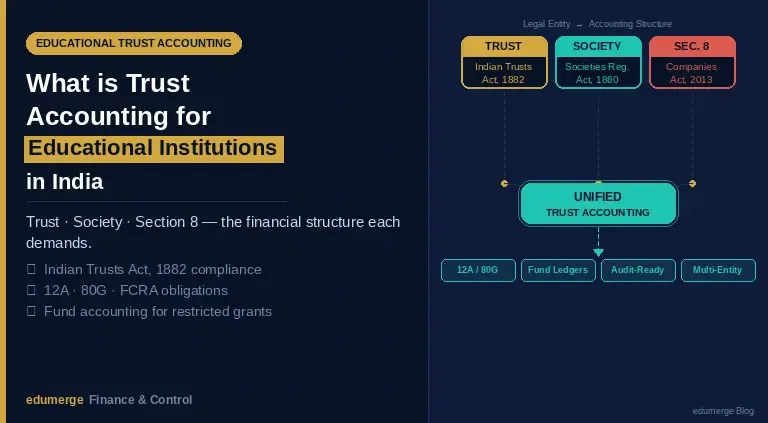
In India, every school, college, or group of institutions operates under a non-profit legal entity. That entity is almost always a public charitable trust, a registered society, or a Section 8 company. And each of these structures carries its own set of accounting obligations, regulatory filings, and financial governance requirements.
Trust accounting for educational institutions in India is the practice of maintaining separate, ring-fenced books for the managing body (the trust or society) that owns the institution. Often distinct from the institution's own operational accounts.
It's not the same as standard double-entry bookkeeping.
It's fund-based, compliance-driven, and structurally bound to the legal entity type under which the institution is registered.
This guide explains what that means in practice, how the three entity types differ financially, and what it takes to stay compliant under Indian law.
TL;DR
Trust accounting for educational institutions in India refers to the maintenance of separate financial books for the legal entity (trust, society, or Section 8 company) that owns & manages an educational institution.
It involves fund-based accounting, income-expenditure statements, compliance with Sections 12A and 80G of the Income Tax Act, adherence to the Indian Trusts Act 1882 or Societies Registration Act 1860, and annual audits. It's distinct from the institution's day-to-day operational accounting.
How Educational Institutions Are Legally Structured in India?
Under Indian law, educational institutions cannot be run on a for-profit basis. Schools, colleges, and universities must be established by one of three types of non-profit legal bodies. Each has its own governing statute, its own management structure, and its own accounting & compliance framework.
Public Charitable Trust - Indian Trusts Act, 1882
A public charitable trust is the oldest & most common vehicle for running educational institutions in India, particularly for family-promoted schools & colleges. Governed by the Indian Trusts Act, 1882, with several states; notably Maharashtra & Gujarat, having additional state-specific legislation (such as the Bombay Public Trusts Act, 1950).
Key financial characteristics:
- Governed by a Trust Deed, which defines the purpose, the trustees, and how funds are managed
- Minimum of 2 trustees required; trustees may hold office for life
- Bank account operations controlled by a single authorised trustee
- Public charitable trusts in Maharashtra must register with the Charity Commissioner
- Audit required if gross income exceeds thresholds specified under state law
- Income & Expenditure Account and Balance Sheet prepared annually
Registered Society - Societies Registration Act, 1860
A registered society is managed by a governing body elected from its membership. It is more democratic in structure than a trust and is often used by community-driven or religiously affiliated educational groups.
Key financial characteristics:
- Minimum 7 members required for registration
- Governed by a Memorandum of Association and Rules & Regulations
- Managed by a governing committee; decisions require collective resolution
- Annual accounts & reports must be filed with the Registrar of Societies
- Audit requirements vary by state; mandatory if income exceeds specified limits
- More stringent reporting obligations compared to a trust
Section 8 Company - Companies Act, 2013
A Section 8 company is the most structured of the three forms. It operates under the Companies Act, 2013, requires a licence from the Central Government, and is subject to the full scope of corporate compliance. Including ROC filings, mandatory CA audits & board-level governance.
Key financial characteristics:
- Managed by a Board of Directors
- Mandatory annual audit by a Chartered Accountant, regardless of income
- Annual returns filed with the Registrar of Companies
- Highest compliance burden, but also highest credibility with donors & government bodies
- Preferred structure for receiving CSR funding & FCRA registration for foreign donations
Also read about making fee collection easy for school groups.
Trust vs Society vs Section 8 - The Financial Differences
| Parameter | Public Charitable Trust | Registered Society | Section 8 Company |
|---|---|---|---|
| Governing Law | Indian Trusts Act, 1882 / State Trust Acts | Societies Registration Act, 1860 | Companies Act, 2013 |
| Minimum Members | 2 Trustees | 7 Members | 2 Directors |
| Root Document | Trust Deed | MoA + Rules & Regulations | MoA + Articles of Association |
| Bank Account Control | Single trustee | President + Secretary / Treasurer | Board of Directors |
| Mandatory CA Audit | State-dependent (above threshold) | State-dependent (above threshold) | Yes; mandatory always |
| Annual Regulatory Filing | Charity Commissioner (where applicable) | Registrar of Societies | Registrar of Companies (MCA) |
| Compliance Burden | Moderate | Moderate–High | High |
| FCRA / Foreign Funding | Possible | Possible | Easiest to obtain |
| Operational Geography | Pan-India (by default) | State-specific (unless all-India reg.) | Pan-India (by default) |
| Dissolution | Irrevocable | Dissolved by 3/5th member vote | Under Companies Act process |
The structure you operate under directly shapes what your finance function must produce; and how often.
What is Trust Accounting? Why Is It Different?
Trust accounting is fundamentally different from commercial accounting in one critical way. Profit is not the objective, and surplus cannot be distributed.
- In commercial accounting, the goal of the books is to determine profitability & guide distribution of returns to shareholders or owners.
- In trust accounting for educational institutions, every rupee that comes in, whether from student fees, donations, government grants, or corpus contributions; must be accounted for against a defined purpose.
- Restricted funds must stay restricted.
- Corpus funds cannot be mixed with revenue receipts.
- Grant utilisation must be traceable, line by line.
This is the principle of fund accounting. Where different pools of money are tracked separately based on their purpose & restrictions. Even when they sit in the same bank account.
The key financial statements in educational trust accounting include:
- Income & Expenditure Account: The educational equivalent of a profit & loss statement, showing revenue receipts against expenditure for the year, with surplus or deficit.
- Balance Sheet: Showing the trust's assets, liabilities, corpus fund & accumulated surplus/deficit.
- Receipts & Payments Account: A cash-basis summary of all money received & paid during the year.
- Fund-wise Utilisation Statements: Required for grants, scholarships & earmarked corpus contributions, showing opening balance, additions, utilisation & closing balance.
Explore how to manage a group of schools in India(without losing control/visibility).
Core Accounting Obligations for Educational Trusts in India
For educational trusts, societies & Section 8 companies operating in India, compliance with the Income Tax Act is as important as maintaining proper books.
Section 12A - Registration for Tax Exemption
A trust or society must register under Section 12A of the Income Tax Act to claim exemption on its income. Provided that income is applied toward charitable or educational purposes.
Without this registration, the institution's surplus is taxable at maximum marginal rate.
Since April 2021, 12A registrations operate on a provisional-then-permanent basis under the revised framework, with mandatory re-registration requirements.
Section 80G - Donor Tax Deduction Certificate
Section 80G registration allows the trust to issue certificates enabling donors to claim tax deductions on their contributions. This is critical for institutions that rely on donation income or CSR funding.
Annual Income Tax Return Filing
All educational trusts must file their income tax returns, typically under ITR-7. The filing must disclose:
- Gross income received
- Application of income toward charitable purposes (85% rule - at least 85% of income must be applied in the year of receipt, or carried forward with stated intent)
- Accumulation of income under Section 11(2) if applicable
- Details of all property held
Statutory Audit
Trusts, societies & Section 8 companies above relevant thresholds must have their accounts audited by a Chartered Accountant (CA) and file the audit report in Form 10B or 10BB with their ITR.
FCRA Registration - For Foreign Donations
Institutions receiving donations from foreign sources must register under the Foreign Contribution (Regulation) Act (FCRA). FCRA requires a dedicated bank account (mandatorily with SBI, as per latest regulations), separate accounting for foreign contributions, and annual online reporting.
Implementation of Accounting Standards in Educational Institutions
The Institute of Chartered Accountants of India (ICAI) has issued guidance notes on the accounting practices applicable to not-for-profit organisations, including educational institutions.
While educational trusts & societies are not currently required to follow Ind AS (Indian Accounting Standards applicable to companies), they are expected to follow generally accepted accounting principles appropriate to their entity type.
Key principles in practice:
- Fund separation: Restricted funds (such as scholarship endowments, lab development grants, or FCRA receipts) must be maintained separately in the books, with clear utilisation tracking. Mixing restricted funds with general income is a common audit finding, and a serious governance risk.
- Depreciation accounting: Fixed assets like land, buildings, lab equipment, furniture, vehicles, must be recorded in the asset register & depreciated appropriately. Many educational institutions run with no formal asset register, which creates reconciliation issues & overstated balance sheets.
- Grant & corpus distinction: Corpus donations (given for perpetuity) must not be treated as revenue income. Similarly, government grants for specific capital purposes must be recognised separately from recurring fee income.
- Accrual vs cash basis: Larger institutions & Section 8 companies are expected to follow accrual-basis accounting. Many smaller trusts & societies still maintain accounts on a receipts-and-payments basis; which, while simpler, does not provide an accurate picture of outstanding payables, receivables, or committed expenditure.
Read about more challenges of running multiple schools under one trust.
Why Generic Accounting Software Fails Educational Trusts?
Most educational groups in India manage trust & institution accounts in separate silos. Trust books are maintained by an external CA, often on Tally, visited once a month. The institution's fee accounts run on a separate fee software. Procurement happens through spreadsheets. Payroll is processed externally.
The result: 4 separate financial records that should tell one coherent story, but they never do.
The specific gaps that generic accounting software creates in an educational trust context:
- No multi-entity architecture. A trust that runs three schools and one college needs four distinct sets of books; and a consolidated view across all of them. Tally requires manual replication across multiple company files. There is no auto-consolidation.
- No education-native fund accounting. Generic software does not understand the difference between corpus & revenue, between a UGC grant & a tuition fee, between a scholarship disbursement & a vendor payment. These distinctions have to be created & maintained manually, with all the error & inconsistency that implies.
- No auto-posting from operations. When a fee collection happens in the fee module, someone has to manually record the journal entry in the accounts. When payroll is processed, someone re-enters the entries in Tally. This duplication is a primary source of reconciliation failures.
- No real-time trust-level visibility. Trustees & CFOs review last month's numbers; prepared manually, often still being reconciled. There is no live view of fund utilisation, outstanding receivables across entities, or budget vs actuals at the trust level.
How edumerge Handles Trust & Society Accounting
edumerge's Finance & Control platform is purpose-built for the accounting & governance complexity of Indian educational institutions. Including full support for trust and society accounting structures.
What this means in practice:
- Separate trust and institution ledgers, connected. The trust or society books are maintained as a distinct entity within the platform. All while sharing a unified chart of accounts and data architecture with the institution. Transactions that flow between entities; grants from trust to institution, capital transfers, inter-entity payables, all post automatically, without manual duplication.
- Education-native fund accounting. The platform understands restricted vs unrestricted funds. Scholarship funds, FCRA receipts, corpus contributions & government grants are tracked in dedicated fund ledgers with full utilisation reporting. So compliance submissions and audit documentation are always current.
- Full double-entry accounting, auto-posted from every module. When fee collections are recorded in the collections module, the revenue journal entries post to the general ledger automatically. When payroll is approved in the HRMS module, the salary expense, PF, ESI & TDS entries post instantly. No re-entry. No reconciliation lag.
- Income & Expenditure, Receipts & Payments, Balance Sheet; on demand. All statutory financial statements required for trust compliance; including the reports needed for 12A/80G filings, annual trust returns & CA audits, are generated directly from live data. Not assembled from exported spreadsheets.
- Multi-entity consolidation for group institutions. Trusts that run multiple schools or colleges get a consolidated financial view across all entities, with entity-level drill-down. Leadership gets one dashboard. Auditors get one system. Finance heads get one general ledger, instead of multiple company files.
- Audit trail and governance controls. Every financial approval; vendor payment, purchase order (PO), expense claim, journal entry, follows a maker-checker workflow. Complete transaction logs with timestamps & user IDs are available on demand, supporting both internal governance and statutory audit requirements.
The Compliance Gap Most Institutions Don't See Until It's Too Late
Trust accounts maintained separately from institutional operations create a dangerous lag.
By the time the CA reconciles last month's books, a grant may have been over-utilised, a fund may have been misclassified, or a statutory deadline may have passed.
A unified system closes this gap by design.
Explore edumerge Finance & Control to see how trust accounting, institution accounting, and multi-entity consolidation work together in a single platform.
Frequently Asked Questions (FAQs)
1. What is trust accounting for educational institutions in India?
Trust accounting is the maintenance of separate financial records for the trust, society, or Section 8 company that owns & manages an educational institution. It involves fund-based accounting; where restricted funds (grants, corpus donations, FCRA receipts) are tracked separately from general income. Along with annual income-expenditure statements, receipts-and-payments accounts, and compliance with the Income Tax Act (Sections 12A, 80G, and ITR-7 filing).
2. What is the difference between a trust, society, and Section 8 company for running a school in India?
A public charitable trust is governed by the Indian Trusts Act, 1882, has the lowest compliance burden, and gives the founding trustee significant control. A registered society operates under the Societies Registration Act, 1860, is more democratic, requires at least 7 members, and has moderate compliance obligations. A Section 8 company is governed by the Companies Act, 2013, has the highest compliance requirements, but offers the strongest governance framework and is most favoured for CSR funding & FCRA registration.
3. What is the 85% rule for educational trusts under the Income Tax Act?
Under Section 11 of the Income Tax Act, a registered charitable trust or society must apply at least 85% of its income toward charitable or educational purposes in the same year it is received in order to maintain its tax-exempt status. If income is not applied within the year, it can be accumulated for up to 5 years for a specified purpose under Section 11(2), with prior intimation to the tax authorities. Failure to meet the 85% threshold results in the unexplained income being taxed at the maximum marginal rate.
4. What financial statements are required for an educational trust in India?
An educational trust operating in India is typically required to prepare the following statements each financial year: Income and Expenditure Account, Balance Sheet, Receipts and Payments Account, and Fund-wise Utilisation Statements. For Section 8 companies, full compliance with the Companies Act's financial disclosure requirements applies additionally.
5. Is Section 12A registration mandatory for educational trusts in India?
Section 12A registration is not technically mandatory, but it is essential in practice. Without it, the trust's income is not exempt from income tax, and the institution faces taxation at the maximum marginal rate on its surplus. Any educational trust or society that intends to claim tax exemption on its income must register under Section 12A and comply with the conditions for application of income under Section 11.
6. What is fund accounting and why does it matter for educational institutions?
Fund accounting is a method of accounting in which resources are allocated to specific "funds". Based on their purpose or source, and tracked separately to ensure that each fund is used only for its designated purpose. For educational institutions, this matters because different categories of income come with specific utilisation conditions. Commingling them with general operational income is a compliance risk and a common audit finding.
7. Can educational institutions in India use standard accounting software like Tally for trust accounting?
Tally can be used for basic double-entry accounting and ledger maintenance. However, it does not natively support fund accounting structures, multi-entity consolidation across trust & institution books, or auto-posting from education-specific operational workflows (fee collections, payroll, procurement).