The HR head of a school/college in India already knows this feeling. Your institution runs on people, but the systems built to manage those people were designed for someone else.
- Generic HR software built for corporate offices misses the academic calendar.
- Spreadsheet-based payroll breaks every June when a new academic year reshuffles grades, designations, and pay scales.
- Compliance obligations that any mid-sized manufacturing company would manage through a dedicated team fall entirely on you. Often while you are also managing recruitment, resolving staff grievances, and preparing for the next board meeting.
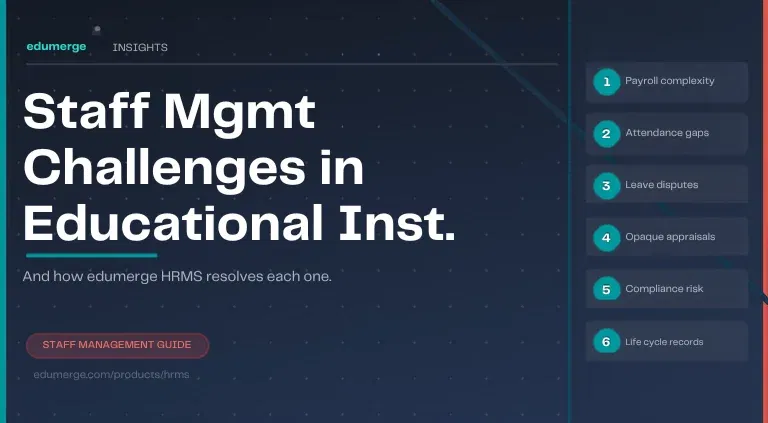
The challenges of staff management in educational institutions are real, specific, and largely unaddressed by off-the-shelf HR tools. This guide names the seven most persistent ones, and maps each to the system-level fix that actually works.
HR Management in Education is Broken
A school or college HR head typically manages a workforce that includes teaching staff (segregated by grade level, subject, and seniority), non-teaching administrative staff, support and housekeeping staff, contractual or visiting faculty, and sometimes hostel or transport staff.
Each with different compensation structures, leave entitlements, working-hour norms, and statutory obligations.
Unlike a corporate organisation, this workforce operates on an academic calendar rather than a financial year. Meaning recruitment cycles, increment decisions, appraisals, and workload allocation all reset on a rhythm that most HR software is not designed for.
Add to this the fact that most private educational institutions in India operate without a dedicated HR department of more than one or two people. Thus, the challenges of managing academic staff compound quickly.
These are not operational inconveniences. They are institutional risks. For staff wellbeing. For regulatory compliance. And for the quality of education the institution can deliver.
Quick-Reference: Challenge → edumerge HRMS
| Staff Management Challenge | edumerge HRMS |
|---|---|
| Complex multi-category payroll with errors and delays | Automated Payroll + Personalised Salary Slips |
| Unreliable manual attendance records | Biometric Attendance Integration (Fingerprint / Facial / RFID) |
| Leave disputes and balance inaccuracies | Digital Leave Management with Payroll Integration |
| Opaque, undocumented appraisals | End-to-End Staff Appraisal Solutions |
| PF, ESI, TDS, Gratuity compliance risk | Integrated Statutory Compliance Processing |
| Fragmented staff lifecycle records | Talent Lifecycle Management (Recruitment to Retirement) |
| Ad hoc, untracked professional development | Training and Development Management Module |
Challenge 1: Managing Payroll Across Complex Staff Hierarchies
The Pain
No two staff members at a school earn under exactly the same terms. A senior mathematics teacher with 14 years of experience and an HRA component earns differently from a junior class teacher who joined mid-year. A contractual visiting faculty member earns per session, not per month. A non-teaching administrative staff member may be on a different pay band entirely.
When payroll is managed manually, or through a generic HR tool that cannot reflect these structures, the result is consistent. Errors, delays, and disputes.
- Salary slips are either not generated or inaccurate.
- Staff advances are tracked informally, then forgotten or disputed.
- PF calculations are run on incorrect basic pay figures.
And when any one of these errors reaches a staff member, trust erodes. Often before the HR head even knows there was a problem.
The Fix: edumerge HRMS - Automated Payroll Built for Education
edumerge HRMS processes payroll across all staff categories simultaneously. Drawing data directly from integrated attendance & leave modules. No manual reconciliation step between who was present, what leave was taken, and what salary is due.
Personalised salary slips are automatically generated for every staff member & delivered digitally. With full pay component breakdowns covering basic pay, HRA, DA, allowances, deductions, advances, and statutory contributions.
Staff advances & repayment schedules are tracked within the same system. Eliminating the informal ledger that causes most advance-related disputes.
The result: payroll that closes on time, every month. Regardless of how complex the staff structure is.
Challenge 2: Tracking Attendance Without Reliable Data
The Pain
Manual attendance registers are the norm in hundreds of schools across India. And these have a well-known problem. They are easily manipulated, routinely incomplete & impossible to audit.
When a teacher marks themselves present on a day they were absent, or when an administrative staff member's register is filled in at the end of the week rather than in real time. The downstream consequences are significant.
- Payroll is processed on inaccurate data.
- Leave balances don't match reality.
- And when a salary dispute arises, there is no reliable record to arbitrate it.
For HR heads at institutions with multiple campuses, the problem multiplies further. Consolidating attendance data from three buildings and reconciling it against payroll manually, every month. It's a significant administrative burden that leaves little time for anything else.
The Fix: edumerge HRMS - Biometric Integration with Real-Time Visibility
edumerge HRMS integrates directly with biometric attendance systems and geo-fencing. Capturing time-stamped, tamper-proof check-in and check-out records across multiple campuses simultaneously.
All attendance data flows automatically into payroll & leave calculations. There is no manual data entry, no end-of-month reconciliation, and no gap between what the system records and what actually happened.
HR heads get real-time staff attendance visibility from a single dashboard. No matter whether they are managing one campus or several.
Challenge 3: Administering Leave in a Calendar-Driven Environment
The Pain
Schools do not operate on a standard 260-day working year. They operate on an academic calendar with term breaks, examination periods, compensatory holidays & institution-specific closure days. All of which interact with leave entitlements in ways that most HR software cannot handle.
- A teacher who applies for 2 days of casual leave during examination week creates a different set of considerations from one who applies during a term break.
- Compensatory leave accrued from Saturday duty needs to be tracked separately from earned leave.
- The sheer volume of leave applications during peak periods (start and end of each term), creates a paper-chase that consumes significant HR bandwidth.
When leave records are maintained on spreadsheets, errors accumulate.
- Staff dispute their balances.
- Approvals happen verbally and are never documented.
- When a payroll deduction is made for unapproved leave, the staff member is encountering that decision for the first time on their salary slip. The worst possible moment.
The Fix: edumerge HRMS - Digital Leave Management with Academic Calendar Alignment
edumerge HRMS handles the full leave lifecycle digitally: application, approval workflow, balance tracking, and payroll integration. All within a single platform.
Leave types are fully configurable to reflect the institution's actual entitlement structure. Including casual leave, earned leave, medical leave, compensatory leave, and maternity/paternity leave.
Because leave data flows directly into payroll, deductions & encashments are calculated automatically & accurately. Staff can view their own leave balances in real time. Eliminating the balance queries that consume a disproportionate share of HR's daily time.
Explore in-detail about leave management in edumerge HRMS.
Challenge 4: Running Fair and Documented Performance Appraisals
The Pain
The challenges of personnel management in education surface nowhere more acutely than in performance appraisals. In most private schools & colleges, the appraisal process is informal, inconsistent, and poorly documented.
- Increment decisions are made by management with criteria that are rarely shared in advance, never explained in writing, and often perceived by staff as arbitrary.
- Teachers who perform well & receive the same increment as a disengaged colleague have no rational basis for continued high performance.
- Staff who receive poor feedback without any development path attached to it are left with the same conclusion: there is no point investing in this institution.
Opaque appraisals are a primary driver of teacher attrition. A dynamic explored in more detail in our piece on how teacher attrition compounds these challenges.
But beyond attrition, they also actively suppress performance among staff who stay.
HR heads often want to fix this. But the obstacle is systemic. Without a platform to structure, document & track appraisal cycles, "improving the appraisal process" remains an aspiration.
The Fix: edumerge HRMS - End-to-End Appraisal Solutions
edumerge HRMS includes a comprehensive staff appraisal module that structures the entire performance review cycle. From criteria configuration, self-assessment workflows & reviewer scoring, to feedback documentation, and final outcome recording. All happen on a single auditable system.
Appraisal criteria can be tailored to the institution's standards & communicated to staff at the start of the review period. Mid-year check-ins can be scheduled & tracked.
At year-end, both the appraiser and the appraisee have a documented record of the review that cannot be revised after the fact. Thus creating a process staff can see, understand, and trust.
Challenge 5: Maintaining Statutory Compliance (PF, ESI, TDS, Gratuity)
The Pain
Schools & colleges employing more than a threshold number of staff are required to remit Provident Fund contributions, ESI contributions (where applicable), deduct & deposit TDS on salaries, and maintain records for gratuity calculations under the Payment of Gratuity Act.
Each obligation has its own calculation methodology, filing schedule, and consequences for non-compliance.
When these calculations are done manually, or through a payroll tool that does not account for education-specific pay structures. Errors are frequent.
- PF is calculated on incorrect basic pay.
- ESI contributions are missed for eligible contract staff.
- TDS is either over-deducted or under-deducted, creating reconciliation problems at year-end.
- Gratuity liability, which accrues silently year over year, is not tracked at all until a long-serving staff member resigns and the liability lands as a surprise.
For the HR head of a school, managing all of this alongside daily operational demands, without a dedicated compliance team. Is among the most acute HR hurdles in the education sector.
The Fix: edumerge HRMS - Integrated Statutory Compliance Processing
edumerge HRMS handles PF, ESI, TDS, and gratuity calculations automatically as part of each payroll cycle. Using the correct pay components for each calculation and generating the statutory reports & challans required for timely filing.
Because compliance processing is integrated with payroll rather than run as a separate step. The risk of calculation errors caused by manual data transfer is eliminated.
HR heads have a single system that processes pay & compliance simultaneously. With a documented audit trail for each statutory obligation.
Challenge 6: Managing the Full Staff Lifecycle, From Hire to Retire
The Pain
A staff member's journey through an educational institution spans recruitment, onboarding, probation, confirmation, transfers, promotions, increment revisions, designation changes, and eventually retirement or resignation. Each of which requires documentation, processing, and record-keeping.
In most schools, these events are managed through a combination of paper files, email threads, and informal records that exist in the memory of whoever has been in the HR role longest. When that person leaves, institutional memory of staff history goes with them.
The practical consequences include:
- inability to reconstruct accurate service records for gratuity calculations,
- disputes over increment history because no documented record exists,
- onboarding that takes weeks because there is no structured process, and
- retirement processing that is handled reactively because no one was tracking years of service in real time.
The Fix: edumerge HRMS - Talent Lifecycle Management, Recruitment to Retirement
edumerge HRMS manages every stage of the staff lifecycle within a single platform. Be it recruitment, offer letter generation, structured onboarding, probation period tracking, confirmation processing, annual increment management, promotion and designation change documentation, transfer processing, or end-of-service workflows including retirement & full-and-final settlement.
Every event is time-stamped, documented, and permanently accessible. Creating a service record that belongs to the institution, not to any individual who happens to be in the HR role at a given time.
When a staff member reaches retirement, the system has a complete, accurate record of their entire tenure. Making gratuity calculation & final settlement processing straightforward, rather than a forensic exercise.
Also read about how teachers are the one thing parents cannot get anywhere else.
Challenge 7: Building a Culture of Professional Development
The Pain
Professional development in schools tends to be ad hoc. A workshop here, an external training programme there, with no structured calendar, no tracking of who attended what, and no link between training completion and career progression.
Teachers who want to grow professionally find that growth is not something their institution actively supports. And eventually, they find somewhere else that does.
This is not primarily a budget problem. Training investment at most schools is modest, and the return on retaining a high-performing teacher for five additional years far exceeds the cost of the training that helped retain them.
The obstacle is organisational. Without a system to plan, track & acknowledge professional development, it cannot be made consistent or credible.
The Fix: edumerge HRMS - Training & Development Management
edumerge HRMS enables institutions to plan & schedule training programmes, record staff participation, track completion, and link development activity to staff career records.
When training is managed as a documented institutional commitment. It's visible to staff, tracked by HR, and connected to career progression decisions. Eventually, it starts being something staff can plan their professional growth around.
The effect on retention is significant. Staff who see investment in their development have substantially higher institutional loyalty.
Moving From Reactive to Systematic
The challenges of staff management in educational institutions are not new. But the scale at which they compound; in schools managing 100 to 1,000 staff, makes them impossible to outrun with manual processes & goodwill alone.
The institutions that are getting this right share one characteristic. They have replaced reactive, manual HR management with a system that handles the recurring, compliance-critical work automatically. Freeing up the HR head to focus on the people dimensions of the role that actually require human judgment.
That is what edumerge HRMS is built to enable. Not just digitised HR, but systematic, scalable, education-specific people management. Across payroll, attendance, leave, appraisals, compliance, lifecycle management, and professional development.
If any of the seven challenges above describes your institution's current reality, the starting point is a closer look at what the right platform can do. Explore edumerge HRMS today.
Frequently Asked Questions (FAQs)
1. What are the main challenges of staff management in educational institutions?
Processing payroll accurately across a complex, multi-category workforce. Maintaining reliable attendance records. Managing leave in an academic calendar context. Running fair and documented performance appraisals. Ensuring statutory compliance for PF, ESI, TDS, and gratuity. Tracking the full staff lifecycle from hire to retirement. Building consistent professional development programmes.
2. Why is HR management in schools different from HR in other sectors?
Due to multiple staff categories (teaching, non-teaching, contractual, visiting faculty), different pay structures, leave entitlements, and statutory obligations for each. They operate on an academic calendar, which means recruitment, appraisals & workload cycles reset on a different rhythm.
3. What does an HRMS designed for educational institutions do differently?
An education-specific HRMS like edumerge is built around the structural realities of school and college HR. It's built specifically for educational workflows, processes and landscape. Unlike generic corporate HRMS, it's built to handle multi-category payroll natively, align leave management with academic calendars, and manage the full staff lifecycle from recruitment through retirement.
4. How does poor staff management affect student outcomes?
The link is direct, even if it is not always visible. Poor HR management drives teacher attrition, and high teacher turnover measurably harms student learning continuity & achievement. It also reduces staff morale & engagement, which affects the quality of teaching in classrooms even before staff leave.
5. What statutory compliances must schools manage for their staff?
Provident Fund (PF) contributions under the EPF Act; Employee State Insurance (ESI) where applicable; Tax Deducted at Source (TDS) on salaries under the Income Tax Act; and gratuity liability under the Payment of Gratuity Act for staff with 5 or more years of service.
6. How can a school manage the staff appraisal process fairly?
Fair appraisals require three things: clear criteria communicated in advance; a structured, documented review process with records accessible to both parties; and outcomes that are consistent with the criteria applied. Without a platform to manage this cycle, it's very difficult to maintain consistency across a large teaching staff, with both fairness & staff trust suffering.
7. Is edumerge HRMS suitable for schools without a dedicated HR department?
Yes. Most private schools in India do not have dedicated HR departments. A single administrator or principal manages HR functions alongside other responsibilities. edumerge HRMS automates the most time-consuming processes so that HR functions can be managed accurately without requiring dedicated specialist headcount.
Some groups still weigh a large enterprise HCM suite before committing to an education-first platform. edumerge HRMS vs Workday HRM walks through why that comparison usually tilts back toward a purpose-built system.