School groups, higher education institutions and multi-campus universities across India are expanding faster than ever. As institutions grow from a single campus to several, scaling operations becomes one of the most pressing questions for trustees, chairpersons and academic leadership.
Rising enrolments and centralised governance expectations have made it harder to run a growing group on disconnected systems.
India's higher education network alone has expanded from 760 universities in FY15 to over 1,400 by FY26. And from roughly 42,000 colleges in FY20 to more than 53,000 in FY26. Alongside this, digital transformation initiatives such as UDISE+ and DIKSHA have pushed even smaller institutions towards structured, digital record-keeping.
For a group running 2 campuses, a spreadsheet & a shared drive can still work. For a group running 10, 15 or 50, the same approach breaks down. Every additional campus multiplies the number of admission workflows, fee ledgers, staff files & compliance filings that leadership has to track separately. Unless the group moves to one connected system.
TL;DR
Scaling operations across a group of institutions requires standardising 10 core areas. Admissions, student information, academics, fee & finance, HRMS & payroll, communication, transport, hostel, compliance & governance, and management reporting.
Every additional campus multiplies the admission workflows, fee ledgers, staff files & compliance filings. That leadership must track separately, unless the group moves to one connected system.
The most effective way to manage all 10 areas simultaneously is through a purpose-built group operating system for multi-campus institutions. An integrated platform that connects governance, finance, HR and academics from a single system.
Core Operational Functions That Must Scale Across Every Campus
Certain operational areas need to be standardised the moment an institution runs more than one campus. The table below outlines what needs to be managed consistently, and the best practice for doing so.
| Operational Area | What Needs to Be Managed Across Campuses | Best Practice |
|---|---|---|
| Admissions | Enquiry-to-enrolment, application forms, seat allocation and merit lists across every campus | Standardise the admission workflow group-wide while allowing campus-specific criteria |
| Student Information Management | Student records, inter-campus transfers, academic history and attendance | Maintain one unified student database that any campus can access with role-based permissions |
| Academics | Timetables, curriculum delivery, examinations and report cards | Use a common academic framework that still adapts to each campus's board or curriculum |
| Fee & Finance | Fee structures, collections, receivables, refunds and campus-wise reconciliation | Centralise fee collection and reconciliation while giving each campus its own ledger view |
| HRMS & Payroll | Staff records, payroll runs, leave and transfers between campuses | Run payroll and compliance from one system so staff moving between campuses keep continuous records |
| Communication | Parent and staff messaging, notices and alerts | Standardise communication channels so no campus depends on informal groups or paper circulars |
| Transport | Route planning, vehicle tracking and driver allocation | Track every vehicle across every campus on one live dashboard |
| Hostel | Room allocation, attendance and mess billing | Manage hostel operations for every campus from a single admin console |
| Compliance & Governance | Statutory filings, audits, accreditation documentation and board reporting | Keep every campus audit ready with document trails the head office can inspect at any time |
| Management Reporting | Consolidated dashboards, campus comparisons and trustee updates | Give leadership one live dashboard instead of spreadsheets rebuilt every month |
11 Major Multi-Campus Operational Gaps edumergeOS Closes
Institutions running each campus on separate tools tend to hit the same operational issues, in ways that get harder to manage as the group grows. edumergeOS, a single platform purpose-built for groups of institutions, addresses each one directly.
1. Fragmented Databases Across Campuses
The Operational Gap: When each campus keeps its own student, staff & finance records, the same person's data ends up duplicated. Campus admins spend hours reconciling numbers that should already match. The head office never has one trustworthy source of truth for the group.
How edumergeOS Closes It: edumergeOS keeps one student, staff & finance database that every campus reads from and writes to. A student's academic history, a staff member's service record and a campus's financial ledger all live in the same system. Every team works from current, shared data rather than a copy that may already be out of date.
2. Inconsistent Processes Across Campuses
The Operational Gap: Without a shared standard, one campus's admission cycle can look nothing like another's. Fee waivers get approved differently depending on who signs off. Comparing two campuses on the same metric becomes guesswork rather than analysis.
How edumergeOS Closes It: edumergeOS standardises the core workflow for admissions, fees and approvals across every campus. The same steps and sign-offs apply group-wide. A campus can still configure its own fee structure, academic calendar or local exceptions where genuinely needed.
3. Duplicate Data Entry
The Operational Gap: Every time a student transfers or a staff member is redeployed to another campus. Someone has to re-key their records, admission history, attendance & payroll details, from scratch. This invites errors and wastes administrative time.
How edumergeOS Closes It: On edumergeOS, records travel with the person. A transferred student's academic file or a relocated staff member's payroll and leave history move directly into the new campus's records. Data is entered once and reused everywhere it is needed.
4. Delayed Approvals
The Operational Gap: When an approval has to move through email threads or physical files, it can sit unattended for days. This is especially true if the approver is travelling or the request needs sign-off from more than one person. Budgets or timelines slip while it waits.
How edumergeOS Closes It: edumergeOS routes procurement, expense and other approvals through defined multi-level approval chains. These move automatically from one approver to the next. With visibility into where a request currently sits. Nothing depends on someone remembering to forward an email.
5. Manual Reporting
The Operational Gap: Reassembling admissions numbers, fee collections & attendance figures from separate campus systems ahead of every board meeting is slow & error-prone. The resulting picture is often already weeks old by the time trustees see it.
How edumergeOS Closes It: edumergeOS replaces that manual reassembly with dashboards that refresh in real time. They pull directly from live campus data rather than a spreadsheet compiled after the fact. Leadership walks into a review with current numbers rather than a snapshot from weeks earlier.
6. Communication Gaps
The Operational Gap: When each campus handles parent & staff communication in its own way. Some through notices, some through informal groups, messages get missed. Records of what was communicated disappear. The head office has no way to confirm a circular actually reached every campus.
How edumergeOS Closes It: edumergeOS gives every campus the same communication layer for notices, alerts and parent updates. Messages are sent, tracked & archived consistently, regardless of which campus initiates them.
7. Limited Head-Office Visibility
The Operational Gap: Without a shared system, trustees & leadership often only find out what is happening at a campus, when it is formally reported to them. Be it a fee shortfall, a staffing gap, or a compliance issue. This can be weeks after the fact.
How edumergeOS Closes It: edumergeOS gives trustees & leadership live, campus-wise dashboards covering admissions, fees, attendance and more. Issues surface as they happen rather than at the next scheduled report.
8. Compliance Risks and Inability to Scale
The Operational Gap: Inconsistent documentation across campuses makes audits harder to prepare for. Every new campus needs its own disconnected setup, so adding campuses becomes progressively slower and riskier rather than easier.
How edumergeOS Closes It: edumergeOS keeps a centralized, audit-ready document trail for every campus. New campuses onboard onto the same platform and workflows already in use elsewhere in the group. They can go live in days rather than the months a separate setup would need.
9. Inconsistent Vendor and Asset Management
The Operational Gap: When procurement, vendor contracts and asset tracking are handled separately at each campus, the same vendor may be negotiated differently at different campuses. There is no group-wide view of what assets exist where, or when they need maintenance or replacement.
How edumergeOS Closes It: edumergeOS consolidates procurement, vendor and asset records into one system. Operations heads get a group-wide view of inventory, contracts and capital assets across every campus.
Explore about the procurement, vendor, asset & inventory management capabilities of edumerge.
10. Weak Access Control Across Systems
The Operational Gap: Data scattered across multiple disconnected tools makes it difficult to enforce who can see or edit. This raises the risk of sensitive student, staff or financial data being accessed by the wrong person at the wrong campus, without anyone noticing.
How edumergeOS Closes It: edumergeOS applies consistent, role-based access control across every campus. This makes a person's access to student, staff or financial data get determined by their role in the system. Not by which campus's local setup they happen to be using.
11. Slow Financial Consolidation Across the Trust
The Operational Gap: Consolidating accounts across campuses for trust or society-level reporting usually means waiting on each campus to close its books separately. The results are then combined manually, a process that can take weeks. If a campus submits a correction late, the whole consolidation often has to be redone.
How edumergeOS Closes It: edumergeOS consolidates finances across the group in real time. So trust or society-level reporting reflects current, campus-wise data rather than a month-end compilation exercise.
These issues compound at the group level as an institution grows, turning small gaps at one campus into governance blind spots for the whole group. edumergeOS keeps every campus on one consistent operating model, with real-time visibility & control for the head office.
Want to go deeper? Read about the 7 challenges of running multiple schools under one trust. It lays out exactly where multi-school trusts get stuck, and what fixes each one.
How edumergeOS Centralises Multi-Campus Operations
edumergeOS brings the entire group onto one operating system instead of stitching together separate products for each campus type.
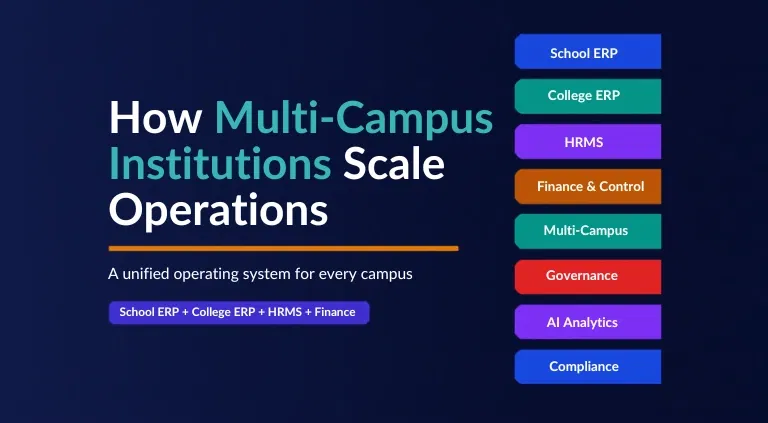
School ERP, College ERP, HRMS, and Finance & Control share a single database. So a change made in one module is visible everywhere it matters, the same day.
| Module | What It Does | Benefit to the Group |
|---|---|---|
| School ERP | Admissions and enquiry management, attendance and timetabling, fee collection with online payments, parent app and communication, transport tracking | Every K-12 campus follows the same admission workflow and fee logic, so a parent at any campus gets the same experience and the group office sees the same data |
| College ERP | Affiliated and autonomous college workflows, OBE framework, NAAC, NBA and NIRF accreditation tracking, exam and result processing, placement and alumni management | Academic governance, accreditation readiness, and placement reporting stay consistent across every college campus, regardless of university affiliation |
| HRMS | Recruitment and onboarding, biometric and geo-fenced attendance, payroll processing, leave and appraisal management, statutory compliance filing, exit and settlement | Every campus's staff lifecycle, from hiring to retirement, runs on one system, so HR policy is enforced the same way whether a teacher is at campus one or campus ten |
| Finance & Control | Society-to-School (S2S) fund flow tracking, multi-level approval chains, Budget vs Actual reporting, live Trustee dashboard | Trustees see one live, consolidated financial position across the group, instead of assembling separate reports from each campus every month |
Every module above sits inside edumergeOS, edumerge's unified operating system for groups of institutions.
And all this while giving real-time visibility for trustees & leadership.
Centralised dashboards let trustees, chairpersons & leadership monitor institution-wide performance. Without waiting for the next board meeting or the next round of campus reports. Instead of reassembling numbers from 9 different tools, leadership works from one live picture of the group. Covering.
- Admissions progress across every campus, in one view, including enquiry-to-enrolment funnel stage, form sales, and confirmed seats by programme
- Fee collections & outstanding receivables, campus by campus, split by fee head, due date, and defaulter ageing
- Student strength & enrolment trends across the group, tracked term over term against sanctioned intake and prior-year numbers
- Attendance patterns for students & staff, flagged by campus, class, or department the moment they fall outside the expected range
- Faculty utilisation across departments & campuses, showing teaching load, vacant positions, and staff available for cross-campus deployment
- Operational approvals pending at each level of the chain, so a request never sits unresolved in an inbox no one is monitoring
- Compliance status for every campus, at any time, covering statutory filings, licence renewals, and audit findings still open
- Campus-wise performance benchmarked on the same basis, so growth at one campus can be compared honestly against another
This kind of real-time, campus-wise visibility is what allows a group of institutions to govern with confidence as it adds new campuses, rather than governing on numbers that are already a month old by the time they reach the board.
Why edumergeOS is the Ideal Operating System for Multi-Campus Educational Institutions
edumergeOS helps groups of institutions move from fragmented campus operations to a unified, scalable operating model. It brings consistent governance, operational efficiency & data-driven decision-making to every campus. This makes it straightforward to add new campuses without adding new operational complexity.
Every additional campus adds operational weight. More admissions to track. More fee ledgers to reconcile. More staff files to maintain, and more compliance filings to keep audit ready. edumergeOS is built to carry that weight on one platform, so growth strengthens governance instead of straining it.
For a group of institutions, the choice is not between growth & control. It is about choosing one platform that lets the two work together. So every new campus makes the group stronger, not harder to govern.
For a college-focused view of this same scaling challenge, 10 Best ERP for Groups of Institutions in India compares platforms specifically on multi-campus governance.
Frequently Asked Questions
1. What does it mean for an educational institution to scale operations across multiple campuses?
It means standardising admissions, academics, fee collection, HR & reporting so every campus runs on the same processes & data, regardless of location.
2. Why do multi-campus institutions struggle with disconnected systems?
Disconnected systems create fragmented databases, duplicate data entry & delayed approvals, which slow decisions and raise compliance risk as an institution grows.
3. What operational areas need to be standardised across campuses?
Admissions, student information, academics, fee & finance, HR & payroll, communication, transport, hostel, compliance and management reporting all need consistent processes across every campus.
4. How does edumergeOS help multi-campus institutions scale operations?
edumergeOS unifies School ERP, College ERP, HRMS and Finance & Control on one platform. Giving every campus the same workflows and giving leadership one live view of the group.
5. Does edumergeOS support both school groups and college or university groups?
Yes. edumergeOS is built for K-12 school groups, affiliated & autonomous colleges, universities, and Groups of Institutions operating multiple campuses under one trust or society.
6. How is edumergeOS different from a traditional ERP built for one campus?
A traditional ERP is usually built around a single campus, while edumergeOS is designed from the ground up for multi-campus governance, reporting & onboarding.
7. What visibility does edumergeOS give trustees and leadership?
Trustees get real-time dashboards covering admissions, fee collections, student strength, attendance, faculty utilisation, approvals, compliance status and campus-wise performance.
8. How long does it take to onboard a new campus onto edumergeOS?
Because every campus runs on the same platform & workflows, new campuses can typically be onboarded in days rather than the months a separate setup would need.
9. Is edumergeOS cloud-based?
Yes. edumergeOS runs on the cloud so every campus, department & stakeholder works from the same live data without on-premise servers at each location.
See how this plays out for real institution groups on edumerge's customers page.