Most education technology decisions are made at the campus level: which ERP should this school use, which platform fits this college. Groups of institutions face a fundamentally different question.
A trust managing 5 schools and 3 colleges does not need 5 separate school ERPs and 3 college ERPs. It needs one unified platform that connects every campus, enforces group-wide policy, consolidates financials in real time, and gives the trustee a single governance dashboard across the entire portfolio.
The platforms that serve individual schools & colleges well are often the wrong answer for education groups. The criteria for a group ERP are different and for that very purpose, this guide evaluates 10 platforms specifically for groups of institutions in India.
TL;DR
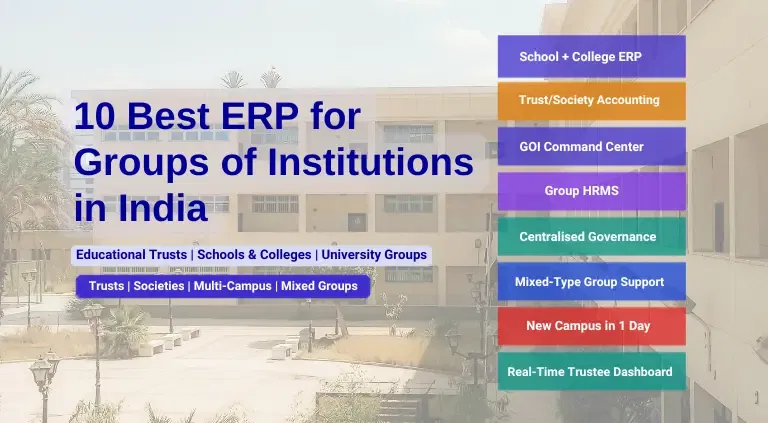
The best ERP for groups of institutions in India is a unified platform where every school, college & campus under the trust or society operates on one database. With centralised governance for the group office & operational autonomy for each institution.
It must handle group-level consolidated reporting, multi-entity trust accounting, group-wide HRMS with inter-campus transfers. Alongside cross-campus fee management, and real-time dashboards for trustees & directors, without manual data consolidation.
edumergeOS combines School ERP, College ERP, HRMS, and Finance & Control on one codebase for education groups managing 2 to 50+ campuses, trusted by 800+ institutions across India since 2013.
Why Most Education Groups Are Running on Disconnected Islands
The operational challenge of an Indian group of institutions is not visible when you look at one campus. It becomes visible when you try to answer a simple trustee question: how many students are enrolled across the group today, and how much fee has been collected this month?
In a group without a unified platform, answering that question requires the group office to call each campus coordinator, wait for reports, manually reconcile numbers from different systems, and compile a consolidated view. By the time it is ready, the data is already days old. This scenario is normal for most Indian education groups, and it is entirely preventable.
The five operational failure modes that define a disconnected education group:
1. Every campus runs its own system
Schools on one ERP, colleges on another, HR on spreadsheets, accounts on a standalone tool, finance on Excel. There is no single view of the group, only fragmented islands of data that never connect.
2. Consolidation takes weeks, not minutes
Group-level financial statements, headcount reports & enrollment numbers require staff to manually pull data from each campus, reconcile it, and compile it every month. By the time it reaches the trustee, the data is already stale.
3. Policy enforcement is impossible
Fee structures, leave policies, appraisal cycles & academic calendars differ across campuses with no way to enforce group-wide standards or monitor compliance centrally.
4. Leadership operates on delayed data
Trustees & directors wait for updates, calls & Excel sheets. They make strategic decisions based on outdated reports. There is no real-time dashboard showing the health of the entire group across academics, finance, HR & operations.
5. New campus onboarding takes months
Adding a campus means fresh ERP implementation, separate configuration, and no inherited group policies. Each new institution becomes another disconnected island, rather than an extension of the governed group.
These are structural problems. They cannot be solved by buying better spreadsheet tools or adding more integrations between separate ERPs. They are solved by deploying a platform where the group is the primary unit and every campus is an extension of it.
10 Best ERP for Groups of Institutions
1. edumergeOS (Top Pick for Indian Education Groups)
The institutional operating system built for Indian education groups
Type: Unified OS for groups of institutions: School ERP + College ERP + HRMS + Finance and Control on one platform.
Key strengths:
- One codebase, one database: School ERP, College ERP, HRMS, and Finance & Control share a single data layer across every campus in the group. Every action in one module updates every related record everywhere else instantly.
- Centralised governance with campus-level autonomy: the group office sets & enforces policies, fee structures, approval chains & academic calendars. Each campus principal operates their own full ERP within those guardrails.
- Mixed-type group support: a trust running both schools & colleges operates both School ERP and College ERP on the same platform without separate products, separate subscriptions, or manual data bridges
- Real-time consolidated dashboards for trustees & directors: live enrollment, fee collection, staff strength, academic performance indicators, and financial health across all campuses at any time
- School ERP: AI timetable with substitution management, competitive exam intelligence, GPS-tracked transport, hostel management, parent and staff help desk, visitor and reception management
- College ERP: OBE with CO-PO, PEO, PSO mapping; NAAC, NBA, and NIRF accreditation management; mentor-mentee management; placement management; alumni management; research and publication tracking
- Group-wide HRMS: vacancy management, recruitment, onboarding, biometric & geo-fencing attendance, leave management, payroll with PF, ESI, TDS compliance, appraisals, and exit management managed centrally with inter-campus staff transfers handled automatically
- Finance & Control: multi-entity trust and society accounting, GOI Command Center for consolidated financial reporting, Budget vs Actual across all entities, Society-to-School fund flow tracking, trustee dashboard, procurement & vendor management, and capital projects planning
- New campus rollout in a day: group templates replicate fee structures, approval chains, HR policies, and academic calendars to any new campus automatically
- Trusted by 800+ institutions managing 500,000+ students across India since 2013
- Named support managers with same-day onboarding and SLA-backed response, not an anonymous ticketing queue
What to note: edumergeOS is purpose-built for the Indian regulatory and operational context; groups with primary international accreditation structures or headquartered outside India may need supplementary compliance modules.
edumergeOS is the only platform in this list designed from the ground up as an operating system for groups of educational institutions rather than adapted from a single-institution product. The shift from disconnected campuses to a confidently governed group follows a clear path: from cause (fragmented systems, no central data) to control (one platform, real-time dashboards, policy enforcement) to confidence (trustees see group health in real time, finance and HR connected end to end, scalable foundation for growth).
2. MasterSoft ERP
Established Indian ERP with strong accreditation and exam management for college groups
Type: India-based college ERP with multi-campus data sharing, examination management, and NAAC compliance tools.
Key strengths:
- Strong examination and result management across affiliated and autonomous colleges
- NAAC and NBA compliance reporting and data management
- Admissions, fee collection, hostel management across campuses
- Multi-campus data sharing for college groups
What to note:
- School ERP & college ERP are separate products rather than a unified OS
- Group HRMS and institutional finance require integration with external tools
- Group-level governance dashboard for trustees is limited
- Mixed-type groups (schools and colleges together) cannot operate on one platform
You might also like this comparison on edumerge vs MasterSoft.
3. Entab CampusCare
Enterprise school ERP with multi-campus capability for premium school chains
Type: India-based enterprise school ERP with 23-plus years in the market, NEP alignment, and GPS and hostel modules.
Key strengths:
- NEP 2020-aligned academic tools built into the core for school groups
- Multi-campus school chain management with centralised governance
- GPS bus tracking, biometric attendance, hostel management natively
- GST-compliant fee receipts and strong parent communication tools
- Established in 1,500-plus premium schools across India
What to note:
- Designed primarily for K-12 schools
- College ERP is outside scope, so mixed groups running both schools & colleges cannot use one platform
- Trust accounting & HRMS across the group require separate tools
- Implementation timelines are longer and pricing is at the premium end
This comparison on edumerge vs entab will make things clearer for you.
4. Fedena
Modular open-source ERP with multi-school dashboard
Type: Plugin-based school and college ERP with open-source community edition, used globally by 40,000-plus institutions.
Key strengths:
- 50-plus modules covering all core school and college operations
- Multi-school management dashboard for basic group-level oversight
- Open-source community edition at no licensing cost
- Long global track record with a large active user community
- Plugin architecture: deploy only the modules required
What to note:
- Group governance depth is limited
- Multi-entity trust accounting, group HRMS with inter-campus transfers, and real-time consolidated trustee dashboards require heavy custom development
- OBE, NAAC, and accreditation management are not core
- UI is dated
- IT-intensive setup and ongoing maintenance
- Mixed-type group support is limited
If you're evaluating, check this comparison between edumerge and fedena.
5. TCS iON Education
Enterprise-grade higher education platform backed by Tata Consultancy Services
Type: Enterprise digital campus platform for large universities, deemed universities, and higher education institutions.
Key strengths:
- Backed by Tata Consultancy Services; strong credibility for large university systems
- Student lifecycle management from admission through alumni
- Digital learning and online assessment capabilities integrated with campus management
- Scalable infrastructure suitable for institutions with 50,000-plus students
- Strong presence in government-linked and large autonomous universities
What to note:
- Not designed for the mixed-type Indian GOI model
- K-12 school ERP and the trust-level governance layer are outside scope
- Implementation cost and timeline are prohibitive for most mid-size education groups
- Trust accounting and inter-campus HRMS for smaller groups are limited compared to purpose-built GOI platforms
6. iCloudEMS
Cloud ERP for higher education groups with NAAC and LMS integration
Type: Cloud-based ERP covering the full academic, administrative, HR, and finance lifecycle for colleges and universities.
Key strengths:
- Full student lifecycle from admissions to alumni on a cloud dashboard
- LMS integration with outcome-based education and NAAC accreditation preparation
- HR, payroll, and finance modules within the platform
- Secure cloud infrastructure with role-based access
- Suitable for affiliated and autonomous college groups
What to note:
- School ERP (K-12) is not a native offering, so mixed-type groups cannot operate on one platform
- Multi-campus group governance and consolidated trustee reporting require configuration
- Trust and society accounting depth for complex GOI structures is limited
Explore the NAAC & NBA accreditation management capability of edumerge.
7. MyLeading Campus
DPIIT-registered India-built ERP for college groups with DigiLocker integration
Type: Indian ERP for colleges and universities with DPIIT registration, DigiLocker partnership, and OBE and NAAC modules.
Key strengths:
- DPIIT registered and ISO 9001:2015 certified Indian platform
- DigiLocker authorized partner for digital mark sheets and certificates
- OBE, CO-PO and PEO attainment, and NAAC management as core features
- Mobile apps for students, faculty, parents, and administrators
- Used by 300-plus institutions across India with government recognition
What to note:
- School ERP (K-12) and mixed-type group support are limited
- Multi-entity trust accounting, group HRMS with inter-campus transfers, and real-time consolidated trustee dashboards are less prominent compared to a purpose-built group OS
8. VAPS Group (i-Vidyalaya)
Established India-based ERP covering K-12 through postgraduate institutions
Type: India-based education ERP covering CBSE, ICSE, state board, and international schools through postgraduate institutions.
Key strengths:
- Covers K-12 schools through postgraduate colleges on one vendor relationship
- Supports CBSE, ICSE, state board, and international affiliations
- Decades of experience in the Indian education ERP market
- Comprehensive modules covering admissions, fee, attendance, exams, and communication
- Strong presence across India including tier-2 and tier-3 cities
What to note:
- A unified codebase OS architecture for mixed groups (schools and colleges on one database) requires verification
- Group governance dashboards for trustees, multi-entity trust accounting depth, and group HRMS with inter-campus transfers are less documented compared to purpose-built GOI platforms
You might also like to read about how edumerge is catering to the Indian education landscape for 14 years now. Using its experience to deliver high quality solutions for educational institutions of all types & sizes.
9. Classter
Global SIS, ERP, and LMS platform with multi-campus scalability
Type: International SIS, ERP, LMS, and CRM on Microsoft Azure, used by 500-plus institutions globally.
Key strengths:
- Unified SIS, ERP, LMS, and CRM on one platform
- Multi-campus support with campus-level and group-level access control
- GDPR compliance built in for schools with international operations
- Microsoft Azure infrastructure with high availability
- Modular pricing: activate only the modules needed
What to note:
- Not built for the Indian regulatory context
- NAAC, NBA, Indian trust accounting, FCRA, PF, ESI & TDS payroll compliance require custom configuration
- Indian academic structures (affiliated colleges, autonomous governance, CISCE board requirements) are not natively supported
- Support model is oriented toward international institutions
10. Skolaro
Wide-coverage school and college ERP with online fee and communication modules
Type: School and college ERP covering student management, HR, payroll, fee, library, hostel, and transport.
Key strengths:
- Covers both school and college institution types under one vendor
- Online fee collection with multi-gateway payment support
- Student management, HR, payroll, timetable, and attendance
- Library, hostel, and transport modules
- Communication tools for parents, students, and staff
What to note:
- Multi-campus consolidated trustee governance dashboards are limited
- Multi-entity trust accounting and GOI Command Center-level financial consolidation are not core strengths
- OBE, NAAC, and accreditation depth for college groups are limited
- AI features and group-level analytics are basic compared to a purpose-built group OS
You might also like to read about edumerge's customer experiences, across 800+ educational institutions in India.
Cross-Platform Capability Matrix: 10 Features Critical for Education Groups
The table below compares 10 capabilities that are specifically critical at the group level, not just at the individual campus level.
| Capability | edumergeOS | Others in this list |
|---|---|---|
| Unified codebase for schools and colleges | Yes, one database for all campus types | Most offer separate products or modules for each institution type |
| Mixed-type group (schools + colleges) | Yes, School ERP and College ERP on same platform | Limited to one institution type in most platforms |
| Trustee and director real-time dashboard | Yes, live cross-campus KPIs without manual compilation | Limited or requires manual data pull in most platforms |
| Multi-entity trust and society accounting | Yes, via Finance and Control + GOI module | Requires separate accounting product in most platforms |
| Group HRMS with inter-campus transfers | Yes, centralised HRMS with transfer workflows | Separate HRMS product needed in all others |
| OBE, NAAC, NBA for college campuses | Yes, native in College ERP module | Available in MasterSoft, MyLeading Campus; limited in school-focused platforms |
| New campus rollout in a day | Yes, via group templates | Typically weeks of configuration in most platforms |
| AI timetable with substitution | Yes, for all school and college campuses | Limited or not native in most platforms |
| Capital projects and capacity planner | Yes, via Finance and Control | Not available in most education ERPs |
| Indian statutory compliance (PF, ESI, TDS, FCRA) | Built in across HRMS and Finance | Requires customisation in global platforms; varies in Indian ones |
This listicle on the Top 10 Multi-Campus Management Software for Educational Groups in India might also help you in your search for the best tech.
What the Best ERP for Groups of Institutions Must Support
These eight capabilities define whether a platform is a genuine group OS or a single-campus ERP that has been extended to support multiple logins. Evaluate every platform you consider against this list.
| Capability | What to Check |
|---|---|
| Mixed-type group (schools and colleges) | Can the same platform operate School ERP and College ERP simultaneously under one group dashboard, without separate products or manual bridges? |
| Centralised governance with campus autonomy | Can the group office set policies, while each campus operates its own full ERP independently within those guardrails? |
| One unified data layer | Do all modules across all campuses share a single database, or does data have to be exported and consolidated manually? |
| Group-wide HRMS with inter-campus transfers | Can staff transfers between campuses be handled in the same system, with payroll, leave, and records automatically following the employee? |
| Multi-entity trust and society accounting | Does the platform manage the trust's books separately from each institution's books, and consolidate them automatically? |
| Real-time consolidated dashboards | Can trustees see live enrollment, fee collection, staff strength, academic performance, and financial health across all campuses right now? |
| New campus rollout in days, not months | Can a new campus inherit the group's fee structures, HR policies, approval chains, and academic calendars automatically? |
| Cross-campus fee consolidation | Can the group view total fee collection, campus-wise outstanding, and fee head-wise breakdown across all institutions in real time? |
Is your education group operating as one organisation, or as a collection of disconnected campuses?
The answer shows at trustee board meetings, at audit time, when a new campus needs to go live, and every time someone asks how many students are enrolled across the group today. edumergeOS is built to make those questions answerable in seconds, not days.
The best ERP for groups of institutions in India is not the one with the most modules on a brochure. It is the one whose architecture starts from the group. Right from unified data, centralised governance, Indian compliance built in, mixed-type campus support, and the ability to add campuses without rebuilding.
edumergeOS is built for exactly that requirement, for education groups across India in 2026.
If you're still scoping what a single-institution platform in this category should cover before adding the group layer, What is a College Management System? A Complete Guide on HEIs is a useful starting point.
Frequently Asked Questions (FAQs)
1. What is a group of institutions ERP?
A group of institutions ERP is a unified platform that manages multiple schools, colleges, or both under common governance on one system. Unlike a single-institution ERP, it includes group-level consolidated reporting, multi-entity accounting, group-wide HRMS with inter-campus transfers, centralised policy enforcement, and real-time dashboards for trustees & directors.
2. What is the difference between a single-institution ERP and a GOI ERP?
A single-institution ERP manages one school or one college end to end. A GOI ERP must do that for every entity in the group simultaneously, while also managing the group-office layer. The group-office layer does not exist in a single-institution ERP. It cannot be added through configuration; it requires an architecture designed for the group from the start.
3. What is the GOI Command Center in edumerge?
The GOI Command Center is the Finance & Control module's consolidated financial governance layer for groups of institutions. It provides role-based dashboards for CFOs and trustees, cross-entity financial reporting, Society-to-School fund flow tracking, Budget vs Actual across all entities, and visual approval workflows for group-level finance decisions.
4. How long does it take to add a new campus to edumergeOS?
edumergeOS supports a new campus rollout in one day using group templates. Fee structures, HR policies, approval chains, academic calendars, and access control settings from the group's existing configuration replicate to the new campus automatically. The new campus is operational the same day, rather than requiring weeks of fresh implementation.
5. What makes edumergeOS different from deploying multiple separate ERPs for each campus?
When each campus runs its own ERP, the group has no shared data, no policy enforcement, no consolidated reporting, and no group governance. Consolidation requires staff to manually pull data from each system every month. edumergeOS starts from the opposite principle: the group is the primary unit. Every campus is an extension of the group, not a separate installation.
Some groups default to a general enterprise ERP for this governance layer instead. edumerge vs Oracle ERP compares that route against an education-first platform built for the same group structure.