Running a single school is hard. Running 5, 10, or 20 under one trust? That is an entirely different category of problem.
Education trusts, no matter whether they manage K-12 schools, colleges, or a mix of both, are built on a straightforward promise. To give every institution the backing of a larger organisation, while preserving each campus's identity & academic focus.
In practice, the challenges of running multiple schools under one trust often undermine that promise. Visibility disappears. Policies drift. Finance teams drown in spreadsheets. IT grows into a patchwork of incompatible tools.
The good news is; these challenges are structural, not inevitable. They tend to follow a predictable pattern. And once you name them, you can fix them.
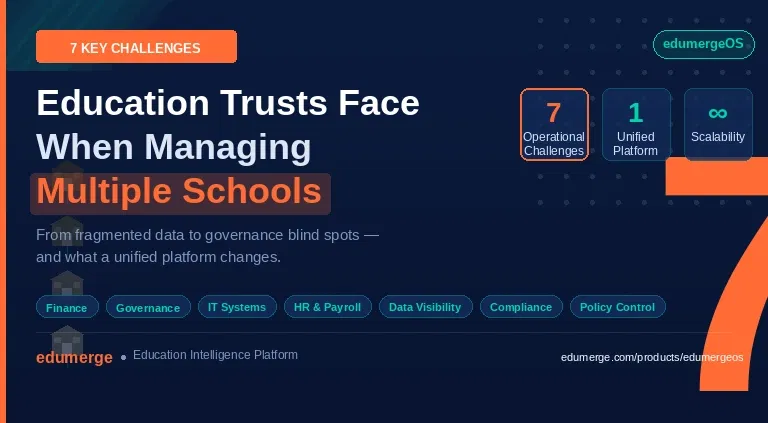
7 Challenges Education Trusts Face When Managing Multiple Schools (And How to Fix Them)
Below are the seven most common challenges multi-campus education groups face. Alongside why they happen, and what it looks like when they are solved.
Challenge 1 — Every Campus Runs on a Different System
This is almost always where the trouble begins.
As an education trust grows; adding schools, merging with existing institutions, or acquiring campuses, each entity typically brings its own legacy software.
One school uses a local ERP. Another runs admissions from spreadsheets. A third has its own fee collection tool. The trust's HR is on a different platform altogether. Finance is consolidated manually, usually in Excel.
The result is a group of disconnected data islands with no common language between them.
- A student transfer between campuses requires manual re-entry of records
- Fee collection data from Campus A does not automatically inform the group's financial dashboard
- Headcount reports need to be physically requested from each principal
This fragmentation is the single root cause behind most of the challenges multi-academy trusts are facing today.
What resolution looks like: A platform like edumergeOS is built from a single codebase and a single database. Meaning School ERP, College ERP, HRMS, and Finance & Control are not stitched together. They are the same system. Every student, every employee, every rupee, across every campus, lives in one connected layer; accessible in real time, without reconciliation.
Challenge 2 — Financial Consolidation Takes Weeks, Not Minutes
Ask any CFO of a multi-school trust how long month-end consolidation takes. The answer is rarely flattering.
When each campus runs its own accounts; whether in Tally, a local ERP, or a spreadsheet. Pulling together a group-level financial picture requires staff to manually export, reformat, cross-check, and re-enter data from multiple sources.
Errors creep in. Timelines slip. The consolidated statement that finally arrives on the trustee's desk is already 2-3 weeks old by the time a decision needs to be made.
Key financial pain points in multi-campus trust management:
- Multiple fee structures that do not map to a unified chart of accounts
- No cross-campus view of outstanding receivables or fee defaults
- Grant tracking happening in isolation from general institutional accounts
- Payroll from different campuses feeding separately into the ledger (or not at all)
- Year-end audit prep requiring a manual reconstruction of transactions
This is one of the most significant risks in growing an academy trust. The larger the group, the more financially opaque it becomes. Unless the finance infrastructure scales in parallel.
What resolution looks like: edumerge's Finance & Control module supports Trust/Society Accounting & Consolidation natively. Fee collected at any campus auto-posts to the group ledger. Consolidated revenue reports update in real time. There are no exports, no manual reconciliation, and no waiting for month-end.
Challenge 3 — Policy Enforcement Breaks Down Across Campuses
Education trusts exist, in part, to standardise quality. The trust sets the academic calendar. It establishes the leave policy. It decides the fee revision cycle and the procurement approval workflow. On paper, every campus follows the same framework.
But in practice? Drift is inevitable when policy lives in email threads, PDF circulars, and verbal instructions.
One campus issues a different fee structure from the others. Leave policies are interpreted loosely by individual HR staff. Appraisal cycles run at different times across schools. Academic calendars fall out of sync.
The trust's governance framework exists, but its enforcement has no mechanism. No system that translates a group-level policy into campus-level behaviour.
This is one of the most quietly damaging challenges multi-academy trusts are facing. Because it erodes the core value of being a trust in the first place.
What resolution looks like: edumergeOS is architected with centralised policy control and campus autonomy as native features, not afterthoughts. A policy change at the group level' fee structure, leave rules, academic calendar: cascades to every campus automatically. Campus teams retain the flexibility to operate within those guardrails; they cannot override them unilaterally.
Challenge 4 — Trustees Are Always Operating on Delayed Data
This challenge is less visible than the others. But its consequences are the most consequential.
Trustees & group directors are responsible for the strategic health of the entire group. Enrolment trends. Revenue per campus. Compliance status. Staff attrition. Academic outcomes. To govern well, they need to see all of this; accurately, quickly, and without having to chase 6 different principals for a weekly update call.
Instead, what most trustees experience is: decisions made on last month's data. Reports compiled over days. Numbers that conflict between sources. A group dashboard that is actually a presentation someone put together in PowerPoint.
The IT challenges in a Multi-Academy Trust are often felt most sharply at the leadership level. Not because trustees use the IT tools directly. But because the absence of good infrastructure means they never see a reliable picture of the group they are governing.
What resolution looks like: edumergeOS gives trustees & group directors a single real-time dashboard showing enrollment, revenue, expenses, compliance status, and academic outcomes across every entity in the group. Without waiting for anyone to compile a report. The data is live, drillable to campus level, and always reconciled.
Challenge 5 — IT Complexity Multiplies with Every New Campus
Each new campus added to the group does not just add students. It adds an ERP licence, a support contract, a set of user credentials, a data migration problem, and a new integration headache.
IT teams in multi-campus academy/school groups routinely manage 5-10 different platforms simultaneously. And none of them talk to each other reliably.
- Single sign-on does not work across tools
- Role-based access has to be configured separately in every system
- When a staff member moves from one campus to another, their access records need to be updated on multiple platforms
- A system update in one tool can break the fragile integration with another
This is the operational reality behind the IT challenges in a Multi-Academy Trust. It's not that any one tool is bad. It is that, 5 mediocre tools wired together create more problems than any of them solve individually.
What resolution looks like: edumergeOS is one platform, not a bundle. IT teams manage a single system with centralised user management, role-based access (RBAC) across all entities, and zero integration overhead. Adding a new campus means a phased rollout on the same platform, not procuring another vendor. From 3-campus groups to 50-campus networks, the IT footprint does not multiply.
Challenge 6 — HR & Payroll Compliance Becomes a Group-Wide Risk
A trust employing staff across multiple campuses is a single employer in the eyes of most statutory & regulatory frameworks. But it often operates like several different ones.
- HR processes vary by campus
- Leave balances are tracked in different tools (or not tracked digitally at all)
- Attendance records from one school do not flow into the group's payroll system
- Staff who move between campuses lose continuity of their records
- Appraisals are conducted on different timelines
- Payroll for one campus is processed on the 25th; another runs on the 1st
- Statutory filings like PF, ESI & TDS happen in silos
The risk is not just operational inefficiency. Inconsistent payroll and compliance practices are a genuine risk in growing an academy trust. Risking the group's exposure to statutory penalties and making talent management across campuses nearly impossible.
What resolution looks like: edumergeOS's HRMS module provides centralised workforce visibility across all campuses. From standardised policies, biometric & geo-fenced attendance, to automated payroll with statutory compliance, and F&F management. All managed from one place. Monthly payroll across campuses auto-generates the corresponding journal entries in the group accounting ledger. HR & Finance are connected, not separate.
Also read about how to reduce teacher turnover.
Challenge 7 — Audit, Governance and Accreditation Pressure Mounts
The larger and more established a trust becomes, the more scrutiny it faces.
Governing body meetings need to be documented with minutes, resolutions, and action trails.
Financial audits require complete, traceable transaction histories across every entity.
If any campus is pursuing accreditation, NAAC, NBA, NIRF, the evidence collection and institutional KPI tracking demands months of manual effort unless processes are digitised.
For most multi-campus groups operating on fragmented systems, governance & audit readiness is reactive. Not built-in.
Documents are scattered. Audit trails are incomplete. Accreditation preparation happens in a scramble every few years. Rather than as an ongoing, documented process.
What resolution looks like: edumergeOS includes a dedicated Governance & Compliance module with Governing Body Dashboards, Audit Trails & Logs, Institutional KPI Tracking, and Accreditation Management (NAAC, NBA, NIRF) with step-by-step workflows & evidence mapping. Governance is not a bolt-on. It is built into the same system running academics, finance, and HR.
Quick Comparison: Fragmented Systems vs. One Unified Platform
| Function | Fragmented Setup | edumergeOS |
|---|---|---|
| Financial Consolidation | Manual, weeks per cycle | Real-time, automatic |
| Policy Enforcement | Email circulars, inconsistent | Group-level cascade, enforced |
| Trustee Visibility | Delayed reports, spreadsheets | Live dashboard, group-wide |
| IT Management | 5–10 systems, constant overhead | One platform, centralised access |
| HR & Payroll | Campus-by-campus silos | Unified, statutory-compliant |
| Audit Readiness | Reactive, document scramble | Built-in audit trails, always on |
| Scaling a New Campus | New vendor, new integration | Phased rollout on same platform |
The Way Forward for Education Groups
The challenges outlined here are not new. Trustees of growing education groups have wrestled with them for years.
What is new, is that the architectural solution now exists. A single platform built specifically for the way group institutions actually operate. Not retrofitted from a single-campus product.
The move from fragmented, campus-by-campus operations to a unified, governed group is not a technology project. It is a strategic one. But the right technology makes it possible at a speed & scale that manual processes never could.
If your trust is experiencing two or more of these challenges today, the conversation worth having is not about which tool to patch the current pain. But about what the group's operational foundation should look like at 3, 5, or 10 times its current size.
See how edumergeOS is purpose-built for education groups managing multiple schools, colleges, HR and finance on one unified platform.
Frequently Asked Questions (FAQs)
1. What are the biggest challenges of running multiple schools under one trust?
The most common challenges are fragmented systems with no shared data & slow financial consolidation. Added with inconsistent policy enforcement across campuses, delayed reporting for trustees, and multiplying IT complexity. Compounded with HR & payroll compliance risks, and growing governance & audit pressure.
2. What are the key risks in growing an academy trust?
The primary risks include financial opacity as campuses scale, and policy drift when group-wide standards cannot be enforced digitally. Also, statutory compliance gaps in HR & payroll, and governance failures when audit trails are incomplete or dispersed across systems.
3. What IT challenges do Multi-Academy Trusts commonly face?
Multi-Academy Trusts typically manage 5 or more disconnected platforms that do not share data. From ERPs & HR tools, to finance software, and communication tools. Single sign-on (SSO) is often broken, integration is fragile, and every new campus multiplies the overhead.
4. How do academy school groups maintain policy consistency across campuses?
The most effective approach is centralised policy control with campus-level autonomy built into the platform. Where a change at the group level automatically cascades to all entities, and campus teams operate within defined guardrails rather than relying on manual communication.
5. Can a single ERP platform really handle schools and colleges in the same trust?
Yes. Platforms like edumergeOS are designed specifically for mixed-entity education groups. Combining School ERP, College ERP, HRMS, and Finance & Control on a single codebase and database. This means no integration overhead and a genuinely unified data layer across every type of institution in the group.