Every year, thousands of qualified teachers walk out of Indian school gates. And they generally don't come back.
Not because they stopped caring about students. Not because they found a better calling. But because the schools they worked for failed them in three painfully preventable ways:
- they paid late,
- they appraised opaquely, and
- they recognised almost nothing.
If your school is facing rising teacher attrition, stagnant student performance, and a revolving door in the staffroom. This guide is for you.
We will walk through the real root causes of the teacher retention crisis in India. How teacher turnover harms student achievement, and what you, as a school leader, can do right now to turn things around.
The Teacher Retention Crisis in India
India's teacher attrition problem is not a new story. But the scale of it is still shocking when you look at it directly.
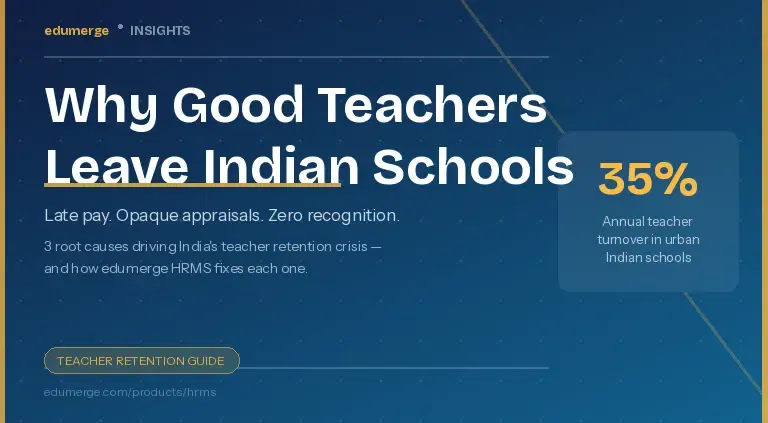
Private and unaided schools, employing a majority of India's teaching workforce, face annual teacher turnover rates estimated between 20-35% in urban centres. This data is according to sector practitioners & ASER-adjacent research.
In tier-2 and tier-3 cities, the picture is often worse. Rural government schools face chronic vacancies that have persisted for years.
What makes this a crisis rather than a routine HR challenge, is the compounding effect. When a teacher leaves mid-year, a school does not simply lose one employee. It loses:
- Months of onboarding investment
- Continuity for the students that teacher was building
- Institutional knowledge about student cohorts
- Morale across the remaining staff
And the replacement, if one is found at all, often arrives underprepared, mid-semester. Most of the time, into a classroom that has already lost learning time.
The teacher retention crisis in India is, at its core, a management systems problem. As much as it is a compensation problem.
Schools that have fixed their systems retain far better. Even without always paying the highest salaries in their market.
Also read about: How to manage teacher attendance in schools in India?
Why Good Teachers Leave: 3 Root Causes
Exit interviews, research surveys, and on-ground conversations with teachers across India consistently surface the same trio of grievances. Understanding these is the first step toward building effective teacher retention strategies.
Root Cause 1: Late and Unpredictable Pay
Ask any teacher who has left a private school in India. Salary delays will come up almost immediately. Not necessarily low salaries, but late salaries.
Teachers have EMIs, school fees for their own children, or household obligations. They cannot absorb a three-week payroll delay, the way a salaried employee at a large corporation might.
When payroll is manual, error-prone, and disconnected from attendance & leave records. Delays are almost inevitable.
Staff may even receive incorrect amounts at times. Deductions are applied inconsistently. PF contributions go unremitted.
The cumulative effect is a deep erosion of trust. And trust, once lost, is rarely rebuilt before the resignation letter arrives.
Root Cause 2: Opaque and Arbitrary Appraisals
"I have no idea how my increment is decided." This is one of the most common statements teachers make when asked about their experience of performance management in Indian schools.
In many institutions, appraisals happen once a year. if at all. With criteria that are vague, undocumented, or inconsistently applied.
Teachers who perform well and receive the same increment as a peer who rarely shows up have no rational reason to continue performing well.
And teachers who receive poor feedback with no clear rationale, no prior conversation, and no development path attached to it are left with little recourse except to leave.
Opaque appraisals do not just fail to retain good teachers. They actively reward mediocrity and punish excellence.
This is the opposite of what any school that cares about teacher quality and retention should be doing.
Root Cause 3: No Recognition, No Growth Path
The third root cause is perhaps the hardest to fix with a spreadsheet. Teachers who feel invisible.
Teaching is one of the most demanding professional roles in existence. It requires emotional labour, intellectual agility, and sustained energy. Every single working day.
When that effort goes unacknowledged: no structured recognition, no career progression framework, no investment in professional development, teachers burn out faster and look elsewhere sooner.
Teacher retention and burnout are directly linked.
Schools that track teacher workload, invest in training, and create clear career pathways retain significantly longer.
Schools that don't, create a cycle of attrition that costs them far more than a recognition programme ever would.
Explore how edumerge HRMS targets to solve all these root causes in educational institutions.
How Teacher Turnover Harms Student Achievement
Before moving to solutions, it is worth dwelling briefly on this. Teacher turnover is not just an HR problem. It is a student outcomes problem.
The research evidence here is unambiguous:
- Students with high teacher turnover in their class demonstrate measurably lower learning gains in literacy and numeracy. As compared to students with stable teachers.
- The impact is disproportionately severe for students from disadvantaged backgrounds. Who rely more heavily on school for their primary learning environment.
- Frequent teacher changes disrupt classroom culture, trust-building, and the differentiated instruction that only comes when a teacher truly knows their students.
- Schools with high attrition also experience declining enrolments over time. As parent communities, particularly in private school markets, are highly sensitive to faculty stability.
The cost of teacher attrition, when calculated fully: recruitment, onboarding, lost productivity, and student learning loss, can run to ₹1.5-₹3 lakh per teacher exit, in a mid-sized private school.
Schools that reduce annual turnover by even 5 teachers recover significant operational budgets.
Reducing teacher turnover is not just the right thing to do for teachers. It is the right thing to do for students, parents, and the institution's long-term standing.
Effective Teacher Retention Strategies That Actually Work
With the root causes clear, here are the strategies that research & practice support. These are not aspirational ideas. They are implementable decisions that school leaders can begin making this academic year.
Strategy 1: Automate Payroll and Make It Predictable
The single highest-impact change most private schools can make is ensuring that salary is disbursed on time. Every time. And with a clear and accurate breakdown.
- Automated payroll: linked directly to attendance & leave data, eliminates the manual processing delays that cause most salary errors & lags.
- Personalised salary slips, delivered digitally to each staff member, add a further layer of transparency.
When a teacher can see exactly how their gross pay was calculated, what deductions were made, and what was remitted to PF. The anxiety & mistrust that come with opaque payroll, disappear.
Strategy 2: Implement Structured, Data-Backed Performance Appraisals
Move away from annual, subjective conversations. Build an appraisal cycle that is transparent, criterion-based, and tied to development outcomes. Not just increments.
Effective appraisals involve:
- Clear criteria communicated at the start of the academic year
- Mid-year check-ins, not just year-end reviews
- Documentation of feedback shared with the teacher
- Development goals set collaboratively between the teacher & management
- Recognition built into the appraisal outcome, not as an afterthought
When teachers understand what they are being assessed on, can see their own performance data, and receive feedback they trust as fair. Retention improves substantially.
Strategy 3: Reduce Administrative Burden
Administrative overload is one of the most underappreciated drivers of teacher burnout in Indian schools.
Teachers who spend significant portions of their week on attendance registers, manual report filling, and paper-based documentation have less energy for the actual work of teaching. And, therefore, less satisfaction with their jobs.
Reducing teacher stress & improving retention often starts with reducing the amount of non-teaching work teachers are asked to do.
Digital systems, today, automate attendance marking, leave applications, report generation, and communication workflows. Directly restoring time & energy to teachers; improving retention without any salary change.
Also read about automated leave management for educational institutions.
Strategy 4: Invest in Professional Development
Teachers who feel they are growing professionally stay longer. Build a structured training calendar into the academic year. Not ad hoc workshops. But planned, documented development that is tracked & acknowledged.
Link training completion to career progression. When teachers see a credible path from classroom teacher to department head to academic coordinator. And when that path is tied to transparent criteria. They have a reason to invest in the long term at your institution.
Strategy 5: Create Cultures of Recognition
Formal recognition does not need to be elaborate to be effective. A structured system of acknowledgement, whether a monthly spotlight, an end-of-year award, or simply a digital record of achievement that teachers can see; signals that the institution values its people.
Recognition programmes cost far less than recruitment cycles. They are one of the highest-ROI strategies to retain the best teachers in schools.
How edumerge HRMS Addresses Every Root Cause
All five strategies above depend on one thing. The right systems in place to execute them consistently.
This is exactly what edumerge HRMS is built to do. Provide educational institutions with an end-to-end talent lifecycle management platform, purpose-built for schools & colleges in India.
Here is how edumerge HRMS addresses each root cause of teacher turnover directly:
On Late Pay: Automated Payroll with Personalised Salary Slips
edumerge HRMS processes payroll accurately & on schedule. By drawing directly from integrated staff attendance & leave management data.
There is no manual reconciliation step that introduces delays or errors.
Personalised salary slips are automatically generated & delivered to each staff member's email. Giving every teacher full visibility into their pay breakdown.
Staff advances and repayment schedules are tracked within the same platform. Eliminating the informal ledger chaos that causes disputes in many schools.
On Opaque Appraisals: Comprehensive End-to-End Appraisal Solutions
edumerge HRMS includes comprehensive end-to-end staff appraisal solutions that make performance management transparent, structured, and documented.
Criteria can be configured to the institution's needs. Review cycles are tracked. Feedback is recorded & accessible.
When appraisals are run on a system that both management & teachers can see. The "opaque black box" experience that drives so much teacher attrition disappears.
Teachers trust the process more. Management makes better, evidence-based promotion decisions.
On No Recognition/No Growth: Training Management and Career Tracking
edumerge HRMS supports structured training & professional development management. Allowing schools to plan, schedule, and track training completion for all staff.
Linking development activity to career records creates the documented growth path that keeps ambitious teachers engaged.
For institutions looking to build end-to-end talent lifecycle management; from recruitment right through to retirement, edumerge HRMS manages every stage. Right from recruitment & onboarding, to attendance, leave, payroll, appraisals, training, and retirement processing.
On Administrative Burden: Integrated Attendance, Leave, and Biometric Systems
Staff attendance in edumerge HRMS integrates directly with biometric systems. Including fingerprint & geo-fencing, for tamper-proof, time-stamped check-ins that require no manual entry from teachers.
Leave applications and approvals are handled within the same platform. Through a digital workflow that replaces paper forms & email chains.
The result? Teachers spend less time on administrative tasks, fewer salary errors occur, and principals have real-time workforce data. All without anyone, ever chasing individual departments.
To explore the full feature set and see how it maps to your institution's specific challenges, visit the edumerge HRMS product page.
Quick-Reference: Retention Problem to HRMS Fix
| Root Cause of Teacher Attrition | edumerge HRMS Feature |
|---|---|
| Late, inaccurate salary disbursement | Automated Payroll + Personalised Salary Slips |
| Opaque, arbitrary appraisals | End-to-End Staff Appraisal Solutions |
| No professional development tracking | Training Management Module |
| Administrative overload and burnout | Biometric Attendance + Digital Leave Management |
| Inconsistent advance/deduction tracking | Staff Advances & Repayment Tracking |
| No career visibility or progression | Talent Lifecycle Management (Recruitment to Retirement) |
| PF/ESI compliance anxiety | Statutory Compliance Processing |
The Bottom Line
India's teacher retention crisis is serious. But it is not unsolvable.
The schools that are successfully retaining their best teachers are not necessarily the ones paying the highest salaries. They are the ones that have made a structural commitment to treating teachers with operational respect.
Paying on time. Appraising fairly. And recognising consistently.
These are not aspirational values. They are system design choices. And the right platform makes all three achievable. Even for schools without dedicated HR departments.
If your school is ready to move from managing turnover to preventing it, explore edumerge HRMS. Built specifically for educational institutions. Trusted by 800+ schools across India.
Frequently Asked Questions (FAQs)
1. What is the main reason for teacher turnover in Indian schools?
The most commonly cited reasons for teacher attrition in Indian schools are: delayed or inaccurate salary payments, lack of transparent performance appraisals, inadequate recognition for effort, high administrative workload, and limited professional development opportunities.
2. How does teacher turnover affect students?
High teacher turnover directly disrupts student learning continuity. Students taught by frequently changing teachers show measurably lower gains in core skills, particularly in early grades. Teacher attrition also negatively affects classroom culture, reduces trust between students & teachers, and over time impacts school enrolment. As parents become aware of teacher instability.
3. What are the most effective teacher retention strategies for Indian schools?
The most effective strategies are: automating payroll for on-time, accurate disbursement; implementing structured & transparent appraisal cycles; reducing non-teaching administrative workload; investing in professional development; and building systematic recognition programmes.
4. How can an HRMS help reduce teacher turnover?
An HRMS designed for educational institutions, like edumerge HRMS, automates payroll, leave, and attendance to eliminate the administrative errors that lead to salary disputes. It provides structured appraisal workflows to replace subjective, undocumented reviews. It tracks training & career milestones to give teachers a visible growth path. Together, addressing the 3 most common root causes of teacher attrition.
5. What is teacher attrition costing Indian schools?
When the full cost of teacher attrition is calculated; including recruitment advertising, interview time, onboarding investment, substitute costs during the vacancy period, and the learning loss incurred by affected students. Each teacher exit in a mid-sized private school can represent a cost of ₹1.5-₹3 lakh or more. Schools with 20–35% annual turnover are absorbing this cost repeatedly, often without realising it.
6. How can school management reduce teacher stress and improve retention?
Reducing teacher stress starts with reducing non-teaching workload. Be it automating attendance marking, leave applications, or report generation. Pair this with predictable, on-time salary disbursement & regular, transparent feedback cycles. Teachers who feel administratively supported, fairly compensated, and professionally recognised are significantly less likely to burn out or resign.