Managing college finances is not the same as managing the accounts of a mid-sized business. The financial engine of a college runs on dozens of parallel tracks.
Between tuition receipts & scholarship disbursements, grant utilisation & vendor payments, payroll posting & audit compliance. When these tracks are not connected, the institution pays the price.
This guide breaks down the real complexity behind college financial management. Diving into why the "spreadsheet + Tally" model breaks down at scale. And what effective management actually looks like in practice.
Why College Finance is More Complex Than It Looks?
College financial management is complex because it spans multiple revenue streams. Be it tuition, grants, hostel, transport, or multiple departments, regulatory compliance obligations, or legal entities like college, trust, or society.
Managing these in silos leads to reconciliation delays, audit gaps, and revenue leakage. Most college finance teams are managing far more than a ledger. On any given day, they are:
- Collecting fees across tuition, hostel, transport, library, lab & exam heads
- Tracking scholarship disbursements and government grant utilisation
- Processing vendor payments through indent-to-invoice workflows
- Running payroll that posts to the books automatically, or manually, if the system isn't integrated
- Preparing reports for governing bodies, NAAC accreditation, or statutory audits
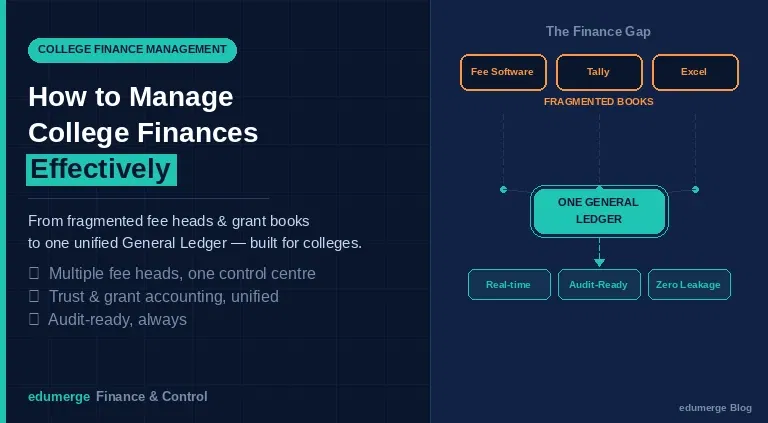
Each of these functions generates financial data. But in most institutions, that data lives in different places. A fee software here, Tally there, an Excel sheet somewhere else.
The result is that your finance team spends enormous time & energy stitching numbers together, rather than acting on them.
The Problem With Multiple Fee Heads and Fragmented Books
A typical college may have anywhere from 8 to 30+ distinct fee heads. From tuition, exam fees, library fees, lab charges & hostel rent, to mess charges, bus pass fees, development fund, and more.
Each of these may be collected by a different department, at different times, through different channels. Here's what that looks like in practice:
- The hostel office collects mess fees in cash & updates its own register
- The exam cell raises exam fee demands manually & reconciles separately
- The central accounts team has no real-time view of what has been collected vs. what is outstanding across these heads
- End-of-month consolidation requires chasing every department for numbers
This fragmentation creates several compounding problems:
1. Revenue Leakage: When fee collection is not linked to a central ledger, small amounts fall through the cracks. Partial payments go untracked. Waiver approvals happen without audit trails.
2. Reporting Delays: Without consolidated data, preparing a complete fee collection report takes days instead of minutes. Governing body meetings run on last month's data, not today's.
3. Compliance Gaps: Regulatory requirements: whether FCRA for foreign donations, UGC grant utilisation norms, or statutory audit requirements. All demand precise, traceable documentation. Fragmented books make this nearly impossible.
4. Inability to Spot Patterns: When hostel, academic & transport fees are tracked in separate systems, it's hard to identify which student cohorts are at risk of defaulting. Or even which fee head has the highest outstanding balance.
You might also like to know about online fee collection using edumerge.
What does a General Ledger Have to Do With All This?
The general ledger is the foundational record of all financial transactions in an institution. Every fee collection, every payroll entry, every procurement payment, every grant receipt; all of it should ultimately post to one general ledger.
In practice, most colleges don't have this. They have:
- A fee software that tracks collections, but doesn't post to accounts
- Tally that records entries manually, based on reports from other systems
- Excel sheets that summarise procurement spends by department
- A trust/society ledger that is maintained completely separately
The consequence: the same transaction gets recorded (or missed) in multiple places. With reconciliation becoming a weeks-long exercise, every month-end.
What a single general ledger enables:
| Fragmented Books | Single General Ledger |
|---|---|
| Manual journal entries after every batch process | Auto-posting from every operational module |
| Month-end close takes 2–4 weeks | Month-end close in days |
| No inter-entity tracking | School, trust, society: consolidated automatically |
| Audit prep requires digging through files | Audit trails generated on demand |
| CFO waits for reports | CFO sees live dashboards |
When fee collections, payroll, procurement, and expense claims all post automatically to one ledger. With no manual re-entry required. The finance team moves from reactive firefighting to proactive financial governance.
The 7 Pillars of Effective College Financial Management
Effective college financial management is not just about having good accounting software. It requires the right processes, controls & visibility, across every financial function.
1. Centralised Fee Management with Multi-Head Support
A single fee engine that handles all fee heads: tuition, hostel, transport, exam, lab; with program-wise templates, concession management, and installment scheduling. Every collection should auto-reconcile against the student's fee ledger.
2. Accounts and General Ledger Integration
All operational activity: admissions, payroll, procurement, fee collection; should automatically generate the correct journal entries into a single chart of accounts. Manual re-entry is a source of both; error & delay.
3. Budget Planning and Utilisation Tracking
Departments should operate within approved budgets. Finance should be able to see, in real time, how much of each department's budget has been utilised. All while receiving alerts way before overspending occurs.
4. Grant and Fund Accounting
Colleges receiving government grants, UGC funds, or CSR donations must track fund receipts, utilisation, and balance separately from general revenue. Grant accounting requires dedicated fund ledgers with utilisation reports for compliance submissions.
5. Vendor and Procurement Control
Purchase indents, approval workflows, purchase orders (PO), goods receipt notes, and vendor payments should follow a defined workflow. With every step creating an auditable record. This prevents unauthorised purchases & duplicate payments.
6. Multi-Entity Accounting for Trust/Society Structures
Most colleges operate within a larger trust or society. The trust may run multiple institutions. Each entity has its own books, compliance obligations, and statutory reports. But leadership needs a consolidated view; without manually stitching spreadsheets together.
7. Audit Readiness as a Default State
Rather than preparing for audits, colleges should operate in a state of audit readiness. This means maker-checker workflows on all financial approvals. Along with complete transaction logs, and the ability to generate statutory reports. Be it balance sheets, income-expenditure statements or trial balances; all on-demand.
Learn more how you can manage all these with edumerge's Institutional Finance & Control.
What Happens When Finance and Operations Are Disconnected?
The cost of disconnected systems is not always visible on a balance sheet. But it is real.
Scenario 1 — The late fee report: A governing board meeting is scheduled for Monday. The CFO needs a consolidated fee recovery report across 3 campuses. Without integrated systems, the accounts team spends the weekend manually pulling data from 3 different software & reconciling discrepancies. By the time the report is ready, the numbers are already outdated.
Scenario 2 — The audit surprise: An internal audit reveals that vendor payments totalling ₹12 lakhs were processed without approved purchase orders (PO). Because procurement & accounts were managed in separate systems, there was no mechanism to block unapproved payments.
Scenario 3 — The grant compliance failure: A college received a ₹50 lakh infrastructure grant. Utilisation had to be reported in a specific format with transaction-level detail. Because grant receipts were not tagged & tracked separately, the accounts team spent weeks reconstructing the trail; and still filed late.
These are not edge cases. They are everyday realities for institutions running on fragmented financial systems.
If you also operate schools, you might like to read about managing school finances in India.
How to Evaluate Whether Your Institution Has a Finance Problem?
Ask your finance team these questions:
- How long does it take to close your books at month-end? If the answer is more than a week, fragmentation is likely the cause.
- Can you generate a real-time fee outstanding report across all fee heads right now? If not, your fee data isn't centralised.
- How many systems does a single fee payment touch before it posts to your accounts? More than one is a sign of manual re-entry risk.
- When did you last know exactly how much of a government grant had been utilised? If the answer involves a spreadsheet, your fund accounting is at risk.
- Can your auditors get the documents they need, without your team spending days preparing them? If not, you're not audit-ready.
If any of these reveal gaps, the issue is not your team. But it's the architecture of your financial systems.
What Effective College Financial Management Looks Like At Scale
A unified platform where every fee head, every department, every entity, and every transaction flows into one general ledger automatically.
Where procurement triggers budget checks.
Where grant receipts are tagged & tracked from day one.
Where the CFO, trustee & auditor can each see exactly what they need. Without waiting for a report to be prepared, or data to be stitched.
That's what edumerge's Finance & Control platform is built to deliver. Not as a standalone accounting tool. But as a financial layer that connects directly to your admissions, HR, and operations modules.
Payroll is one of the largest recurring line items on that ledger. 10 Best HRMS for Colleges in India looks at which platforms actually post payroll straight into the GL versus requiring a separate reconciliation step.
If your institution is weighing a heavier accounting platform for this layer, edumerge Finance & Control vs Ellucian Finance breaks down where a purpose-built, education-first platform differs from a general accounting suite.
Frequently Asked Questions (FAQs)
1. What are the main challenges in managing college finances?
The main challenges include managing multiple fee heads across departments, consolidating books across entities like trust & society, tracking grant utilisation for compliance, preventing revenue leakage from manual processes, and achieving real-time financial visibility for leadership. Most institutions compound these challenges by using disconnected tools: fee software, Tally, and Excel, that don't share data.
2. Why is a single general ledger important for colleges?
A single general ledger ensures that all financial activity is recorded in one place automatically. Thus, eliminating manual re-entry, reducing reconciliation effort, enabling real-time reporting, and making audit preparation significantly faster.
3. How should colleges track government grants and scholarship funds?
Colleges should use dedicated fund accounting, where each grant/fund has its own ledger, separate from general revenue. This enables precise tracking of receipts, utilisation & balances per fund. Utilisation reports for compliance bodies (like UGC or government departments) can then be generated directly from the system, with full transaction-level detail.
4. What is the difference between fee software and a finance management system?
Fee software handles collection; generating invoices, processing payments, and tracking dues. A finance management system goes further. By connecting fee collections to the general ledger, tracking budgets, managing procurement & vendor payments, handling multi-entity accounting, and producing statutory reports. For effective college financial management, fee management must be part of a larger, integrated financial platform.
5. How can colleges become audit-ready without increasing workload?
By implementing maker-checker workflows, automated journal posting, and complete transaction audit trails as part of day-to-day operations. Rather than as a separate audit preparation exercise. When every approval, payment & receipt is logged automatically in the system, audit readiness becomes a default state. Not a once-a-year scramble.
6. What is multi-entity accounting in the context of educational institutions?
Multi-entity accounting refers to maintaining separate books for each legal entity in an educational group. Be it a college, a trust, a society, or any management body. All while enabling consolidated reporting across all entities. It allows leadership to see group-level financial health, while ensuring each entity's statutory reports remain compliant & accurate.