With vacations & a new admission cycle around the corner, your accounts team might be hunched over three open laptops, two sets of physical ledgers, one Tally screen, and a spreadsheet that hasn't been properly reconciled since November.
The auditors may arrive. The trustees may want a consolidated view of all campuses. And somewhere in the confusion, a vendor invoice from October may have gone missing.
If this feels familiar, you are not dealing with a people problem or a discipline problem. You are dealing with a systems problem. And it is one that hundreds of Indian schools are quietly suffering through every single year.
This blog on how to manage school finances in India is written not just for accountants, but for principals, CFOs, trustees & administrators who are tired of year-end chaos and want a way out.
And we will walk you through the real causes of financial mismanagement in schools, why conventional tools like Tally & Excel are structurally insufficient for institutional finance, and what a purpose-built, unified system actually looks like in practice.
TL;DR
To manage school finances effectively in India:
- Centralise all financial data — fee collections, payroll, procurement & expenses — on a single general ledger rather than across disconnected tools.
- Automate journal entries so every admission, payment & purchase order (PO) posts directly to accounts without manual keying.
- Use real-time dashboards for cash flow, budget utilisation & fee recovery — not month-end reports.
- Implement maker-checker workflows & complete audit trails for compliance-readiness at all times.
- Consolidate multi-entity books — school, trust & society — in one system with inter-entity tracking.
- A purpose-built institutional finance platform like edumerge Finance & Control handles all five on a unified architecture.
The Financial Reality Most Schools Don't Admit
Ask any school finance head in India how their accounts are managed, and the honest answer is often a variation of the same story.
- Fee collections are tracked in one software,
- Salaries are processed in another,
- Vendor bills are filed in a folder or entered into Tally,
- Miscellaneous expenses live in a spreadsheet, and
- The trust or society accounts are maintained separately by a chartered accountant (CA) who visits once a month.
This isn't negligence. But an accidental architecture that forms when institutions grow without a unified financial strategy. That is, adding new tools to solve new problems without ever consolidating the foundation.
The result is what we at edumerge call "the patchwork problem." And it has real consequences:
- Books never close on time. When data lives in 5 different systems, closing the monthly accounts requires someone to manually pull, reconcile & re-enter figures. In many schools, month-end close stretches into weeks. Year-end audit preparation can take months.
- Inventory leaks go unnoticed. Stationery, lab equipment, furniture, uniforms & more. Assets purchased & never properly recorded erode school budgets quietly. Without an integrated asset & inventory module, duplicate purchases are invisible until someone physically walks the building.
- Multi-entity accounting becomes a nightmare. Most Indian educational institutions operate as a complex web: a trust or society as the parent entity, one or more schools, sometimes a college, a management committee, and shared services functions. When each entity runs separate books, consolidation requires manual effort that is both time-consuming & error-prone. Inter-entity transactions — where funds or resources flow between entities — are nearly impossible to trace.
- Leadership flies blind. Trustees & CFOs waiting for month-end reports that arrive late, and are already outdated cannot make proactive decisions. There is no live view of cash flow, fee recovery rates, or budget utilisation. Strategic planning becomes a guesswork.
Why Tally + Excel + Manual Ledgers Are Failing Indian Schools
Tally is an excellent accounting software. Excel is a powerful analytical tool. Neither of them is the villain.
The problem is what happens when institutions try to run institutional finance on tools that were designed for something fundamentally different. The gap is in the education-specific workflows, multi-entity structures, and operational complexity of schools.
Here's the structural mismatch:
| Tally records transactions. It does not understand education workflows. | When a student is admitted, a fee structure needs to be generated, an invoice created, a collection tracked, a receipt issued, and the journal entry posted. All as one connected workflow. In Tally, each of these is a separate manual step. There is no concept of an "academic year cycle," a "fee concession policy," or a "trust accounting structure" built into the system. |
| Excel is flexible. That flexibility is also its vulnerability. | When spreadsheets are used for reconciliation, they're manually maintained, version-controlled by email, and entirely dependent on the individual who built them. When that person leaves the organization, the institutional memory leaves with them. A single formula error in a shared sheet can cascade into reporting inaccuracies that take weeks to trace. |
| Manual ledgers create compliance risk, not just inconvenience. | NAAC accreditation, FCRA compliance for trust entities, state board financial audits, and income tax filings all require date-stamped, traceable, tamper-proof financial records. Paper ledgers & ad-hoc spreadsheets do not meet this bar. And when auditors arrive, institutions scramble to reconstruct records that should have been maintained in real time all year. |
The Governance Gap: Most institutions only discover financial & control gaps during audits, inspections, or a leadership change. By then, the cost — in time, money & credibility — is already paid. A unified finance platform surfaces these gaps while operations are running normally. Thus, giving leadership the chance to act before problems compound.
Also read: How edumerge simplifies management for finance heads.
The 5 Biggest School Finance Pain Points & What's Really Causing Them
Understanding the root cause of each pain point is the first step toward resolving it. Here are the 5 most common finance challenges in Indian schools, with what's actually driving them.
Pain Point 1: Reconciliation Takes Days Every Month
What schools say: "Our accounts team spends 3-4 days at month-end just on reconciliation."
What is really happening: Fee payments come in through multiple channels — cash, UPI, bank transfer, payment gateway. And, again, are recorded in the fee software. These then need to be manually matched to bank statements & posted to Tally. Each mismatch requires investigation. Each correction requires a manual journal entry. There's no automated matching layer connecting payment receipt to bank confirmation to ledger posting.
The fix: Bank reconciliation auto-matching, where the system automatically matches incoming payments to invoices & posts the corresponding journal entries to the general ledger. Reconciliation that took 4 days now takes 4 minutes.
Pain Point 2: Books Close Weeks After Month-End
What schools say: "We get our monthly financials sometime in the third week of the following month."
What is really happening: Journal entries for payroll, vendor payments, fee concessions, and expense claims are being keyed manually, in batches. Often days after the underlying transaction occurred. There is no automated posting layer, so the ledger is always behind reality.
The fix: Auto-posting of all financial transactions — fee collections, payroll runs, approved purchase orders, vendor invoices — directly to a single general ledger the moment they occur. When a salary is processed in the HRMS module, the salary expense, PF, ESI & TDS entries post to accounts automatically. No one has to key them in.
Pain Point 3: No Real-Time View of Cash Flow or Budget
What schools say: "By the time we know where we stand financially, the month is already over."
What is really happening: Financial visibility is entirely dependent on reports that are generated manually & shared periodically. There's no live dashboard. No real-time cash flow view. Budget utilisation is tracked in a spreadsheet that may or may not be current.
The fix: Real-time financial dashboards for CFOs, trustees & finance heads that show cash flow, outstanding receivables, budget utilisation, fee recovery rates, and expense trends. All live, all accurate, all in one place.
Pain Point 4: Multi-Entity Consolidation is a Manual Process
What schools say: "Getting a consolidated view of all our entities takes our CA a week every quarter."
What is really happening: Each entity — school, trust, society, management committee — runs separate books in separate systems. Consolidation is done by manually exporting data, aligning charts of accounts, eliminating inter-entity transactions, and compiling a consolidated view in Excel. It is skilled work, it takes time, and it is prone to errors.
The fix: A multi-entity architecture where school, trust & society books all run on the same system with a shared chart of accounts. Inter-entity transactions are tracked automatically. Consolidated reports are generated on demand, not reconstructed manually each quarter.
Pain Point 5: Audit Preparation is a Fire Drill
What schools say: "Every audit season, we spend 2-3 weeks just pulling together supporting documents."
What is really happening: Supporting documentation like purchase approvals, payment confirmations, journal entry justifications, fee concession authorisations, all live in email threads, physical files, or disconnected systems. When required, audit trails are reconstructed, not maintained. Maker-checker workflows either do not exist or are informal.
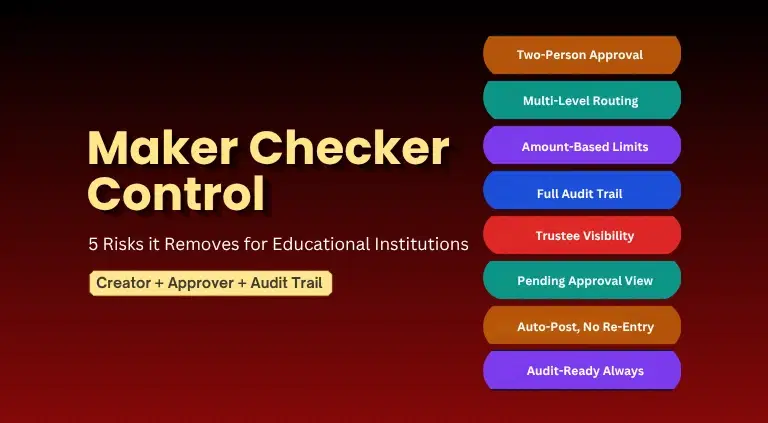
The fix: Maker-checker workflows embedded in every financial process. From purchases & expense claims, to fee concessions & journal adjustments. With complete, tamper-proof audit trails generated automatically. When auditors arrive, every supporting document is already date-stamped, contextualised, and retrievable in one click.
How to Manage School Finances Effectively: A Practical Framework
Regardless of the tools your institution uses today, the following framework represents the gold standard for managing school finances efficiently. With each principle mapping directly to how a well-designed finance system should operate.
- One Source of Truth for All Financial Data: Every rupee flowing into or out of your institution, must be recorded in a single, authoritative system. Be it fee receipts, salary disbursements, vendor payments, expense reimbursements, grant income, or even utility bills. The moment your finance data is spread across multiple tools, you have introduced the conditions for errors, delays & misreporting.
- Automate Journal Posting, Not Just Data Entry: The highest-value automation in school finance is not eliminating typing. But eliminating the manual decision of which account to post to, and when. When your system understands that a fee receipt should auto-post to the student receivables ledger and the corresponding bank ledger simultaneously, your accounts team is freed from transaction processing & now able to focus on analysis and oversight.
- Manage Finances at the Entity Level, Reports at the Group Level: Indian educational trusts & societies often have complex structures. Good financial management respects this complexity while giving leadership the ability to view consolidated financials across all entities instantly. By maintaining clean, separate books for each entity. This is the difference between a system designed for education finance & generic accounting software.
- Build Compliance In, Not On Top: Audit trails, maker-checker workflows, role-based access controls (RBAC), and statutory report generation should not be activities that happen before an audit. But a natural byproduct of how your finance system operates every day. If your team is doing extra work to prepare for compliance, your system is not compliant by design.
- Give Leadership Real-Time Visibility, Not Period Reports: A trustee who reviews financials once a month is making decisions based on data that is already 30 days old. Real-time dashboards for cash flow, outstanding fee receivables, budget vs actuals, and pending approvals give leadership the visibility to act. Not react.
How a Unified Finance System Fixes This: The edumerge Effect
edumerge's Finance & Control platform is built specifically for this problem.
Not as a generic accounting tool dressed in an education skin. But as a system designed from the ground up, around how educational institutions actually operate.
| The Old State | With edumerge Finance & Control |
|---|---|
| Reconciliation takes days of manual effort every month | Auto-reconciled payments with bank matching, done in minutes |
| Books close weeks after month-end, with errors | Auto journal entries into a single ledger: close faster, cleaner |
| Disjointed view across entities, branches, accounts | Multi-entity dashboards from group level to individual branch |
| Month-end reports that are outdated by the time they arrive | Real-time financial dashboards for CFOs & trustees |
| Audit preparation takes weeks of document hunting | On-demand audit trails, maker-checker logs, statutory reports |
| Asset and inventory blind spots causing budget leakage | Integrated inventory & asset management, with every item tracked |
| Tally + Excel + manual processes across 5 systems | One general ledger, one system, zero reconciliation headaches |
edumerge Finance & Control: Built for Education, Not Generic Accounting
edumerge's Finance & Control module is purpose-built for the governance & financial complexity of Indian educational institutions. Covering everything from day-to-day accounting to multi-campus compliance.
Here's a detailed view into each module, for you.
- Accounting & Trust/Society Accounting: Full double-entry accounting with education-native concepts built in. Academic-year cycles, fee structures, scholarship accounting, and trust/society-specific chart of accounts. Run school, trust & society books on one system with consolidated reporting and inter-entity transaction tracking.
- Budgeting & Forecasting: Build annual budgets by department, cost centre, or project. Track actuals against budget in real time. Generate variance reports & forecasts without exporting to Excel. Finance heads & trustees always know where the institution stands against the plan.
- Institution Sales & Revenue/Receivables & Collections Control: Complete fee receivables management. From invoice generation to collection tracking, to automated payment reminders. Outstanding fee dashboards give billing teams & finance heads a live view of what's collected, what's overdue, and where to follow-up.
- Expense & Claims Management: Digitise the entire expense workflow with approval chains, policy controls, and automatic posting to accounts. Be it for staff claims, petty cash, or departmental expenses. No more expense vouchers on paper. No more reimbursement delays.
- AI Insights: AI-powered analytics that surface trends in fee recovery, expense patterns, budget utilisation, and cash flow projections. Enabling the leadership with actionable foresight, not just historical data.
- Procurement & Vendor Management: Multi-level approval workflows from purchase indent to purchase order, to goods receipt, to vendor payment. Every approved PO auto-creates an accounts payable entry & updates budget utilisation. Vendor management includes rate contracts, payment terms & performance tracking.
- Audits: Complete audit trails for every financial transaction. Maker-checker workflows ensure no transaction is processed without the right authorisation. Statutory reports, including FCRA-related documentation for trusts, are generated on demand. Auditors get everything they need without the institution scrambling to produce it.
- Inventory & Asset Management: Track every asset from procurement to disposal. From furniture & equipment, to lab instruments, IT hardware & vehicles. Identify under-utilised assets before ordering duplicates. Eliminate the budget leakage that comes from invisible inventory.
- Capacity Planner: Capital projects and new campus planning are integrated with financial projections. Plan infrastructure investments, model different scenarios, and align capital expenditure with long-term institutional strategy.
- Integrated Management Dashboard for Group Institutions: For multi-campus educational groups, one dashboard shows financial health across all entities. Revenue, collections, expenses, fund positions, and compliance status, nothing requires a manual consolidation exercise.
The key differentiator: Most accounting software records what happened. edumerge Finance & Control understands why it happened. Because it's connected to admissions, HR, and operations.
When a student enrols, the fee structure auto-generates. When payroll runs, salary journals auto-post. When a purchase order is approved, the AP entry is created automatically. There is no data re-entry. No reconciliation step. No gap between operation & accounting.
Conclusion: Stop Patching. Start Controlling.
The financial complexity of running an Indian school, trust, or group of institutions is not going to get simpler. Regulatory requirements are increasing. Multi-campus operations are growing. And the stakes of financial mismanagement, across in audit findings, trustee credibility & institutional reputation, have never been higher.
The answer is not a better spreadsheet. It is not a new Tally workaround.
It is a unified, purpose-built institutional finance platform that understands how education institutions actually work. Connecting every financial event to the general ledger automatically. Giving leadership real-time visibility to govern with confidence.
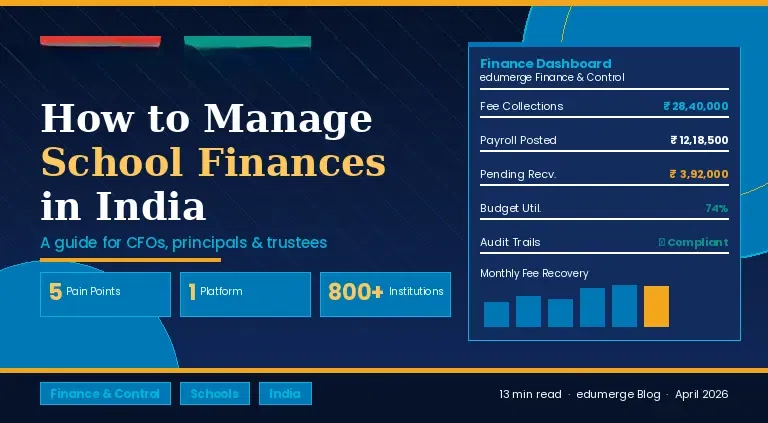
edumerge Finance & Control is that platform. Already trusted by 800+ institutions across India. Built by a team that understands education finance from the ground up. And designed to take your institution from financial chaos to audit-ready confidence.
The best time to fix your school's financial systems was last year. The second-best time is today.
Frequently Asked Questions (FAQs)
1. How to manage school finances in India effectively?
Effective school financial management in India is simpler than thought. It just requires centralising all financial data on a single general ledger, while automating journal entries for fee collections, payroll & procurement. Further, implementing real-time dashboards for cash flow & budget visibility, building maker-checker workflows for compliance, and consolidating multi-entity books — school, trust, and society — in one system.
2. Why is Tally not enough for school financial management?
Tally is excellent for recording transactions but was not built around education-specific workflows. It does not natively understand fee structures, academic-year cycles, trust accounting, or operational workflows like admissions-to-fee-generation or payroll-to-journal-posting. Schools using Tally still require significant manual effort for reconciliation, consolidation, and reporting. Making it insufficient as a standalone solution for institutional finance management.
3. What is the difference between school fee management and school financial management?
Fee management covers just the collection, tracking, and follow-up of student fee payments. School financial management is broader. It includes fee management, payroll, vendor payments, procurement, expense claims, asset tracking, budgeting, multi-entity consolidation, and compliance reporting.
4. How can schools reduce reconciliation errors?
Reconciliation errors occur when data is spread across disconnected systems & manually matched. Schools can eliminate them by implementing a unified finance platform with bank auto-reconciliation. One where the system automatically matches incoming payments to invoices & posts journal entries to the general ledger. Without any manual intervention required.
5. What does "maker-checker workflow" mean in school finance?
A maker-checker workflow is a two-step authorisation process. In this, one user (the "maker") initiates a financial transaction, like a payment, journal entry, or purchase order (PO). And a second authorised user (the "checker") reviews & approves it before it is processed. This control mechanism prevents errors & fraud, and creates a traceable audit trail.
6. How should a school manage finances across multiple entities like a trust and a society?
Multi-entity financial management requires a system that maintains separate books for each entity: school, trust, society, management committee. That too, on a shared chart of accounts, with inter-entity transaction tracking & automated consolidation. This allows entity-level accountability while giving trustees & CFOs a group-level consolidated view.
7. What reports should a school's finance system generate automatically?
A well-managed school finance system should automatically generate: trial balance, profit & loss statement, balance sheet, cash flow statement, budget vs actuals, outstanding fee receivables, vendor payment schedules, asset registers, and statutory reports for compliance. These should be available on demand, not prepared manually just for audits.
8. Is there a finance management tool specifically built for Indian educational institutions?
Yes. edumerge's Finance & Control platform is purpose-built for Indian educational institutions. Especially with native support for trust & society accounting, FCRA compliance, academic-year-aligned fee structures, multi-campus consolidation, and seamless integration with the school's ERP, HRMS, and admissions systems.