edumerge Finance & Control is an institutional finance and governance platform purpose-built for schools, colleges, and groups of educational institutions.
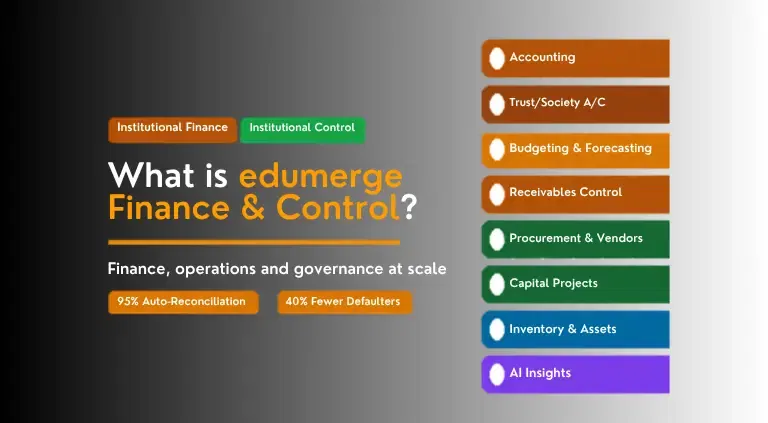
It covers 14 modules across two clusters:
- Institutional Finance (accounting, trust & society consolidation, budgeting & forecasting, revenue management, receivables & collections, expense management, and AI insights), and
- Institutional Control (procurement & vendor management, audits, group management dashboards, capital projects & capacity planning, inventory & asset management, marketplace, and group operating model)
Every module shares a single general ledger, integrates with admissions, HRMS & ERP automatically, and generates audit-ready reports on demand. Key outcomes: month-end close reduced from weeks to days.
Most schools, colleges, and education groups manage their financial operations across a patchwork of tools. A fee collection system, a standalone accounting software, Excel spreadsheets for budget tracking, and a separate procurement process managed through email chains & paper approvals.
Each tool does its job in isolation. None of them talk to each other. And every month, the finance team spends days reconciling figures that should never have drifted apart in the first place.
edumerge Finance & Control brings all of these together. It is a unified system where every rupee that moves through the institution, from fee collection-to-payroll-to-procurement-to-capital investment, flows through a single general ledger, is tracked against a single budget, and is visible to leadership in real time without anyone compiling a report.
The Problem: Education Finance is Broken by Disconnected Systems
Most institutions discover their financial and control gaps during audits, inspections, or leadership change. By then, the losses have already occurred.
The following are not hypothetical scenarios; they are the day-to-day reality for finance teams at most educational institutions in India.
| The Problem | What It Looks Like | What It Actually Costs |
|---|---|---|
| Books never close on time | Journal entries keyed manually. Trial balances reconciled in Excel. Year-end audit preparation takes weeks because data lives in five different systems. | Finance team burns weeks on reconciliation every month. Errors accumulate. Auditors find gaps that should have been visible in real time. |
| Manual fee reconciliation across payment modes | Matching bank statements with fee receipts across cash, cheque, UPI, net banking, and wallets takes days. Errors slip through and audits become difficult to defend. | Reconciliation delays cascade to reporting. Leadership asks for daily collection data and gets it days late, already stale. |
| Multi-entity consolidation is a nightmare | Schools, trusts, societies & management entities each maintain separate books. Consolidation happens manually and inter-entity transactions are nearly impossible to trace. | Group leaders have no real-time view of the group's financial health. Strategic decisions are made on data that is weeks old. |
| No live visibility for trustees and leadership | CFOs & trustees wait for month-end reports that arrive late and are already outdated. There is no live dashboard showing cash flow, fee recovery, or budget utilisation. | Governance gaps go undetected until they surface in audits or inspections. Leadership cannot act on financial data they cannot see. |
| Inventory leakage and untracked assets | Purchase of assets already in stock, under-utilised equipment, and small inventory inconsistencies add up to significant financial leakage over a financial year. | Cumulative losses from procurement without visibility can run into lakhs annually at a mid-sized institution. |
| Procurement without control | Purchase orders, vendor bills, and expense approvals live in different places. There is no unified view of institutional spending or budget utilisation against approved limits. | Overspending against the budget goes undetected. Vendor payments are delayed because approval chains are informal. No audit trail for inspectors. |
The edumerge Finance & Control Shift: From Cause to Control to Confidence
In the journey with edumerge Finance & Control, the shift is from disconnected, reactive financial management to unified, proactive institutional governance.
Cause
- Reconciliation takes days of manual effort every month
- Books closed weeks after month-end, with errors
- Disjointed view across entities, branches & accounts
- Audit prep takes weeks; data scattered across systems
- No live visibility for trustees or CFO
Control
- Auto-reconciled payments with bank matching in minutes
- Auto journal entries into a single general ledger
- Multi-entity dashboards from group level to branch level
- Procurement, payroll & admissions post automatically
- Maker-checker workflows & full audit trails on every transaction
Confidence
- Month-end close reduced from weeks to days
- Trustees & auditors get on-demand financial insight
- Zero leakage with full audit trails on every transaction
- 40% fewer fee defaulters through AI reminders
- Capital projects & inventory tracked against budget in real time
edumerge Finance & Control: Complete Module Overview
While institutional finance covers the end-to-end financial management of the institution. Institutional control eliminates operational gaps, leakages, and blind spots across every function.
Cluster 1: Institutional Finance
Institutional Finance covers every financial management function of the institution. From the opening of an account group & ledger through daily transactions, statutory compliance, and AI-driven financial insights. All transactions across admissions, payroll & procurement post to a single general ledger automatically.
| Module | What It Delivers for Your Institution |
|---|---|
| Accounting | A single general ledger for all institutional transactions. Journal entries from admissions, fee collection, payroll, and procurement are posted automatically without manual data entry. Trial balance, profit & loss, and balance sheet generated on demand. Account groups, ledgers, and voucher types configured to the institution's chart of accounts. |
| Trust and Society Accounting and Consolidation | Multi-entity book-keeping where each campus, trust, or society maintains independent accounts while leadership sees a consolidated view across all entities. Inter-entity transactions are tracked with full traceability. FCRA-compliant reporting for trusts receiving foreign contributions. Consolidated financial statements generated across the group without manual extraction. Read in-detail on how to manage educational trust accounts in India. |
| Budgeting and Forecasting | Annual budget creation by department, cost centre, or campus. Actual expenditure tracked against approved budgets in real time. Variance reports generated automatically. Forecasting tools project end-of-year positions based on current run rates. No more end-of-quarter budget surprises for leadership. |
| Institution Sales and Revenue | Comprehensive revenue tracking across all income streams: tuition fees, hostel, transport, canteen, events, and ancillary sources. Revenue recognised in the correct accounting period. Branch-wise and program-wise revenue dashboards available to finance leadership in real time. |
| Receivables and Collections Control | End-to-end fee collection management covering 15-plus payment modes including UPI, net banking, debit and credit cards, wallets, cash, and cheque. Automated payment reminders via SMS, email, and WhatsApp. AI-powered defaulter identification and recovery nudges. Bank statement upload and automatic reconciliation with a 95% accuracy rate. Real-time ledger reconciliation; no end-of-month matching required. |
| Expense and Claims Management | Structured expense submission, multi-level approval, and reimbursement tracking. Every expense is coded to the correct budget line. Claims are linked to the payroll cycle for automatic disbursement. Expense trends visible to finance leadership without requiring a manual report. |
| AI Insights | AI-powered analytics surfacing predictions and alerts that manual reporting cannot provide. Fee recovery risk by student or cohort, budget utilisation forecasts, revenue projection by program or campus, and anomaly detection in transaction patterns. Insights are delivered proactively, not extracted on demand. |
Cluster 2: Institutional Control
Institutional Control addresses the operational side of education finance. In short, the processes through which money leaves the institution. Without structured control over procurement, vendor payments, inventory, and capital expenditure, even institutions with accurate books will experience leakage. edumerge Finance & Control closes those gaps.
| Module | What It Delivers for Your Institution |
|---|---|
| Procurement and Vendor Management | End-to-end purchase workflow from indent to payment. Purchase requisitions, purchase orders, goods receipt, vendor invoice matching, and payment release managed through structured, approval-gated workflows. Vendor master with performance tracking, payment history, and compliance documentation. Three-way matching between PO, receipt, and invoice before any payment is released. |
| School, College and Education Group Audits | Built-in internal audit capability with configurable audit checklists for financial, compliance, and operational processes. Every transaction carries a complete audit trail: user, timestamp, amount, approval chain, and supporting documentation. Statutory audit preparation is a report generation exercise, not a weeks-long data compilation exercise. |
| Integrated Management Dashboard for Group Institutions | A single consolidated financial dashboard for group-level leadership covering every campus: fee collection status, budget utilisation, outstanding payables & receivables, cash positions by entity, and compliance standing. Updated in real time as transactions are recorded across the group. |
| Capital Projects and New Campus Planning (Capacity Planner) | Track capital expenditure on construction, renovation, equipment, and infrastructure against approved project budgets. Milestone-based payment release tied to project progress. New campus planning tools with capacity modelling for enrollment projections, infrastructure requirements, and financial feasibility. Capital projects are always visible against the institution's overall budget. |
| Inventory and Asset Management | Complete asset register covering fixed assets, laboratory equipment, library stock, and consumable inventory. Asset acquisition tracked from purchase through useful life to disposal. Depreciation computed automatically. Inventory levels monitored in real time with reorder alerts. Asset audits conducted against the register without manual stock-taking exercises. |
| Marketplace | A structured procurement marketplace for institutions to source common supplies and services through pre-approved vendors at institutional pricing. Reduces ad-hoc procurement and brings repeat purchases into the controlled workflow automatically. |
| Group Institution Operating Model (GOI) | A governance framework module for groups of institutions managing multiple legal entities under common leadership. Defines the operating model for how policies, approvals, and financial workflows are structured across the group. Ensures consistency in financial governance while allowing each entity to operate with appropriate autonomy. |
Also read about the best ERP for group institutions in India.
How Every Transaction Finds Its Way to the Ledger: The Integration Architecture
The defining characteristic of edumerge Finance & Control is that no financial transaction requires manual journal entry. Every action in the connected edumerge platform that has a financial consequence, automatically posts the correct entry to the general ledger.
This is what makes the 95% reconciliation accuracy figure achievable in practice, not just in theory.
| Originating Module | → | Receiving Module | What Happens Automatically |
|---|---|---|---|
| Admissions and Fee Engine | → | General Ledger and Receivables | A new student enrollment automatically generates the complete fee structure, first invoice, payment schedule, and opening receivable entry. No manual ledger creation required. |
| Fee Collection | → | General Ledger and Bank Reconciliation | Every payment received across any of 15+ modes auto-posts journal entries to the correct revenue account and bank ledger. Bank statement uploads are matched automatically at 95% accuracy. |
| HR Payroll | → | General Ledger and Compliance | Monthly salary processing auto-posts salary, PF, ESI, and TDS entries to the institutional books. Statutory filing-ready reports generated simultaneously. |
| Procurement and Vendor Payments | → | General Ledger and Budget Control | Approved purchase orders & vendor invoices auto-create accounts payable entries and update budget utilisation in real time. Overspending is flagged before a payment is released. |
Who Benefits: A Stakeholder-by-Stakeholder View
CFOs and Finance Directors
A consolidated real-time financial dashboard covering every campus and entity in the group. From cash flow position, fee collection status, budget utilisation by department, outstanding receivables, to compliance standing. Strategic financial decisions backed by current data, not month-old reports. Forecasting tools that surface end-of-year projections before the year ends.
Explore edumerge capabilities for finance heads.
Accounts and Billing Teams
Automated fee collection across 15-plus payment modes with bank reconciliation completing in minutes rather than days. Every payment matched, receipted, and ledgered automatically. Fee defaulter lists generated with outstanding amounts and contact details for follow-up. No manual reconciliation at month-end; the ledger closes itself.
Trustees and Governing Bodies
An on-demand financial health dashboard showing the institution's revenue, expenditure, fund position, budget utilisation, and audit readiness at any point in time. No more waiting for a monthly report compiled by the finance team. Every financial KPI relevant to institutional governance available with a single login.
Procurement and Administration Teams
A structured purchase workflow that replaces informal approvals with a documented, auditable process. Every purchase request goes through the correct approval chain before a purchase order is raised. Three-way matching ensures vendors are paid accurately and only after goods or services are confirmed received.
Auditors and Compliance Officers
Complete audit trails on every transaction, including user identity, timestamp, approval chain, and supporting documentation. Statutory reports for GST, TDS, and trust audits generated at the click of a button. Maker-checker workflows ensure no transaction is posted without the required sign-off. Internal audits conducted using the platform's built-in audit module rather than external checklists and paper files.
IT Administrators
A cloud-hosted platform requiring no on-premise financial infrastructure. Role-based access ensures sensitive financial data is visible only to authorised roles. API integration with banks for automated statement import. Zero infrastructure overhead; security, backups, and updates managed by edumerge.
Also read about how edumerge eases work for IT admins in educational institutions.
Why edumerge Finance & Control is Different
Educational institutions have operated on standalone accounting tools for decades. These tools are proficient at recording transactions.
What they cannot do is understand workflows, connect to operations, or surface the institutional insights that leadership needs for governance decisions.
edumerge Finance & Control is built around what education finance actually requires.
| Standalone Finance Tools | edumerge Finance & Control |
|---|---|
| Transactions recorded after the fact; no workflow integration | Every operational action in admissions, HR, and procurement posts its financial consequence to the ledger automatically |
| Reconciliation is a manual, periodic exercise | Bank reconciliation auto-matches payments to invoices in real time; 95% accuracy with no manual effort |
| Multi-entity consolidation requires manual export and merge | Multi-entity architecture with inter-entity tracking built in; consolidated view generated automatically across all campuses and legal entities |
| Budget tracking requires separate spreadsheet maintenance | Budget vs. actual tracked in real time against a single live data source; variance reports generated automatically |
| No visibility into procurement, inventory, or capital projects | Institutional Control cluster covers procurement, vendor management, asset tracking, inventory, and capital project monitoring in the same platform |
| Audit preparation is a weeks-long exercise | Every transaction carries a complete, timestamped audit trail; statutory reports generated on demand; maker-checker workflows standard |
| No AI-driven financial insights | AI Insights module surfaces fee recovery risk, budget forecast, revenue projection, and anomaly detection proactively |
Your Institution's Financial Health Deserves Real-Time Visibility
The financial gaps that hurt educational institutions most are rarely discovered in the moment they occur. They surface during audits, at leadership transitions, or when a funding body asks a question no one can answer quickly.
edumerge Finance & Control is designed to close those gaps while operations are running normally, not after the damage is done.
When every rupee that enters & leaves the institution flows through a single general ledger, posts automatically, and is visible to the right leaders in real time. The conversation about institutional financial health changes from retrospective to proactive.
Explore every module here, or to see the consolidated trustee dashboard and auto-reconciliation in a live institutional environment:
Frequently Asked Questions (FAQs)
1. How does edumerge Finance & Control handle multi-entity accounting?
edumerge Finance & Control includes multi-entity architecture as standard. Each campus, school, trust, or society maintains independent books while leadership sees a consolidated view across all entities. Inter-entity transactions are tracked with full traceability. Consolidated profit & loss, balance sheet, and cash flow statements are generated across all entities automatically.
2. What is the auto-reconciliation accuracy of edumerge Finance & Control?
edumerge Finance & Control achieves 95% auto-reconciliation accuracy. Incoming payments across 15+ payment modes are automatically matched to fee demands & invoice records. Bank statement uploads reconcile in minutes rather than days. The remaining 5% of transactions requiring manual review are flagged automatically for finance team attention.
3. Does edumerge Finance & Control support FCRA compliance?
Yes. The Trust & Society Accounting and Consolidation module in edumerge Finance & Control includes FCRA-compliant reporting for educational trusts & societies receiving foreign contributions. Separate FCRA account tracking, restricted & unrestricted fund management, and FCRA annual return data are managed within the platform.
4. How does edumerge Finance & Control integrate with the ERP and HRMS?
Every financial action in the broader edumerge platform posts automatically to the Finance & Control general ledger. Student enrollment generates fee receivable entries. Fee collection auto-posts to revenue accounts and bank ledgers. Monthly payroll auto-posts salary, PF, ESI, and TDS entries. Approved purchase orders (POs) create accounts payable entries and update budget utilisation in real time.
5. How does the trustee dashboard work in edumerge Finance & Control?
The Integrated Management Dashboard for Group Institutions in edumerge Finance & Control provides trustees and governing bodies with an on-demand view of the institution's or group's financial health. It shows fee collection status across campuses, budget utilisation by department, cash positions by entity, outstanding receivables & payables, and compliance standing. The dashboard updates in real time as transactions are recorded; no compilation is required.
6. How long does it take to implement edumerge Finance & Control?
Setup and configuration takes 1 to 2 weeks. Data migration of opening balances, fee ledgers, and vendor records is conducted in parallel with the existing financial system to ensure continuity. Role-wise training is conducted for accounts, billing, and procurement staff. A dedicated account manager with education finance expertise is assigned from sign-up through go-live and ongoing.