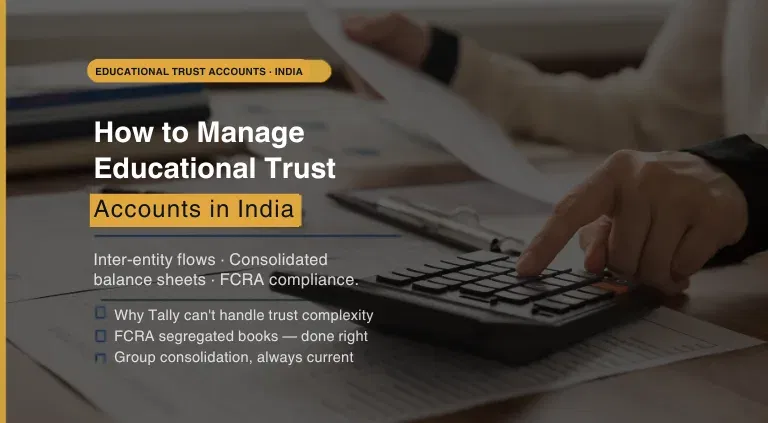
Most educational groups in India don't have one set of accounts. They have many. One for the trust or society, one per school or college under its umbrella, separate FCRA books if foreign funding is involved, and often a parallel set prepared specifically for audit.
Each of these is maintained differently, updated at different times, and reconciled (if at all) under significant time pressure at month-end and year-end. This is the actual state of trust account management in Indian education.
This guide covers what effective management of educational trust accounts actually requires. How finance heads can move from manual repetitive work to financial governance.
TL;DR
Managing educational trust accounts in India requires:
- maintaining separate books for each legal entity; trust, institution, and any FCRA account;
- tracking inter-entity fund flows (grants from trust to institution, capital transfers, shared service charges) with proper journal entries & elimination on consolidation;
- preparing consolidated financial statements across all entities for trustees and governing bodies; and
- maintaining a fully segregated FCRA account with dedicated books, a separate SBI account, and annual FC-4 returns certified by a CA.
Generic accounting software handles none of these natively. This is where edumerge Finance & Control stands apart; enabling institutions complete financial governance.
The Multi-Entity Reality of Indian Educational Trusts
A typical mid-sized educational group in India does not operate as a single entity. The structure looks something like this:
- A public charitable trust or registered society sits at the top.
- It holds the land, the buildings, and the corpus.
- It receives donations, manages endowments, and makes capital grants to the institutions below it.
- It has its own bank accounts, its own PAN, its own 12A and 80G registrations, and its own annual audit and tax return obligations.
- Under the trust, there are one or more institutions; schools, junior colleges, degree colleges, professional colleges, hostels.
- Each institution has its own fee accounts, its own operating budget, its own staff and payroll, and, in many cases, its own bank accounts.
- Some institutions are affiliated to different universities, each with its own financial reporting format.
- If the trust receives foreign donations or international research funding, there is also an FCRA entity. Or at minimum, a designated FCRA account at SBI; with books that must be maintained in complete isolation from domestic funds.
This is the minimum configuration. Larger educational groups operate across 5, 10, or 15 institutions, sometimes across multiple states, sometimes under multiple trust or society registrations.
Every one of these entities generates financial transactions every day.
Every one of them has independent compliance obligations.
And all of them need to roll up into a picture that the trustees, the CFO, and the auditors can actually understand and rely on.
We cover this complexity in-detail, in our piece on Trust Accounting for Educational Institutions in India.
What are Inter-Entity Fund Flows and Why Do They Break Down?
Inter-entity fund flows are financial transactions that move money or value between the trust and its institutions, or between institutions within the same group. They are routine, unavoidable, and, when managed poorly; a primary source of accounting errors, compliance gaps, and audit qualifications.
The most common inter-entity flows in educational groups include:
1. Trust-to-Institution Capital Grants
The trust funds the construction of a new building at one of its colleges. The money moves from the trust's corpus account to the institution's capital project account.
This transaction must be recorded correctly in both sets of books. As a grant or corpus transfer in the trust's accounts, and as a capital receipt or inter-entity loan in the institution's accounts.
2. Shared Service Cost Allocations
The trust provides centralised HR, IT, legal, or administrative services to all its institutions. The cost of these services must be allocated to each institution on some reasonable basis.
Each allocation creates an inter-entity receivable in the trust's books and a corresponding payable in the institution's books.
3. Institution-to-Trust Surplus Transfer
At year-end, institutions with operational surpluses may transfer funds back to the trust corpus.
This is particularly common in trust structures where the trust deed specifies that surpluses must accrue to the central corpus rather than being retained at the institution level.
4. Scholarship Disbursements Through the Trust
When the trust manages a named scholarship fund and disburses directly to students enrolled in one of its colleges, the transaction crosses entity boundaries. The trust disburses, but the cost is attributable to the institution's operations.
Why Do These Flows Break Down?
Inter-entity transactions are the most poorly managed category in educational trust accounting. The reasons are structural:
- When each entity's books are maintained separately; often by different people, on different software, or at different times, there is no mechanism to ensure that both sides of an inter-entity transaction are recorded simultaneously and consistently.
- The trust records a grant.
- The institution doesn't record the receipt, or records it under the wrong head.
- The trust's books show an inter-entity receivable that doesn't appear in the institution's books as a payable.
- By the time this is discovered, reconciling the discrepancy may take days.
At consolidation, uneliminated inter-entity balances inflate both the trust's assets and the institution's liabilities, or vice versa. This is one of the most common findings in statutory audits of educational trusts.
Consolidated Balance Sheets for Educational Groups
A consolidated balance sheet for an educational group is a financial statement that presents the combined financial position of the trust and all its institutions as a single economic entity, after eliminating inter-entity transactions and balances.
Preparing one accurately requires:
- A consistent chart of accounts across all entities: If the trust uses different ledger heads from the institution, consolidation requires manual mapping before any aggregation can happen. This is a significant source of delay and error in manual consolidation processes.
- Complete and reconciled inter-entity balances: Before consolidation, every inter-entity receivable in one entity's books must be matched and confirmed against the corresponding payable in the other entity's books. Any discrepancy must be resolved, not estimated or carried forward.
- Elimination of inter-entity transactions: Grants from trust to institution, cost allocations, and intra-group asset transfers must be eliminated from the consolidated statements so they don't double-count income, expense, or asset values.
- Uniform accounting policies: If one institution depreciates fixed assets at 10% and another at 15%, the consolidated balance sheet will be distorted unless adjustments are made for consistency.
What this looks like in practice without a unified system:
| Step | Reality Without Unified System |
|---|---|
| Chart of accounts alignment | Manual mapping exercise every year |
| Inter-entity reconciliation | Chasing each entity for their version of shared balances |
| Elimination workings | Multi-tab Excel file, usually maintained by the CA |
| Consolidated statements | Ready 6-8 weeks after year-end at best |
| Trustee review | Based on last year's numbers, not this year's reality |
This is not a governance failure on the part of any individual finance team. It is a systems failure; a predictable consequence of using entity-level accounting tools in a multi-entity institutional structure.
Explore how edumerge Finance & Control solves each of these steps/problems.
FCRA Compliance: The Toughest Layer in Trust Account Management
For educational trusts in India that receive foreign donations, FCRA compliance adds a layer of accounting obligation that is stricter, more specific, and more easily violated than most finance teams appreciate. Whether it's from international alumni, foreign foundations, overseas research sponsors, or global CSR programs.
The core FCRA accounting requirements:
- Fully segregated books. The organisation must maintain a completely separate set of accounts for foreign contributions. Distinct from all domestic income, including tuition fees, Indian donations, and government grants. There is no permissible overlap. Every receipt of foreign funds, every utilisation, and every closing balance must be traceable in the FCRA books alone.
- Dedicated SBI account. As per the FCRA Amendment Rules effective January 2025, all foreign contributions must be received exclusively in a designated account at the State Bank of India, New Delhi Main Branch. Secondary utilisation accounts may be maintained at other banks, but funds must flow from the SBI primary account, and no other funds may be deposited into those utilisation accounts.
- No inter-entity transfer of FCRA funds without prior approval. FCRA funds received by the trust cannot be transferred to its institutions or to any other organisation without prior government approval. This is a critical and frequently misunderstood restriction. Many educational groups that route international scholarships or research grants through their trust to their colleges are potentially in violation if they have not obtained the relevant approval.
- Annual FC-4 return. The trust must file an annual return in Form FC-4 on the FCRA online portal within 9 months of the close of the financial year. The return must be accompanied by an audited income-expenditure statement and receipts-and-payments account for FCRA funds, certified by a Chartered Accountant. The auditor's certification confirms that funds were used only for the stated purpose.
- 2024-25 amendment impacts. The Foreign Contribution (Amendment) Rules, effective 1 January 2025, introduced tighter requirements including trustee-level certification, enhanced donor KYC documentation, and stricter treatment of administrative expense carry-overs. Organisations managing FCRA accounts in Tally or Excel need to manually build compliance tracking for these requirements. There is no automation.
- The core compliance risk: Because FCRA funds must be tracked in isolation, the temptation, particularly in smaller trusts, is to manage the FCRA account as a separate manual register rather than integrating it into the main accounting system. This creates a third set of books that exists outside any real-time visibility, and is reconciled only when the CA arrives for the annual audit.
Why Tally Can't Handle Educational Trust Complexity
Tally is India's most widely used accounting software, and for good reason. It handles GST compliance, basic double-entry accounting, and financial reporting effectively for the typical Indian business.
But educational trusts are not typical Indian businesses, and the gaps become significant at the point where trust complexity begins.
Gap 1 - No Native Multi-Entity Architecture for Trusts
Tally's "group company" feature allows multiple company files to be consolidated for comparative reporting. But each entity is still a separate Tally installation; with a separate chart of accounts, separate user access, and no shared data infrastructure.
Inter-entity transactions cannot be entered as linked journal entries that post to both sides simultaneously. Reconciliation must be done manually, outside the system.
Gap 2 - No Fund Accounting
Tally does not distinguish between restricted and unrestricted funds. There is no mechanism to tag a receipt as "corpus donation - restricted to lab development" and track its utilisation against that restriction over time.
All fund-level tracking must be replicated through manual ledger structures. Which means it depends entirely on the discipline of the person entering data, with no system-level enforcement.
Gap 3 - No Education-Native Operational Integration
In Tally, fee collections, payroll entries, and procurement payments are all manual journal entries. Either entered directly or imported from other systems. There is no live connection between the fee module, the HR system, and the accounts.
Every operational event generates a manual accounting task. In a trust running four institutions, this adds up to thousands of manual entries/month, each a potential error.
Gap 4 - FCRA Compliance is Entirely Manual
Tally has no FCRA-specific module. Maintaining a segregated FCRA ledger is possible in Tally, but there is no system-level control that prevents FCRA funds from being mixed with domestic funds. It relies on the user's awareness and discipline.
FC-4 return preparation requires exporting data and reformatting it manually into the return format. There is no audit trail purpose-built for FCRA certification.
Gap 5 - Consolidated Balance Sheet for the Group Requires Manual Assembly
Even with the group company feature, producing a trust-level consolidated balance sheet requires significant manual work outside Tally. Especially with inter-entity eliminations, consistent depreciation treatments, and fund-wise disclosures. Most educational groups rely on their statutory CA to produce this document once a year, using workings in Excel.
Note: This is not a criticism of Tally as a product. It is a statement about the mismatch between what Tally was built to do and what educational trust accounting actually demands.
What Purpose-Built Trust Account Management Looks Like
edumerge's Finance & Control platform is built around the financial structure of Indian educational groups. And not adapted from a commercial accounting tool.
- Multi-entity architecture, built in. The trust, each institution, and any FCRA entity are distinct accounting entities within a single platform. Sharing a unified chart of accounts, user access management, and data infrastructure. Inter-entity transactions post to both entities simultaneously, with automatic creation of the receivable and payable. Reconciliation is not a month-end task. It is current, always.
- Fund accounting, natively. Every receipt can be tagged to a fund; general corpus, restricted scholarship fund, government grant, FCRA receipt, or any other category the institution defines. Utilisation is tracked against each fund in real time. When an auditor or regulatory body asks for a fund-wise utilisation statement, it is generated from live data, not assembled from transaction histories.
- Auto-posting from every operational module. Fee collections post to revenue accounts the moment they are recorded. Payroll approval posts salary expense, PF, ESI, and TDS entries simultaneously. Purchase order approvals trigger budget checks. Nothing enters the accounts manually from an operational event. Which means reconciliation between operations and finance is a system default.
- FCRA account management. FCRA receipts are maintained in a fully segregated ledger with system-level controls that prevent commingling with domestic funds. Utilisation tracking against FCRA-specific purposes is built in. The FC-4 return format is pre-mapped; annual return preparation draws directly from the FCRA ledger, not from a manual export.
- Consolidated balance sheet, on demand. Because all entities share a common chart of accounts and all inter-entity transactions are recorded on both sides simultaneously. A consolidated view of the group's financial position is always available; with inter-entity balances automatically identified and available for elimination. The trustees, the CFO, and the auditors are working from the same current data, not from competing versions of last month's spreadsheets.
The question most educational CFOs don't ask until it's too late: "If my CA needed a clean, complete, consolidated picture of our group's financial position as of today, not last month, not last quarter. Could I produce it without a week of preparation?"
If the answer is no, the problem is not your team's capability. It's your data architecture. edumerge Finance & Control is built so that question always has a yes.
Frequently Asked Questions (FAQs)
1. Can Tally be used for educational trust accounting in India?
Tally can handle basic ledger maintenance and financial statement preparation for individual entities. However, it has some limitations for educational trust accounting. These gaps are manageable for a single-institution trust, but become significant sources of error and compliance risk for educational groups running multiple institutions.
2. How often should educational trust accounts be reconciled?
Best practice is continuous or at minimum weekly reconciliation for operational accounts, and monthly reconciliation for inter-entity balances. Annual reconciliation, which is the default in many trusts, is a significant governance risk. It means that errors in inter-entity entries, fund misclassification, or FCRA commingling may not be detected until the year-end audit, at which point correction requires restating months of entries.
3. What financial statements does an educational trust need to prepare annually?
Income and Expenditure Account (showing income applied toward charitable purposes and any surplus or deficit), Balance Sheet (showing corpus fund, assets, and liabilities), and Receipts and Payments Account (a cash-basis summary of all inflows and outflows). If the trust has received government grants or FCRA funds, a Fund-wise Utilisation Statement for each fund is also required.