On Monday morning, an IT coordinator submits a request for Rs. 1.2 lakh to purchase new laptops for the computer lab. By Wednesday, the payment has been released.
This might sound efficient, but here's the catch: just one person did everything. They raised the request, selected the vendor and authorised the payment. But no one verified whether the amount was accurate, the vendor was genuine, or the funds were transferred to the correct bank account.
Now imagine they typed Rs.12 lakh instead of Rs.1.2 lakh. The money would already have left the institution, and the error might only come to light weeks later during an audit.
Maker checker control addresses this risk through one clear principle: the individual who creates a transaction cannot approve it. This means, every transaction is independently verified before it is processed.
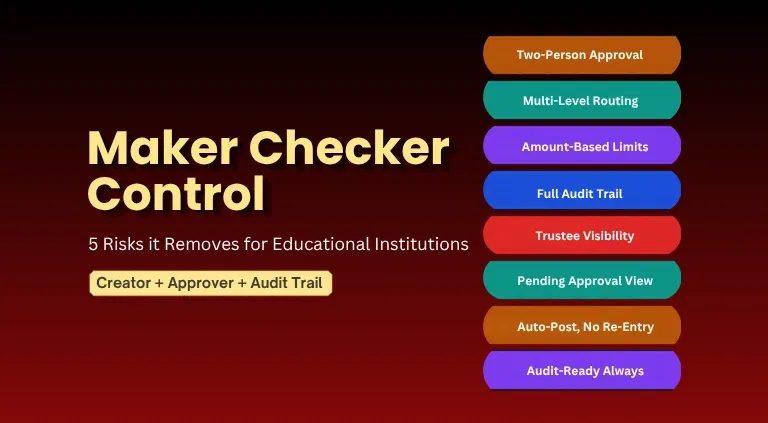
This blog outlines the 5 risks that maker checker control eliminates for educational institutions and how edumerge applies it across 3 key areas: procurement, fee management, teachers & academics.
TL;DR
Maker checker control means no transaction or change is completed by one person alone. One person creates it (the maker) and another reviews and approves it (the checker). It removes five risks:
- single-person approval,
- errors that create friction between staff,
- audit findings that affect credibility,
- unclear accountability and
- a lack of transparency.
In edumerge, it protects three areas: procurement (purchase orders, vendors and invoices), fee management (fee structures, discounts, concessions and scholarships), and academics (assignments, question papers, marks, lesson plans and attendance).
What is Maker Checker Control?
Maker checker control is an approval process in which one person (the maker) creates a transaction and a different person (the checker) reviews and approves it before it is processed. It ensures that no payment, fee structure change or academic record is finalised on one person's authority alone.
Why this is considered important in education is because money in an institution comes from parents' fees, government grants and donations. And every rupee is answerable to trustees, auditors & regulators.
Also academic records carry great weight, since marks & results shape students' futures and the institution's accreditation. Hence, maker checker control protects both by building a second, independent review into every important change.
In edumerge, this principle is built into procurement, fee management and academic workflows, so every important change is reviewed before it takes effect.
Maker Checker vs Segregation of Duties vs Four Eyes Principle
| Term | What it means | How it applies in an institution |
|---|---|---|
| Segregation of duties | The broad principle of splitting responsibilities across different people | The person who manages vendors does not also release payments |
| Four eyes principle | Two people must review a transaction before it is completed | No payment or result goes out on one person's review alone |
| Maker checker control | A specific workflow where one person creates and another approves | Purchase orders (POs), fee changes and marks entry follow a defined maker and checker path |
In practice, maker checker control is how institutions turn segregation of duties and the four eyes principle into something that runs every day, not just a policy on paper.
Explore more about this in our school fee management & college fee management feature pages.
5 Financial Risks edumerge Maker Checker Control Removes
edumerge maker checker control removes 5 financial risks:
- Single-person approval,
- Workplace friction caused by unchecked errors,
- Audit findings that damage credibility,
- Lack of accountability,
- Lack of transparency.
It does this by ensuring every transaction is created by one person and approved by another before it takes effect.
To see how this works in practice, consider a single transaction at a college that is part of a Group of Institutions. The college hostel needs urgent plumbing repairs, and a local contractor quotes Rs. 48,000 for the work. The campus accounts executive handles the entire payment from start to finish, with no one else involved.
Here is how this one transaction exposes the institution to 5 financial risks, and how edumerge solves each one.
1. When One Person Holds the Purse Strings: Single-Person Approval
Overview: When the same person can both create & approve a payment, no one else checks it before the money goes out. This goes against a basic rule of financial control called segregation of duties. Which means the work of handling money should be split between different people, so that no single person controls the whole process.
The scenario: The contractor emails new bank account details. Only the accounts executive updates them and releases the payment the same day, with no one else verifying either step.
The effect: If the bank details are incorrect, the money goes to the wrong account and becomes difficult to recover.
How edumerge solves it: In edumerge, the person who creates a payment request cannot approve it. The request is automatically sent to a checker, who verifies the vendor's bank details before the payment is released. This ensures that no money leaves the institution without a second, independent review.
Know more on how edumerge streamlines vendor management for educational institutions.
2. How Small Errors Create Workplace Friction
Overview: When entries are not checked before payment, mistakes stay hidden until someone else finds them. This makes a simple correction into a dispute.
The scenario: The accounts executive mistakenly enters Rs. 4,80,000 instead of Rs. 48,000. Weeks later, a colleague spots the overpayment, the executive feels their work is being questioned, and the Finance Head has to step in to recover Rs. 4.32 lakh.
The effect: Such disputes weaken trust between colleagues. And larger the amount involved, the greater the friction it creates within the team.
How edumerge solves it: Following the four eyes principle, a checker reviews every entry before payment. As a result, errors are sent back to the maker as a routine correction, instead of showing up as a cause for conflict.
3. When Audit Findings Put Credibility at Stake
Overview: Unchecked transactions are a common source of audit observations, which affect an institution's standing with its governing body and regulators.
The scenario: The TDS (Tax Deducted at Source) required on the contractor payment is never deducted. The lapse surfaces during the annual audit, by which time, interest and penalties apply.
The effect: Costs rise, and trustees, regulators & accreditation bodies such as NAAC lose confidence in the institution's financial controls.
How edumerge solves it: The checker verifies tax deductions before approval. And every action is recorded in a complete audit trail that is ready whenever auditors ask for it.
4. When No One Owns the Decision: The Accountability Gap
Overview: Accountability means every decision has a clear owner. Verbal or phone approvals leave no record of who decided.
The scenario: The accounts executive says the hostel warden approved the payment over the phone. The warden says they only confirmed the work was needed, not the amount.
The effect: When no one can be held responsible for a decision, the institution is unable to identify and fix the cause. Allowing the same mistakes to happen again and leaving staff who acted in good faith open to unfair blame.
How edumerge solves it: Every approval is recorded against a named checker, and higher amounts follow a defined approval hierarchy to designated senior checkers.
5. When Spending Happens Out of Sight: The Transparency Gap
Overview: Transparency means the right people can see the status of a transaction at any time, not weeks later.
The scenario: The Trustee overseeing the group's campuses learns of the overpayment only in the month-end report, long after the money has left the account.
The effect: Leadership reviews decisions when it is too late to change them, and blind spots multiply across campuses.
How edumerge solves it: With real-time approval tracking, finance heads and trustees can see every request, its current checker and how long it has been waiting, across all campuses.
edumerge Maker Checker Control Risks at a Glance
| Risk | The effect | How edumerge solves it |
|---|---|---|
| Single-person approval | Errors and misuse with no safety net | The maker cannot approve their own request |
| Workplace friction from errors | Disputes and weakened trust between staff | A checker reviews every entry before payment |
| Audit findings | Penalties and loss of credibility | Tax checks before approval and a full audit trail |
| No accountability | Repeated mistakes and unfair blame | Every approval recorded against a named checker |
| No transparency | Problems discovered too late | Real-time visibility for Finance Heads and Trustees |
Read more about the top financial management software for schools in India.
How Maker Checker Control Works in edumerge
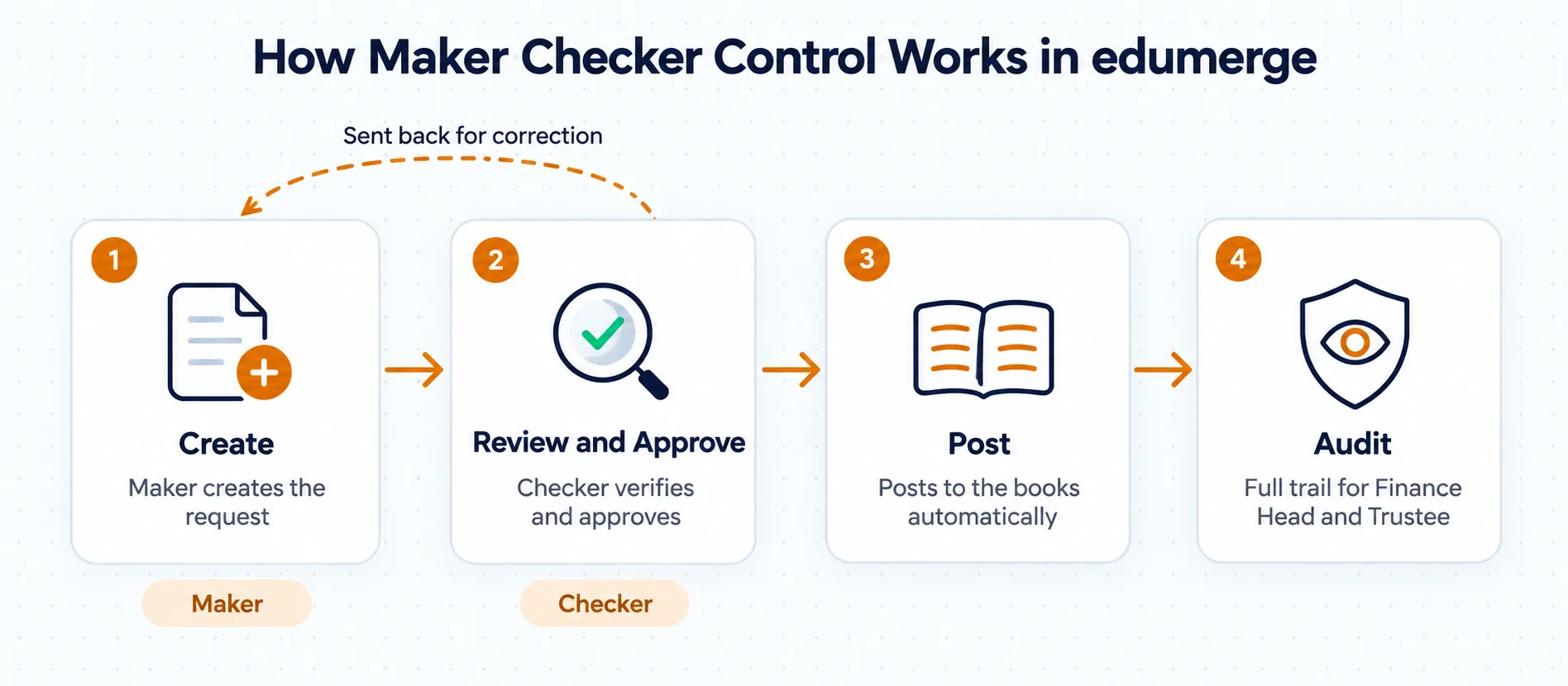
In edumerge, every transaction or change involves two roles:
- Maker (creator): the person who creates the request in edumerge, such as a department raising a purchase order, an accountant updating a fee or a teacher entering marks.
- Checker (approver): the person to whom edumerge automatically routes the request. The checker verifies the details and supporting documents, then approves it or sends it back for correction.
Depending on the amount or the sensitivity of the change, a request may need more than one checker. edumerge routes it through each level of your institution's hierarchy in turn. For example from the HOD to the principal, and the checker at each level must approve it before it moves forward.
Once the request is approved, it takes effect and every step is recorded with who acted and when. On the finance side, approved transactions post to the books automatically, without anyone re-entering them.
Amount-Based Approval Authority
Not every transaction needs the Principal's signature. In edumerge, the number & seniority of checkers is linked to the size of the transaction, using limits your institution defines. A typical structure might look like this:
| Transaction amount (illustrative) | Maker | Checker levels (in order) |
|---|---|---|
| Up to Rs. 25,000 | Department In-charge | Head of Department or administrative officer |
| Rs. 25,000 to Rs. 2 lakh | Department In-charge | Head of Department, then principal |
| Rs. 2 lakh to Rs. 10 lakh | Department In-charge | Head of Department, then finance head, then Principal |
| Above Rs. 10 lakh | Finance team | Finance head, then principal, then trustee or governing body |
These limits are only an example. Each institution sets its own, according to its delegation of financial powers. The principle stays the same: the higher the amount, the more senior the person responsible for it.
Use Case 1: edumerge Maker Checker Control in Procurement
Procurement is where most institutional spending happens, and where the 5 risks above appear most often. Every purchase passes through several hands, from the department that needs an item to the vendor who supplies it. edumerge procurement management builds a maker and a checker into each stage.
1. Purchase Orders (PO)
A department raises the purchase order (maker), and the HOD or finance head approves it (checker) before it reaches the vendor. This ensures every purchase is needed, fairly priced and within budget before the institution commits to it.
2. Vendor Review
Adding a new vendor or changing an existing vendor's bank details is verified by a second person. This is one of the most important controls in procurement, since it prevents payments from going to fake or incorrect accounts.
3. Invoice Verification
The accounts team records the vendor's invoice, and a checker matches it against the purchase order (PO) and the goods actually received before payment is released.
Example: A college orders 50 classroom chairs. The vendor's invoice bills for 50, but the stores team has received only 40. Because the checker compares the invoice with the goods received, the mismatch is caught before payment, and the vendor is asked to correct the invoice or deliver the balance.
| Procurement stage | Maker | Checker | What it prevents |
|---|---|---|---|
| Purchase orders | Department | HOD or Finance Head | Unapproved or unnecessary spending |
| Vendor review | Accounts or procurement team | Finance Head | Payments to fake or incorrect accounts |
| Invoice verification | Accounts team | Checker matching PO and goods received | Paying for goods not received |
Use Case 2: edumerge Maker Checker Control in Fee Management
Fees are the main source of income for any educational institution, and every change to them affects parents directly. With edumerge fee management, maker checker control applies both to the fee structure itself and to any reduction in what a student pays.
1. Fee Structure Changes
Fee structures change during the year, whether it is a late-payment fine, a new sports fee or a revised transport fee. The accounts team makes the update (maker), and a senior person such as the finance head approves it (checker) before it reaches parents.
2. Discounts, Concessions and Scholarships
Discounts, concessions and scholarships directly reduce the institution's income, which makes them one of the highest-risk areas for unchecked changes. A staff member applies the concession or scholarship (maker), and the Principal or Finance Head approves it (checker).
Example: At the start of the term, the accounts team introduces a new sports fee of Rs. 1,500 for a class of 60 students, but enters it as Rs. 15,000. In the same week, a 10% sibling concession is applied to a student in the same class but recorded as 100%, which waives the student's entire annual fee of Rs. 85,000.
Without an independent check, 60 families would receive an incorrect fee demand, and the front office would face a wave of complaints. The institution would also lose Rs. 76,500 in fee income beyond the intended concession, without the error being noticed.
In edumerge, both changes are routed to the Finance Head for approval before they take effect. The Finance Head identifies the unusual sports fee and the full fee waiver and returns both to the accounts team for correction. As a result, parents receive the correct fee demand, the right concession is applied, and every approval is recorded for leadership and auditors to review at any time.
| Fee activity | Maker | Checker | What it prevents |
|---|---|---|---|
| Fee structure changes | Accounts team | Finance Head or senior approver | Incorrect fees charged to students |
| Discounts and concessions | Staff member | Principal or Finance Head | Unauthorised or excessive income loss |
| Scholarships | Staff member | Principal or Finance Head | Ineligible or unrecorded fee waivers |
Use Case 3: edumerge Maker Checker Control for Teachers and Academics
Maker checker control is just as valuable for academic work, where errors affect students' results and the institution's reputation. Across edumerge's academic modules, like examination management, every important academic record is reviewed before it reaches students & parents.
1. Assignments
The teacher creates the assignment with questions, rubric and due date (maker). Whereas the HOD or subject coordinator checks it for syllabus fit and difficulty before it is published to students (checker).
2. Question Papers
A faculty member sets the question paper, and the HOD or a moderation panel reviews it before the exam. This prevents errors, repeated questions and leaks.
3. Marks Entry
The teacher enters internal or assignment marks, and the HOD verifies and locks them before they flow into results or report cards. This completely stops incorrect or altered marks from reaching students and parents.
4. Lesson Plans and Attendance Corrections
The teacher submits a lesson plan or a late attendance change, and the academic coordinator approves it. This not only keeps teaching on track with the syllabus but also ensures attendance records cannot be changed without a record.
Every academic approval is recorded with who acted & when, giving colleges clear, documented evidence for NAAC and NBA audits.
Example: A teacher enters internal marks for 60 students, and one student's score of 18 is typed as 81. Without a check, the wrong mark flows into the report card, and the error surfaces only when another student's parent questions the class rankings. Through edumerge's maker checker control, the HOD verifies the marks before locking them, spots the unusual score and sends it back for correction. Therefore the right mark reaches the student, and the approval is recorded for NAAC and NBA.
| Academic activity | Maker | Checker | What it prevents |
|---|---|---|---|
| Assignments | Teacher | HOD or subject coordinator | Off-syllabus or unsuitable assignments |
| Question papers | Faculty member | HOD or moderation panel | Errors, repeated questions and leaks |
| Marks entry | Teacher | HOD | Incorrect or altered marks in results |
| Lesson plans and attendance | Teacher | Academic coordinator | Unrecorded changes to academic records |
Key Features of edumerge Maker Checker Control
Across all 3 use cases, edumerge applies maker checker control in the same consistent way, so every team follows one clear approval model:
- Two people on every transaction: Every transaction or change has a creator (maker) who creates it and an approver (checker) who approves it, so no single person can complete it alone.
- Multi-level approval workflow: Where more than one approver is needed, requests follow your institution's hierarchy automatically. For instance, a request from the IT team goes to the HOD and then to the Principal, without anyone forwarding emails or chasing signatures.
- Amount-based approval authority: Specific amounts can be approved only by designated checkers. Higher-value requests reach senior leadership automatically, and that leadership is accountable for them.
- A full audit trail: Every request, approval & rejection is recorded with who acted & when, and is visible to trustees and auditors.
- Live visibility for leadership: Finance heads & trustees can see what is pending, with whom and for how long, across every campus.
On the finance side, edumerge Finance & Control works alongside your existing books, rather than being a replacement. Also, approved transactions post automatically without re-entry, and every approval is reflected on the trustee dashboard.
How to Set Up Maker Checker Control in edumerge
- List what needs control: Identify every transaction or change that requires a second check. This includes purchase orders (POs) & vendor changes in procurement, fee updates & concessions in fee management, and question papers & marks entry in academics.
- Set approval limits: Decide who can approve how much. For example, a Head of Department may approve purchases up to Rs. 25,000, while anything above that goes to the Principal.
- Map your approval hierarchy: Define the path each request will follow: from the department to the HOD, then to the principal, and finally to the trustee for high-value items. Make sure to repeat this for every campus, as the people in each role may differ.
- Keep the maker and checker separate: The person who creates a transaction should never be able to approve it. This one rule is what makes the control work.
- Train your teams: Help staff and teachers understand that maker checker control is there to protect them, not to monitor them. For example, when entry is reviewed before it is processed, no individual can be wrongly blamed for an error later
- Review the process every month: Look at pending approvals, rejected requests and any delays. Use your findings to adjust limits and roles, so the process stays both secure and quick.
Every Rupee Checked, Every Record Verified with edumerge
Remember the Rs. 1.2 lakh laptop request from Monday morning? With maker checker control, a second person would have verified the amount, the vendor and the bank account before a single rupee left the institution.
That is its real value. In procurement, every purchase and payment is verified. In fee management, every fee change and concession is authorised. In academics, every paper and set of marks is reviewed before it reaches students.
With edumerge, these checks run automatically across every campus, so governance no longer depends on individuals. It becomes part of how your institution works, every day.
Frequently Asked Questions (FAQs)
1. What is maker checker control?
Maker checker control is an approval process where one person creates a transaction or change and a different person reviews and approves it before it takes effect. Nothing is completed on one person's authority alone.
2. What is the difference between a maker and a checker?
The maker initiates the transaction, such as a purchase order, fee update or marks entry. The checker independently verifies it, then approves or rejects it.
3. Can the maker and checker be the same person?
No. The value of maker checker control comes from separating the two roles. If one person can both create and approve a transaction, the control does not exist.
4. Why do schools and colleges need maker checker control?
Institutions manage fee income, grants and donations that are answerable to trustees, auditors and regulators, along with academic records that shape students' futures. Maker checker control catches errors before they take effect and records every approval.
5. Where does maker checker control apply in an institution?
It applies in 3 main areas: procurement (purchase orders, vendors and invoices), fee management (fee structures, discounts, concessions and scholarships), and academics (assignments, question papers, marks entry, lesson plans and attendance corrections).
6. How does maker checker control work in procurement?
A department raises the purchase order, and the HOD or Finance Head approves it. Vendor changes are verified by a second person, and invoices are matched against the purchase order and goods received before payment.
7. Why should fee concessions and scholarships need approval?
Concessions and scholarships reduce the institution's income. A second approval prevents unauthorized or excessive discounts and keeps a record of who approved each one.
8. Can maker checker control be used for marks entry and question papers?
Yes. Teachers enter marks or set papers as makers, and HODs or moderation panels review them before results are published or exams are held.
9. What is the four eyes principle?
The four eyes principle means at least two people must review a transaction before it is completed. Maker checker control is the most common way to apply it.
10. Does maker checker control slow things down?
Not when it is automated. Requests route to the right approver instantly, small amounts stay at lower levels, and leadership can see which approvals are pending and for how long.
11. How does maker checker control help with audits, NAAC and NBA?
Every request, approval and rejection is recorded with who acted and when. This gives auditors and IQAC teams documented evidence of financial and academic controls without manual compilation.
12. Can maker checker control work across multiple campuses?
Yes. Each campus can have its own makers, checkers and approval limits, while Finance Heads and Trustees see approvals across all campuses in one place.