India has over 130 UGC-recognised deemed universities spanning engineering, medicine, management, law, humanities and research. Each holds significant academic autonomy, including the right to design its own curriculum, conduct its own exams & confer its own degrees.
These are operational loads that a conventional college software wasn't built to carry. These institutions also punch above their weight: 45 of the top 100 in the latest NIRF University rankings are deemed universities. Many running multiple faculties under one governing body across multiple campuses and cities.
That's where single-campus tools stretch thin fast. A system built for one faculty on one campus cannot hold consolidated fee ledgers, cross-campus attendance, faculty-specific accreditation cycles and trustee-level dashboards without breaking down at scale.
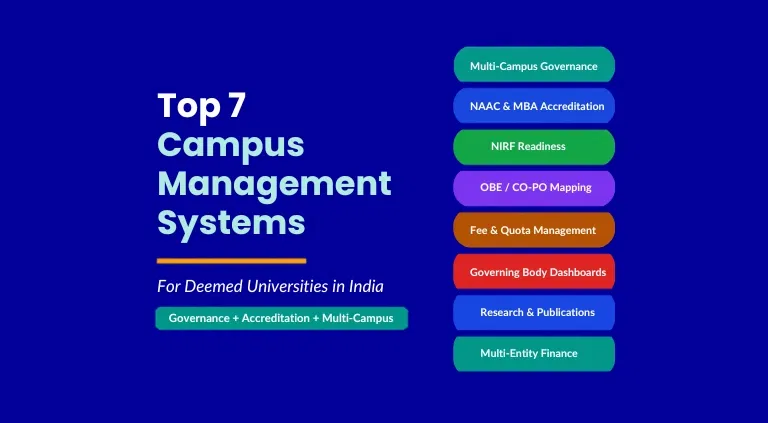
Here's a closer look at the top 7 campus management systems for deemed universities in India. And how each one holds up against that load.
TL;DR
Deemed universities in India operate with academic autonomy, multi-faculty structures and continuous NAAC/NBA/NIRF compliance needs that generic college software isn't built to handle.
This blog lays out the unique challenges, comparing purpose-built campus management systems against single-campus tools. And highlighting the operational gaps institutions face without one, such as siloed data, manual accreditation scrambles and outdated trustee reporting.
It then compares 7 platforms, each summarized with key strengths and honest caveats. And finally wraps up with 10 evaluation criteria spanning scalability, governance dashboards and accreditation readiness. Positioning edumerge College ERP as the strongest overall fit.
Why Deemed Universities Need Specialized Campus Management Systems
Deemed universities are not just larger colleges running the same workflows at scale. Their governance structure, academic autonomy and compliance load are fundamentally different. And that changes what the underlying platform needs to do:
- Degree-granting autonomy needs its own governance layer, not a school or single-college tool stretched to fit
- Multiple faculties under one university, such as engineering, medicine, management and law, often run across different campuses and cities under one governing body
- OBE, CO-PO mapping and NEP 2020 credit frameworks need to sit inside the core academic workflow, not arrive as a bolted-on module
- NAAC, NBA and NIRF readiness has to be continuous, since accreditation bodies expect multi-year data, not a scramble assembled once a cycle
- Fee structures span government quota, management quota, NRI quota and scholarship slabs across dozens of programs, which generic fee tools cannot model
- Governing Body, Academic Council and Board of Studies each need a different view of the same institutional data, not one generic report
- Research output, patents and publications need one central repository across departments, not scattered spreadsheets that surface only during a ranking submission
The table below shows how a purpose-built campus management system compares with software designed for a single campus.
| Parameter | Campus Management System (Deemed University) | Single-Campus College Software |
|---|---|---|
| Governance structure | Built for a Governing Body overseeing multiple campuses and constituent colleges under one trust or society | Built for one campus, one administration |
| Accreditation readiness | NAAC, NBA and NIRF data structures built into daily academic workflows | Accreditation data assembled manually before each cycle |
| Fee and finance handling | Multiple programs, quotas and scholarship slabs modeled across campuses | Single fee structure, limited quota handling |
| Data visibility | Real-time dashboards across every campus and department | Reports compiled campus by campus, department by department |
| Scalability | New campuses, faculties or programs added on the same platform | Requires a new instance or manual workaround per campus |
Fee complexity is only one piece of the financial picture. See how to manage college finances effectively across quotas, scholarships and multiple campuses.
Key Challenges Deemed Universities in India Face Without a Campus Management System
NAAC evaluation criteria call for institutional data spanning up to 5 years across several parameters. From curriculum delivery to student progression outcomes.
A deemed university without a system that captures this continuously ends up compiling all of it at once, in the months before the peer visit, which affects far more than accreditation alone.
| Challenge | Effect on Operations | Who Feels It Most |
|---|---|---|
| Department-level spreadsheets with no shared data layer | Registrar, exam cell and accounts office rarely work from the same numbers, so decisions lag behind reality | Registrars, Deans |
| Accreditation data assembled only before a NAAC or NBA cycle | IQAC coordinators lose months to a manual, error-prone data hunt across every department | IQAC Coordinators |
| Complex fee structures managed on generic finance tools | Quota-wise, scholarship-linked and NRI fee tracking breaks down as programs scale | Finance Heads |
| No live governance dashboard | Governing Body and Trustees rely on outdated monthly reports instead of real-time institutional health | Trustees, Governing Body |
| Research output scattered across departments | Faculty publications, patents and grants have no central visibility for accreditation or NIRF submissions | Deans, Academic Directors |
| Manual multi-campus consolidation | Leadership cannot compare campus-wise performance without weeks of manual collation | Vice Chancellors, Chancellors |
The same visibility gap shows up in people, not just data. Read what trustees can't see about staff across campuses when there is no unified HRMS behind the campus management system.
Top 7 Campus Management Systems for Deemed Universities in India
1. edumerge College ERP
edumerge College ERP is a purpose-built campus management platform for deemed universities and multi-campus education groups. Unifying academics, accreditation, finance and HR on one architecture.
Key strengths:
- Centralised campus management across every department and campus from a single dashboard, with institutional-level KPIs for academics, attendance, fee recovery and accreditation readiness, purpose-built for the multi-campus and multi-college structure common to deemed universities.
- Autonomous Governance System built for the academic and administrative freedom deemed universities operate under, including OBE and credit system support out of the box.
- Native NAAC & NBA accreditation and NIRF ranking management via consolidated CO-PO mapping, student feedback and outcome reports instead of leaving them scattered across faculty spreadsheets.
- Placement and alumni management alongside core student lifecycle, so post-graduation tracking sits on the same data layer as admissions and academics.
- One unified codebase shared across School ERP, College ERP, HRMS and Finance & Control, so a deemed university running affiliated schools or associated institutes under the same trust gets one source of truth rather than stitched-together systems.
- Auto fee collection with program-wise structures, real-time ledger reconciliation and audit-ready reports built for trustee-level financial scrutiny.
2. MasterSoft UAIMS
Indore-based ERP vendor with one of the widest module counts in the Indian higher-ed ERP market, used across university and college segments.
Key strengths:
- 23+ pro modules and 45+ built-in modules spanning admissions, curriculum, HR, finance, library and alumni in a single system.
- Outcome Based Education software mapping CO-POs to help institutions meet NBA guidelines.
- Biometric and RFID-integrated attendance with centralised cloud storage and automatic email and SMS alerts.
- Over two decades of implementation experience across schools, colleges and universities in India.
What to note:
- Breadth of modules is a strength, but institutions report a heavier configuration and onboarding effort compared to platforms built around fewer, deeper modules.
- Feature depth varies by module vintage since the suite has grown through incremental additions over many years rather than a single unified rebuild.
Take a deeper look at how edumerge compares with MasterSoft.
3. DigiiCampus
Bangalore-headquartered LMS-first platform, used by deemed universities for both ERP and learning management.
Key strengths:
- Strong learning management layer alongside ERP, with lesson scheduling, assignments, quizzes and forums built into the same platform used for administration.
- Exportable reports aligned to NAAC and NBA formats, plus in-platform guidance content on improving NAAC scores.
- Digitised examination and evaluation workflows, including online re-evaluation requests with payment options.
What to note:
- Positioning leans toward the LMS and teaching-learning side
- Institutions with heavy finance, HR or multi-entity governance needs should confirm those modules match ERP-first vendors before comparing.
- Public documentation is thinner on multi-campus group governance than on single-institution academic delivery.
4. Contineo
Bengaluru-based campus system of record, explicitly positioned for autonomous colleges and deemed and private universities.
Key strengths:
- Four integrated discipline areas (academic delivery, people, finance, and leadership analytics).
- Digital admissions intake with webcam capture and verifier workflows
- Dedicated PhD admissions and research milestone tracking, relevant to deemed universities running doctoral programs.
- Fee management and budgeting built around continuous NAAC, NBA and AICTE inspection-readiness rather than periodic reporting.
What to note:
- Public information on HRMS depth (payroll compliance, staff appraisal cycles) is lighter than on the academic and admissions pillars.
5. Camu (Octoze)
Global EdTech platform recognised as a Niche Player in the 2026 Gartner Magic Quadrant for Higher Education SaaS Student Information Systems, deployed in institutions across countries.
Key strengths:
- Unified SIS and LMS architecture used by Indian institutions as their core ERP.
- Out-of-the-box support for NEP, OBE and CBCS, aimed squarely at current Indian regulatory frameworks.
- AI-driven insights and automation layered across admissions, fee collection and attendance, with real-time dashboards for leadership.
What to note:
- Being a global platform with international clients, some configuration and support cycles may prioritise broader EdTech markets over India-specific statutory nuances; confirm local compliance SLAs during evaluation.
- Gartner Niche Player status reflects a specific evaluation scope and market focus, not a ranking against every category, so institutions should weigh it alongside direct reference calls.
Take a look at our comparison on edumerge vs Camu.
6. Heraizen DHI ERP
Engineering-education-focused digital transformation platform built around continuous accreditation readiness and outcome-based performance tracking.
Key strengths:
- Automation and performance dashboards built specifically around NBA and NIRF preparedness rather than as a bolt-on report generator.
- Descriptive, prescriptive and predictive analytics on student and faculty performance, going beyond static MIS reporting.
- In-built expert system aimed at capability improvement of students and faculty, tied to an outcome-based education model.
What to note:
- Product focus began with engineering education specifically, so deemed universities with large non-engineering faculties (medicine, law, humanities) should verify module maturity outside the technical stream.
- Some user reviews on app stores flag performance and login stability issues on the mobile app, worth stress-testing during a pilot.
7. Academia by Serosoft
Indore-based, Java-built ERP used by institutions across countries.
Key strengths:
- Full student lifecycle coverage from enquiry to graduation, alongside inventory, hostel, library and HR in the same suite.
- Multi-currency and internationalisation support, relevant for deemed universities with international student intake or overseas campuses.
What to note:
- Java-based architecture is stable but institutions should confirm current release cadence and cloud-native capabilities against newer SaaS-first competitors.
- Client base spans schools, colleges and corporates broadly, so deemed university-specific workflows (autonomy governance, PhD/research tracking at scale) may need deeper scoping during evaluation compared to platforms built primarily for higher ed.
You may also like our comparison on edumerge vs Generic College ERPs.
Evaluation Criteria for Campus Management Systems for Deemed Universities
Once leadership has weighed in by role, these 10 criteria narrow the shortlist to platforms actually built for deemed university complexity, not generic higher-education software:
| Evaluation Criterion | What to Look For |
|---|---|
| Multi-campus and multi-faculty architecture | Native support for engineering, medical, management and law faculties under one governing body |
| NAAC, NBA and NIRF readiness | Accreditation data structures built into daily academic workflows, not a bolt-on |
| OBE and NEP 2020 compliance | CO-PO, PEO and PSO mapping with credit-based curriculum support |
| Governance dashboards | Real-time visibility for the Governing Body, Academic Council and Board of Studies |
| Fee and finance complexity | Quota-wise, scholarship-linked and multi-program fee handling |
| Research and publication tracking | A central repository for faculty output, patents and grants |
| Multi-campus consolidation | Campus-wise and consolidated institutional reporting on one platform |
| Data security and access control | Role-based access with audit trails for sensitive academic and financial data |
| Scalability | Ability to add campuses, faculties or programs without a re-implementation |
| Implementation and support | A structured rollout with data migration and role-specific training for higher education |
Governance dashboards are only as good as the intelligence behind them; see how AI governance software for Indian education groups extends this criterion across multi-campus decision-making.
Conclusion
Deemed universities operate with an academic and administrative autonomy that conventional college software was never designed to support at this scale. Choosing a campus management system for a deemed university in India is a governance decision, not just a technology purchase.
The right platform delivers continuous accreditation readiness, real-time visibility for every stakeholder from Registrar to Governing Body, and room to add campuses or faculties without starting over. The 10 evaluation criteria in this guide are a practical starting point for any shortlist.
edumerge College ERP is built for exactly this complexity, with NAAC, NBA and NIRF data structures native to the platform and multi-campus governance trusted by 800+ institutions across India. It is a strong starting point for any deemed university evaluating its next campus management system.
Frequently Asked Questions
1. How is a Campus Management System different from a college ERP?
A college ERP typically manages one campus's day-to-day academic and administrative workflows. A campus management system for a deemed university adds multi-campus governance, research management and institution-wide accreditation reporting on top of that.
2. Do deemed universities need a separate platform for NAAC and NBA accreditation?
No. A campus management system built for higher education includes NAAC, NBA and NIRF data structures natively, so accreditation evidence is collected as part of daily operations instead of through a separate tool.
3. Can one Campus Management System manage multiple constituent colleges?
Yes, when it is purpose-built for university groups. Each constituent college can operate independently while university leadership gets a consolidated view of admissions, fees, accreditation status and operations across all campuses.
4. How long does it take to implement a Campus Management System for a university?
Timelines vary with scale, but a structured rollout typically covers initial setup, historical data migration, role-specific training and ongoing support, often starting with core modules live within a few weeks.
5. Does a Campus Management System handle quota-wise and scholarship-linked fees?
A system built for deemed universities should support government quota, management quota, NRI quota and scholarship-linked fee structures across multiple programs and campuses, which generic finance tools cannot model accurately.
6. Who should evaluate a Campus Management System for a deemed university, the registrar or IT head?
Both, along with the Vice Chancellor, Finance Head, IQAC Coordinator and Governing Body, since each role depends on a different part of the same platform for daily operations and compliance.
7. Is edumerge College ERP suitable for deemed universities with multiple campuses?
Yes. edumerge College ERP is built for multi-campus, multi-entity institutions, supporting a single university running 20 or more campuses on one unified platform.
8. Can a Campus Management System support NEP 2020 credit frameworks?
A platform built for Indian higher education should support credit-based curriculum structures, the Academic Bank of Credits and outcome-based assessment required under NEP 2020, integrated with the academic and examination modules.