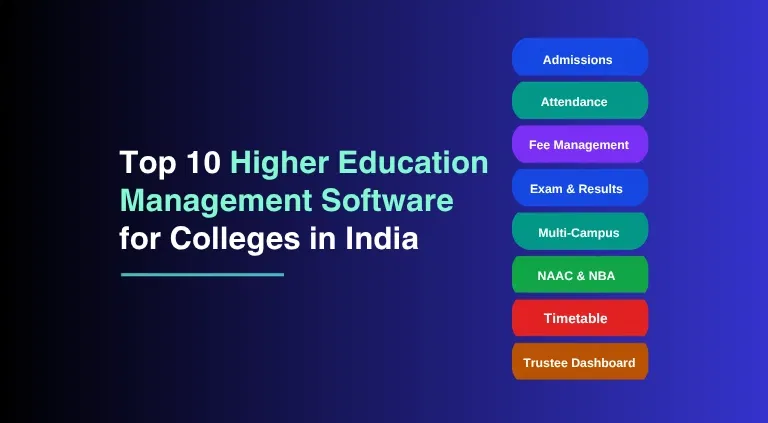
India now runs 64,456 higher education institutions (HEIs) with 48,246 colleges & 1,289 universities. Enrolling 45 million+ students, according to the AISHE 2023-24 survey. Picking the right higher education management software for colleges becomes a governance decision, instead of a routine IT purchase.
Moreover, only about 9,000 of the roughly 45,000 HEIs in the country hold NAAC accreditation, leaving more than 70% without formal quality recognition. Much of that gap comes down to data, not intent.
This allows colleges to use software that captures the right academic, faculty & infrastructure data right from the first semester. This changes the trajectory well before the next accreditation cycle begins,
That is the lens this guide uses. It measures the top higher education management software for colleges in India against the evaluation criteria that actually hold up under scrutiny. So that college leadership can choose a system that survives the next NAAC visit, Trustee review or multi campus audit.
TL;DR
A generic ERP tracks transactions. A higher education management software understands NAAC criteria, CBCS credit structures, multi campus governance and academic outcomes together.
Colleges without dedicated education software lose time to manual self study report preparation, disconnected attendance & fee systems, and delayed Trustee reporting across departments.
The right choice is measured against evaluation criteria such as NAAC readiness, multi campus support, role based access and finance governance, not brand recognition alone.
edumerge College ERP is built exactly for this. Eliminating manual labor, saving time & effort for every person in the college leadership/management role.
Why Do Colleges Need Specialized Education Management Software, Not a Conventional ERP?
A conventional, generic ERP is built for inventory, payroll & finance across any industry. But when specific to higher education, an ERP runs entirely on different rules. When a gap is identified, it directly shows up in real operational and compliance costs.
Here's how that mismatch shows up across 5 areas of institutional operations:
- Accreditation is data heavy: 70% of a NAAC score is drawn from quantitative institutional data collected across several years. Covering data (faculty qualifications, publications, pass rates and infrastructure spend) that a generic ERP was never built to map.
- Credit based academics need a course engine: Colleges running the Choice Based Credit System (CBCS) must calculate SGPA & CGPA while managing elective groups. A finance-first or HR-first ERP simply doesn't include these functions.
- Attendance carries legal weight: Most universities enforce a 75% minimum attendance rule for exam eligibility. That means attendance tracking has to connect directly to exam eligibility. Instead of sitting in a separate system that someone reconciles manually.
- Enrolment is growing faster than admin capacity. India's Gross Enrolment Ratio rose to 30% in 2023-24, up from 23.7% in 2014-15 (AISHE 2023-24, released 8 July 2026). This is a decade-long trend, not a spike. So more student records flow through the same administrative teams every year. Hence, colleges scaling this fast can't keep running on manual processes sized for a smaller student body.
Read about the other major challenges faced by college administration in India, and how a proper ERP fixes each one.
Why a Generic ERP Can't Absorb This Growth?
That kind of enrollment growth exposes a structural gap, because most ERPs weren't built to hold what a college actually generates. The two systems solve for different problems entirely:
| Area | Conventional ERP | Educational Management Software |
|---|---|---|
| Data model | Generic finance, HR, inventory records | Student, faculty, academic and compliance records in one structure |
| Compliance mapping | Not built for accreditation bodies | Maps directly to NAAC, NBA and UGC reporting needs |
| Academic calendar | Absent or bolted on | Native semester, credit and exam calendar support |
| Reporting | Department level reports | Board ready, Trustee level consolidated dashboards |
Before comparing the 10 platforms below, it helps to be clear on what a College ERP is actually meant to cover. Our what is College ERP software - a complete guide for HEIs, breaks down the core modules every HEI should expect from one.
Top 10 Higher Education Management Software for College in India
1. edumerge College ERP
edumerge College ERP is built around Indian higher-ed compliance. Covering the complete student lifecycle for colleges, universities and multi-campus groups of institutions.
Key strengths:
- Purpose-built NAAC & NBA accreditation workflows that pull self-study report data straight from live institutional records, cutting the manual compilation load on IQAC teams.
- Outcome-Based Education (OBE) administration with automated course outcome and program outcome mapping and attainment calculations.
- Alumni management, placement tracking and research administration sit on the same student record. So accreditation evidence stays current without duplicate data entry.
- Full admission-to-alumni lifecycle: admissions, attendance, examinations, fees and academic records in one system.
- Part of the wider edumergeOS suite, so a College ERP customer can extend into HRMS and Finance & Control on one shared database rather than a second implementation.
- Governed AI layer (edumerge Govern) for permission-scoped, audit-logged querying of student and institutional data. Useful for trustees and chairpersons overseeing multiple campuses.
- 14+ years focused on the Indian education sector, with 800+ institutions live and 500K+ students accessing the platform daily.
2. MasterSoft ERP
A two-decades-strong education ERP built specifically for Indian institutional deployments.
Key strengths:
- Accreditation Data Management System (ADMS) built specifically to compile NAAC, NBA and NIRF reports, with multi-user data entry and proof uploads.
- Deployed across NITs, IIITs, central universities and autonomous colleges
- Centralized Campus Management System (CCMS) for cloud-based multi-campus operations.
What to note:
- Functionality has grown through several distinct modules (ADMS, CCMS, Feepayr, Atcovation) built up over time, so confirm how tightly these are integrated rather than sold as separate add-ons.
- MasterSoft's own accreditation marketing carries a disclaimer that it is not associated with NAAC, worth keeping in mind when evaluating claims.
Explore our comparison on edumerge vs MasterSoft Education ERP.
3. Camu
An SIS and LMS platform serving both higher education and K-12 campuses.
Key strengths:
- Integrated SIS and LMS covering the full student lifecycle from admissions to graduation.
- Native support for Choice Based Credit System (CBCS) and Outcome-Based Education (OBE) structures.
What to note:
- Independent review volumes are modest; reference checks with similarly sized institutions are worth doing before committing.
Also take a look at our comparison on edumerge vs Camu.
4. Creatrix Campus
An AI-native, cloud-only SaaS built solely for higher education since 2006, with a solid footprint across India and the Middle East.
Key strengths:
- Configurable rubrics and learning outcome mapping suited to NAAC, NBA and ABET-style reporting.
- Broad modules spread from admissions through alumni and placements, delivered mobile-first.
What to note:
- Pricing is custom enterprise, quoted per institution and starting well above budget-tier tools; confirm total cost of ownership upfront for smaller autonomous colleges.
- Focuses exclusively on education modules, so finance and HR typically sit on separate systems needing integration.
5. Academia ERP by Serosoft
A unified ERP/SIS platform with accreditation baked into its product direction from the start.
Key strengths:
- OBE module explicitly aligned to NAAC and NBA requirements, with automated CO-PO mapping and attainment calculations, also mapped to NEP.
- Positioned as a single platform for academics, admissions, examinations and campus operations.
What to note:
- Public feature detail is comparatively lighter than more established India-first players; insist on a demo against your specific accreditation cycle before deciding.
6. TCS iON Digital Campus
The education arm of Tata Consultancy Services, delivering campus services through a "phygital" model that blends digital tools with physical infrastructure.
Key strengths:
- Backed by TCS engineering scale, with a pay-as-you-use, IT-as-a-Service commercial model.
- Digital Assessment product has delivered secure exams at scale industry-wide.
What to note:
- Built as one vertical inside a very large IT services organisation rather than a dedicated education-only vendor, so account attention can vary by engagement size.
- Strongest reference base is large public universities and skilling programmes; fit for a mid-size autonomous college's routine NAAC workflow needs closer scrutiny.
Also explore edumerge College ERP for affiliated colleges.
7. Digiicampus
An engagement-first campus management and analytics platform.
Key strengths:
- Five-layer stack: administration ERP, academic/LMS, workflow automation, engagement console, and analytics.
- Strong stakeholder engagement tools: gate pass, grievance, IT help desk, alumni and parent modules alongside the core ERP.
What to note:
- Materials emphasise engagement and workflow more than accreditation-specific reporting; confirm NAAC/NBA report depth directly.
- Primarily an app-first experience; institutions wanting a heavier desktop admin console should check parity across platforms.
8. Heraizen (DHI ERP)
A platform founded in 2017, built specifically to automate accreditation work.
Key strengths:
- Purpose-built to automate accreditation, academics, administration, examination and learning management workflows.
- Focused product aimed squarely at reducing manual accreditation documentation effort.
What to note:
- A younger, seed-stage company relative to two-decade incumbents; check implementation references and support depth before a multi-year commitment.
- Narrow scope centred on accreditation and academics means finance, HR and payroll typically need a separate system.
You might also like this guide on the 6 best ERP for college groups in India.
9. Contineo
A campus management tool Indian colleges use for their day-to-day administrative and academic workflows.
Key strengths:
- Covers core admissions, academics and day-to-day institutional operations.
- Positioned for colleges wanting a straightforward, education-specific workflow tool.
What to note:
- Public documentation and independent reviews are limited; request a live demo and vendor references directly rather than relying on third-party listings.
- Confirm NAAC/NBA-specific report formats explicitly, since this isn't prominently documented.
10. Ellucian Banner
An enterprise SIS that occasionally finds its way into large or elite Indian universities.
Key strengths:
- One of the global SIS platforms, with decades of deployment at large research universities worldwide.
- Deep, mature functionality for complex, multi-faculty university administration.
What to note:
- Built for large global universities, not India-specific college workflows, so NAAC/NBA/AICTE reporting typically needs heavy customisation or a bolt-on tool.
- Enterprise pricing and implementation timelines are considerably heavier than what most Indian colleges or mid-size groups of institutions need.
You might also like our comparison on edumerge College ERP vs. Ellucian Banner.
How to Match Software Capabilities to Your College's Structure
1. Autonomous vs Affiliated Colleges
Autonomous colleges need in-house exam and credit engines since they design their own curriculum. While affiliated colleges need tight synchronisation with the affiliating university's academic calendar, syllabus updates and grading scale.
2. Single Campus vs Multi Campus Groups
A single campus college can operate with a simpler setup. Whereas a group of institutions running multiple campuses needs one shared data architecture. This helps leadership see a consolidated, real time picture instead of per-campus registers.
3. Professional and Technical Colleges vs General Degree Colleges
Engineering, medical and other technical colleges require lab scheduling, project tracking and placement modules. General degree colleges, where more than 60% of India's colleges fall, prioritise admissions volume, attendance and exam management at scale.
4. Growth Stage of the Institution
Younger colleges still building their accreditation history need self-study report data captured from year one, not compiled later. Retrofitting this after 2 or 3 years means going back and rebuilding historical records that should have been generated automatically from day one.
Autonomous colleges carry governance and compliance demands that a generic ERP often misses. Our guide on how to manage autonomous college operations lays out what to look for in a platform before signing on.
What to Look for in Higher Education Management Software: Evaluation Criteria
Use this table as a working checklist when shortlisting the top higher education management software for colleges in India.
| Criteria | What Good Looks Like |
|---|---|
| NAAC and NBA readiness | Maps student teacher ratio, publications and infrastructure spend directly to the seven NAAC criteria for self study report generation |
| Multi campus governance | One data architecture across campuses with a consolidated Trustee dashboard |
| Academic structure support | Handles CBCS, credit based grading, SGPA and CGPA, and elective management natively |
| Admissions and attendance | Digital admissions plus biometric or app based attendance with automated eligibility flags |
| Finance and fee management | Online fee collection, automated reminders and real time reconciliation |
| Role based access | Separate portals and permissions for Vice Chancellor, Registrar, Finance head, faculty and students |
| Cloud and mobile access | No on premise servers required, with mobile access for admin, faculty, students and parents |
| Implementation and support | A defined onboarding timeline, clear SLAs and dedicated support after go live |
Conclusion
The right higher education management software for colleges in India turns NAAC readiness, multi campus governance and finance control into one live system instead of a yearly scramble across departments.
With India's higher education system now serving over 45 million students across nearly 65,000 institutions, the cost of choosing generic software over education specific software only grows with scale.
edumerge College ERP is built around exactly this evaluation criteria, giving Vice Chancellors, Registrars and Finance Heads one governed platform instead of a collection of disconnected tools.
Frequently Asked Questions
1. Does edumerge College ERP support NAAC and NBA accreditation reporting?
Yes. edumerge College ERP maps faculty, infrastructure and academic data directly to NAAC & NBA criteria. Reducing manual self study report preparation.
2. Can higher education management software handle multiple campuses?
Yes, a well built college ERP runs every campus on one shared data architecture. Giving Trustees and Vice Chancellors a consolidated, real time view instead of separate per-campus systems.
3. How does college ERP help with CBCS and credit based grading?
It calculates SGPA and CGPA automatically, manages elective groups, and keeps credit structures aligned with UGC CBCS guidelines without manual spreadsheets.
4. How long does college ERP implementation typically take?
Implementation timelines vary by college size and modules chosen. So ask any shortlisted vendor for a defined onboarding timeline and service level agreement before signing.
5. Does college management software support online fee collection?
Yes, most modern college ERPs, including edumerge College ERP, support online fee collection with automated reminders and real time reconciliation for the finance team.
6. What should Finance Heads look for in college ERP software?
Finance Heads should look for fee automation, real time reconciliation, audit trails and consolidated books across every campus or entity within the trust.
7. Can college ERP integrate attendance with exam eligibility rules?
Yes. A properly built college ERP links attendance tracking directly to the university's minimum attendance rule, flagging eligibility issues automatically before exams.