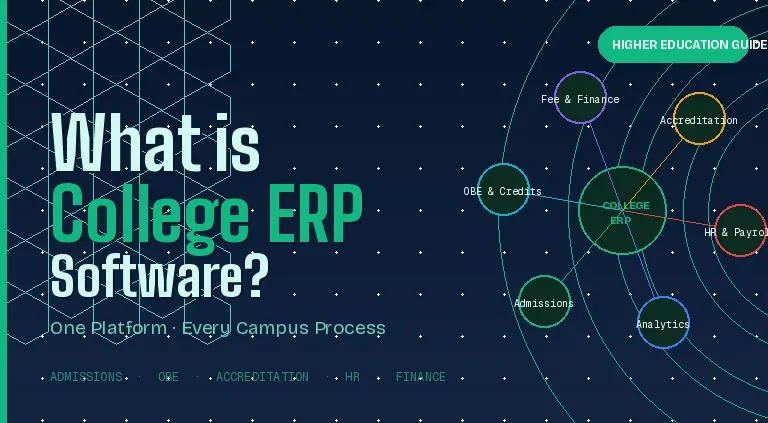
A college ERP system is an all-in-one college management system software that replaces manual processes and disconnected tools with a unified platform. It helps colleges run everything from one system—from student enrollment to graduation.
Enabling colleges & universities to manage academic, administrative, financial, and operational processes through a single system.
It integrates functions like admissions, student records, attendance, fees, examinations, faculty management, and communication—enabling institutions to automate workflows and improve efficiency.
The most efficient college ERP platforms enable it even for affiliated colleges, autonomous colleges, deemed-to-be universities as well as universities. Supporting institutions & learners at every scale.
What Does College ERP Software Do?
A college & university ERP manages the complete lifecycle of a student and institutional operations. Here are some of its core functions:
- Admission and enrollment management
- Student information and academic records
- Attendance and timetable tracking
- Fee collection and financial management
- Accreditation, research & publication management
- Examination, grading, and transcripts
- Faculty and payroll management
- Hostel, library & transport management
- Staying in-line with university guidelines
- Communication with students and parents
It acts as the digital backbone of a modern campus management system.
Key Features of a College ERP System
Student Information System (SIS)
Centralized student lifecycle data management.
Admission Management
Application tracking and onboarding processes.
Attendance & Timetable
Automated tracking and scheduling capabilities.
Fee & Finance Module
Billing, payments, and accounting with respect to scholarships and complex fee calculation.
OBE & Credits
With CO-PO mapping, PEO & PSO matrices for smoother credit management.
Examination & Results
Grades, transcripts, and analytics.
Accreditation Management
Evidence tracking for NAAC, NBA & NIRF.
Faculty & HR Management
Payroll, leave, performance & more.
Communication System
Notifications via SMS, email, and apps.
Analytics & Reporting
Real-time dashboards for decision-making.
Difference Between School ERP and College ERP
| Aspect | School ERP | College ERP |
|---|---|---|
| Complexity | Moderate | High |
| Departments | Limited | Multiple (departments, faculties) |
| Autonomy | Centralized | Department-level autonomy |
| Features | Basic academic + admin | Advanced workflows, credits, transcripts |
How to Choose the Best College ERP Software?
The best college ERP software is one that is scalable, cloud-based, customizable, and capable of managing complex higher education workflows efficiently. Yet, one thing that often goes missed in the buying journey, is the quality of after-sales support provided by the college ERP vendor.
Here are a few key factors to consider when looking out for ERPs for colleges:
- Ease of use for multiple stakeholders
- Custom workflows for departments
- Cloud accessibility
- Integration with LMS, payment systems, biometric attendance & more
- Data security and compliance
- Strong customer support, training & onboarding
- Scalable architecture to accommodate growing courses, students & staff
Benefits of College ERP Software
A college ERP software improves operational efficiency, reduces manual workload, enhances transparency, and enables data-driven decision-making in higher education institutions (HEIs). Here's how:
1. Operational Efficiency
Automates routine administrative and academic tasks. Reducing the burden on department heads/admins.
2. Centralized Data Management
Creates a single source of truth across departments. Preventing the creation of data silos.
3. Improved Student Experience
Faster processes, better communication, and transparency. Results in happier students & parents, ultimately helping in referrals & building a legacy for your institution.
4. Better Faculty Productivity
Reduces administrative burden on teaching staff. Educators spend more time on improving pedagogy that would've otherwise been taken up updating data manually, or in paperwork.
5. Data-Driven Decisions
Real-time analytics and reports for leadership. Since all the data is centralized and easily accessible; registrars, chairpersons & trustees can make decisions in real-time. Without having to assign & depend on individuals for stitching up reports.
6. Scalability
Supports multiple campuses and large institutions. Enabling institutions to easily scale when their courses & students grow, without having to worry about anything.
For a deeper look at what a scalable rollout across admissions, examinations, and accreditation actually looks like for an autonomous institution, see How to Manage Autonomous College Operations.
Frequently Asked Questions
What is college ERP software used for?
College ERP software is used to manage academic, administrative, and financial operations in colleges through a single integrated system.
What is the difference between ERP and college management software?
College ERP software is more comprehensive, integrating all departments into one platform, while basic college management software may handle only specific functions like academics and attendance.
Is ERP software necessary for colleges?
Yes, ERP software is essential for modern colleges to handle complex operations, improve efficiency, and ensure transparency.
What are the benefits of a campus management system?
- Streamlined operations
- Centralized data
- Better communication
- Improved decision-making
- Enhanced student experience
Can ERP systems be used in universities?
Yes, university ERP software is specifically designed to manage large-scale and multi-departmental operations in higher education institutions.
Is college ERP software cloud-based?
Most modern college ERP systems are cloud-based, offering remote access, scalability, and lower infrastructure costs. There are on-premise options as well but they pose more limitations than benefits.
How much does college ERP software cost?
The cost depends on:
- Institution size
- Number of users
- Features required
- Deployment model
Most solutions follow a subscription-based pricing model.