India is now home to close to 470 international schools. And ISC Research ranks it among the top 5 countries worldwide by number of international schools, alongside China, the UAE, Pakistan and Indonesia. That count has grown by roughly 45% over the past 5 years.
The 3 major forces that drive this growth are:
- multinational companies relocating employees,
- NRI families returning home,
- a growing middle class seeking English-medium education with globally recognised curricula.
The technology behind this growth is scaling right along with it. The global school management software market was valued at approximately Rs. 1.83 lakh crore (USD 21.94 billion) in 2024 and is projected to reach roughly Rs. 6.46 lakh crore (USD 77.57 billion) by 2032. A CAGR of 17.10%.
For institutions running multiple curricula and multi-currency fee books, this infrastructure is no longer optional. This guide is for decision-makers evaluating school management software for an international school in India. Exploring the operational gaps that appear without it, features worth prioritising, and a practical checklist for choosing the right platform.
TL;DR
International schools in India run parallel curricula, multi-currency fees, and dual compliance obligations that generic software cannot handle well. Administrative staff at schools without a unified system routinely spend 30 to 40% of their week on manual data entry & reconciliation instead of serving students & parents.
The must-have features are curriculum flexibility, multi-currency fee architecture, real-time dashboards, and mobile parent communication. Along with role-based access, and cloud deployment. Each of these directly reduces manual effort & closes a specific compliance or communication gap.
Choosing the right platform comes down to a focused, 6-point evaluation checklist. Right from curriculum support, fee architecture, compliance, integrations, implementation speed, and total cost of ownership.
edumerge's School ERP is built around this exact checklist. Covering multi-curriculum academic structuring, multi-currency fee management, and role-based dashboards in one platform.
Why International Schools Need School Management Software
International schools carry a layer of operational complexity that a typical single-curriculum, single-currency school never has to face. Here are 5 reasons why dedicated software transitions from being a nice-to-have system to becoming essential for an international school.
- Parallel curricula, parallel paperwork: A single campus may run IB PYP or MYP, Cambridge IGCSE or A-Level, and CBSE tracks side by side. Each with its own grading scale, report card format and transcript structure. While spreadsheets cannot maintain 3 rule sets all at once without error.
- Multi-currency, multi-source fee collection: Families pay tuition in INR, USD or GBP depending on employer reimbursement arrangements. And reconciling these manually creates delays and revenue leakage.
- Frequent mid-year admissions and withdrawals: Expatriate & transferring families move in and out of India on corporate assignments throughout the year. Not just at the start of an academic session. This makes admission and withdrawal workflows to run continuously.
- Dual compliance obligations: International schools must satisfy Indian regulatory boards such as CBSE or state education departments. While also meeting international accreditation standards from bodies such as CIS or NEASC. These two sets of requirements often follow different reporting cycles. So schools end up preparing similar data twice, in different formats, at different times.
- Governance across distributed campuses: Trustees & chancellors overseeing multiple campuses need consolidated, real-time visibility into enrolment, fee collection & academic outcomes. Without waiting for a monthly report from each campus.
For a broader look at what a school ERP actually covers, see what is school ERP software - a complete guide for modern institutions.
Key Features of School Management Software International Schools Actually Need
The global Student Information System (SIS) segment alone is projected to grow at a CAGR of 14.19% between 2024 & 2029. Reflecting how central these platforms have become to institutional operations. The features below matter most for international schools specifically, each paired with the outcome it drives.
| Feature | What It Changes on the Ground |
|---|---|
| Multi-curriculum academic engine (IB, Cambridge, CBSE) | Each curriculum gets report cards in its own correct format automatically. So staff aren't manually reformatting grades for different tracks and making fewer errors in the process. |
| Multi-currency fee and payment gateway | Fees in INR, USD, and GBP reconcile faster and more accurately, which directly cuts down on revenue leakage. |
| Real-time trustee and admin dashboard | Leadership makes decisions on live, consolidated data from every campus, instead of waiting on month-end reports. |
| Mobile parent-teacher communication app | Parents get the same instant, transparent updates that they're used to from a bank or an e-commerce app, which lifts satisfaction and trust. |
| Role-based access control (RBAC) | Records stay audit-ready at all times, lowering compliance risk across two overlapping reporting cycles. |
| Cloud-based deployment with no on-premise hardware | New campuses onboard faster, and the IT team carries a lighter operational load. |
| Integrated attendance and transport tracking | Parents and administrators both get real-time safety alerts, closing the gap between when something happens and when it's known. |
Spreadsheet-based fee & grade tracking looks easy, until the real cost shows up in staff hours & errors. See the hidden cost of spreadsheet administration for a closer look.
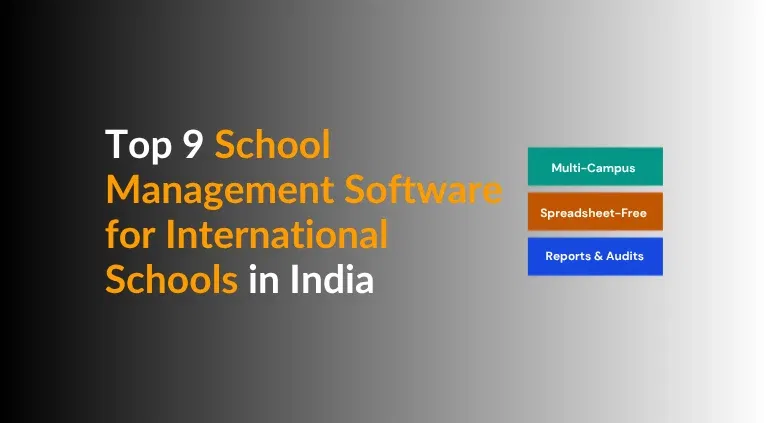
Top 9 School Management Software for International Schools in India
1. edumerge School ERP
edumerge's School ERP suite is an end-to-end school management platform. Built for CBSE, ICSE, IB & IGCSE schools across India. Spanning the entire student lifecycle on a single platform. It has supported the Indian education sector for over 14 years now, with 800+ institutions running on the platform today.
Key strengths:
- Online admissions with enquiry-to-enrolment tracking, document management and a centralised student record store
- Attendance tracking (biometric or manual) tied to automated timetable & substitution management
- Online fee collection with an integrated payment gateway, concession handling and financial reporting for parents
- Exam and result management backed by AI-powered performance dashboards for academic tracking
- Library, transport (route & GPS linked), hostel and visitor management modules built into the same platform, not separate add-ons
- Lesson plan module and online assessments for classroom-level academic delivery
- Parent-teacher-student communication built directly into the ERP.
- Part of the wider edumergeOS suite, so schools within a group of institutions can extend onto HRMS and Finance & Control on the same data layer
- GOI Command Center gives multi-campus trusts a consolidated view across their international-curriculum campuses
2. Entab (CampusCare)
An Indian school ERP known for CampusCare, a cloud SIS built for K-12 schools including CBSE and international-curriculum campuses.
Key strengths:
- Core ERP covering admissions, attendance, timetable, exams, progress cards in one platform
- GPS-linked transport tracking with real-time parent alerts for pick-up, drop-off and delays
What to note:
- Strongest for CBSE/ICSE-heavy institutions
- IB or Cambridge curriculum planning is not its core strength, so schools on global boards may still need a separate curriculum tool
- Positioned toward premium, experiential schools, so pricing and onboarding can be heavier than a single-campus international school needs
Take a look at our comparison between edumerge vs Entab School ERP.
3. PowerSchool SIS
A US-origin SIS used across countries, including a number of India-based international schools, valued for deep customisation and global interoperability.
Key strengths:
- Built-in Lesson Planner and Curriculum & Instruction modules for instructional alignment across grades
- Multi-language parent portal and mobile app, useful for diverse international school communities
What to note:
- Built primarily for US/global K-12 operations
- India-specific compliance such as CBSE affiliation reporting needs local implementation partners
- Deployment is typically enterprise-grade, which can exceed what smaller independent international schools require
4. MyClassboard
A Hyderabad-based, India-focused school management SaaS used by schools across CBSE, ICSE, IB and IGCSE boards.
Key strengths:
- Gradebook module with automatic grade calculation and bulk report card printing, board-agnostic
- School Messenger for SMS, email and group chat, plus bulletin boards and homework diaries
What to note:
- Designed and priced for the Indian market
- Schools planning international branches or global academic structures outside India may hit platform limits
- No native LMS, so digital classroom delivery needs a separate tool alongside it
5. Next Education (NextERP / NextOS)
Combines school ERP with Next Education's own academic content and LMS under one "total school solution."
Key strengths:
- Bundles ERP with academic content, connecting administration directly to classroom learning outcomes
- Assessment, classroom and parent-portal modules delivered as one integrated ecosystem
What to note:
- The bundled academic content is built around Indian board curricula, so it's less relevant for schools running IB, Cambridge or American curricula
- Best suited to schools wanting content plus ERP together, less so schools that already have a separate curriculum partner
6. LEAD Group School ERP
A cloud ERP from India serving mostly affordable private schools with attendance, fee and communication tools.
Key strengths:
- Single dashboard for attendance, fees, staff and parent communication
- Large support network across 400+ cities, useful for schools without dedicated in-house IT teams
What to note:
- Built primarily for the affordable/mid-market segment rather than premium international schools on IB or Cambridge boards
- ERP is tightly bundled with LEAD's own curriculum and teaching kits, limiting flexibility for schools wanting ERP alone
7. Toddle
An India-built, IB-licensed teaching and learning platform used by IB, Cambridge & American-curriculum schools worldwide.
Key strengths:
- Purpose-built for IB PYP, MYP, DP plus Cambridge, American and British curricula, rather than a generic ERP retrofitted for international boards
- Collaborative unit and lesson planning, portfolios and criteria-based rubric assessment built around each framework
What to note:
- Focused on curriculum planning, assessment and family engagement rather than back-office administration
- Schools still need a separate ERP for fees, admissions and HR
8. Fedena
An open-source, multi-tenant school ERP from Foradian Technologies. Widely used across India, Southeast Asia & the Middle East.
Key strengths:
- Plugin architecture lets schools extend admissions, fee structures or report card formats without vendor lock-in
- Open-source core with add-on modules (library, Moodle integration, video conferencing) for schools wanting customisation control
What to note:
- Depth of support and update cadence depends on the plan or partner chosen, since core releases have slowed in recent years
- Getting full value from the open customisation model needs in-house or partner technical capacity, a heavier lift than a fully-managed SaaS ERP
Also explore how edumerge compares with Fedena.
9. Frappe Education (built on ERPNext)
A free, open-source education management app on the ERPNext/Frappe framework. Adopted by Indian schools for full-stack, self-hosted management.
Key strengths:
- Full student lifecycle (admissions, enrollment, transfer certificates) tied directly into ERPNext's accounting and compliance reporting
- 100% open source, so schools own their data and can self-host instead of depending on a vendor's cloud
What to note:
- Requires technical setup (bench install, hosting, or a Frappe partner) rather than a plug-and-play SaaS signup, so schools without in-house IT may need a partner
- International-curriculum-specific features such as IB portfolios or Cambridge reporting formats aren't native and need custom configuration
You might also like to give a read on how edumerge compares with generic school ERPs on different features & capabilities.
How to Choose the Right School Management Software for International Schools
Every vendor claims to check the same boxes, so the real differentiator is execution at scale. This 6-point evaluation checklist gives decision-makers a clear, practical way to compare options and choose with confidence.
- Curriculum flexibility: Confirm the platform can run IB, Cambridge & CBSE grading rubrics and report formats in parallel, not as a bolt-on customisation.
- Multi-currency and multi-campus fee architecture: Check that fee collection, invoicing & reconciliation work natively across currencies and across every campus in the group.
- Compliance and data residency: Verify the platform supports Indian data protection norms alongside the reporting formats accreditation bodies expect.
- Integration ecosystem: Ensure the system connects cleanly with existing tools such as biometric attendance devices, learning management systems and payment gateways.
- Implementation timeline and support: Ask for a realistic onboarding schedule, dedicated implementation support & staff training, not just a login link.
- Total cost of ownership and scalability: Model pricing against your 5-year campus expansion plan, not just this year's student count.
Disconnected student records create problems long before they surface in an audit. See the silent chaos in school & student management systems.
Conclusion
Choosing school management software for an international school is a governance decision as much as a technology one. And the right platform should reduce manual work while giving every stakeholder, from teacher to trustee, real-time visibility.
A single School ERP that runs IB, Cambridge & CBSE tracks together, collects fees across currencies, and gives trustees a live, multi-campus dashboard removes the exact gaps this guide has walked through. All without stitching together separate tools.
That is exactly what edumerge School ERP is built to deliver for international schools in India. One platform that runs multi-curriculum academics, multi-currency fees and multi-campus governance together, so trustees & principals get answers, not spreadsheets.
Explore edumerge School ERP to see why it is the platform international schools across India are choosing to run on.
Frequently Asked Questions (FAQs)
1. What is school management software for international schools?
It is a cloud platform that unifies admissions, academics across multiple curricula, fee collection in different currencies and parent communication into one system. For schools serving globally mobile families.
2. Does school ERP support IB and Cambridge curricula together?
A capable school ERP configures IB PYP, MYP or DP and Cambridge IGCSE or A-Level as separate academic tracks. Each with its own grading rubric and report card format, running on the same platform.
3. Can school management software handle fees in multiple currencies?
Yes. A properly built fee module accepts payments in INR, USD, GBP and other currencies and reconciles them against a single ledger. Which is essential for schools with expatriate or NRI families.
4. Is edumerge suitable for schools running CBSE and IB tracks on the same campus?
edumerge's School ERP is built to run multiple curriculum tracks in parallel on a single platform. Which suits campuses combining CBSE with IB or Cambridge programmes.
5. How long does it take to implement a school ERP system?
Implementation timelines vary by campus size and data migration complexity. So ask any vendor for a specific onboarding schedule and dedicated support plan before signing.
6. Is edumerge cloud based?
Yes, edumerge runs as a cloud-based Software as a Service platform. So schools do not need to maintain on-premise servers.
7. Can trustees see consolidated data across multiple campuses in real time?
A real-time trustee dashboard is one of the must-have features for any multi-campus international school group. Replacing monthly reports from each campus with live, consolidated visibility.
8. Does school management software help with accreditation compliance?
Yes, platforms with built-in compliance reporting reduce the manual work of preparing for CIS, NEASC or Indian regulatory audits. By keeping records structured and export-ready year-round.
9. What is the difference between a school ERP and a student information system?
A student information system focuses on student records and academic data. While a school ERP extends further into finance, HR & payroll, which matters more for larger school groups and chains.
10. Does a school management software manage vendor purchase orders and budgets?
Some school ERP suites include a finance module with source-to-settle purchase order workflows, approval chains and Budget vs Actual tracking. Giving trustees direct oversight of institutional spend.