Today, managing a school efficiently goes far beyond attendance registers & spreadsheets. From admissions to fee collection, exams to communication—schools handle hundreds of interconnected processes daily.
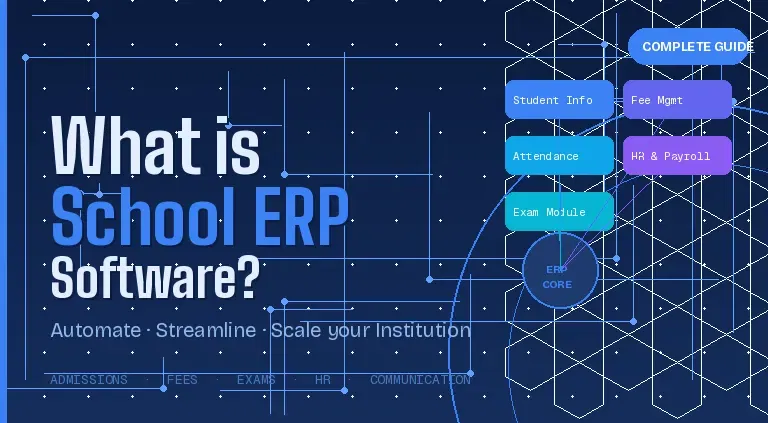
This is where a school ERP software comes into play. A school ERP system is a centralized platform designed to automate, streamline & manage all administrative, academic, and financial activities within an educational institution, through a single platform.
It integrates functions like student data, attendance, fees, exams, communication & HR—allowing schools to automate processes, reduce manual work & access real-time insights.
In simple terms: It replaces manual processes with automation and gives school stakeholders better control, visibility, and efficiency.
Why Do Schools Need an ERP System?
Without tech, managing a school can often lead to inefficiencies, errors, and lack of transparency. A school management ERP helps institutions:
- Eliminate repetitive manual work
- Reduce administrative costs
- Improve communication between stakeholders
- Ensure data accuracy and security
- Enable faster decision-making with real-time insights
Key Features of a School ERP System
A robust ERP for Schools typically includes the following modules:
1. Student Information Management
- Centralized student database
- Admission and enrollment tracking
- Academic history and records
2. Attendance Management
- Daily attendance tracking
- Automated notifications to parents
- Reports and analytics
3. Fee Management
- Fee structure setup
- Online fee collection
- Automated receipts and reminders
4. Examination & Gradebook
- Exam scheduling
- Marks entry and report cards
- Performance analytics
5. Communication Tools
- SMS, email, and app notifications
- Parent-teacher communication
- Announcements and circulars
6. HR & Payroll
- Staff records management
- Salary processing
- Leave and attendance tracking
7. Timetable & Scheduling
- Class and teacher scheduling
- Conflict-free timetable generation
Types of School ERP Systems
1. Cloud-Based School Management System
A cloud-based school management system is hosted online and accessible anytime, anywhere. It has the following benefits over an on-premise software:
- No installation required
- Automatic updates
- Scalable and cost-effective
- Ideal for multi-branch institutions
2. On-Premise ERP Systems
These are installed locally on the school servers. When compared to cloud/SaaS-based platforms, these fall short due to their:
- Higher upfront cost
- Maintenance dependency
- Limited remote access
In short, the best-fit for modern schools is a cloud-based ERP.
Benefits of Using ERP Software in School Management
Implementing ERP software in school management transforms how institutions operate.
- Operational Efficiency: It automates routine tasks, reducing workload for staff.
- Improved Transparency: All stakeholders have access to accurate & real-time data.
- Better Parent Engagement: Parents stay informed through timely updates & communication tools.
- Data-Driven Decision Making: Analytics & reports help school leaders make informed decisions.
- Scalability: It easily adapts to growing institutions & multiple campuses.
How to Choose the Best School ERP
Selecting the best school ERP depends on your institution's needs. Some of the key factors to consider, in order to make the right choice are:
- Ease of Use – User-friendly interface for staff & parents
- Customization – Ability to adapt to your workflows
- Cloud Capability – Prefer modern, cloud-based solutions
- Integration – Should integrate with payment gateways, LMS, etc.
- Support & Training – Reliable vendor support is critical
- Security – Data protection & compliance standards
Challenges Solved by School ERP Systems
Without a proper system, schools face:
- Data silos across departments
- Manual errors in fee & attendance records
- Communication gaps with parents
- Lack of visibility into operations
A school ERP system eliminates these issues by creating a single source of truth.
Future of School ERP Systems
The next generation of school management ERP platforms is evolving rapidly with:
- AI-driven analytics
- Mobile-first experiences
- Integration with learning management systems (LMS) & CRMs
- Automation of complex workflows
Schools adopting advanced ERP solutions today are better prepared for tomorrow.
Conclusion
A school ERP software is no longer a luxury—it is a necessity for institutions aiming to operate efficiently & scale sustainably.
By digitizing & integrating all school processes, ERP systems empower educators, administrators, and parents alike.
If you're looking to modernize your institution, investing in a cloud-based school management system is the smartest step forward.
Frequently Asked Questions
What is ERP software in school management?
ERP software in school management is a system that integrates and automates all school processes such as academics, administration, finance, and communication into one platform.
Why do schools need ERP software?
Schools need ERP software to:
- Automate manual tasks
- Improve operational efficiency
- Ensure data accuracy
- Enhance communication with parents
- Make informed decisions using real-time data
What are the modules of a school ERP system?
Common modules include:
- Student Information System
- Attendance Management
- Fee Management
- Examination & Results
- HR & Payroll
- Communication System
- Timetable Management
Is school ERP software secure?
Yes, modern school ERP systems use encryption, role-based access, and secure cloud infrastructure to protect sensitive data.
What is the difference between ERP and school management software?
A school ERP is more comprehensive than basic school management software, as it integrates all departments into a single system with shared data and automation capabilities.
Can small schools use ERP systems?
Yes, cloud-based ERP systems are scalable and affordable, making them suitable for small schools as well as large institutions.
How much does a school ERP system cost?
The cost depends on:
- Number of students
- Features required
- Deployment type (cloud vs on-premise)
Most modern systems follow a subscription-based pricing model.
What are the advantages of a cloud-based school ERP?
- Remote accessibility
- Lower upfront cost
- Automatic updates
- High scalability
- Better data security