The hidden cost of spreadsheet administration rarely shows up as a single line item on any budget. It shows up as 3 extra hours in the accounts office every month end, a fee receipt that does not match the bank statement, and a report that took the exam coordinator two days to compile by hand.
Across India, thousands of schools & groups of institutions still run admissions, fees, attendance and reporting on spreadsheets. Just because they are familiar, cost nothing to start with, and need no training.
But the real cost surfaces later, in staff hours, errors, and decisions made on numbers that are already out of date by the time anyone reads them.
TL;DR
Spreadsheets create hidden costs in staff time, reconciliation delays, audit risk & error rates that grow as a school scales.
This guide breaks down where those costs arise, compares spreadsheets against a school ERP side by side, and shows how edumerge School ERP removes them with one connected platform for admissions, fees, attendance and communication.
Why Schools Still Depend on Spreadsheets
Spreadsheets are easy to start and hard to leave. A single teacher can build a fee tracker in an afternoon, and it works, right up until the school crosses a few hundred students and multiple people need to update the same file at once.
At that point, the tool that once saved time starts quietly taking it back. The hidden cost of spreadsheet administration is the staff time, errors, delayed fee collection and compliance risk that build up as a school scales beyond a few hundred students.
Manual reconciliation, duplicate data entry and version control issues consume days of administrative time every month. This cost stays invisible because it is buried inside salaries rather than a vendor invoice.
A school ERP removes this cost by automating data entry, reconciliation and reporting across every department.
Key Challenges of Spreadsheet-Based Administration
Before an institution can fix the cost of manual administration, it helps to see exactly where that cost is hiding. Here is what typically goes wrong as schools and school groups grow. Broken down by what happens, why it becomes a problem, and what it costs the institution.
No Audit Trail and Compliance Risk
What happens: edits, deletions and fee waivers are made directly in the file with no record of who changed what, or when.
Why it is a challenge: trust audits and board reviews expect a traceable history of every financial entry, which a shared spreadsheet cannot provide.
Effect: schools face avoidable audit flags and, in some cases, unexplained gaps between collected and recorded fees.
Version Control Chaos
What happens: the same fee register or attendance sheet circulates as multiple copies over email and WhatsApp.
Why it is a challenge: once two people edit different copies, there is no single source of truth left in the institution.
Effect: departments end up working from conflicting numbers, and reconciling them consumes hours that should go to students.
Manual Reconciliation Overload
What happens: finance staff manually match cash receipts, online payments and bank transfers against the fee register.
Why it is a challenge: this matching cannot be automated in a spreadsheet, so it repeats in full every single month.
Effect: month-end closing is routinely delayed, and the finance team's time is consumed by matching instead of planning.
Delayed, Outdated Visibility
What happens: Trustees and principals only see consolidated numbers once someone manually compiles them at month end.
Why it is a challenge: decisions on budgets, staffing or fee follow-ups end up based on data that is already weeks old.
Effect: problems such as slipping collections or attendance dips are caught late, after they have already compounded.
Human Error at Scale
What happens: broken formulas, copy-paste mistakes and duplicate entries creep in as more people update the same file.
Why it is a challenge: spreadsheets have no built-in validation, so a single wrong entry can silently skew an entire report.
Effect: errors are usually caught only when a parent or auditor raises a discrepancy, which damages trust in the numbers.
Disconnected, Siloed Systems
What happens: attendance, fees, exams and communication each live in a separate file that was never designed to talk to the others.
Why it is a challenge: any report that needs data from more than one area has to be assembled by hand, sheet by sheet.
Effect: as a school group adds campuses, this manual assembly work multiplies rather than scales.
Explore more on school administration challenges in India to understand the broader operational issues schools face beyond spreadsheet-based administration.
The Hidden Costs of Spreadsheet Administration
The table below maps where these costs actually arise inside a school's operations, and what that means day to day for staff and leadership.
| Where the Cost Arises | Operational Impact |
|---|---|
| Manual fee reconciliation | Finance staff spend 2-3 days every month matching cash, online payments and bank transfers, delaying the closing of books. |
| Delayed fee reminders | Phone-based or manual reminders lead to a 25-30% delay in fee collection, tying up working capital that the school could otherwise use. |
| Duplicate data entry | The same student data is typed into separate admission, attendance and exam sheets, multiplying the risk of mismatched records. |
| No audit trail | Every edit or waiver goes unrecorded, creating exposure during trust audits and board reviews. |
| Manual report generation | Report cards, attendance summaries and compliance reports are built by hand each cycle, consuming hours that could go toward academics. |
| Version control failures | Circulated copies of the same file create conflicting numbers between departments and campuses. |
| Loss of institutional knowledge | Understanding how a sheet works walks out the door when the staff member who built it exits. |
| Multi-campus consolidation | Groups of institutions manually combine numbers from every campus, delaying group-level financial visibility for trustees. |
Figures above reflect patterns edumerge has observed while onboarding schools and school groups onto edumerge School ERP; actual impact varies by institution size and existing processes.
Spreadsheets vs School ERP: A Side-by-Side Comparison
Once the hidden costs are visible, the difference between a spreadsheet-based approach and a purpose-built school ERP becomes easier to quantify.
| Aspect | Spreadsheet-Based Administration | School ERP |
|---|---|---|
| Data entry | Manual, repeated across separate sheets | Entered once, shared automatically across every module |
| Fee reconciliation | Manual matching of cash, online and bank transfers, two to three days monthly | Automated, real-time reconciliation across all payment modes |
| Reporting | Built by hand every cycle | Generated instantly from live data |
| Audit trail | None; edits and waivers are untraceable | Every entry, edit and waiver logged with a timestamp |
| Access control | Anyone with the file can view or edit it | Role-based access limits visibility to authorised staff |
| Multi-campus visibility | Manual consolidation across campuses | Live, group-level dashboard for trustees and leadership |
| Fee collection speed | 25-30% delayed collection is common | Automated reminders keep collection closer to on time |
| Scalability | Breaks down beyond a few hundred students | Scales to thousands of students across multiple campuses |
| Error rate | High, from copy-paste and formula errors | Low, with validation built into every workflow |
| Staff time | Consumed by repetitive manual tasks | Freed up for academic and strategic priorities |
How edumerge Eliminates Spreadsheet Administration
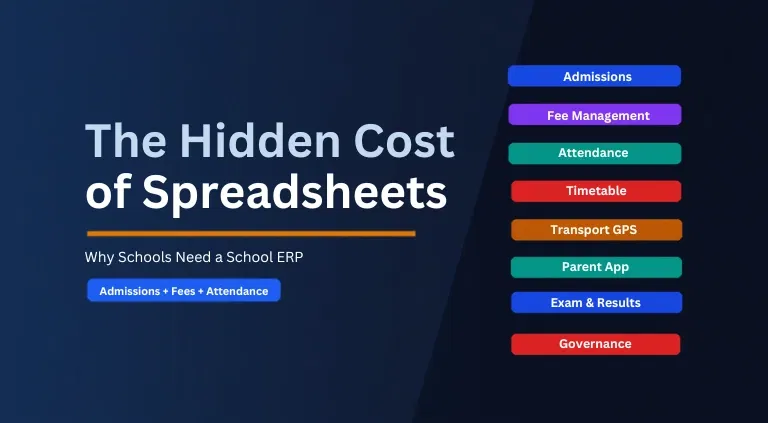
edumerge School ERP replaces the fragmented spreadsheet stack with a single, centralised platform where admissions, attendance, fee management, timetable, transport and parent communication all run on one connected data architecture.
Data entered once, during admission for instance, flows automatically into attendance, fee allocation, timetable, and the parent app, without anyone re-typing it into a second file.
- For finance heads, this means real-time reconciliation without manual matching, and books that are audit-ready at any time rather than only after a month-end scramble.
- For principals & academic heads, it means a 360-degree view of student performance without chasing individual departments for updates.
- For trustees and chairpersons, it means consolidated financials across the trust without waiting for monthly reports from each campus.
- For IT heads, edumerge runs on the cloud, so there is no on-premise server hardware to maintain, and role-based access ensures fee, salary and academic data stays in the right hands.
A single platform replaces the multiple disconnected tools that most schools accumulate over the years, one for fees, one for attendance, one for communication, none of them talking to each other.
Before edumerge vs After edumerge
The table below summarises what typically changes for a school in the months after moving from spreadsheets to edumerge.
| Area | Before edumerge | After edumerge |
|---|---|---|
| Fee reconciliation | Two to three days of manual matching every month | Real-time automatic reconciliation across payment modes |
| Fee collection | 25-30% delayed dues from manual reminders | Automated WhatsApp and SMS reminders improve on-time collection |
| Reporting | Hours spent compiling reports by hand each cycle | Reports generated instantly from live data |
| Data accuracy | Frequent duplicate entries and formula errors | Single source of truth entered once and used everywhere |
| Trustee visibility | Numbers available only after month-end compilation | Live dashboard with real-time, group-level visibility |
| Multi-campus visibility | Manual consolidation across campuses | Live, group-level dashboard for trustees and leadership |
| Fee collection speed | 25-30% delayed collection is common | Automated reminders keep collection closer to on time |
| Scalability | Breaks down beyond a few hundred students | Scales to thousands of students across multiple campuses |
| Error rate | High, from copy-paste and formula errors | Low, with validation built into every workflow |
| Staff time | Consumed by repetitive manual tasks | Freed up for academic and strategic priorities |
| Staff productivity | Administrative staff tied up in repetitive manual tasks | Staff time redirected to academic and student-facing work |
| Audit readiness | No trail of edits or fee waivers | Every transaction logged and audit-ready at any time |
Figures above reflect edumerge's onboarding data across 800+ institutions; results vary by school size and prior processes.
How edumerge Eliminates the Hidden Cost of Spreadsheets in School Administration
Spreadsheets look free on day one. The hidden cost of spreadsheet administration shows up later, in staff hours, delayed collections and audit risk.
edumerge School ERP removes that cost with one connected platform built for schools and groups of institutions. See exactly how edumerge replaces spreadsheet administration for a school your size.
Frequently Asked Questions
1. What is the hidden cost of spreadsheet administration in schools?
It is the staff time, errors, delayed fee collection and compliance risk that build up as schools manage admissions, fees and records manually on spreadsheets instead of an automated system.
2. How much time do schools lose to manual spreadsheet reconciliation?
Finance teams typically spend two to three days every month matching cash, online payments and bank transfers by hand when relying on spreadsheets.
3. Why do fee collections get delayed without a school ERP?
Manual reminders sent by phone or message tend to have a 25-30% delay rate, whereas automated reminders keep collections closer to on time.
4. Can a school ERP handle multiple campuses under one trust?
Yes, a school ERP built for groups of institutions consolidates data from every campus into a single, live dashboard for trustees and management.
5. Is spreadsheet-based administration risky for compliance and audits?
Yes, spreadsheets have no built-in audit trail, so edits, waivers and deletions go unrecorded, which creates exposure during trust audits and board reviews.
6. How does edumerge replace spreadsheet-based school administration?
edumerge centralises admissions, attendance, fees, timetable, transport and communication on one platform, so data entered once is available across every module in real time.
7. Does a school ERP reduce administrative costs?
Yes, by automating reconciliation, reminders and reporting, a school ERP reduces the staff hours that spreadsheet administration requires every month.
8. Who benefits most from moving away from spreadsheets?
Trustees gain real-time visibility, finance heads gain automated reconciliation, and principals gain instant reports, all without manual compilation.
9. How long does it take to move from spreadsheets to a school ERP?
Implementation timelines vary by school size, but structured onboarding typically brings core modules like admissions and fees live within a few weeks.