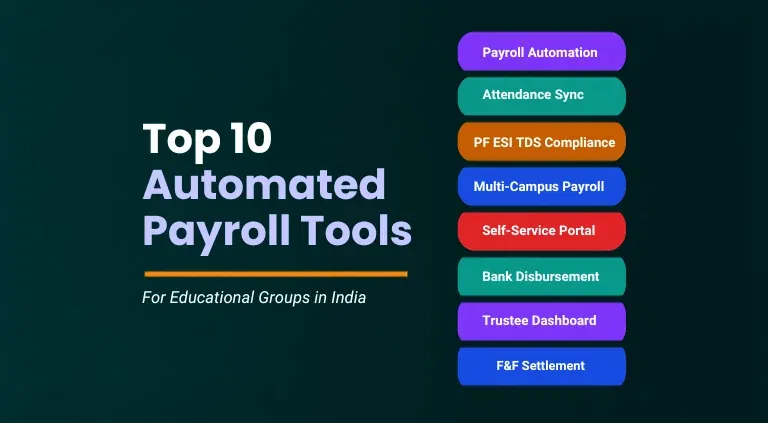
India's education sector runs mostly on spreadsheets and generic payroll software. Even though a 30-50 employee institution making just a few common payroll errors can face Rs. 5-20 lakh in annual penalties.
An automated payroll tool fixes this by linking salary processing directly to attendance, leave and statutory compliance data. Education payroll isn't typical. One run can span:
- Teaching staff
- Non-teaching staff
- Contractual faculty
- Hostel and transport staff
Each has different pay structures and academic-calendar cycles. Self-service payslip and leave access alone can cut HR desk queries by up to 60%.
For multi-campus trusts, this gets harder still. Consolidated reporting, inter-campus transfers and real-time trustee visibility need a payroll tool built for education, not adapted from a corporate one.
Why Educational Groups Need Specialized Automated Payroll Tools
Traditional payroll software is built for a fixed corporate calendar and a single category of employee. Educational groups operate differently, and the reasons below explain why a purpose-built automated payroll tool matters.
- Academic calendar alignment: Pay cycles need to follow academic terms, contractual faculty periods and vacation-linked adjustments, not a fixed corporate month.
- Multiple staff categories in one payroll run: Teaching staff, non-teaching staff, contractual faculty, hostel and transport staff each carry different salary structures and statutory treatment.
- Attendance-to-payroll without manual bridging: Biometric and geo-fenced attendance should feed directly into salary calculation, so loss of pay and sandwich leave rules apply automatically.
- Multi-campus, multi-entity consolidation: A group of institutions needs one payroll run across campuses with a single trustee-level view, not campus-by-campus spreadsheets.
- Compliance built for institutional structures: PF, ESI, TDS, professional tax & gratuity calculations that account for trusts, societies and Section 8 companies, not a generic corporate template.
- Integration with institutional operations: Payroll that connects to finance, fee management and HR records on one data architecture, instead of a standalone tool needing separate reconciliation.
Explore the full picture on how to automate payroll for schools and colleges in India, for a step-by-step look at moving off spreadsheets.
Key Challenges Educational Groups Face Without Automated Payroll Tools
Without an automated, education-specific payroll tool, these challenges show up repeatedly and slow down institutional operations.
| Challenge | Impact on Operations |
|---|---|
| Manual attendance-to-salary reconciliation | HR teams re-enter attendance and leave data by hand each month, delaying payroll runs and increasing the risk of Loss of Pay errors reaching staff payslips. |
| Inconsistent statutory compliance across campuses | Different campuses may apply outdated PF, ESI or professional tax slabs. A business with just 3 or 4 common payroll errors can face Rs. 5 to 20 lakh in penalties annually across five separate authorities. |
| No unified view for trustees | Without consolidated reporting, trustees wait on individual campus updates instead of seeing group-wide payroll costs in real time. |
| High HR desk workload | Staff routinely approach HR for payslips, leave balances and salary queries that a self-service portal could resolve directly. |
| Delayed full and final settlements | Exit processing that depends on manually cross-checking leave, dues and advances slows down staff separations and creates disputes. |
| Disconnected payroll and finance | When payroll runs outside the finance system, Budget vs Actual reporting on staff cost is always a step behind. |
These payroll gaps rarely exist in isolation. See the challenges of staff management in educational institutions for how they connect to broader HR operations.
Comparing the Top 10 Automated Payroll Tools for Educational Groups India
1. edumerge HRMS
Purpose-built payroll and HR platform for schools, colleges, and education groups, running on the same architecture as the rest of the edumerge suite. One codebase, one database, ensuring your current setup of disconnected tools, spreadsheets & manual labour are reduced.
Key strengths:
- Integrated with School ERP as well as College ERP to suit your educational group's requirements
- One-click payroll that auto-calculates every statutory deduction (PF, ESI, TDS, professional tax) directly from integrated attendance and leave data, with no manual bridge between HR and payroll.
- Multi-campus payroll runs across an entire school or college group in a single cycle, with consolidated payroll cost reporting rolled up for the trustee dashboard.
- Education-specific salary structures built in, covering teaching, non-teaching, and contractual staff categories, along with examination duty allowances and academic-term-linked leave policies that generic HR platforms don't support out of the box.
- Payroll automatically generates the corresponding journal entries in the Finance & Control module, posting salary expenses to the correct cost centre and PF/ESI/TDS liabilities to payable accounts without a manual journal entry step.
- Trusted by 800+ educational institutions managing 500,000+ students across India, purpose-built for the sector since 2012.
- Automated leave encashment, gratuity, and full-and-final settlement calculations aligned to each institution's HR policy, removing manual computation at exit.
- Real-time payroll cost visibility by campus, department, and staff category, giving group leadership a live view instead of month-end reconciliation.
2. Keka HR
Cloud-based HR and payroll platform popular with Indian mid-size businesses, occasionally adopted by education groups for payroll processing.
Key strengths:
- Clean, modern interface with strong employee self-service adoption.
- Flexible payroll engine handling multiple pay structures and state-wise statutory compliance.
- Performance management and goal-tracking bundled alongside payroll.
- Payroll compliance dashboard with real-time alerts on filing deadlines and rule changes.
- Robust integrations with third-party biometric and attendance devices.
What to note:
- Built for general businesses, not education, so faculty pay grades, examination duty allowances, and academic-term leave cycles need custom configuration.
- No native link to student, fee, or academic data, so payroll runs as a standalone system alongside the school's ERP.
Read our guide on how edumerge HRMS compares with Keka HR on features.
3. greytHR
Widely used Indian payroll and compliance platform, common among small and mid-sized schools for standalone payroll.
Key strengths:
- Strong statutory compliance coverage (PF, ESI, PT, LWF) tuned for Indian regulations.
- Fast payroll processing cycle, well suited to smaller HR teams.
- Established support network across India.
- Employee self-service portal for payslips, tax declarations, and Form 16 downloads.
- API-based integrations with common attendance and accounting tools.
What to note:
- Designed for general SMEs, so education-specific staff categories and academic calendars aren't native and need workarounds.
- Multi-campus consolidation for larger school groups is limited compared to education-first platforms.
Take a deeper look into how edumerge HRMS compares with greytHR.
4. Darwinbox
Enterprise HR and payroll suite used by large Indian corporates, occasionally by large education groups with corporate-scale HR needs.
Key strengths:
- Comprehensive HRMS covering payroll, talent, and workforce analytics in one enterprise-grade suite.
- AI-driven analytics for workforce planning.
- Scales well for large, distributed employee bases.
- Configurable approval workflows suited to layered organisational hierarchies.
- Strong mobile experience for a distributed, multi-location workforce.
What to note:
- Enterprise pricing and implementation efforts are heavier than most education groups need.
- Built for corporate HR structures, so academic staff categories and school-specific compliance need significant configuration.
Explore our comparison on how edumerge HRMS compares with Darwinbox.
5. Zimyo
Indian HR-tech platform offering payroll, attendance, and engagement tools for SMEs, used by some smaller education groups.
Key strengths:
- Affordable, bundled HR and payroll suite suited to smaller institutions.
- Reasonable mobile app for staff self-service.
- Quick to deploy for simple payroll needs.
- Built-in employee engagement and recognition tools alongside payroll.
- Simple onboarding flow for new hires with document collection built in.
What to note:
- Limited depth in education-specific workflows such as faculty appraisal or examination duty pay.
- Multi-campus and trustee-level consolidated reporting isn't a strong suit.
6. Zoho Payroll
Cloud payroll software from Zoho's business suite, used by some Indian schools already running Zoho Books or Zoho People.
Key strengths:
- Automated salary calculation with built-in PF, ESI, PT, and TDS compliance updated for current Indian tax rules.
- Native integration with Zoho Books and Zoho People, useful for institutions already in the Zoho ecosystem.
- Employee self-service portal for payslips, investment declarations, and Form 16.
- Flexible pay schedules and salary structures, including support for arrears and off-cycle payments.
- Free-to-low-cost tiers make it accessible for smaller schools with limited HR budgets.
What to note:
- Built for general SMEs, not education, so faculty categories, examination duty allowances, and academic-term leave policies need manual setup.
- Full value depends on also adopting Zoho Books and Zoho People; used standalone, it stays a narrow payroll tool without HR or attendance depth.
For a feature-by-feature look at payroll and HR capabilities, see edumerge HRMS vs. Zoho People.
7. Oracle Human Capital Management (HCM)
Global enterprise HCM suite occasionally deployed by large Indian university systems and deemed universities.
Key strengths:
- Deep, configurable HR and payroll functionality across large, complex organisations.
- Global scalability with strong analytics and reporting depth.
- Backed by Oracle's broader enterprise ecosystem.
- Advanced workforce analytics and predictive attrition modelling.
- Broad global payroll coverage for institutions with staff across multiple countries.
What to note:
- Enterprise-grade cost and implementation timelines make it impractical for most schools and mid-size education groups.
- Configuration for education-specific staff categories and academic calendars requires significant custom work.
Discover how edumerge HRMS compares with Oracle HCM.
8. SAP SuccessFactors
SAP's cloud HCM suite, used by some large Indian education groups with existing SAP investments.
Key strengths:
- Comprehensive HR suite covering payroll, talent, and workforce planning at enterprise scale.
- Strong integration with other SAP modules where a group already runs SAP.
- Continuous performance and goal management tied to the same platform as payroll.
- Strong succession planning and talent management modules.
What to note:
- Best suited to groups already invested in the SAP ecosystem; standalone adoption is costly for education budgets.
- Education-specific staff categories, examination allowances, and academic-term policies need custom build-out.
You might also like our detailed comparison edumerge HRMS vs. SAP SuccessFactors HCM.
9. Workday
Global cloud HCM and payroll platform, used by a small number of large Indian higher-education institutions with global affiliations.
Key strengths:
- Unified HR, payroll, and finance data model with strong global reporting.
- Well-regarded user experience and mobile access.
- Machine learning-driven insights on workforce cost and planning.
- Single system of record spanning HR, payroll, and financial data.
What to note:
- Positioned and priced for large global enterprises, well beyond what most Indian school groups need.
- Indian statutory payroll compliance and education-specific workflows require third-party add-ons or heavy configuration.
Also give a read on our comparison between edumerge HRMS & Workday HRM.
10. Saral PayPack
India-focused payroll software with a long history in statutory compliance, used by some schools and colleges for payroll alone.
Key strengths:
- Long-standing focus on Indian payroll compliance and statutory filings.
- Handles complex salary structures and arrears calculations reliably.
- Established base among accountants and payroll processors.
- Detailed Form 24Q and TDS return preparation built into the payroll cycle.
- Supports bulk salary revisions and increments across large employee lists.
What to note:
- Payroll-only tool, so it needs to be paired separately with attendance, HR, or ERP systems for a full picture.
- Education-specific staff categories and academic-term leave policies aren't built in.
For a closer look at how specific platforms stack up against these role-based priorities, see the 7 best payroll software for educational institutions in India.
Evaluation Criteria for Automated Payroll Tools
Use these criteria to evaluate any automated payroll tool before shortlisting it for your institution or group.
- Attendance-to-payroll automation, including biometric and geo-fenced attendance feeding directly into salary calculation, so Loss of Pay and leave deductions are never manually recalculated.
- Support for multiple staff categories: teaching, non-teaching, contractual faculty, hostel and transport staff, each with distinct salary structures, allowances and statutory treatment.
- Built-in statutory compliance: PF, ESI, TDS, professional tax and gratuity calculated automatically and kept current with regulatory changes, so HR isn't tracking slab updates manually.
- Multi-campus and multi-entity consolidation with a single trustee-level dashboard showing group-wide payroll cost in real time.
- Staff self-service access to payslips, leave balances and salary history, reducing routine HR desk queries.
- Inter-campus staff transfer support that carries payroll records without re-entry, so mobility across a group doesn't create data gaps.
- Direct integration with finance for budget vs actual staff cost reporting, so payroll never sits outside the general ledger.
- Automated bank disbursement file generation and payslip distribution, removing manual file preparation each pay cycle.
- Full and final settlement processing built into the exit workflow, drawing on verified payroll, leave encashment and dues data.
- A data architecture built for education, not a generic HR platform configured after the fact, so payroll, attendance and academic records live on one system.
- Audit trail and record retention, since payroll records, wage registers and statutory challans must be maintained and easily retrievable for a minimum of seven years.
- Implementation and onboarding speed, since a platform that takes months to configure delays every benefit above it; look for institutions that go live within days, not quarters.
For institutions weighing HRMS options at the college level specifically, see 10 best HRMS for colleges in India.
Also, trustee-level visibility is often the hardest criterion to satisfy in an educational group. Check out this piece on what trustees can't see about staff across campuses for why this gap persists even with existing systems.
Conclusion
Automated payroll tools for educational groups in India remove the manual work, compliance risk and disconnected reporting that spreadsheets and generic HR software cannot solve for schools, colleges and multi-campus trusts.
The right platform links payroll directly to attendance, finance and staff records, giving trustees real-time visibility and HR teams fewer manual reconciliations every month.
edumerge HRMS is built specifically for this context, with one-click payroll, multi-campus consolidation and built-in statutory compliance.
Frequently Asked Questions
1. How is payroll software for educational institutions different from generic HR software?
It accounts for academic calendars, multiple staff categories such as teaching and contractual faculty, and trust or society-based financial structures that generic corporate payroll tools are not built for.
2. Can automated payroll tools handle multi-campus payroll software needs in India?
Yes, purpose-built tools run payroll across every campus in a single action and consolidate cost reporting for trustees, instead of requiring campus-by-campus reconciliation.
3. Do automated payroll tools handle PF, ESI, TDS and professional tax automatically?
Yes, statutory compliance payroll software for India calculates these deductions automatically and generates the relevant challans and returns for filing.
4. How long does it take to implement automated payroll software in a school or college?
Implementation timelines vary, but education-specific platforms typically configure staff records, leave policies and payroll structures within days rather than months.
5. Does automated payroll software integrate with biometric attendance?
Yes, biometric and geo-fenced attendance data feeds directly into payroll calculation, removing the need for manual reconciliation of Loss of Pay and leave deductions.
6. Is cloud payroll software for the education sector secure for staff data?
Reputable platforms use role-based access control so payroll and personal data are visible only to authorised HR and finance users.
7. What happens to payroll records when staff transfer between campuses in a group?
With inter-campus transfer support, payroll history and records move with the staff member automatically, without manual re-entry.
8. Can staff access their own payslips and leave balances?
Yes, a staff self-service portal lets employees view payslips, apply for leave and check salary history without raising HR desk queries.
9. Who is edumerge HRMS built for?
edumerge HRMS is built for schools, colleges, universities and groups of institutions in India that need payroll linked directly to attendance, finance and academic operations.
10. Does edumerge HRMS support full and final settlement processing?
Yes, F&F settlement is processed within the exit management workflow, using verified payroll, leave encashment and Loss of Pay data already in the system.