Most Indian colleges manage their most important asset, their people, with their least capable tools. Employee records across Excel files. Monthly payroll calculated manually by the accounts officer. Leave managed through physical applications. Appraisals done once a year on paper. Compliance tracked on a wall calendar with no audit trail.
For a standalone college with 80 staff, this is uncomfortable. For a college group managing 1,000+ faculty and non-teaching staff across 5 campuses, it is operationally dangerous.
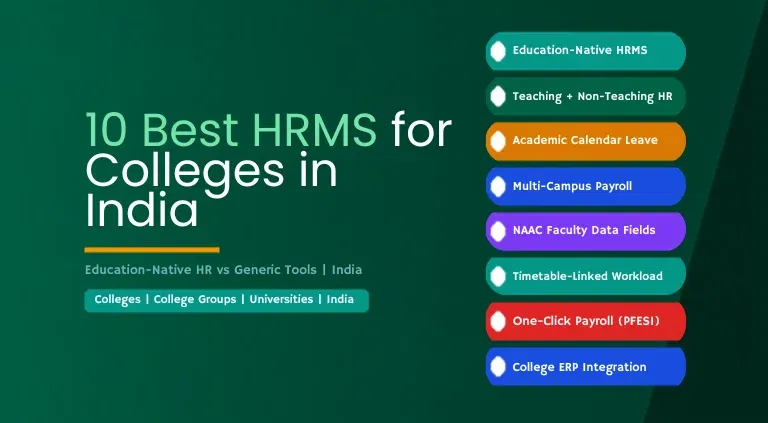
This guide evaluates 10 HRMS platforms available to Indian colleges & college groups. Most of them are excellent HR tools. Most of them are built for corporate businesses and not for educational institutions. The guide explains why that gap matters for colleges specifically.
TL;DR
The best HRMS for colleges in India is one designed for the education context.
- Teaching & non-teaching staff managed as separate categories with different workflows,
- Academic-calendar-aligned leave policies,
- Timetable-linked faculty workload tracking,
- Biometric attendance directly connected to payroll,
- One-click multi-campus payroll with PF/ESI/TDS/PT compliance,
- Probation & appraisal workflows that reflect academic performance metrics, and
- Integration with the college ERP so that staff data connects to timetable, attendance & accreditation without manual re-entry.
edumerge HRMS is purpose-built for exactly this. The only education-native HRMS in this guide, integrated directly with College ERP and Finance & Control on the same database.
Why College HR is Structurally Different from Corporate HR
Generic HRMS platforms handle payroll, leave & attendance correctly. The gap between them & a purpose-built education HRMS is about whether the tool understands the context in which those basics happen in a college.
1. Teaching and non-teaching staff have fundamentally different HR workflows
A college manages teaching faculty with workload calculations, lesson plan compliance, CO-PO performance, and timetable-linked attendance alongside non-teaching administrative staff who work conventional shifts with fixed leave quotas.
Generic HRMS platforms are built for one employee type. Colleges end up customising salary structures, leave policies & appraisal frameworks manually for each category because the tool has no concept of academic employment context.
2. Academic-calendar leave policies cannot be replicated in a corporate HRMS
College staff leave management revolves around academic calendars: summer vacation does not consume earned leave, compensatory offs for extra exam duties must be tracked separately, medical leave for faculty carries different encashment rules from admin staff, and exam-period leave restrictions are institution-specific.
A generic corporate HRMS has calendar-year leave policies. Mapping these to the academic year structure requires either expensive customisation or perpetual workarounds.
3. Timetable-linked faculty workload is invisible in a generic HRMS
NAAC requires colleges to track faculty workload: hours assigned, hours completed, department-wise workload distribution, and subject-wise teaching logs.
Generic HRMS systems have no concept of timetable. The faculty workload data that lives in the college's timetable module never reaches the HRMS. So the appraisal system operates on generic KPIs disconnected from actual academic delivery.
4. Multi-campus payroll for college groups requires group-aware architecture
A college group managing 5 campuses with 1,200 staff members across all locations needs one payroll run that covers every campus. With campus-level cost-centre reporting & inter-campus transfer handling.
Generic HRMS tools either run payroll per entity (multiplying admin effort) or offer multi-entity as an enterprise add-on at a cost that most college groups cannot justify.
5. NAAC and NBA require structured faculty data that HR systems must supply
NAAC accreditation criteria require faculty qualification data, designation history, UGC API (Academic Performance Indicator) scores, publications, and professional development records.
This data lives in HR records but generic HRMS platforms have no awareness of NAAC requirements, no structured data fields for API scores or academic qualifications, and no report templates for accreditation evidence submission.
6. Probation management for academic positions follows education norms, not corporate norms
New faculty appointments often have probation periods defined by university statutes or UGC guidelines, not standard 6-month corporate probation. Confirmation of appointment may be contingent on NAAC committee review, teaching feedback scores, or publication targets.
A generic HRMS has no mechanism to link probation outcomes to academic performance data.
7. Quality talent churn has a direct impact on academic continuity and student outcomes
When a faculty member leaves mid-semester, the institution faces timetable disruption, student impact, and NAAC data gaps. The cost of replacing a faculty member in terms of recruitment, onboarding, and academic disruption is estimated at Rs. 1.5-3 lakh per exit.
A purpose-built education HRMS treats faculty retention as an institutional risk metric, not just an HR headcount number.
The Education HR Gap in one sentence: A generic HRMS processes payroll & manages leave correctly. But it has no concept of a timetable, an academic calendar, a NAAC accreditation requirement, or the difference between teaching faculty & administrative staff. An education-native HRMS like edumerge HRMS is built around all of these from the ground up.
10 Best HRMS for Colleges in India
1. edumerge HRMS (Top Pick for Indian Colleges)
The only education-native HRMS built for Indian colleges and college groups
Type: Purpose-built HRMS for educational institutions: schools, colleges, universities, and groups. Integrated with College ERP and Finance & Control on one database.
Key strengths:
Complete Talent Acquisition Tailored for Educational Institutions:
| Vacancy Management with budget-linked Finance Approval | Job Posting on internal and external platforms | Career Portal for applicant self-service |
| Resume Database with error-free screening | Screening & Shortlisting with configurable evaluation criteria | Background Verification workflows |
| Offer Management with digital acceptance | Structured Onboarding with policy document | Payroll setup on day one |
- Staff Profile: Comprehensive employee master covering personal details, academic qualifications (UGC-aligned), designation history, department, campus, employment type, and document repository. Education-specific fields for faculty qualification verification and accreditation data.
- Probation Management: Configurable probation periods aligned to university statutes or UGC guidelines, probation review linked to teaching feedback scores, academic KPIs & department head evaluation, digital probation confirmation or extension workflows.
- Appraisals with KPIs & KRAs: Education-context appraisal framework covering teaching workload, student feedback scores, research output, publications, professional development, and co-curricular contribution. 360-degree feedback from students, peers & supervisors, continuous feedback loop rather than annual paper review.
- Attendance Management with Biometric & Geo-Fencing: Biometric device & RFID integration, geo-fenced mobile attendance for multi-campus faculty, automatic attendance sync to payroll engine, eliminating manual attendance-to-payroll reconciliation.
- Leave Management: Academic-calendar-aligned leave policies, summer vacation excluded from earned leave, separate leave types for exam duty, medical, maternity, paternity & compensatory off, multi-level leave approval with department head & principal routing.
- Payroll: One-click payroll run auto-computing PF (12%), ESI (0.75%), TDS based on investment declarations, Professional Tax by state, and gratuity. Bank file generation for salary disbursal, individual payslip generation and digital distribution. LOP auto-calculation from leave & attendance data. Arrears processing for mid-year increments, Full & Final (FnF) settlement in exit workflow.
- Exit Management: Digital resignation submission, exit interview workflow, clearance checklist across departments, LOP & leave encashment verification, Full & Final settlement generation with documentation.
- Multi-campus group payroll: All campuses, one payroll run, one screen. Campus-wise cost-centre reporting for the Finance & Control accounting module.
- Education-specific design: Academic calendars, teaching workloads, substitution records, and staff academic profiles connected to the same database as the college's timetable, attendance & accreditation modules. NAAC faculty data fields structured for direct evidence submission.
- Cause-to-Confidence transformation: Employee data centralised from spreadsheets, payroll cycle reduced from 3-5 days to one click, HR team reclaims 40-plus hours per month, zero payroll errors with full audit trail, leadership decisions backed by real-time workforce data.
- Integration: edumerge HRMS shares one database with College ERP and Finance and Control; faculty timetable data, attendance, and student feedback flow into the HRMS automatically; payroll journal entries post to Finance and Control without manual transfer.
What to note: edumerge HRMS is purpose-built for the Indian education sector. Institutions in sectors outside education, or those requiring industry-specific HR frameworks such as factory act compliance or manufacturing shift management, should evaluate sector-specific tools.
edumerge HRMS is the only platform in this list that was built for educational institutions from the ground up. Every other option in this guide is a strong HR product for the corporate sector that a college can deploy with customisation. edumerge HRMS is built around how colleges actually hire, manage, pay & develop their people. With academic calendars, teaching workloads, NAAC data structures & college ERP integration as architectural decisions rather than configuration afterthoughts.
2. Darwinbox
India's leading enterprise HCM with AI-driven automation
Type: Enterprise cloud HCM platform with AI-driven recruitment, performance, and payroll for large organisations.
Key strengths:
- AI-first HCM with automation across recruitment, performance, and workforce planning
- Strong mobile-first experience for employees and managers
- Advanced analytics and workforce intelligence dashboards
- Multi-location payroll with Indian statutory compliance
- Recruitment module with AI-driven candidate sourcing and screening
- 800-plus large enterprise clients across India
Education gap:
- Designed for corporate enterprises, not educational institutions
- Academic-calendar leave policies, timetable-linked faculty workload, NAAC faculty data fields, and education-context appraisals require configuration
- No integration with college ERP academic modules
- Pricing is enterprise-grade and typically unsuitable for mid-size college groups
- Implementation typically takes 2 to 4 months
This comparison on edumerge HRMS vs Darwinbox might help your college HRMS evaluation.
3. Keka HR
Modern HRMS with strong payroll and performance management
Type: Cloud HRMS for SMEs and mid-market companies with strong payroll, attendance, and performance management.
Key strengths:
- Modern, clean interface with strong employee experience design
- One-click payroll with automatic PF, ESI, TDS compliance
- OKR-based performance management with continuous feedback loops
- Pulse surveys and eNPS for employee engagement tracking
- Shift management and attendance tracking with biometric integration
Education gap:
- Corporate-sector design philosophy
- Academic-calendar leave types, NAAC faculty qualification fields, and timetable-linked workload tracking are not native
- No college ERP integration
- OKR-based appraisals need reconfiguration for academic KPIs
- Better suited for the non-teaching administrative workforce of a large college than for the teaching faculty
This comparison on edumerge HRMS vs Keka HR might interest you.
4. greytHR
India's compliance-first payroll and HRMS for SMEs
Type: Dedicated payroll & HRMS platform with deep Indian statutory compliance, widely used by SMEs and NGOs.
Key strengths:
- India's most widely trusted HRMS among CAs and payroll agencies
- Deep Indian statutory compliance: PF, ESI, Professional Tax across all states, Form 16, Form 24Q
- Automated payroll with leave and attendance integration
- Strong query management system for HR helpdesk
- Employee self-service portal for payslips and leave
- Free for up to 25 employees; paid plans from Rs. 3,495 per month
Education gap:
- Not built for educational institutions
- Academic-calendar leave, NAAC faculty data, timetable-linked workload, teaching and non-teaching category distinctions, and college ERP integration require significant customisation
- Designed for the SME payroll and compliance use case
- Education-specific probation and appraisal workflows are absent
You might also like to read this feature comparison between edumerge HRMS & greytHR.
5. Zoho People
Cloud HR integrated with the Zoho business ecosystem
Type: Cloud-based HR platform in the Zoho suite, covering employee records, attendance, leave, appraisals, and basic payroll.
Key strengths:
- Native integration with Zoho Payroll, Zoho Books, and Zoho Analytics
- Competitive per-employee pricing from Rs. 48 per employee per month
- Leave and attendance management with mobile access
- Performance management with goal setting and appraisal workflows
- Employee self-service portal and mobile app
Education gap:
- Best value only for institutions already in the Zoho ecosystem
- Academic-calendar leave policies & teaching staff workflows require configuration
- No college ERP integration
- NAAC faculty data & accreditation fields are absent
- Payroll sold separately and limited to the Zoho payroll product
- Education-context appraisals and workload tracking are not pre-built
6. factoHR
India-built HRMS with strong biometric integration and multi-location payroll
Type: India-native HRMS with biometric depth, multi-location payroll, and Indian statutory compliance.
Key strengths:
- Strong biometric and GPS attendance integration with the payroll engine
- Multi-entity payroll for multi-campus institutions
- PF, ESI, TDS, PT, and Labour Welfare Fund compliance for multi-state payroll
- Bank disbursement file generation and payslip distribution
- Mobile self-service app for employees
Education gap:
- Primary design focus is industrial and field workforce management
- Education-context HR workflows (academic leave policies, teaching staff onboarding, NAAC faculty qualifications, timetable workload) require configuration
- No integration with college academic modules
- Appraisal system is designed for corporate performance frameworks, not academic evaluation
7. HROne
Inbox-style HRMS with deep statutory automation for mid-market teams
Type: Cloud HRMS with inbox-style task management, deep Indian statutory automation, and built-in LMS.
Key strengths:
- Inbox-style task management that surfaces pending HR actions
- Deep Indian statutory automation; cited as one of the strongest in the market for PF, ESI, PT
- Built-in LMS for employee learning & development
- Strong analytics and reporting for data-driven HR decisions
- Supports 100+ employee teams effectively
Education gap:
- Corporate-oriented product design
- Academic leave calendar, faculty workload management, NAAC accreditation data structures, and college ERP integration require custom development
- The LMS is general-purpose corporate training, not academic faculty development tracking
- Education-sector deployments are limited
8. Pocket HRMS
AI-enabled HRMS for SMBs with fast implementation and affordable pricing
Type: Cloud HRMS for SMBs with AI-enabled features, payroll, attendance, and core HR modules.
Key strengths:
- Fast implementation and simple onboarding for SMBs
- AI-enabled features including CV parsing and smart attendance analytics
- Core HR modules: attendance, leave, payroll, and employee records
- Affordable pricing suitable for smaller institutions
- Mobile app and employee self-service portal
Education gap:
- Designed for SMBs across sectors
- Education-specific HR contexts (academic calendars, faculty workload, NAAC data, multi-campus college group payroll) are not built in
- Limited depth for large college groups with complex HR requirements
- Primary strength is simplicity and price, not education-sector depth
9. Zimyo
Engagement-focused HRMS with performance and employee experience tools
Type: Cloud HRMS with a focus on employee engagement, performance management, and core HR automation for SMEs.
Key strengths:
- Strong employee engagement tools: surveys, recognition, and communication channels
- Performance management with continuous feedback and goal tracking
- Leave and attendance management with biometric integration
- Payroll with Indian statutory compliance
- Competitive pricing for the engagement and performance module combination
Education gap:
- Designed for the corporate SME market
- Academic leave calendar alignment, teaching staff category management, NAAC faculty data, and timetable-linked workload tracking require configuration
- College ERP integration is absent
- Engagement survey templates are corporate-oriented and not calibrated for academic staff culture
10. Workday HCM
Global enterprise HCM for large universities and education institutions
Type: Enterprise cloud HCM integrating HR, finance, and planning for large organisations & university systems.
Key strengths:
- Deepest HR-Finance-Planning integration of any platform in this list
- Advanced analytics and workforce planning across large university systems
- Cloud-native with strong security and compliance for large institutions
- Student-to-HR integration available through Workday Student
- Globally recognised platform with strong higher education presence internationally
Education gap:
- Enterprise pricing makes it inaccessible for most Indian college groups
- Indian statutory compliance (PF, ESI, PT) requires configuration
- NAAC, NBA, and Indian regulatory frameworks are not natively built
- Implementation typically takes 12-18 months with dedicated consultant teams
- Primarily suited to very large internationally oriented university systems, not the typical Indian college group
Education HRMS Gap: edumerge vs Generic HR Tools
The table below shows how education-specific HRMS requirements map across platforms in this guide. Generic tools pass on payroll compliance. They fail in the education context.
| Education HR Requirement | edumerge HRMS | Generic HRMS tools |
|---|---|---|
| Teaching + non-teaching staff categories | Education-native config, distinct workflows | Requires manual configuration in all generic tools |
| Academic-calendar leave policies | Built-in academic calendar alignment | Calendar-year default; academic mapping requires custom dev |
| Timetable-linked faculty workload | Integrated via College ERP same database | No timetable awareness in any generic HRMS |
| NAAC faculty qualification and API data | Structured fields built for accreditation | No NAAC data fields in any generic HRMS |
| Multi-campus one-click payroll | All campuses, one run, one screen | Per-entity run or enterprise add-on in all others |
| Inter-campus staff transfer workflows | Automated records and payroll transfer | Manual re-entry in a new entity in most tools |
| College ERP integration (same database) | Zero-bridge, live data sharing | API integration needed; data lag in all others |
| Probation linked to academic performance | Configurable against academic KPIs | Corporate milestone-only in all generic tools |
| 360° faculty feedback | Student + peer feedback built in | Generic 360 not education-context in most tools |
| Education-context appraisals (KPIs/KRAs) | Academic workload, publications, feedback | OKR-based corporate appraisals in most tools |
| HR reclaims 40+ hours/month | Documented outcome from education deployments | No education-sector benchmark available for others |
| Same-day go-live | Yes, education-first onboarding | Weeks in Darwinbox, Keka, Workday; days in greytHR |
Is your college's HRMS built for a company or an academic institution?
The HR requirements of a college are distinct from those of a corporate employer. Academic leave calendars, faculty workload tracking, NAAC data fields, and multi-campus payroll are not configuration options in generic HR tools. They are architectural requirements.
The best HRMS for colleges in India is not the one with the most corporate features. It is the one whose architecture reflects how colleges actually function. From academic calendars & teaching workloads, to NAAC compliance & staff records, connected to the same database as the academic ERP.
edumerge HRMS is built for that reality. Every other platform in this guide is a capable corporate HR tool that a college can adapt with effort. The difference is whether the tool starts from the education context or arrives at it through configuration.
The same architectural gap shows up on the academic side of college software. 5 Best Student Information System for University covers what to look for there.
Frequently Asked Questions (FAQs)
1. Can edumerge HRMS manage teaching and non-teaching staff separately?
Yes. edumerge HRMS is designed for both teaching & non-teaching staff workflows from the ground up. Teaching faculty have education-specific salary structures, academic-calendar leave policies, timetable-linked workload tracking, OBE-aligned appraisals with student feedback integration, and research publication records. Non-teaching staff have standard HR workflows with shift-based attendance, corporate leave types, and administrative KPI appraisals. Both categories run on the same platform with separate configurations.
2. How does edumerge HRMS help colleges with NAAC accreditation?
edumerge HRMS maintains structured faculty data fields aligned to NAAC criteria. Academic qualifications, UGC designation compliance, teaching workload hours, student feedback scores, publications & research output, professional development participation, and API score tracking. Because the HRMS shares a database with College ERP, the faculty data that the accreditation module uses for evidence packs is always current without manual data compilation from a separate HR system.
3. What is multi-campus payroll in an education HRMS?
Multi-campus payroll means processing salary for staff across all campuses in a college group in a single payroll run. With campus-wise cost-centre breakdowns for the finance team. With pending approvals on specific campuses surfaced before the run is confirmed. This eliminates the need for separate payroll runs per campus, which is the default in generic HRMS tools deployed in multi-campus groups.
4. Does edumerge HRMS integrate with college academic modules?
Yes. edumerge HRMS shares one database with College ERP and Finance & Control. Faculty timetable assignments, substitution records & attendance data flow from College ERP into the HRMS automatically. Student feedback scores feed into faculty appraisals. Payroll journal entries post to Finance & Control without manual transfer. This is a native database integration, not an API bridge, which means there is no data lag & no reconciliation overhead.
5. What is an academic-calendar leave policy in a college HRMS?
An academic-calendar leave policy aligns leave management to the college's academic year (typically April-March in India) rather than a calendar year. Summer vacation does not consume a faculty member's earned leave balance. Compensatory offs for additional exam supervision duty are tracked as a separate leave type. Exam-period leave restrictions are enforced by the system. Maternity, paternity & medical leave carry rules defined by the institution's appointment terms rather than generic corporate policies. edumerge HRMS supports these configurations natively.
6. How does edumerge HRMS handle inter-campus staff transfers for college groups?
When a staff member transfers from one campus to another within a college group, edumerge HRMS moves their complete employment record, payroll configuration, leave balance, and access rights to the new campus automatically. The finance team does not re-enter the employee in a new entity. The receiving campus HR sees the complete employment history from day one. Payroll for the month of transfer is prorated correctly between campuses.
7. What is the Cause-to-Confidence transformation in edumerge HRMS?
edumerge describes its HRMS value delivery in 3 stages sourced from its own product page.
- Cause: Employee data scattered across files, monthly payroll taking 3-5 days of manual effort, compliance tracked on calendars with no audit trail.
- Control: Centralised digital staff records with RBAC, one-click payroll with auto-computed deductions, automated statutory compliance with filing-ready reports.
- Confidence: HR team reclaims 40+ hours per month, zero payroll errors with full audit trails, leadership decisions backed by real-time workforce data.
8. How long does it take to implement edumerge HRMS for a college group?
edumerge HRMS supports same-day go-live for basic modules including staff records, attendance, leave & payroll configuration. A full implementation for a college group covering all campuses, NAAC faculty data migration, timetable integration & appraisal framework configuration typically takes 1-3 weeks depending on group size & data complexity. This compares favourably with generic enterprise HRMS platforms like Darwinbox & Workday that typically take 2-4 months.
Weighing edumerge HRMS against a large enterprise HCM suite? edumerge HRMS vs SAP SuccessFactors HCM lays out exactly where a purpose-built college HRMS diverges from a generic autonomous HCM platform.