A university registrar's office managing 8,000 students without an integrated student information system (SIS) runs on a combination of manual registers, departmental Excel files, and physical requests.
A student's academic standing lives in the exam cell's spreadsheet, fee status in the accounts office, attendance record in each department's notebook, and placement eligibility in the placement cell's tracker.
No one has a complete view of any student at any given moment. A student information system changes this entirely. Let's explore how along with the 5 best SIS for universities.
TL;DR
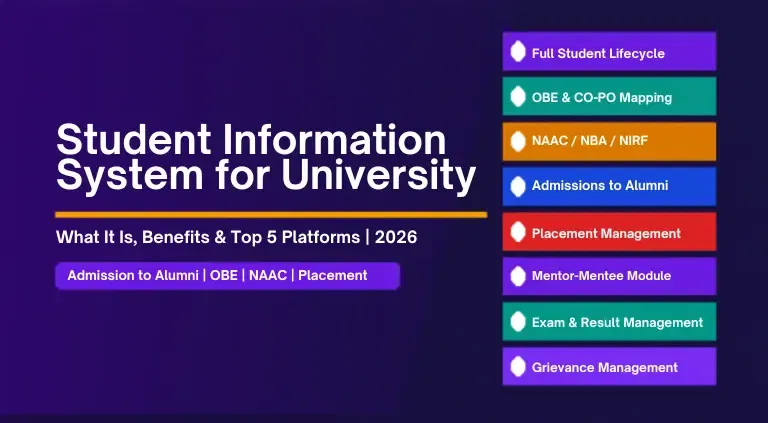
A student information system (SIS) for a university is the centralized database & workflow engine that manages every piece of a student's academic & administrative record from admission enquiry through graduation and alumni.
It covers enrollment, course registration, attendance, academic records, assessment, grading, transcripts, fee management, accreditation data, placement, and alumni engagement, all accessible to students, faculty, registrars, and institutional leadership from one system.
The right SIS for an Indian university must also handle NAAC, NBA & NIRF compliance, OBE with CO-PO & PEO mapping, university-affiliated exam workflows, and program-wise fee complexity.
edumerge College ERP covers all of this as part of its integrated platform, with the student record at the centre of every module from admission to alumni.
SIS vs Student Database: Key Distinction
| Student Database | SIS |
|---|---|
| Stores information | Manages workflows connected to that information |
The difference is whether an action on the student's record (a fee payment, a grade entry, a hall ticket request) automatically triggers the right outcome everywhere else without anyone manually carrying the message from one office to another.
Problems Universities Face Without an Integrated SIS
Most universities & colleges in India currently manage student information across a combination of tools: manual registers, department-wise spreadsheets, standalone fee collection software, and disconnected exam management systems. The problems that result are structural.
- Departmental data silos: Each department maintains its own attendance registers, mark sheets, and student records in Excel or paper. There is no single view of a student's status across departments, and no way for the registrar to see real-time data without collecting reports manually from each head of department.
- Manual fee reconciliation: Fee collection happens through bank challan, online gateway, or counter, with three separate records that the accounts team manually reconciles at month-end. Program-wise fee variations, scholarship deductions, and hostel charges compound the reconciliation burden.
- Accreditation data as crisis: NAAC & NBA visits trigger weeks of frantic data compilation because the institution's academic data (attendance, outcomes, marks, faculty workload) is scattered across Excel files, faculty laptops, and paper registers. An integrated SIS maintains this data in real time.
- No student lifecycle view: The admission team, the academic section, the exam cell, the finance office, and the placement cell each see a fragment of the student's record. No one has a complete view of a student's enrollment status, academic standing, fee position, and placement readiness at the same time.
- Manual certificate workflows: Bonafide certificates, transcripts, and transfer certificates are typed, signed, stamped, and issued manually. The registrar's office processes dozens per day with no digital audit trail and no way for students to track the status of their request.
- Accreditation reporting without automation: CO-PO attainment calculations, student feedback analysis, and outcome evidence for NAAC are done manually at the end of each academic year, requiring faculty to fill forms and registers that serve no operational purpose during the year, only appearing as an audit exercise before a visit.
These problems share a common root: the absence of a unified student record connected to operational workflows. An integrated SIS resolves all of them by establishing one source of truth and connecting every action on that record to every module that needs to know about it.
Explore more on challenges faced by college administration.
5 Best Student Information Systems for Universities
1. edumerge College ERP (Top Pick for Indian Universities and Colleges)
India-native SIS covering the entire student lifecycle for affiliated and autonomous colleges and universities
Type: Purpose-built college ERP & SIS for Indian affiliated colleges, autonomous colleges, and university groups, covering the full student lifecycle on one integrated platform.
Best for: Indian universities, affiliated colleges, autonomous colleges, and college groups that need the full student lifecycle from admission to alumni integrated with OBE, NAAC/NBA/NIRF accreditation, fee management, HRMS, and institutional finance on one platform.
Student lifecycle coverage:
- Admissions Management: Program-specific application forms with dynamic eligibility criteria, multi-level approval pipeline, category-based seat matrix with real-time seat confirmation tracking, automated offer letter generation, admission fee payment integration with auto student record creation
- Student Information System: Comprehensive master record covering personal details, academic history, program & branch allocation, student category, document repository, fee ledger, attendance summary, conduct record, and all academic touchpoints in one profile
- Student Portfolio: Cumulative academic portfolio tracking achievements, co-curricular activities, certifications, and institutional milestones across the entire study period
- Attendance Management: Lecture, lab, tutorial, and practical session-wise attendance, cumulative attendance percentage with threshold alerts, automated parent & student notifications, department-level & institution-level attendance dashboards
- Academics and Timetable: Program-wise academic structure, course & batch management, subject allocation, faculty assignment, timetable generation with substitution management, and lesson plan tracking
- Online Assessments & Student Performance: Internal marks, continuous assessment, mid- & end-semester result entry, CO (Course Outcome) mapping per assessment, student performance analysis dashboard with predictive indicators
- OBE with CO-PO, PEO & PSO Mapping: Outcome-based education framework built into the core, CO-PO attainment calculation, PEO & PSO mapping, student attainment reports, and NAAC/NBA evidence generation automated
- Examination & Results Management: Exam schedule management, hall ticket generation with fee clearance validation, seating plans, result processing, mark statement and grade card generation
- NAAC, NBA & NIRF Accreditation Management: Accreditation data structures built into the platform; live accreditation readiness dashboards; automated evidence mapping; AQAR and SSR data pack generation
- Fee Management: Program-wise fee structures, government & management quota billing, scholarship deductions, hostel & transport charges, instalment plans, online payment gateway integration, automatic reconciliation, defaulter management with exam hall ticket blocking
- MIS Report Builder: Custom report generation across any module without IT dependency, scheduled report delivery to relevant stakeholders
- Placement Management: Recruiter portal, job posting & student application workflows, interview scheduling, offer management, placement analytics by program & batch
- Alumni Management: Centralised alumni database, career progress tracking, event management, professional networking, and alumni contribution records
- Research & Publication Management: Faculty research output tracking, publication records, conference participation, and research project management
- Mentor-Mentee Management: Structured faculty-student mentoring workflows, mentoring session logs, and student concern tracking
- Competitive Exam Intelligence: Tracks student preparation and performance on entrance tests and competitive exams alongside internal assessments
- Role-Based Access with Full Audit Trail: Purpose-built views for registrar, dean, department head, faculty, and student; every action logged with timestamp and user identity
- Grievance Management: Structured student grievance submission, routing, resolution tracking, and escalation workflows
- Same-day onboarding; Named support managers with SLA-backed response; Trusted by 800-plus institutions since 2013
Every student touchpoint in edumerge College ERP, from the first online application to placement and alumni engagement, lives in one unified record. No data re-entry. No cross-referencing spreadsheets.
The student record that admissions creates is the same record that attendance reads, the fee module invoices against, the exam cell uses for hall ticket generation, and the placement portal queries for eligibility. This architectural choice is what makes every other benefit listed above possible at scale, for single-campus colleges and 50-campus university groups alike.
Explore edumerge College ERP Explore edumerge College SIS
2. Ellucian Banner
Market-leading enterprise SIS for large universities worldwide
Type: Enterprise SIS and ERP for large public & private universities, used by 3,000-plus institutions globally serving 21 million-plus students.
Student lifecycle coverage:
- Comprehensive student lifecycle management: admissions, enrollment, registration, financial aid, grading, transcripts, and alumni
- Deep financial aid management and student finance workflows for US and international models
- Integration with finance, HR, and advancement modules for unified campus operations
- Scalable to serve universities with tens of thousands of students across multiple campuses
- AI-enabled SIS features introduced in the Ellucian Student product line in 2025-2026
- Strong partner ecosystem and global implementation support
What to note:
- Implementation cost typically starts above Rs. 40 lakh annually and scales significantly with institution size
- Not designed for Indian affiliated college workflows, NAAC/NBA Indian compliance, or charitable trust accounting
- OBE with CO-PO mapping for Indian regulatory context is not native
- Better suited for large international-standard universities than mid-size Indian college groups
- Implementation typically takes 6 to 12 months
3. Classter
Modular cloud SIS, LMS, and CRM on Microsoft Azure
Type: Modular cloud SIS, LMS, and CRM platform built on Microsoft Azure, used by 500-plus institutions globally.
Student lifecycle coverage:
- Modular SIS, LMS, and CRM that can be deployed component by component
- Centralised academic records, admissions, and enrollment management
- Strong CRM tools for prospective student recruitment and enrollment marketing
- API-first architecture for integration with third-party tools
- GDPR compliance built in for institutions with European operations or students
- Microsoft Azure infrastructure with high availability and cloud-native access
What to note:
- Not built for the Indian regulatory context: NAAC, NBA, Indian trust accounting, PF/ESI payroll compliance, and university affiliation workflows require custom configuration
- OBE with CO-PO mapping for Indian compliance is not native
- Pricing and support orientation favours international institutions
- Indian academic structures including affiliated college autonomy and board-specific requirements are not pre-configured
4. Workday Student
Cloud-native SIS integrated with Workday HCM and Finance
Type: Enterprise cloud SIS from Workday, integrating student services with HR, finance, and analytics for large universities.
Student lifecycle coverage:
- Student lifecycle management integrated with Workday HCM and Finance on the same platform
- Advanced analytics and reporting connecting student outcomes with institutional workforce and financial data
- Cloud-native architecture with automatic updates and no on-premise infrastructure
- Student success tools: advising, degree audit, and academic planning
- Financial aid and student finance modules integrated with the institutional finance layer
What to note:
- Enterprise pricing is very high for Indian universities without Workday HCM or Finance already in place
- Implementation timelines of 12 to 18 months are standard
- Not designed for the Indian affiliated college system or NAAC/NBA compliance workflows
- OBE with CO-PO mapping, university affiliation management, and Indian trust accounting require custom development
- Support model is oriented toward large global universities
5. Jenzabar
Higher education SIS with strong academic administration for mid-market colleges
Type: Higher education ERP and SIS for mid-size colleges and universities, covering student records, advising, finance, and advancement.
Student lifecycle coverage:
- Student records, course management, registration, and grading workflows
- Academic advising and degree audit tools for student retention and success
- Integrated finance and advancement (fundraising) modules
- Retention analytics and early alert systems for at-risk students
- Mobile-accessible student and faculty portals
What to note:
- Designed for North American institutions
- Indian regulatory compliance (NAAC, NBA, NIRF, university affiliation, Indian trust accounting) requires significant customisation
- OBE with CO-PO and PEO mapping for Indian context is not pre-configured
- Pricing and support are oriented toward US and Canadian institutions
- Adoption in Indian universities is limited compared to the other platforms in this list
How to Evaluate a Student Information System for Your University: 8 Criteria
Use these 8 criteria when evaluating any SIS platform. Ask for a live demonstration that shows data flowing across modules, not just individual module screens.
| Criterion | What to Check | Why It Matters for Universities |
|---|---|---|
| Single unified student record | Does the platform use one master student record shared across all modules, or does each module maintain its own copy that requires reconciliation? | A shared student record is the foundation of every other SIS benefit; without it, data inconsistencies proliferate across departments |
| Student lifecycle completeness | Does the platform cover every stage from admission enquiry through placement and alumni, or does it require separate tools for some stages? | Lifecycle gaps mean manual data handoffs; each handoff is a source of errors and delays |
| OBE and CO-PO mapping for Indian compliance | Does the SIS have OBE built natively with CO-PO, PEO, and PSO attainment calculation, feeding directly into NAAC and NBA evidence repositories? | OBE without automation is an administrative burden; OBE with automation is a compliance advantage |
| NAAC, NBA, and NIRF readiness | Does the platform maintain accreditation data continuously as part of normal operations, or require a separate data compilation exercise before each visit? | The difference between a dashboard refresh and a months-long fire drill |
| Fee management integration | Is student fee management built into the same platform as the academic SIS, with auto-reconciliation and defaulter-based hall ticket blocking? | Disconnected fee tools create reconciliation backlogs and allow undeclared defaulters to appear at exams |
| Placement and alumni as core | Are placement management and alumni tracking built into the SIS as core modules, or are they optional add-ons or separate products? | NAAC criteria explicitly evaluate placement outcomes; a disconnected placement tool means manual aggregation before every assessment |
| University affiliation workflow support | Does the platform support affiliated college constraints: university exam calendars, syllabus alignment, result submission timelines, and compliance reporting to the parent university? | Affiliated colleges have two sets of masters: their own processes and the university's requirements; the SIS must serve both |
| Student and faculty self-service portals | Do students and faculty have mobile-accessible portals covering the full range of their interactions with the institution, reducing registrar and admin office queues? | Self-service reduces administrative overhead and improves student satisfaction simultaneously |
Is your university's student record connected to every module that depends on it, or is your registrar's office the manual connection?
The registrar's office should be the governance layer of the student lifecycle, not its data-entry engine.
An integrated SIS makes the difference. It's not simply a database of student records. But the operational foundation that connects every stage of a student's university experience to every department that serves that student.
The right SIS for a university in India must cover the full lifecycle, handle NAAC & NBA compliance natively, support OBE without manual calculation, and connect fee, academic & placement data on one shared record.
edumerge College ERP covers every stage of the student lifecycle on one platform, from the first enquiry to alumni engagement.
For college groups running this same SIS across multiple campuses, 6 Best ERP for College Groups in India compares platforms specifically on multi-campus consolidation.
Frequently Asked Questions (FAQs)
1. What is the difference between a student information system and a college ERP?
A student information system focuses on the student data layer: records, grades, attendance, transcripts & enrollment. A college ERP extends this to cover the full institutional operation: HR, payroll, finance, procurement, governance & multi-campus management, all connected to the student record on one database.
2. How does an SIS help with NAAC & NBA accreditation for Indian universities?
An SIS with accreditation built into its core maintains the required data continuously as part of normal academic operations. CO-PO attainment, student attendance patterns, outcome evidence, research records, faculty workload, and placement data are always current. When an accreditation visit is scheduled, the institution generates the required data packs and dashboards from the system rather than spending months manually compiling records from Excel files and paper registers.
3. How does a university SIS manage affiliated college workflows?
Affiliated colleges must align to their parent university's exam schedules, syllabus updates & result submission timelines, while managing their own internal processes (attendance, internal marks, fee collection, timetable). An SIS built for the Indian affiliated college context manages both layers simultaneously. It respects university calendar constraints for exam scheduling & result processing while giving the college full autonomy over its internal academic & administrative operations.
4. What is the benefit of mentor-mentee management in a university SIS?
Mentor-mentee management in a university SIS assigns faculty mentors to specific students & records all mentoring interactions, student concerns, and follow-up actions within the system. This provides a structured welfare mechanism for students, creates documentation for NAAC criteria on student mentoring, and gives department heads visibility into student welfare patterns without informal follow-up.
Evaluating a dedicated college SIS against a regional alternative? edumerge vs Camu compares the two on exactly these lifecycle & accreditation capabilities.