India runs 1.47 million schools and over 45,473 colleges, yet most institutions still track vendor details on registers, spreadsheets, or scattered files. At a time when procurement fraud is the single biggest economic crime risk for Indian organisations.
Cited by 50% of businesses surveyed by PwC, while only 34% of companies audit their third-party vendors regularly. Education trusts, with multi-campus purchasing & seasonal procurement cycles, carry this exposure without always realising it.
Choosing among the top vendor management tools for educational institutions in India starts with understanding why generic, off-the-shelf software falls short here. This guide sets out what separates a vendor management tool built for educational institutions.
Along with the key challenges institutions face without one, how education leaders should evaluate a tool, and the 10 evaluation criteria that matter most before signing a contract.
TL;DR
This guide ranks the top 10 vendor management tools for educational institutions in India. Weighing GST/PAN verification, pricing catalogue checks, and vendor blocking controls. Against trust-specific needs like academic-year cycles and multi-campus governance.
It sets out 10 evaluation criteria institutions should check before signing. From onboarding-stage duplicate detection to integration with budgeting & trustee dashboards. Plus role-specific guidance for trustees, finance heads, and procurement teams.
edumerge Vendor Management tops the list, built into Finance & Control to give every campus one GST/PAN verified, catalogued, and controlled vendor master from day one.
Why Educational Institutions Need Vendor Management Tools That Are Not Like Conventional Software
A vendor management system built for a corporate supply chain is not built for a school trust, a college society, or a group of institutions. The reasons come down to how institutions actually govern and procure:
- Trust and society governance requires a single, consolidated vendor view across every campus, not department-level silos that a generic tool assumes.
- Academic-year procurement cycles create seasonal vendor spikes for uniforms, lab equipment, and transport contracts that most corporate tools are not tuned for.
- GST and PAN verification at vendor creation matters more where finance teams are lean and manual checks get skipped under workload pressure.
- Budget-linked approval chains must connect vendor selection directly to budget vs actual and trustee-level dashboards, a link generic procurement suites rarely make.
- Multi-category vendors are common in institutions; a stationery supplier that also sells lab equipment needs one record, not two duplicate ones.
- Compliance document expiry, insurance, trade licences, and contractual agreements, needs tracking against the academic calendar, not a generic renewal reminder.
Vendor governance is one piece of the larger picture. See how to manage educational trust accounts in India for the full framework trustees and finance teams need.
Key Challenges Educational Institutions Face Without a Vendor Management Tool
- Vendor records get duplicated across campuses
Effect: The same supplier is onboarded multiple times under different spellings, inflating vendor count and masking real spend. - No automated GST or PAN verification
Effect: Non-compliant or ghost vendors slip through, a risk flagged as the top economic crime concern for 50% of Indian businesses in PwC's latest survey. - PO prices are entered manually with no catalog check
Effect: Overcharging goes unnoticed until a year-end audit, when recovery is difficult. - Vendor blocking is handled by email or verbal instruction
Effect: A blocked vendor still gets selected by a different department or campus, since only 34% of Indian companies audit third-party vendors regularly. - Compliance documents sit in physical files or local folders
Effect: Expired insurance or trade licences surface only during a compliance review or dispute, not before. - No cost-centre-level vendor spend visibility
Effect: Trustees see fund flow only in month-end summaries instead of in real time across campuses.
Check out this LinkedIn post by our CRO on vendor concentration risk in educational institutions.
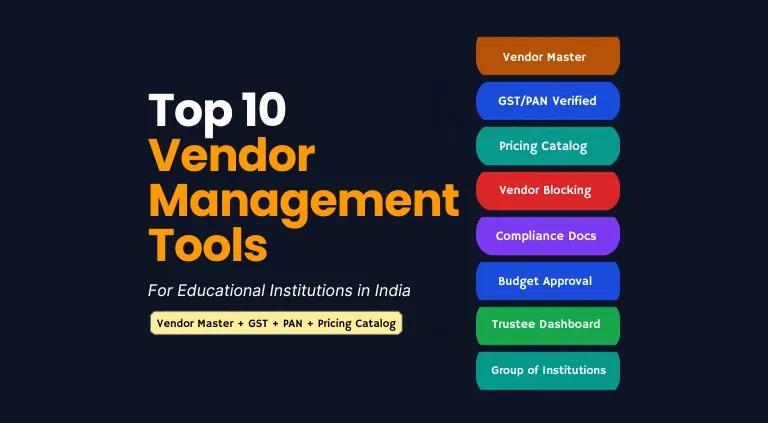
Top 10 Vendor Management Tools for Educational Institutions in India
1. edumerge Vendor Management
Purpose-built vendor system for Indian schools, colleges, and groups of institutions. With GST/PAN verification, pricing catalogues, and blocking controls baked in from the ground up.
Key strengths:
- GST number and PAN checked automatically at vendor creation, so the same supplier cannot be registered twice under a different name or spelling.
- Item pricing catalogue maps agreed rates per vendor; any PO price entered outside that rate is flagged before approval.
- FULL and PARTIAL blocking lets institutions restrict a vendor entirely or just by category (for example, blocked for lab equipment, active for stationery), with the change applying instantly across every campus and department.
- Compliance document repository holds GST certificates, trade licences, insurance, and agreements against each vendor record, searchable and downloadable for audit.
- Multi-category classification and auditable bank account history keep a single deduplicated vendor record even when a supplier provides goods and services across categories.
- Sits natively inside the edumerge Finance & Control suite, so vendor data flows straight into procurement, budgeting, and trust or society accounting without a separate integration project.
- Built specifically for Indian academic-year cycles, trustee reporting, and multi-campus GOI structures rather than adapted from a generic enterprise template.
2. Oracle Fusion Cloud Procurement
Enterprise-grade cloud procurement suite from a global ERP major, occasionally deployed by large, well-funded university systems.
Key strengths:
- Deep supplier qualification and risk-scoring workflows across large, multi-entity supplier bases.
- Tight integration with Oracle Fusion Financials for organisations already on the Oracle stack.
- Strong analytics and reporting on spend, contracts, and supplier performance.
What to note:
- Designed for large enterprise supply chains, not academic trust accounting, fee-to-ledger flows, or DD Month YYYY academic-year budgeting; these need heavy custom configuration.
- Implementation timelines and licensing costs are enterprise-scale, usually out of reach for standalone schools or mid-size colleges.
You might also like our comparison on edumerge vs Oracle ERP.
3. SAP Business One (Procurement & Vendor Master)
SME-focused ERP from SAP, sometimes adopted by larger institution groups for finance and vendor management alongside inventory.
Key strengths:
- Vendor master ties directly into SAP's broader accounting and inventory modules for a unified ledger view.
- Established partner and implementation ecosystem in India.
- Configurable approval hierarchies for purchase orders and vendor payments.
What to note:
- Built as a general-purpose SME ERP, so trust or society accounting, fee-to-finance integration, and NAAC or NBA-linked reporting are not native and require add-ons or custom build.
- Partner-led implementation model means costs and timelines vary widely, and support quality depends on the local SAP partner.
Take a look at our comparison between edumerge Finance vs SAP Business One.
4. Zycus Procure-to-Pay (Merlin AI)
Indian-origin, AI-driven source-to-pay platform used mainly by large enterprises, occasionally by well-funded institutions.
Key strengths:
- Guided procurement system standardises how requisitioners buy, reducing off-catalogue purchases.
- Merlin AI automates invoice data extraction and vendor query handling, cutting manual accounts payable effort.
- Deep, organically built procurement modules rather than acquired, stitched-together tools.
What to note:
- Built for large enterprises across manufacturing, BFSI, and similar sectors, not education, so academic budget cycles and trustee reporting need custom mapping.
- Pricing and implementation are enterprise-grade, heavier than most colleges or mid-size Groups of Institutions need.
5. GEP SMART
Unified cloud procurement platform combining sourcing, contract lifecycle management, and vendor management for large organisations.
Key strengths:
- Single platform spans sourcing, savings tracking, and contract lifecycle management alongside vendor records.
- Flexible configuration supports collaborative onboarding and performance tracking workflows.
What to note:
- Sector-agnostic design means education-specific needs like fee-linked budget validation or trust consolidation are absent.
- Typically positioned and priced for large enterprises, not standalone schools or single-campus colleges.
Vendor & procurement management are still just one strand of the feather. Read on how edumerge integrates both with asset management & inventory management.
6. Kissflow Procurement Cloud
No-code, workflow-first procurement tool popular with mid-size Indian businesses for purchase requests and vendor onboarding.
Key strengths:
- Low-code workflow builder lets non-technical admin staff configure approval chains without developer support.
- Vendor self-service onboarding and basic performance monitoring reduce manual data entry.
- Mobile app supports approvals on the go.
What to note:
- Generic workflow tool, not built for GST/PAN duplicate detection or item-wise pricing catalogues specific to Indian vendor compliance.
- No native link to fee collection, trust accounting, or academic-year budgeting, so it works best as a standalone add-on rather than a single system of record.
7. Jaggaer
Global source-to-pay platform with strong supplier risk and performance dashboards, used across manufacturing, healthcare, and some university systems abroad.
Key strengths:
- Detailed supplier risk and performance dashboards support strategic sourcing decisions.
- Broad supplier collaboration tools for RFQs and contract negotiation.
- Established presence in higher education procurement internationally.
What to note:
- Indian deployment and support footprint is thinner than domestic vendors, which can slow implementation and local compliance updates.
- Not aligned to Indian trust or society accounting formats, TDS on vendor payments, or GST-linked vendor verification out of the box.
8. Zoho ERP (Vendor & Purchase Management)
Widely used Indian SaaS suite offering purchase order, vendor, and inventory modules as part of a broader business applications stack.
Key strengths:
- Affordable, familiar interface with a large existing user base across Indian SMEs.
- Purchase order and vendor modules integrate with Zoho Books for accounting.
- Fast to set up for basic purchase-to-pay workflows.
What to note:
- Built as a general business suite, so academic-year budgeting, fee-to-ledger posting, and NAAC/NBA-linked reporting are absent without significant customisation.
- Vendor blocking, item-wise pricing catalogues, and multi-campus GOI consolidation are limited compared with education-specific vendor masters.
Discover how edumerge Finance compares Zoho Books on features.
9. Procol
Fast-growing Indian procurement platform focused on AI-enabled sourcing and supplier collaboration for mid-market businesses.
Key strengths:
- AI-assisted sourcing and real-time purchase tracking reduce manual RFQ effort.
- Indian-origin support and pricing suited to mid-market budgets.
What to note:
- Not built for education; academic budget cycles, trust accounting, and fee integration are outside its scope.
- Younger platform with a smaller India-education reference base compared with established ERP vendors.
10. TYASuite
Cost-effective, cloud-based Indian procurement platform aimed at SMBs, covering vendor management, RFQs, purchase orders, and invoice approvals.
Key strengths:
- Lower cost of ownership relative to enterprise procurement suites, suited to smaller budgets.
- Covers the core purchase-to-pay cycle including vendor onboarding and invoice matching.
What to note:
- General SMB focus means no built-in academic-year budgeting, trust or society accounting, or fee-to-finance integration.
- Vendor compliance depth (GST/PAN duplicate checks, item-wise pricing validation) is lighter than education-specific vendor masters.
Vendor management sits inside a wider procurement stack. Compare it against the top procurement management software for colleges in India to see how the two connect.
Evaluation Criteria for Choosing the Right Vendor Management Tool
1. GST and PAN verification at onboarding, not after
- Verification runs the moment a vendor record is created, not during a later audit
- Closes the window where a non-compliant or fraudulent vendor could be paid before anyone checks
2. Automatic duplicate detection on name, GST number, PAN, and inactive vendors
- Covers more than exact name matches, catches spelling variants and different branch addresses
- Cross-checks GST number and PAN, not just the name field
- Prevents duplicate vendor count and masked spend with the same supplier
3. Item-wise pricing catalog with automatic PO price validation
- Maps specific items or item categories to a negotiated price per vendor
- Checks entered PO price against the catalog automatically
- Flags mismatches for review instead of relying on manual memory of agreed rates
4. FULL and PARTIAL vendor blocking, applied institution-wide instantly
- FULL blocking removes a vendor from every new transaction, for non-compliance or discontinued relationships
- PARTIAL blocking restricts a vendor by category or transaction type only
- Restriction applies across every campus immediately, not just the flagging department
5. Centralised compliance document repository with expiry tracking
- GST certificates, trade licences, insurance, and contractual agreements stored against each vendor record
- One searchable location, not physical files or personal folders
- Surfaces upcoming renewals before a certificate lapses, not after a dispute exposes the gap
6. Multi-category vendor classification without duplicate records
- One vendor record carries multiple category classifications
- No need to create a second, duplicate entry to transact under a different category
- Common case: a stationery vendor who also supplies lab equipment
7. Multiple bank account management per vendor, with tracked changes
- Payment routing always follows the correct, currently active account
- Every addition, update, or deletion logged with who made the change and when
- Gives the accounts team an audit trail for any payment or dispute
8. Cost-centre and category-level vendor spend reporting
- Spend broken down by cost centre and category, not one aggregate number
- Lets finance or operations heads catch an overrun early, department by department
- Avoids discovering issues only at annual budget-versus-actual review
9. Integration with budgeting, approval chains, and trustee dashboards
- Vendor selection connects directly to the approval chain
- Vendor-linked spend feeds into the same dashboards trustees already use
- Vendor risk and spend sit alongside everything else leadership already tracks
10. Purpose-built for trust/society, multi-campus, and academic-year structures
- Decides whether the other nine criteria actually work as intended
- Corporate-built platforms need to be bent into shape for trust/society accounting and multi-campus vendor masters
- Institution-built platforms handle academic-calendar procurement spikes natively, without workarounds
Vendor spend decisions ultimately flow into the budget. See how to prepare budget for schools and colleges in India for how finance heads should plan around it.
Conclusion
Choosing among the top vendor management tools for educational institutions in India comes down to one question. "Does the platform understand trust and society governance, multi-campus operations, and academic-year procurement, or was it adapted from corporate software?"
With procurement fraud now the leading economic crime risk flagged by Indian businesses. The 10 evaluation criteria in this guide give institutions a practical way to compare tools before committing budget and vendor data to one system.
edumerge Vendor Management, built into edumerge Finance & Control, was designed specifically for groups of institutions, trusts, and societies. Giving every campus one verified, catalogued, and controlled vendor master from day one.
Frequently Asked Questions (FAQs)
1. Why can't a school or college just use general procurement software?
General procurement software is not built for trust/society accounting, multi-campus governance, or academic-year purchasing cycles. So it misses controls institutions actually need, like trustee-level spend visibility.
2. Does a vendor management tool prevent duplicate vendor records?
A well-built tool checks GST number & PAN automatically at the point of vendor creation. And flags any match against an existing or inactive vendor before the record is saved.
3. What is the difference between FULL and PARTIAL vendor blocking?
FULL blocking stops a vendor from being selected for any new procurement transaction. PARTIAL blocking restricts a vendor at the category or transaction-type level. For example, blocked for lab equipment but still active for stationery.
4. Can one vendor supply multiple categories of goods or services?
Yes, a properly designed vendor master allows a single vendor to be classified under multiple procurement categories in one record. Instead of creating duplicate entries.
5. How does a vendor management tool validate purchase order prices?
It maps each item or item category to an agreed price per vendor in a pricing catalog. Then automatically checks the entered PO price against that catalog and flags discrepancies.
6. Is vendor management software cloud-based?
Most modern vendor management platforms for educational institutions, including edumerge, are cloud-based and require no on-premise server hardware.
7. How long does it take to implement a vendor management system?
Implementation timelines vary by institution size. But a focused vendor master module can typically go live within a few weeks once existing vendor data is migrated and verified.
8. Does vendor management software support multi-campus groups of institutions?
Yes, purpose-built platforms maintain one deduplicated vendor master across all campuses. With block status and pricing catalogs applied institution-wide rather than campus by campus.
9. What compliance documents should a vendor management tool track?
GST registration certificates, trade licences, insurance certificates, and contractual agreements should be stored centrally against each vendor record, with expiry dates tracked for renewal.
10. Who should be involved in evaluating a vendor management tool?
Trustees, finance heads, procurement or administrative heads, IT heads, and operations heads should each evaluate the tool against their specific concerns before an institution signs a contract.