Most colleges in India still run procurement on paper indents, WhatsApp approvals, and standalone spreadsheets. This breaks down quietly as departments, budgets, and vendor lists grow.
The scale is real. The number of colleges in India rose from 42,343 in FY20 to 53,461 in FY26. And each new campus adds more points where an approval can stall or a budget breach can go unnoticed.
The trouble is that most procurement tools are built for corporate supply chains, not academic-year budgets, trust-level governance, or multi-campus approval chains. Generic business software forces the institution to adapt to the tool, instead of the other way around.
This guide covers why dedicated procurement software matters, the risks without it, what to ask before buying, and the criteria that should shape a final decision.
TL;DR
Most procurement tools are built for corporate buying, not academic budgets, trust-level governance, or multi-campus approval chains, which is why generic software struggles in colleges.
This guide breaks down the real risks of manual procurement, the questions & criteria college management should evaluate before buying, and how 10 procurement options for Indian colleges compare on the criteria that matter.
edumerge's Procurement Management module, part of Finance & Control, is built specifically for this workflow. With budget validation, full document linkage, and audit-ready tracking from indent to payment.
Why Colleges Require Specialized Procurement Management Software
Off-the-shelf purchasing tools are built for a single buying office with one budget owner. Colleges operate differently, and that difference is exactly why generic software falls short.
- Multi-campus, multi-trust budget structures that generic purchasing tools were never designed to handle.
- Budgets owned by trustees and governing bodies, not one finance department. So approval chains must mirror institutional hierarchy, not a corporate org chart.
- Compliance and audit requirements specific to education, including trust & society accounting, FCRA-linked reporting, and NAAC or NBA documentation.
- Mixed procurement needs spanning consumables, lab equipment, capital assets, and recurring services such as housekeeping, transport, and security, each needing a different workflow.
- Seasonal, academic-calendar-driven spend, with admissions, exam season, and new-semester stock creating predictable demand spikes.
- Requests originating from departments, not a central purchasing office. So the system has to be usable by non-finance staff across campus.
- Direct linkage between procurement, inventory, and asset registers. Since colleges track lab equipment and fixed assets closely for audit and insurance purposes.
Procurement only works well when it starts from a realistic budget. Our guide on how to prepare budget for schools & colleges in India walks through building that foundation before software enters the picture.
Key Challenges Colleges Face Without the Right Procurement Management Software
When procurement stays manual, the impact is not limited to slower purchasing. It shows up directly in the college's financial operations. Often only becoming visible during an audit or a leadership review.
A CAG audit of the Education Ministry's autonomous bodies found Rs. 4,553.85 crore in grants left unutilised in 2022-23. The exact kind of gap a real-time approval and budget-tracking system is built to catch before it happens, not after.
Here is where these gaps show up most often, and what each one costs the institution:
| Challenge Without Procurement Software | Impact on College Financial Operations |
|---|---|
| Manual, paper or email-based approvals | Delayed purchases, no visibility into pending requests, budget overruns discovered only at month-end |
| No budget validation before purchase | Departments spend against unsanctioned budgets, forcing finance to reconcile after the fact |
| No competitive bidding process | Vendor rates go unchallenged; institutions overpay without a documented comparison |
| Disconnected purchase and inventory records | Stock and asset registers fall out of sync; physical verification takes weeks |
| No document linkage across the purchase cycle | Auditors cannot trace a payment back to its originating requisition, slowing statutory and NAAC or NBA audits |
| Manual invoice tracking | Vendor disputes and late payments go unnoticed until vendors escalate, damaging relationships |
| No real-time visibility for leadership | Trustees rely on periodic reports instead of live budget utilisation data |
Read this article by our CRO on vendor concentration risk in group educational institutions.
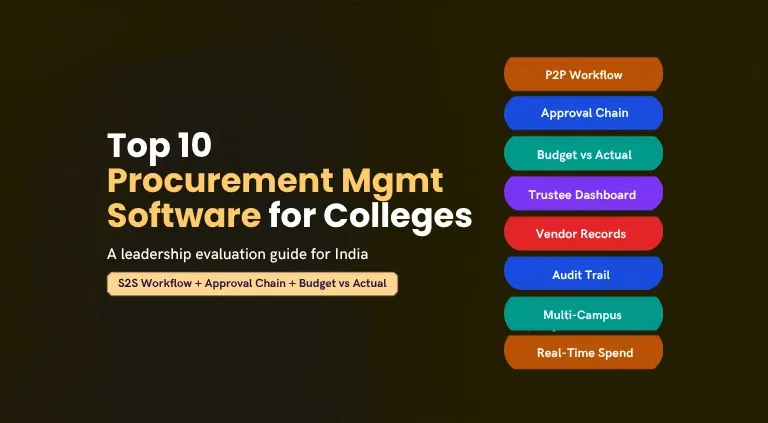
Top 10 Procurement Software for Colleges in India
1. edumerge Finance & Control
A complete procurement management module for the complete procure-to-pay (P2P) lifecycle. Built as part of Finance & Control for colleges, universities, groups of institutions, and schools. Covering the full workflow from department indent to vendor payment in one connected module.
Key strengths:
- Covers the entire P2P chain in a single system: Indent, Purchase Requisition, RFQ, Purchase Order, GRN or Service Entry Sheet, and Invoice & Payment, with every document linked back to its parent for a complete audit trail.
- Budget is validated at the point a PR is submitted, reserved on approval, and released automatically on rejection or cancellation, so purchases are blocked or escalated before they breach budget, not after. Also read about budgeting & forecasting.
- RFQ module runs multi-vendor bulk bidding with side-by-side quote comparison, and awarding a quote auto-creates the PO, removing manual price entry. Read more about this on our vendor management feature page.
- Goods Receipt Notes accept or reject line items individually, post accepted quantities to inventory automatically, and auto-generate asset records for ASSET-type items. Closing the loop between procurement, inventory, and asset management.
- Two-layer approval (department L1, amount-based L2) with escalation triggers, plus a dedicated Service Entry Sheet workflow for service-based purchase orders.
- Designed to work the same way for a single campus or a multi-institution group, with budget controls at cost-centre level across every department, not just central procurement.
2. Zycus Procure-to-Pay (Merlin AI)
Indian-origin, AI-driven source-to-pay platform used mainly by large enterprises, occasionally by well-funded institutions.
Key strengths:
- Guided Procurement System (GPS) standardises how requisitioners buy, reducing off-catalogue purchases.
- Merlin AI automates invoice data extraction and vendor query handling, cutting manual AP effort.
- Deep, organically built procurement modules rather than acquired, stitched-together tools.
What to note:
- Built for large enterprises across manufacturing, BFSI, and similar sectors, not education, so academic budget cycles and trustee reporting need custom mapping.
- Pricing and implementation are enterprise-grade, heavier than most colleges or mid-size Groups of Institutions need.
3. GEP SMART
Cloud-based, AI-powered source-to-pay suite built on Microsoft Azure, aimed at large organisations.
Key strengths:
- Single platform covering requisitioning through supplier performance monitoring, with no separate bolt-on modules.
- Strong, consistently cited user experience for procurement teams.
- Optional managed-services layer for institutions that want day-to-day procurement operations run externally.
What to note:
- Positioned for large corporations; education-sector reference cases in India are limited.
- Full value depends on adopting the wider spend-management stack, not just a purchase-order (PO) tool.
4. SAP Business One (SAP B1)
SAP's SME-tier ERP with a procurement module, occasionally deployed by larger private universities.
Key strengths:
- Purchase orders tie directly into SAP's finance & inventory ledgers within one ERP backbone.
- Familiar to institutions already running SAP for other functions.
What to note:
- Built as a general SME ERP, not for education, so academic workflows like indent-to-department-budget mapping are absent by default.
- Customisation and licensing costs can run high relative to a single institution's procurement volume.
You might also find this comparison helpful: edumerge Finance vs SAP Business One.
5. Oracle Fusion Cloud Procurement
Enterprise cloud procurement module from Oracle's Fusion suite, used by a small number of large Indian university systems.
Key strengths:
- Strong sourcing, supplier qualification, and contract management depth.
- Handles complex, multi-entity approval hierarchies at scale.
- Solid audit trail and compliance controls out of the box.
What to note:
- Complexity and cost typically exceed what a standalone college or mid-size group of institutions needs.
- Long implementation cycles, usually requiring dedicated Oracle-certified partners.
Also take a deeper look at how edumerge compares with Oracle ERP.
6. Zoho ERP (Zoho Books / Zoho Creator procurement)
Low-cost, configurable business suite smaller colleges use to build a lightweight purchase and approval flow.
Key strengths:
- Affordable entry point for standalone colleges without group-level complexity.
- Zoho Creator lets institutions build custom purchase-approval apps without heavy development.
- Connects to Zoho's broader finance and inventory apps.
What to note:
- Procurement workflows (RFQ, GRN, budget validation) must be custom-built rather than configured out of the box.
- Multi-campus, trustee-level consolidation is not a native feature and needs additional development.
You might also like our comparison between edumerge Finance & Control vs Zoho Books.
7. GeM (Government e-Marketplace)
Government of India's national public procurement portal, mandatory for the government and many aided colleges buying notified categories of goods and services.
Key strengths:
- Mandatory compliance route for government and autonomous institutions under GFR Rule 149.
- Built-in e-bidding, reverse e-auction, and demand aggregation tools for competitive pricing.
- Large, verified seller base covering common categories colleges purchase.
What to note:
- Relevant mainly to government and government-aided institutions; private colleges have no compliance obligation to use it.
- It is a marketplace, not an internal workflow tool. It doesn't manage internal indents, approval chains, or budget validation on its own.
8. Academia ERP (Serosoft)
Full-scale campus management platform with a purchase and inventory module, used by colleges and universities.
Key strengths:
- The purchase and store module sits alongside admissions, examinations, and student records in one suite.
- Migration support for institutions moving off legacy or spreadsheet-based purchase tracking.
What to note:
- Procurement-specific depth (RFQ bidding, GRN quality checks, invoice ageing) is not the module's primary design focus.
- Implementation timelines can extend for larger groups given the breadth of modules configured together.
9. Camu
Cloud-based campus ERP with an inventory and procurement module bundled into the wider student lifecycle suite.
Key strengths:
- Inventory and stock module covers library, hostel, mess, and canteen assets alongside academic procurement.
- Modular, on-demand feature selection lets institutions scale procurement usage as needs grow.
What to note:
- Procurement sits as one module inside a broader student-lifecycle suite, so approval-chain depth and budget-validation granularity vary by deployment.
- India-specific compliance nuances (GeM linkage, GST handling) should be confirmed during evaluation.
Take a deeper look at how edumerge compares with Camu.
10. MasterSoft ERP (Store and Purchase module)
Store management module within MasterSoft's broader education ERP, used by 2,000+ institutions in India.
Key strengths:
- Covers goods procurement, stock book entries, receipt of goods, issue write-off, bill passing, and store reports in one flow.
- Automates receipt of goods, stock book entries, bill generation, and material issuance across departments.
- Large existing India installed base, so implementation partners and support are readily available.
What to note:
- Store management is one module among 25+ pro modules and 30+ inbuilt modules, so procurement-specific depth (RFQ bidding, invoice ageing, budget escalation) is not the platform's primary design focus.
- Institutions evaluating it purely for procurement may end up paying for the broader ERP suite even if only the store module is needed.
Also explore how edumerge & MasterSoft Education ERPs compare on features.
What Criteria Should Leadership Evaluate for Choosing Procurement Management Software for Colleges in India
Once role-specific concerns are on the table, leadership needs a shared checklist to score every shortlisted system against. These 10 criteria cover the full procure-to-pay lifecycle.
| Evaluation Criterion | Why It Matters |
|---|---|
| Budget validation at requisition stage | Prevents overspend before it happens, not after |
| Multi-level, role-based approval workflow | Matches institutional governance instead of forcing a generic hierarchy |
| Competitive bidding and vendor comparison | Ensures institutions get fair market rates on every purchase |
| Separate goods and service receipt workflows | Different acceptance paths for consumables, assets, and services |
| Full document linkage and audit trail | Supports NAAC, NBA, statutory audit, and trustee review |
| Inventory and asset integration | Keeps stock and asset registers accurate without duplicate entry |
| Invoice ageing and dispute management | Protects vendor relationships and payment discipline |
| Scalability across campuses | Avoids re-implementation as the institution or trust grows |
| GST-compliant purchase orders | Keeps procurement statutorily compliant by default |
| Reporting for every stakeholder | Gives each role the visibility it needs without manual extracts |
For Groups of Institutions running procurement across multiple campuses, consolidated visibility matters as much as the workflow itself. See our comparison of the top 10 consolidated financial reporting tools for educational groups for how group-level reporting connects to campus-level procurement.
Conclusion
The 'top' procurement management software for colleges in India is not the one with the longest feature list. It is the one that validates budgets before spend, links every document from indent to payment, and matches how your institution actually governs itself.
edumerge Procurement Management is built for exactly this. A full procure-to-pay workflow, budget validation at every stage, and complete document linkage designed specifically for education institutions in India.
For colleges and groups of institutions ready to move procurement off email and spreadsheets, edumerge Procurement Management is a straightforward next step.
If you're also evaluating global procure-to-pay platforms, see how edumerge compares with Order.co and Procurify.
Frequently Asked Questions
1. What is the difference between procurement software and a simple purchase order system?
A purchase order system only records what was ordered. Procurement management software for colleges covers the entire lifecycle before and after the PO, including budget validation, competitive bidding, goods receipt, and invoice payment, with every document linked to the one before it.
2. Does procurement management software support multi-campus colleges and trusts?
Yes. A system built for education applies consistent approval structures and budget controls at the cost-centre level across every department and campus within a group of institutions.
3. How does budget validation work in procurement software for colleges?
Available budget for the relevant cost centre is checked at the point a purchase requisition is submitted, before it enters the approval chain. The budget is reserved on approval and released if the request is rejected or cancelled.
4. Can vendors submit competitive quotes through the system?
Yes. Approved purchase requisitions can be converted into an RFQ that invites multiple vendors to submit item-wise pricing. Quotes are compared side by side, and awarding the winning quote automatically creates the purchase order.
5. Is procurement management software the same as inventory management?
No, but the two should be connected. Procurement management software for colleges handles the buying cycle, while inventory management tracks stock levels; the best systems post accepted goods receipt quantities to inventory automatically.
6. How long does it take to implement procurement software for a college?
Timelines vary by institution size and the number of cost centres, but a cloud-based, purpose-built system for education typically onboards faster than a generic ERP module adapted for colleges.
7. Does procurement software handle service-based purchases, not just goods?
A well-designed system uses a separate acceptance workflow, such as a Service Entry Sheet, for service-based purchase orders like housekeeping or transport contracts, distinct from the goods receipt process.
8. Is edumerge Procurement Management cloud-based?
Yes. edumerge Procurement Management runs as part of the edumerge Finance & Control suite, accessible across campuses without on-premise server hardware.
9. Who in a college should use procurement management software for colleges in India?
Department staff raise indents, store managers process approvals and issues, procurement or finance admins manage the full purchase-to-payment lifecycle, finance approvers review requisitions and invoices, and trustees or management review budget utilisation and audit trails.
10. How does procurement software help with NAAC or NBA audits?
Because every document in the purchase cycle links back to its parent, from goods receipt to purchase order to requisition to the originating indent, auditors and accreditation reviewers can trace any payment to its source without manual reconstruction.