Every group of schools, colleges, or universities in India eventually hits the same wall. Trustees ask for one consolidated number. The finance team spends days assembling it from spreadsheets pulled off each campus, reconciled by hand and stitched together before the board meets.
Vendors use different languages for the same problem. Consolidation, group reporting, a generic ERP module. The real question stays the same, "does the platform give a single, real-time, audit-ready number across every campus, or does it just move the spreadsheet problem elsewhere?".
This guide breaks down the top consolidated financial reporting tools for educational groups in India by capability, not by brand name. You will find why consolidation stops being optional once a group scales past 2 or 3 campuses, and what actually goes wrong without it.
TL;DR
Groups of institutions in India running multiple campuses under a trust or society need one consolidated financial number, not spreadsheets stitched together from each campus. This guide compares the top consolidated financial reporting tools by capability. Automated multi-entity consolidation, real-time Budget vs Actual, approval chains, and a trustee dashboard.
Generic accounting tools like Tally, QuickBooks & Zoho Books work at the single-entity level. But do not consolidate across trusts, societies, or campuses without heavy manual work. Enterprise ERPs like Oracle Fusion, SAP B1, NetSuite, and Microsoft Dynamics offer strong consolidation. But are built for large commercial organisations, not Indian trust and society structures.
edumerge Finance & Control is the only platform in this list built natively around this problem. Sanction to settlement workflow, structured approval chains, Budget vs Actual tracking, and a live trustee dashboard, all on one ledger shared with School ERP & College ERP.
The Problem Without Consolidated Financial Reporting Tools for Educational Groups
Most education groups in India did not plan to run 5 different accounting setups across 5 campuses. It happened gradually, one new campus and one new spreadsheet at a time.
Without a consolidated system, the finance team becomes the connective tissue between disconnected campuses, manually. That work is invisible until it fails, and it fails in predictable ways.
Financial closes take too long
Effect on the group: Group-level statements take weeks to prepare. Every campus's numbers must be collected, checked, and re-keyed by hand before anyone sees a full picture.
Manual consolidation introduces errors
Effect on the group: Spreadsheet-based consolidation brings formula mistakes and version-control issues. These compound as the group adds more campuses.
Compliance gaps surface too late
Effect on the group: Discrepancies between campus books surface during audits or inspections. They are not caught during the normal course of business, when they would be cheaper and safer to fix.
Trustees lose confidence in finance
Effect on the group: Governing bodies keep asking for numbers they cannot get quickly. Over time, they start to question the finance function's control over the group.
Warning signs stay hidden
Effect on the group: Budget overruns, cash shortfalls, or fund misallocation at one campus go unnoticed. They only surface once they show up inside a much bigger group-level number.
Decisions slow down
Effect on the group: Expansion, borrowing, and campus-level interventions all wait on financial data. If that data takes too long to compile, the decision waits with it.
If your group also manages standalone schools alongside these consolidation needs, top 9 financial management software for schools in India covers the options built for that layer.
Top 10 Consolidated Financial Reporting Tools for Educational Groups in India
1. edumerge Finance and Control Suite (Most Comprehensive)
Purpose-built consolidation and governance layer for Indian education institutions, running on the same data architecture as edumerge's School ERP and College ERP.
- Society-to-School (S2S) fund flow tracking, so every rupee moved from a trust or society to an institution carries a full audit trail
- Multi-level approval chain, configurable per campus and per cost centre
- Real-time Budget vs Actual reporting; overspending flags surface as they happen, not at month-end
- Trustee dashboard: a read-only, mobile-accessible consolidated view of cash position, fee collection health, and budget utilisation across all campuses
- Fee collections auto-post to the group ledger since Finance runs on the same database as School ERP and College ERP; no exports or manual reconciliation
- Backed by edumerge's base of 800+ institutions and 500,000+ students across India since 2013, giving the consolidation layer real multi-campus scale behind it
2. Oracle Fusion Cloud Financials
Enterprise cloud ERP financial suite built for large, multi-entity organisations running complex consolidations.
- General Ledger supports multiple balancing segments, so individual-entity reports can be produced and then rolled up into consolidated financial statements across legal entities
- Grants management and project financial management with Budget vs Actual and IFRS 15/ASC 606 revenue recognition, relevant for large university systems handling research grants
- Single cloud platform supporting multi-entity, multi-currency, and multi-GAAP operations with AI-assisted anomaly detection
What to note:
- Not education-native; Indian trust structures, FCRA compliance, and S2S fund flow require heavy custom configuration
- Implementation and licensing costs sit well above what mid-size GOIs typically budget for
If you're looking for integrated financial management and ERP capabilities, take a look at how edumerge compares with Oracle ERP.
3. SAP Business One (SAP B1)
SME-focused ERP with add-on based financial consolidation, positioned for organisations running under 300 users.
- Runs on HANA or SQL Server with Crystal Reports and industry-specific add-ons
- Company Consolidation add-ons combine G/L accounts across multiple entities automatically each month once source companies, exchange rates, and target accounts are mapped
- Implementation typically runs Rs. 1 lakh to Rs. 7.5 lakh over 6 to 12 weeks, faster to deploy than large enterprise suites
What to note:
- Multi-entity consolidation depends on a third-party add-on rather than being native to the core product
- No education-specific modules; trust and society accounting, academic-year alignment, and fee-to-ledger sync all need custom build
- Indian education adopters are typically large single institutions, not multi-campus GOIs
You might also like our comparison on edumerge Finance vs SAP Business One.
4. Zoho Books / Zoho ERP
GST-compliant cloud accounting platform, commonly used by small and mid-size Indian institutions for standalone bookkeeping.
- GST filing, multi-currency support, and automated approval workflows built in
- Client portal and bank feeds reduce manual reconciliation for single-entity accounts
What to note:
- No native fund accounting or trust and society structures for education groups
- Multi-campus consolidation, FCRA compliance, and S2S fund flow require heavy custom configuration
- Best suited to a single school or college, not a group of institutions
If you're looking for HR capabilities and employee management operations, take a look at how edumerge HRMS compares with Zoho People.
5. Tally Prime
India's most widely deployed accounting software, often the base ledger system schools and colleges already run on.
- Deep familiarity among Indian accountants and auditors; minimal training overhead
- GST, TDS, and statutory compliance built for Indian regulations
- Low cost of ownership and wide partner ecosystem for support
What to note:
- No native multi-campus consolidation; each campus typically runs a separate Tally instance
- No trustee dashboard, approval chain, or Budget vs Actual visibility out of the box
- Requires a school ERP layered on top (and manual reconciliation between the two) for education-specific workflows
Discover how edumerge Finance & Control vs TallyPrime stacks up on features.
6. Microsoft Dynamics 365 Finance
Enterprise financial management suite with strong multi-entity and multi-currency consolidation.
- Power BI integration for real-time financial dashboards
- Deep integration with the Microsoft ecosystem (Excel, Teams, Power Automate)
What to note:
- Licensing and implementation costs are enterprise-grade, not sized for mid-market GOIs
- No education or trust-specific accounting logic without a specialised implementation partner
- Longer implementation timelines given the breadth of configuration involved
7. NetSuite ERP (Oracle NetSuite)
Enterprise cloud ERP with education vertical support, used by large university systems and multi-state groups.
- Multi-entity accounting with consolidated financial statements across subsidiaries
- Grant tracking and advanced analytics for institutions with research income
- Global compliance framework suited to groups with cross-border operations
What to note:
- Implementation cost and complexity are prohibitive for most Indian GOIs
- Not purpose-built for trust or society structures common in Indian education
- Requires dedicated IT resourcing to maintain, unlike education-native platforms
Also, explore our comparison between edumerge vs Oracle ERP
8. QuickBooks Online
Generic SME cloud accounting platform, common among small standalone schools and NGO-run institutions.
- Double-entry accounting, invoicing, and bank reconciliation
- GST-compliant reporting for the Indian market
- Simple setup, minimal training required
What to note:
- No fee-to-ledger sync, academic-year structures, or trustee governance module
- Not designed for multi-entity or multi-campus consolidation
- Fund accounting for trusts and societies is absent
9. Ramco ERP
Indian enterprise ERP with financial & HR modules, used across manufacturing, aviation, and some large institutional groups.
- Multi-entity general ledger with consolidation across business units
- Automation-heavy finance workflows (invoice processing, reconciliation)
What to note:
- Not education-vertical; no fund accounting, S2S fund flow, or trustee dashboard
- Better suited to commercial enterprises than charitable trusts or societies
- Limited case studies in the Indian education GOI segment specifically
10. Aplos Fund Accounting
Non-profit fund accounting platform built for donor and grant-based reporting.
- Fund-based accounting designed for the structure of a trust or society, not a for-profit entity
- Donor and grant tracking with financial statements formatted for non-profits
- Useful for FCRA-registered trusts receiving foreign contributions
What to note:
- Not India-specific; limited integration with Indian education ERPs or local fee structures
- No multi-campus fee-to-ledger integration or Indian statutory compliance (12A/80G, TDS) built in
- Works best as a donor-reporting layer alongside a separate operational ERP, not as the primary consolidation system
What Capabilities a Financial Reporting Tool Should Have and How It Benefits Your Educational Group
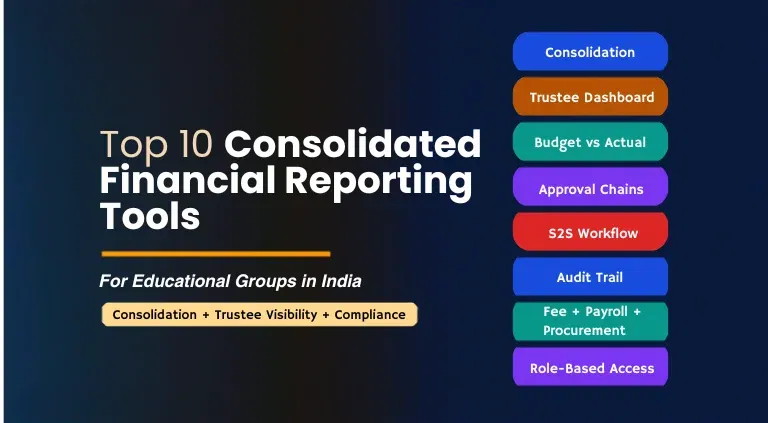
Use this table as a checklist. These are the top 10 capabilities that separate a genuine group finance platform from a standalone accounting tool adapted for education.
| Capability | What It Does | Benefit to the Educational Group |
|---|---|---|
| Automated Trust, Society, and Multi-Entity Consolidation | Rolls up transactions from every trust, society, or Section 8 entity in the group into one ledger automatically. | Trustees get a true group number without waiting for manual compilation. |
| Centralized Chart of Accounts Across Campuses | Applies one consistent account structure across every campus, instead of each campus defining its own. | Numbers from different campuses compare cleanly, with no manual mapping required. |
| Real-Time Dashboards for Trustees and Finance Heads | Displays revenue, expenses, fund position, and audit readiness on demand. | Governing bodies see group health between meetings, not only at reporting deadlines. |
| Budget vs Actual Tracking | Compares planned spend against real transactions as they happen, campus by campus and group-wide. | Overspends are caught during the year, not discovered at annual close. |
| Automated Bank Reconciliation | Matches bank statements against ledger entries without manual entry. | Finance teams save hours each month and reduce reconciliation errors. |
| Approval Chains and Workflow Controls | Routes procurement, expense, and claim requests through defined sign-off levels. | Spending stays within policy before money leaves the account, not after. |
| Audit Trail and Maker-Checker Logs | Records every transaction with who created it and who approved it. | Audits move faster because documentation already exists, on demand. |
| Statutory and Compliance Reporting | Generates GST, TDS, and FCRA-related reports directly from live transaction data. | Compliance filing stops being a scramble before every deadline. |
| Fee, Payroll, and Procurement Integration Into One Ledger | Posts fee collections, payroll runs, and vendor payments to the same ledger automatically. | Finance heads see the complete financial picture without stitching together separate systems. |
| Role-Based Access and Group-Level Permissions | Restricts what each user sees and edits, based on their role and campus. | Data stays secure while every stakeholder still gets the view relevant to their responsibility. |
If you're comparing platforms on the budgeting side too, budgeting & forecasting tools for colleges in India breaks down the options.
Conclusion
Consolidated financial reporting has stopped being a nice-to-have for education groups in India. Once a trust or society crosses 2 or 3 campuses, the spreadsheet approach breaks down in predictable ways.
Closes take too long, errors compound, and trustees end up governing on numbers that are already out of date. The right platform closes that gap, not by replacing what the finance team already knows. But by giving every campus, trust & society one consolidated view that updates in real time.
edumerge Finance & Control is built around exactly this problem, with every module tailored for the needs of Indian education groups. Right from S2S workflow, structured approval chains, live trustee dashboard, and more. All without forcing a group to abandon its existing accounts.
If your trust or society is still assembling one consolidated number from five sets of spreadsheets, that is worth changing before the next audit, not after it.
Frequently Asked Questions
1. How is consolidated reporting different from regular school accounting software?
Regular school accounting software manages one entity's books. Consolidated financial reporting tools link multiple entities, campuses, and trusts into a single group-level ledger with inter-entity tracking.
2. Does a consolidated financial reporting tool support trust and society accounting?
A tool built for Indian education groups should natively support public charitable trusts, registered societies, and Section 8 companies, since these have different statutory obligations than a standard company.
3. How long does it take to implement a consolidated financial reporting tool?
Implementation timelines vary by group size and data readiness. But cloud-based, education-native platforms are typically configured and live within a few weeks rather than months.
4. Is edumerge Finance and Control cloud based?
Yes, edumerge Finance & Control is a secure cloud platform with role-based access and no on-premise server hardware required.
5. How does consolidated reporting help with FCRA and statutory compliance?
Consolidated platforms maintain complete audit trails and generate statutory and FCRA-related reports on demand. Replacing the manual compilation that usually happens right before an inspection.
6. Can consolidated financial reporting tools work alongside our existing accounting software?
Some platforms are designed to sit alongside your existing books rather than force a full replacement, which reduces migration risk for groups that are not ready to switch systems entirely.
7. What should finance heads check before switching reporting tools?
Confirm the tool supports your legal entity structure, integrates with fee & payroll data, offers a clear implementation timeline, and gives trustees a dashboard view without extra manual reporting.