Every Indian school, college, university, and educational trust uses some form of accounting software. For most of them, that software is TallyPrime, running on a single accounts officer's desktop, receiving manually entered receipt vouchers for fee collections, manually passed journal entries for payroll, and manually compiled consolidated statements for the annual audit.
The tool works, technically. But the work around it is enormous.
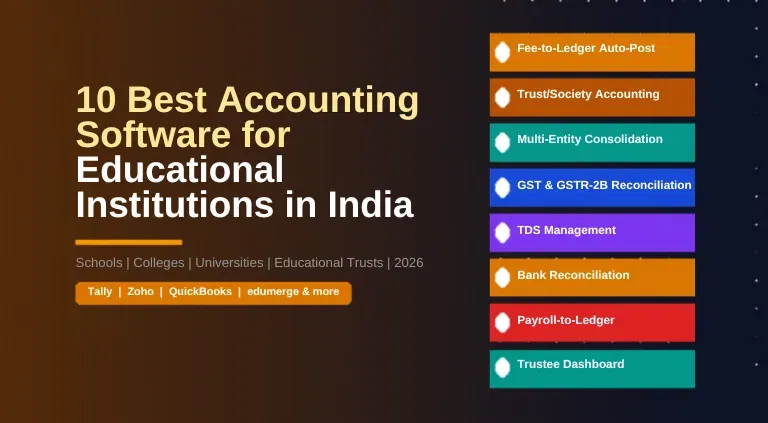
This guide evaluates 10 accounting software options available to Indian educational institutions in 2026. The question is which one is built for the specific financial structure of Indian schools, colleges, and educational trusts.
TL;DR
The best accounting software for educational institutions in India is one that handles both sides of the problem.
- Complete double-entry accounting with GST invoicing, bank reconciliation, TDS management, and statutory compliance on one side, and
- the education-specific requirements on the other: student fee auto-posting to the general ledger, academic-year-aligned budgeting, multi-entity trust & society accounting, payroll-to-ledger integration, and real-time dashboards for the CFO & trustee.
edumerge Finance & Control is the only platform in this guide built explicitly for this combination, offering a full accounting lifecycle connected directly to the school or college's fee management, payroll, procurement, and governance systems on one shared database.
Why Educational Institutions in India Have Unique Accounting Requirements
The financial structure of an Indian educational institution is not the same as a commercial business. The differences are structural, and they define why generic accounting tools require significant workarounds when deployed in schools or colleges.
1. Fee collection is the primary revenue source, but it never posts automatically to the books
Most schools & colleges collect fees through an ERP or fee management tool, then separately reconcile those collections with the accounting software at month-end. Every payment that comes through UPI, cash, or cheque must be manually entered as a receipt voucher in the accounting system. A school with 2,000 students collecting fees in three installments generates thousands of transactions per year that the accounts officer re-enters manually, introducing errors at each step.
2. The institution operates under a trust or society, which has its own accounting obligations
Every Indian school, college, or university is owned by a charitable trust, registered society, or Section 8 company. The trust has independent financial obligations: separate income and expenditure statements, receipts and payments accounts, balance sheets, 12A & 80G compliance, FCRA reporting if it receives foreign contributions, and annual audit requirements under the Income Tax Act and respective state trust laws. Generic accounting software built for commercial businesses does not have the fund-based accounting structures these entities require.
3. Multi-campus groups cannot consolidate financials without weeks of manual work
A school group managing 5 campuses under one trust has five sets of books that must be consolidated into a single group financial statement for the trustee. When each campus uses a different accounting tool, or the same standalone tool without cross-entity features, the finance team manually exports, reformats, and reconciles data from each campus every month. By the time the consolidated statement reaches the trustee, it is already weeks old.
4. Payroll is the largest expense, but it is managed in a separate system from the books
Staff salaries are most educational institutions' largest operating expense, yet in most schools & colleges the payroll process runs in a separate tool (often Excel) and the accountant manually passes journal entries to the accounting software at month-end. PF liabilities, ESI liabilities & TDS payable are tracked in the payroll system but posted to the ledger manually, creating mismatches between the payroll register and the books at every period-end.
5. Procurement, vendor payments, and capital expenditure have no approval trail connected to the books
In most educational institutions, purchase orders (POs) are raised informally, vendor invoices arrive as physical documents, and the accountant enters payment vouchers without any system-enforced approval. Capital expenditure on campus infrastructure, laboratory equipment, or library books has no budget validation before the payment is made. The books reflect what was spent, not what was approved.
6. Audit preparation requires weeks of manual work that a connected system would produce instantly
Indian educational institutions face annual statutory audits, government inspections, NAAC & NBA accreditation data reviews, and trustee board meetings, all of which require organised financial records. In institutions running disconnected accounting tools, preparing audit documentation means assembling vouchers, reconciling bank statements, matching fee records, and compiling reports manually across tools. This is a weeks-long exercise that a connected system produces as a report on demand.
These six structural requirements mean that generic accounting software, deployed in an Indian educational institution, always has a gap between what the tool can do and what the institution's finance team actually needs. The question is how large that gap is, and whether an education-native platform closes it entirely.
Detailed Profiles: 10 Best Accounting Software for Educational Institutions
1. edumerge Finance & Control (Top Pick for Educational Institutions)
Education-native accounting and financial governance for Indian institutions
Type: Purpose-built institutional finance platform: accounting, trust/society consolidation, budgeting, fee-to-finance integration, payroll-to-ledger, procurement, and AI insights on one platform.
Key strengths:
- COA Builder with group hierarchy: Chart of Accounts supports parent-child account groupings organised by entity, department, or cost centre within a single ledger, allowing a group to maintain one consolidated chart across all institutions
- Full double-entry accounting lifecycle: Payment, Receipt, Journal, and Contra voucher types supported; GST voucher and invoice entry built into the core workflow; GST amounts posted correctly at point of entry with GSTIN and HSN configuration
- Bank reconciliation dashboard: statement upload and auto-matching reconciles bank statement lines against posted ledger entries automatically; PDC management tracks post-dated cheques with clearing dates; banking module shows all institutional bank accounts consolidated
- GST compliance and GSTR-2B reconciliation: GST configuration, filing preparation, and GSTR-2B reconciliation tool matching purchase records against GSTR-2B data; ITC mismatch surfaced before the claim is filed
- TDS management: TDS configuration and compliance workflows built natively into the accounting module
- Period-end locking and audit lock: completed accounting periods are locked, preventing any further voucher entry without explicit override; locked period figures are stable for audit and reporting
- GL viewer, GL diagnostics, and suspense workflow: general ledger viewer for any period; GL diagnostics surfaces imbalances, unposted entries, and account anomalies; suspense voucher workflow tracks unclassified transactions with aging
- Financial statements: Balance Sheet, Profit and Loss, Trial Balance, Cash Flow Statement, Ledger reports, Aging analysis, Budget vs Actual comparisons, and custom report templates all generated from one ledger
- Role-based dashboards: purpose-built views for CFO, Accountant, Finance Officer, and Management without each role accessing all system functions
- Trust & Society Accounting and Consolidation: entity-wise books for every institution in the group with independent records; Consolidated Balance Sheet, P&L, and Trial Balance across all entities; Trustee and Management dashboard with net worth, cash position, and pending approvals; multi-entity GST and TDS compliance; grants management and trust-level audit trail
- Fee-to-Finance integration: every fee collected in School ERP or College ERP auto-posts to the corresponding GL account per fee head mapping; no manual receipt voucher entry for online or counter payments
- Payroll-to-ledger connection: monthly payroll from HRMS auto-generates journal entries in Finance and Control; salary expense, PF liability, ESI liability, and TDS payable post automatically
- Budgeting and Forecasting: academic-year-aligned budget preparation, multi-level budget approval workflows, Budget vs Actual variance reporting in real time
- AI Finance Insights: anomaly detection and financial intelligence module surfacing unusual patterns, cash flow projections, and budget deviation alerts
- Procurement and Vendor Management: purchase requisitions with budget validation before commitment, vendor records, purchase orders with approval chains, GRN matching, and vendor ledger
- Capital Projects and Capacity Planner: tracks capital expenditure on construction, equipment, and new campus development with milestone-based budget control
edumerge Finance & Control is the only platform in this list built from the ground up for the financial governance requirements of Indian educational institutions. Every feature from fee posting to trust consolidation reflects an education-specific workflow rather than a commercial business adaptation.
edumerge Finance and Control is the only platform in this list where accounting is not a standalone product adapted for education, but a module designed from the ground up as the financial backbone of an educational institution. The fee-to-ledger integration, trust consolidation, payroll-to-ledger connection, procurement approval workflows, and trustee governance dashboards reflect education-specific workflows that no generic accounting tool covers without extensive custom configuration.
Explore edumerge Finance & Control Explore edumerge Accounting Module
2. TallyPrime
The most widely used accounting tool in Indian educational institutions
Type: India's dominant double-entry accounting software, Windows-based, used by most Indian school and college accountants.
Key strengths:
- Most widely understood accounting tool among Indian accountants and CAs; easy CA handover and audit support
- Strong GST compliance: GSTR-1, GSTR-3B, GSTR-2B reconciliation, and TDS management built in
- Customisable voucher types and cost centres for department-wise tracking
- Balance Sheet, P&L, Trial Balance, cash flow, and extensive MIS reports
- TallyPrime 5.0 introduces cloud hosting options for remote access
Education gap:
- Not connected to any school or college ERP
- Fee collections must be manually entered as receipt vouchers
- No student-wise ledger linked to the admission system
- Payroll posted manually
- Multi-entity trust consolidation requires separate manual work or customisation
- No multi-campus governance dashboard for trustees
- Academic-year budget alignment requires manual setup
- The platform was designed for commercial businesses, not educational institutions
3. Zoho Books
Cloud-first GST accounting integrated with the Zoho ecosystem
Type: Cloud-based accounting platform with GST compliance, bank reconciliation, and Zoho ecosystem integration.
Key strengths:
- Fully cloud-based with no installation; accessible from any device
- Native Zoho ecosystem integration (Zoho Books, Zoho Payroll, Zoho People)
- GST-compliant invoicing, GSTR filing support, and automated bank reconciliation
- Client and vendor portals for self-serve document access
- Affordable pricing with a free tier for low-revenue organisations
Education gap:
- No education-specific modules
- Fee-to-ledger integration requires custom API or Zoho Flow configuration
- Student fee records, hostel fees, and academic-year structures require manual setup
- Multi-entity trust accounting for education groups is limited
- Payroll integration requires Zoho Payroll subscription & mapping
- Academic-year-aligned budgeting is not native
- Not designed for the non-profit trust & society accounting structure that all Indian educational institutions operate under
4. QuickBooks Online India
Cloud accounting with clean UX and good SME adoption
Type: Cloud-based accounting platform with invoicing, expense tracking, bank reconciliation, and basic GST compliance.
Key strengths:
- Clean, modern cloud interface with mobile access
- Automated bank reconciliation and expense tracking
- Invoice creation and customer ledger management
- Third-party app integrations through the marketplace
- GST-compliant invoicing for India
Education gap:
- Designed for commercial SMEs
- No academic-year structures, no student fee module, no fee-head-wise ledger
- Trust & society accounting for Indian educational trusts requires extensive custom configuration
- No education ERP integration
- Multi-entity group consolidation is limited
- Payroll requires a separate subscription
- Academic budgeting and NAAC-ready financial reports are not available
- Better suited as a standalone invoicing tool for very small institutions than as the accounting backbone for a school or college
5. Busy Accounting Software
India-built accounting with strong GST depth for SMEs and education
Type: India-native accounting software with comprehensive GST, TDS, and inventory management, used widely in small institutions.
Key strengths:
- Comprehensive Indian GST compliance with all return types
- TDS and TCS management built in
- Multi-company support for basic multi-entity tracking
- Inventory management for school stores and laboratory supplies
- Competitive per-user pricing
Education gap:
- Windows-desktop architecture similar to Tally
- No education ERP integration
- Fee management must be manually entered as receipt vouchers
- Student-wise fee ledger is not native
- Trust accounting for charitable education bodies requires custom configuration
- Payroll integration is limited
- No academic-year budget alignment
- Group-level trustee dashboards are absent
- Primarily designed for trading and manufacturing businesses
6. RealBooks
Cloud accounting with strong multi-company and education add-on capability
Type: Cloud-based Indian accounting platform with multi-location, multi-company, and RealFees education integration.
Key strengths:
- Cloud-based with role-based access and multi-location support
- Direct sync with RealFees for fee-to-ledger posting within the RealBooks ecosystem
- TDS compliance and audit-ready reports
- Multi-company structure for basic group-level accounting
- No desktop installation required
Education gap:
- The fee-to-ledger integration works natively only for institutions using RealFees
- For schools or colleges on other ERP platforms, integration requires configuration
- Education-specific modules beyond fee integration (OBE, NAAC data, academic HR) require separate products
- Trust and society consolidation for complex GOI structures is limited
- Not widely recognised outside the RealFees user base
- Support depth for large institutions may require verification
7. ERPNext Education (Frappe)
Open-source ERP with accounting and education modules
Type: Open-source cloud ERP with full accounting, HR, education management, and procurement modules.
Key strengths:
- Full double-entry accounting with GL, bank reconciliation, and financial statements
- Integrated student information system, fee management, and HR modules
- Open-source with no per-user licensing cost for self-hosted deployments
- Active global community and extensive documentation
- Procurement, inventory, and project management included
Education gap:
- Requires significant technical expertise to deploy, configure, and maintain
- Education module does not match the depth of purpose-built Indian education ERPs (OBE, NAAC, CISCE report cards are not native)
- Indian trust & society accounting and FCRA compliance require custom development
- Cloud hosting adds cost
- Support is community-based for self-hosted instances
- For most Indian schools and colleges without an IT team, the setup burden outweighs the licensing saving
8. HostBooks
Cloud accounting and GST filing platform for Indian businesses and institutions
Type: Cloud-based accounting, GST, TDS, and payroll platform designed for Indian compliance requirements.
Key strengths:
- Comprehensive GST filing support including all return types and e-invoicing
- TDS management and Form 26AS reconciliation
- Integrated payroll module within the accounting ecosystem
- Cloud-based with role-based access for multiple users
- Audit trail and period-end locking
Education gap:
- Designed for general Indian businesses
- No education-specific modules
- Fee-to-ledger integration with school or college ERP requires custom API work
- Trust accounting for charitable education bodies is not natively configured
- Multi-entity consolidation for school groups is limited
- Academic-year budget structures and trustee governance dashboards are absent
- Better suited as a standalone accounts and compliance tool than as an integrated educational finance system
9. SAP Business One (Education Edition)
Enterprise ERP with education vertical for large universities and institution groups
Type: Enterprise ERP from SAP with finance, procurement, HR, and inventory for mid-market and large organisations.
Key strengths:
- Globally recognised enterprise ERP with strong financial reporting and audit depth
- Comprehensive procurement workflow with multi-level approvals
- Multi-currency, multi-entity accounting for large groups
- Strong analytics and BI integration through SAP Analytics Cloud
- Robust compliance and audit trail for large institutions
Education gap:
- Implementation cost & timeline are prohibitive for most Indian schools, colleges, and mid-size education groups
- Not designed for the Indian charitable trust accounting structure
- Indian FCRA, 12A/80G, and education regulatory compliance require custom development
- No native integration with Indian education board structures (NAAC, NBA, CBSE, CISCE)
- Per-user licensing and consultant dependency make ongoing costs high
- Better suited for large universities than for the typical Indian school or college group
This comparison on edumerge vs SAP Business One might further enable your evaluation.
10. Marg ERP
India-built accounting and ERP for SMEs with strong inventory and GST focus
Type: India-native ERP with accounting, inventory management, GST compliance, and basic HR modules.
Key strengths:
- India-native with strong GST compliance and e-invoicing support
- Inventory and stock management suitable for school stores and lab supplies
- Payroll module for basic salary processing
- Affordable per-user pricing with perpetual licence option
- Widely serviced by local IT partners across India
Education gap:
- Primarily designed for trading & pharmaceutical businesses
- Education-specific accounting (student fee ledgers, academic-year budgets, trust & society consolidation) requires custom configuration
- No education ERP integration
- Multi-entity group accounting and trustee governance are not native
- Payroll module lacks education-specific features (biometric integration, academic staff leave policies)
- Better suited as a basic accounts and inventory tool for very small institutions than as the financial backbone for a school or college group
The Education Accounting Gap: 10 Requirements That Generic Tools Cannot Cover
The table below shows the 10 accounting capabilities that matter specifically for Indian educational institutions, and where each capability lands across the market.
| Education-Specific Requirement | edumerge Finance & Control | Generic accounting tools |
|---|---|---|
| Fee-to-ledger auto-posting | Yes, per fee head mapping | Not available natively in any other platform; manual receipt voucher entry required |
| Academic-year-aligned budgeting | Yes, with Budget vs Actual live | Manual setup required in Tally, Zoho, and QuickBooks; not native |
| Trust/society accounting structure | Yes, entity-wise + consolidated | Charitable trust fund-based accounting requires custom configuration in all generic tools |
| Multi-entity group consolidation | Yes, live consolidated statements | Manual export-reconcile in Tally; limited in Zoho; available at cost in SAP |
| GSTR-2B reconciliation | Yes, native ITC mismatch detection | Available in Tally and Zoho; limited in others |
| Payroll-to-ledger auto-posting | Yes, via HRMS integration | Manual journal entries required in all other platforms |
| Procurement with budget validation | Yes, PR to PO to GRN workflow | Not available in Tally, Zoho, QuickBooks; available in SAP and ERPNext |
| Trustee governance dashboard | Yes, live net worth and cash view | Not available in any other platform in this list |
| Period-end locking and audit trail | Yes, audit lock per period | Available in Tally, HostBooks, SAP, ERPNext; limited in others |
| Role-based views (CFO/Accountant/Mgmt) | Yes, purpose-built per role | Generic role management in most; SAP has role depth at high cost |
Is your institution's accounting software connected to its operations, or is your accounts team bridging the gap manually?
The gap between a standalone accounting tool and an integrated institutional finance system shows every month at fee reconciliation, every payroll cycle, and every trustee board meeting. edumerge Finance and Control eliminates those manual bridges.
The best accounting software for Indian educational institutions is not simply the tool with the best double-entry engine. It is the one whose accounting layer connects directly to fee management, payroll, procurement, and governance, because those are the financial workflows that define an educational institution's operations. edumerge Finance and Control is built for exactly those connections, for schools, colleges, educational trusts, and groups of institutions across India in 2026.
Frequently Asked Questions (FAQs)
1. Why do educational institutions in India need specialised accounting software?
Educational institutions in India have financial structures that differ structurally from commercial businesses. They operate under charitable trusts, registered societies, or Section 8 companies with fund-based accounting obligations. Their primary revenue is student fee collections that must post to the ledger head-wise. Their largest expense is payroll processed separately. They must manage multi-entity consolidation for the trust's books and each institution's books simultaneously. Generic accounting software can handle double-entry bookkeeping correctly but cannot natively connect fee collections to the ledger, consolidate trust-level and institution-level books, or produce academic-year-aligned budget reports.
2. Can TallyPrime be used for school and college accounting in India?
TallyPrime is the most widely used accounting tool in Indian schools and colleges because most Indian accountants and CAs know it well. It handles GST, TDS, and standard accounting correctly. The gap is integration: fee collections from the school ERP must be manually entered as receipt vouchers in Tally, payroll journal entries are passed manually, and multi-entity trust consolidation requires manual data aggregation. TallyPrime is a good standalone accounting ledger; it is not an integrated school finance system.
3. What is fee-to-ledger integration in educational accounting?
Fee-to-ledger integration means that every student fee payment collected through the ERP or fee management system automatically creates the corresponding receipt voucher and GL entry in the accounting module without any manual action by the accounts team.
4. What is trust and society accounting for educational institutions?
Trust and society accounting refers to the financial reporting obligations of the charitable trust, registered society, or Section 8 company that owns and operates a school or college. Unlike commercial double-entry bookkeeping, trust accounting requires fund-based accounting, income and expenditure statements (not profit and loss), receipts and payments accounts, balance sheets under the Trust Act, FCRA-compliant foreign contribution registers if applicable, and annual audit under Section 12A and 80G of the Income Tax Act.
5. What is multi-entity consolidation in educational group accounting?
Multi-entity consolidation in educational group accounting means generating consolidated financial statements across all entities in the group, such as the parent trust and each school or college under it, from a single system without manual data aggregation.
6. Does accounting software for schools in India need to handle GST and TDS?
Yes. Indian educational institutions collect GST on certain fee components (hostel, canteen, coaching, examination fees), pay GST on vendor invoices, and must file GSTR-1 and GSTR-3B regularly. They also deduct TDS on vendor payments, contractor services, rent, and professional fees, and deposit it with the government by the 7th of each month. An accounting platform that does not have these workflows built natively forces the accounts team to manually track GST and TDS in separate tools and reconcile them with the books at period-end.
7. What is Budget vs Actual reporting for educational institutions?
Budget vs Actual reporting compares the approved annual budget for each cost centre, department, or campus against actual expenditure in real time. For educational institutions, this means seeing whether the science laboratory is over-spending on consumables, whether the transport department is within its fuel budget, or whether administrative overheads are within the trustee-approved limits.
8. How is school accounting software different from commercial accounting software?
Commercial accounting software handles invoicing, expense tracking, and bank reconciliation for businesses that sell products or services. School accounting software must additionally manage: student fee structures with head-wise posting to specific GL accounts; academic-year-aligned budgets (April to March); non-profit trust and society accounting obligations; multi-entity consolidation for groups; fee waiver and scholarship adjustments; government scholarship reconciliation; capital expenditure on campus infrastructure; and trustee-level governance reporting. These requirements are not covered by commercial accounting tools without significant custom configuration.
9. What financial reports does an educational institution need for its annual audit?
An Indian educational institution typically needs: income and expenditure statement, receipts and payments account, Balance Sheet under the applicable trust or society legislation, fund-wise schedules, fixed assets register, bank reconciliation statements for all accounts, TDS certificates (Form 16A) issued to vendors, details of foreign contributions if FCRA-registered, and grant utilisation certificates.
10. What is the difference between a fee management module and accounting software for schools?
A fee management module handles the collection side: fee structures, invoices, online payment gateways, receipts, reminders, and defaulter tracking. Accounting software handles the institutional books: GL entries, bank reconciliation, financial statements, and compliance filing. In most schools these are separate tools, with the accounts team manually bridging the two every month. edumerge integrates both on the same database: the fee management module within School ERP or College ERP posts every payment directly to the Finance and Control accounting ledger through fee head-to-GL account mappings, eliminating the bridge entirely.