Every group of colleges in India eventually reaches a point where its spreadsheets stop keeping up with its ambitions. The search for the right budgeting and forecasting tools for colleges in India usually starts the same way: a trustee asks a question finance cannot answer quickly.
This guide looks at what separates a budgeting tool built for Indian colleges. It covers the capability areas worth evaluating, the questions to ask before you commit, and where governance-focused platforms like edumerge Finance & Control fit into the picture.
The goal here is not to crown a single winner. It is to help trustees, finance heads & ERP decision-makers evaluate budgeting and forecasting tools for colleges in India. Against the realities of multi-campus operations, statutory compliance, and boards that expect answers in real time.
TL;DR
Colleges running multiple campuses outgrow spreadsheets fast. Since budgeting, approvals, and compliance across entities need one shared system. Delayed variance reports mean boards catch problems months too late. Trustees now expect real-time financial answers, not quarterly updates.
This guide compares the top budgeting and forecasting tools for colleges in India on multi-campus consolidation, statutory compliance, and live trustee visibility.
edumerge Finance & Control leads as the most comprehensive option built for Indian groups of institutions, followed by nine other platforms spanning global ERPs and India-focused academic systems.
The right fit depends on whether a tool treats multi-campus consolidation, fund-level compliance, and trustee reporting as core, not add-ons.
Why Budgeting and Forecasting Tools Matter for Colleges in India
A single-campus college could once get by on an annual spreadsheet budget and a finance officer who knew every line item by memory. That approach breaks down the moment a trust runs more than one institution. Because spending decisions made at one campus affect the financial position of the whole group, and nobody at the centre finds out until much later.
1. Multi-campus operations
Every additional campus adds its own cost centres, its own local approvals, and its own version of the truth. Without a shared system, consolidating even a basic budget versus actual report becomes a monthly exercise in chasing down data instead of acting on it.
The Operational Cost: Fragmented spending, no group-level view
- The trust office manages 5,10, or 50 separate financial pictures instead of one.
- Decisions get made locally with no centre-wide visibility into how they add up.
- Numbers only get stitched together weeks later, by which point they are historical, not actionable.
You might like to explore how educational institutions scale operations across multiple campuses.
2. Statutory financial compliance
Trusts & societies running colleges must maintain fund-based bookkeeping, produce audit-ready statements on demand, and account for inter-entity transfers between the parent trust & each institution. Manual reconciliation across 5,10,or 50 entities is where errors and delays creep in.
The Operational Cost: Audit risk and compliance exposure
- Every manual reconciliation step is a point where an error, a missed transfer, or a mismatched fund entry can slip through.
- Institutions scramble to reconstruct records during audit season or a regulator's request instead of producing them on demand.
- The trust carries compliance risk it should never have had to carry.
Also read about managing educational trust accounts in India.
3. Delayed variance visibility
When a department overspends its budget in March but the report only reaches finance in June, there is no window left to correct the course. Boards end up managing history instead of managing the institution.
The Operational Cost: Loss of course-correction window
- By the time an overspend surfaces, the money is already gone.
- There is no opportunity to intervene, reallocate, or renegotiate.
- Leadership ends up explaining a variance rather than preventing it, and the same pattern repeats the following year.
Trustees today expect none of this to feel like guesswork. They want an answer to "where do we stand right now" without waiting for a quarterly meeting, and that expectation is exactly what basic spreadsheets and generic accounting habits were never designed to meet.
For practical ways to improve budgeting, cash flow, fee collection & financial control, read our guide on how to manage college finances effectively.
The Recurring Cost of Budgeting Without the Right Tools
Colleges that continue to run budgeting on spreadsheets or a generic accounting tool tend to hit the same set of problems, and each one carries a real operational cost. The table below maps the recurring problem to its effect on the institution.
| Problem | Effect on the Institution |
|---|---|
| No consolidated view across campuses | Group-level financial decisions made on incomplete or outdated data |
| Manual budget approval routing | Spending gets delayed, or worse, happens without the right sign-off |
| Variance reports compiled monthly by hand | Overspending caught weeks after it happens, when it's too late to act |
| No fund-based tracking for trust and society transfers | Statutory filings and audits take longer and carry higher error risk |
| Trustees rely on emailed reports and calls | Governance decisions lag behind actual financial position of group |
| Budget data lives separately from fee and payroll systems | Forecasts built on assumptions instead of live operational numbers |
For a step-by-step approach to budgeting, read our guide on how to prepare budget for schools and colleges in India.
Comparing Top 10 Budgeting & Forecasting Tools for Colleges in India
1. edumerge Finance & Control
edumerge Finance & Control unifies budgeting, approvals & trustee-level financial oversight in one system. Backed by edumerge's base of 800+ institutions and 500,000+ students since 2012. Giving it a scale of deployment across Indian trusts that few competitors match.
Key strengths:
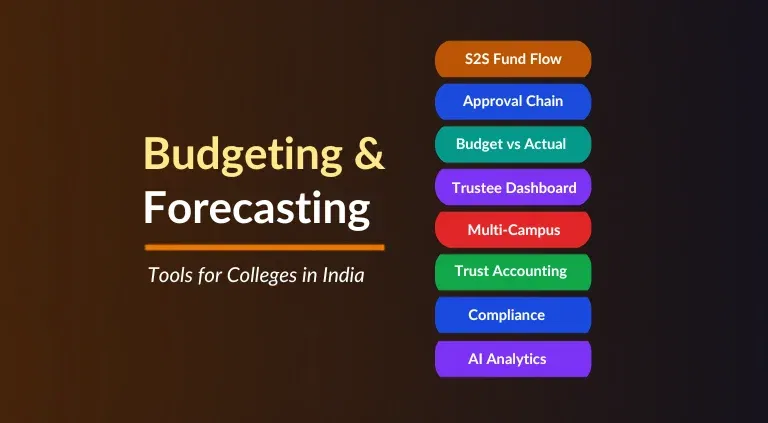
- Purpose-built for GOI structures: handles multi-institution, multi-trust budgeting & consolidation out of the box, not retrofitted from a generic corporate ERP.
- Structured sanction-to-spend (S2S) workflow with configurable approval chains suited to how Indian trusts sanction and release funds.
- Budget vs Actual tracking with live variance visibility across institutions.
- Trustee dashboard gives management and board-level stakeholders direct, real-time visibility without needing finance team intermediation.
- Sits on the same platform as the Educational ERP (School ERP, College ERP) and Educational HRMS, so budgeting data connects naturally with enrollment, payroll & fee data.
2. SAP Business One (SAP B1)
Global mid-market ERP with a finance module often deployed by larger Indian education trusts and universities that need broad financial consolidation. It offers strong general ledger & multi-entity consolidation.
What to note:
- Not education-specific out of the box.
- Budgeting & forecasting for academic cycles, fee structures, or trustee reporting typically requires custom configuration or a partner add-on, adding implementation time and cost.
You might also like our comparison on edumerge Finance & Control vs SAP Business One.
3. Oracle Fusion Cloud Finance and Accounting
Enterprise-grade cloud financial management suite with dedicated higher-education tooling, used by large Indian university systems and corporate-backed education groups.
Key strengths:
- Purpose-built higher-ed capabilities including Grants Management, endowment accounting, and sophisticated budgeting, planning, and scenario-modeling tools.
- Strong scalability for large multi-campus groups; robust integration with Oracle's broader HCM and procurement management.
What to note:
- The higher-ed depth is built around US compliance frameworks (GASB/FASB, Title IV financial aid) rather than Indian trust or GOI accounting structures.
- Enterprise-scale pricing (typically starting well into six figures annually) makes it impractical for most Indian institutions outside a handful of large, well-funded universities.
See how edumerge compares with Oracle ERP across key enterprise and educational management capabilities.
4. Zoho ERP (Books/Finance suite)
Overview: Popular cloud accounting & finance suite among smaller Indian colleges and standalone institutions for its affordability and ease of setup.
Key strengths: Quick to deploy; strong for basic accounting, invoicing, and expense tracking; budget vs actual reporting available at a functional level; low cost of entry.
What to note:
- Not built with academic or trust-governance workflows in mind.
- Multi-institution consolidation, sanction-based approval chains, and trustee-level reporting typically require significant customization or third-party connectors.
Look how edumerge HRMS weighs against Zoho People on key HR management features in our detailed comparison.
5. Workday Adaptive Planning
Overview: Cloud-native enterprise planning platform used by a smaller set of large, well-funded Indian universities for driver-based budgeting and forecasting.
Key strengths:
- Supports enrollment-driven budgeting, grant tracking, multi-entity fund accounting, and scenario planning to handle complex academic and operational finances.
- Strong collaborative planning tools across departments.
What to note:
- High initial implementation costs and timeline for complex setups, with premium pricing.
If you're looking into key HRMS and workforce management capabilities, take a look at our comparison between edumerge HRMS vs. Workday HRM.
6. Anaplan
Overview: Connected planning platform occasionally used by large Indian higher-education groups for advanced scenario modeling and forecasting.
Key strengths: Highly flexible no-code modeling for intricate budgets including what-if scenarios, with real-time collaboration across finance and academic stakeholders.
What to note:
- Requires dedicated financial planning expertise to configure and maintain.
- It is a planning layer rather than an end-to-end institutional finance system, so it typically sits on top of an existing ERP rather than replacing one.
7. Planful
Overview: Financial performance management platform used selectively by larger Indian institutions for consolidation and forecasting alongside an existing ERP.
Key strengths: Advanced AI-driven forecasting for volatile enrollment and funding patterns, with seamless integrations to major ERPs and strong scenario & multi-entity consolidation support.
What to note:
- Has a steep learning curve requiring dedicated financial planning expertise
- Custom pricing can be prohibitive for smaller colleges, limiting its practical fit for most Indian college budgets.
8. Mastersoft ERP
Overview: India-focused college and university ERP with finance and accounts modules bundled alongside academic and administrative management.
Key strengths: Built with Indian higher-education processes in mind; broad functional coverage across admissions, academics, and fee management alongside basic financial tracking.
What to note:
- Finance and budgeting functionality tends to be a module within a broader academic ERP rather than a dedicated planning and control system.
- So depth on trustee-level reporting and approval workflows is limited compared to purpose-built finance suites.
You might also like to read this comparison on edumerge vs MasterSoft Education ERPs.
10. Camu
India-based higher-education ERP covering the full student lifecycle, with an accounting and budgeting module bundled in alongside SIS, LMS, and accreditation tools.
Key strengths:
- Strong fit for Indian academic administration and accreditation workflows (NAAC, NBA, NEP, OBE, CBCS)
- Integrated fee collection, accounting, and budgeting with real-time dashboards;
- Broad modular coverage across academics, HR, and finance in one system.
What to note:
- Finance and budgeting is one module within a broader academic-first ERP rather than the product's core focus.
- No public evidence of multi-institution consolidation or a dedicated trustee/board-level governance dashboard for groups running multiple campuses under one trust.
Explore the comparison between edumerge and Camu across features that matter to educational institutions.
Questions to Ask Before Choosing a Budgeting Tool for Your College
Shortlisting a budgeting & forecasting tool is easier when the evaluation starts with questions specific to how Indian college groups actually operate, not a generic software checklist.
- Does it consolidate across every campus and entity? Confirm whether the tool gives a true group-level view, or whether consolidation still needs manual export and merge work.
- Can approval chains be configured per campus and per cost centre? Every institution has different sign-off levels; the tool should reflect that structure, not force a single flat workflow.
- Is Budget vs Actual reporting available in real time? Ask whether variance data updates as transactions happen, or only after a manual month-end close.
- Does it support trust and society fund flow tracking? Transfers between the parent trust and individual institutions need an audit trail, not manual journal entries on both sides.
- Is there a dedicated view for trustees and managing committee members? A read-only, role-separated dashboard matters more than another report only the finance team can interpret.
- Does the tool sit on the same data as fee collection and payroll? Budgets built on numbers that are already a month old are forecasts in name only.
- What does statutory and audit-readiness look like day to day? Ask for a walkthrough of how the system produces trust returns and audit trails, not just a feature list.
- How long does onboarding actually take across multiple campuses? A tool that needs a fresh implementation per campus will slow down exactly the visibility it promises to deliver.
Conclusion
Choosing among budgeting & forecasting tools for colleges in India comes down to one question: can the trust see, approve & act on its finances in real time, across every campus it runs, without waiting for a report to be assembled by hand.
Spreadsheets and generic accounting habits were never built to answer that question at scale. The right tool treats multi-campus consolidation, statutory compliance, and trustee visibility as core requirements, not add-ons.
Whatever platform a college group chooses, the evaluation should start with the questions above, and the fit should be judged against the institution's actual governance structure, not a generic vendor feature list.
Frequently Asked Questions (FAQs)
1. Does a budgeting tool need to support multiple campuses?
Yes, for any trust or society running more than one institution. Without multi-campus consolidation, group-level financial decisions are made on incomplete data.
2. What is S2S fund flow in college finance?
S2S, or Society-to-School fund flow, refers to the transfer of funds from a parent trust or society to individual institutions under it, tracked with an audit trail so both sets of books stay reconciled.
3. How does an approval chain help with budgeting?
An approval chain routes spending requests through the correct sign-off levels per campus and cost centre, ensuring no payment is released without the right authorisation.
4. Who should be involved in choosing a budgeting tool for a college?
Trustees, finance heads, and ERP decision-makers should all be involved, since the tool affects governance visibility, day-to-day approvals, and statutory compliance at once.
5. How long does it typically take to see real-time budget visibility after adoption?
This depends on how quickly campuses onboard and how well the tool integrates with existing fee and payroll data; platforms built on a shared data layer tend to show live visibility faster than those requiring manual data feeds.