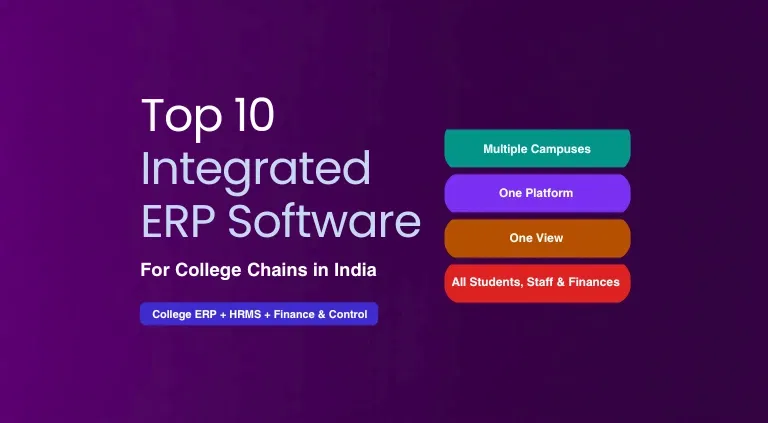
India has 45,473 affiliated colleges under 328 affiliating universities, and over 1,400 colleges holding autonomous status with their own curriculum & examination authority. For any group managing several colleges, the choice between conventional software & an integrated ERP decides whether leadership sees one group or disconnected campuses.
Most college chains do not start with a group-wide system. They start with one college. Adding a spreadsheet, a fee tool, and by the 3rd or 4th campus, reconciliation eats up weeks every month.
Autonomous colleges make this harder still. Since each sets its own calendar & evaluation process. Industry research shows 39% of higher education institutions name a lack of system integration as their single biggest technology gap.
This guide covers why conventional software fails college chains, and the challenges leadership face without an integrated platform. Along with the criteria that separate real integrated ERP from a bundle of connected apps.
TL;DR
College chains in India run into the same wall once they cross 2 or 3 campuses. Conventional, single-campus ERP has no group layer. So data stays siloed and leadership rebuilds the group picture by hand every month. This is why 39% of institutions cite integration gaps as their biggest technology problem.
The real fix is an integrated ERP built for group governance, not just a bigger feature list. It needs one shared database, native NAAC/NBA/NIRF workflows, trust & society-level financial consolidation, and role-specific value for trustees, principals, IT & finance heads alike.
Among the platforms compared, most solve pieces of this (academics, OBE, or single-campus ERP). But stop short of a true group operating system. edumergeOS is built specifically to close that gap. Unifying College ERP, HRMS, and Finance & Control on one codebase. So every campus, department, and rupee is visible from a single dashboard.
Why College Chains Need An Integrated ERP Software, Not Conventional Software
A single college can run on standalone software and manage fine. A chain of colleges under one trust cannot, because the operating problem is fundamentally different.
Conventional college software is built for one campus with one set of rules. A college chain needs one system governing many campuses with one set of standards. The reasons this distinction matters:
- Conventional ERP has no group layer: It manages a single college well but has no concept of a trust, society, or multi-college consolidation above it.
- Data stays siloed by campus: Each college's admissions, fees, and academic records live in a separate database, so nothing rolls up automatically.
- Policy enforcement breaks at scale: Fee structures, leave policies, appraisal cycles, and academic calendars that a group wants standardized cannot be enforced when every campus runs its own configuration.
- Trust and society accounting needs a different architecture: Sanction-to-settlement workflows, multi-entity consolidation, and audit trails are not features a single-campus tool is built to handle.
- HR complexity multiplies, not just adds: Staff transfers between campuses, group-level appraisal cycles, and consolidated statutory compliance are operationally impossible when HR is managed campus by campus.
- Adding a new campus should take days, not months: With conventional software, every new college means a fresh implementation. Integrated ERP lets a new campus go live on the same platform almost immediately.
The table below sets out the practical difference between the two approaches.
| Aspect | Standalone ERP | Integrated Group ERP |
|---|---|---|
| Data architecture | Separate database per campus | One shared database across all colleges |
| Leadership visibility | Campus-level only | Real-time, group-level, consolidated |
| Policy enforcement | Configured independently per campus | Standardised centrally, applied automatically |
| Financial reporting | Manually consolidated across campuses | Live trustee dashboard with automatic roll-up |
| New campus onboarding | Fresh setup, weeks to months | Same platform, rapid rollout |
| Accreditation data | Compiled manually each cycle | Tracked continuously, audit-ready |
If you are still working through the basics, our guide on what a college management system actually covers breaks down the core modules before you evaluate group-level fit.
Key Challenges College Chains Face Without Integrated ERP Software
Every challenge below stems from the same root cause. Campuses running on disconnected tools, and someone having to manually stitch the picture together every month.
- Fragmented data across campuses
Effect: By the time the governing board meets, the numbers leadership reviews are often 15 to 20 days old. Because the group picture is rebuilt by hand from separate campus reports. - No system integration between admissions, fees, academics, and finance
Effect: 39% of higher education institutions cite lack of system integration as their primary technology gap, which directly slows decision-making at the group level. - Inconsistent fee structures and policies across colleges
Effect: Fee leakage becomes invisible in real time. And no two campuses report figures on the same basis, making comparison across colleges unreliable. - Manual accreditation data compilation
Effect: NAAC, NBA, and NIRF documentation becomes a last-minute scramble each cycle. Increasing both audit risk and the workload on IQAC coordinators & principals. - HR and payroll are managed separately per campus
Effect: Staff transfers between colleges, group-level appraisal cycles, and consolidated PF and ESI compliance turn into manual reconciliation work prone to error. - Staff adopting tools leadership never approved
Effect: Without a sanctioned, unified platform, staff increasingly turn to unapproved apps and AI tools to fill gaps, creating data governance and security risk across the group.
For a side-by-side look at how platforms stack up against these criteria, see our roundup of multi-campus management software for educational groups in India.
These challenges compound as a group grows. See how multi-campus institutions scale operations without losing control as they add new campuses.
Comparing the top 10 Integrated ERP Software for College Chains in India
1. edumergeOS
edumergeOS is an unified institutional operating system built specifically for groups of colleges and college chains. Combining College ERP, HRMS, and Finance & Control on one platform.
Key strengths:
- A student's fee allocation, attendance, and communication data flow to every relevant module without manual re-entry.
- Centralised governance for the group office, with campus-level autonomy for each college. So that group leadership sets policies & monitors compliance while individual campuses keep their own operational flexibility.
- The Autonomous Governance System gives governing body dashboards, audit trails, and institutional KPI tracking from a single interface across every campus in the chain.
- Accreditation management workflows for NAAC, NBA, and NIRF map evidence department-wise. Compressing months of manual compliance effort into a structured, always-ready system.
- Trust and society accounting, budgeting, expense & claims management, procurement, and vendor management are built into the same platform as academics, not bolted on through a separate integration.
- Scales from 3-campus groups to 50-campus networks with a phased rollout and a dedicated implementation lead for the entire chain.
- Trusted by over 800 educational institutions and 500,000+ students across India since 2012.
- Built ground-up as an operating system for groups rather than adapted from a single-institution product.
2. Mastersoft ERP
Indian college ERP with a large module library, used across affiliated, autonomous, and government-funded colleges.
Key strengths:
- Wide module coverage, over 25-30 modules, spanning admissions, examinations, biometrics, and compliance reporting.
- BI tools and analytics dashboards give precise reporting on admissions, scholarships, and compliance.
What to note:
- Module breadth is built around single-institution deployments
- Consolidating data across a multi-campus chain typically needs custom configuration rather than a native group layer.
- Governance and finance are handled as separate add-ons, not a shared data architecture with HR and finance.
You might also find our comparison helpful on edumerge vs MasterSoft Education ERP.
3. Camu (Camu Digital Campus)
Cloud-based, AI-assisted campus management platform aimed at universities and multi-campus higher education groups.
Key strengths:
- Modular, cloud-first architecture lets institutions add features on demand as the group scales.
- Structured phased rollout with dedicated onboarding and success teams supports smoother go-live for larger institutions.
What to note:
- Positioned primarily around academic and campus operations
- Trust or society-level financial consolidation across a chain is not the platform's core strength.
- Deployment quality depends heavily on the implementation team, since onboarding and change management are called out as the platform's main differentiator.
Take a look at how edumerge compares with Camu.
4. Digiicampus
Campus engagement and administration platform covering ERP, academic, and analytics layers for colleges and universities.
Key strengths:
- Five-layer technology stack spans campus administration, academics & learning management, engagement, and analytics in one platform.
- Covers admissions, fees, venue booking, placements and faculty feedback within the core administration layer.
- Serves multiple stakeholder groups, students, faculty, admin, alumni, and parents, through one digital experience.
What to note:
- Built around single-campus engagement and academic workflows
- Group-level governance and consolidated finance across a college chain need separate tools or custom work.
- Less established track record specifically with large, multi-campus Indian college groups compared with dedicated group-ERP platforms.
5. Heraizen (DHI ERP)
Bengaluru-based education technology platform focused on automating accreditation, academics, administration, and examinations.
Key strengths:
- Purpose-built automation for accreditation-heavy processes, useful for colleges managing NAAC or NBA documentation.
- Focused product scope keeps academic and examination workflows relatively straightforward to configure.
- India-based support with an understanding of local affiliating-university requirements.
What to note:
- Narrower scope than a full operating system
- HRMS, group-level finance, and multi-campus consolidation are not native to the core platform.
- Best suited to single institutions or small groups rather than large college chains needing centralised governance.
6. Contineo
Outcome-Based Education (OBE) platform focused on NBA and ABET-aligned academic administration for engineering and professional colleges.
Key strengths:
- Deep, purpose-built support for OBE with over 7 India-practiced OBE variations available out of the box.
- Configurable assessment engine handles CO, PO, and Bloom's-level tagging across theory, lab, and project-based evaluation.
- Supports both cloud and on-premises deployment, useful for colleges with existing infrastructure investments.
What to note:
- Scope is concentrated on OBE and academic outcomes rather than full institutional ERP
- Finance, HR, and group governance sit outside the platform.
- A college chain would need this alongside a separate ERP and finance system rather than as a single consolidated platform.
7. Ellucian (Banner)
Globally established, purpose-built higher-education ERP with limited but notable adoption among premium Indian universities.
Key strengths:
- Purpose-built exclusively for higher education, so compliance updates and academic workflows are designed around the sector rather than adapted from generic ERP.
- Large global market share and a long deployment track record at scale.
What to note:
- Multi-year, custom-contract implementations with long go-live timelines, generally 9-18 months, are heavier than most Indian college chains need.
- Limited India-specific depth on trust and society accounting, GST-linked vendor compliance, or Indian academic-year budgeting cycles.
Explore our comparison on edumerge College ERP vs. Ellucian Banner.
8. Oracle PeopleSoft Campus Solutions
Enterprise higher-education ERP from Oracle, favoured by large research universities already invested in Oracle infrastructure.
Key strengths:
- Strong reporting and integration capabilities within the broader Oracle ecosystem.
- Well suited to institutions needing deep, configurable academic and financial workflows.
What to note:
- Best fit for large, Oracle-invested universities rather than mid-size Indian college chains
- Total cost of ownership and implementation complexity are significant.
- Indian-specific trust accounting, NAAC or NBA workflows, and multi-campus group governance require custom build rather than native support.
If you're looking for HR capabilities, then take a look into edumerge HRMS vs Oracle HCM.
9. Fedena
Cloud-based, modular ERP offering 50+ integrated modules for college and school management, including a multi-institution dashboard.
Key strengths:
- Broad module coverage across attendance, examinations, gradebook, transport, and hostel management.
- Unified dashboard supports managing multiple institutions from one login.
What to note:
- Originated as a school ERP
- College-chain-specific needs like OBE, NAAC or NBA accreditation workflows, and trust-level finance consolidation are limited.
- Initial setup requires significant IT involvement and is not straightforward for lean administrative teams.
Give a quick read into our comparison on edumerge vs Fedena.
10. Creatrix Campus
AI-native, modular higher-education platform covering the academic and administrative lifecycle with configurable, low-code workflows.
Key strengths:
- Embedded AI features span accreditation automation, student success insights, and intelligent chatbots.
- Unified data platform aims to replace fragmented point systems with a single source of truth.
What to note:
- Users report a steep initial learning curve given the breadth of features and modules.
- Group-level trust or society accounting and India-specific compliance depth are not the platform's primary focus
- It centres on academic and student-lifecycle operations.
For a deeper look at the architecture behind this, read what edumergeOS is and how it works as a group operating system.
Evaluation Criteria for Choosing the Right Integrated ERP Software
Once each stakeholder has weighed in, leadership needs a shared checklist to compare ERP vendors objectively. The criteria that matter most for a college chain:
- Single codebase, single database. Every module should share the same data layer, not a bundle of acquired products stitched together after the fact.
- Group and campus-level access together. The platform should give each college operational autonomy while giving group leadership consolidated, role-based visibility.
- Built-in accreditation support. NAAC, NBA, and NIRF workflows should be native to the platform, not a manual add-on before every audit cycle.
- Financial architecture for trusts and societies. Sanction-to-settlement workflow, multi-level approval chains, budget vs actual tracking, and a live trustee dashboard should be standard, not custom-built.
- Proven scale across multiple campuses. Ask for evidence the platform runs cleanly from a 3-campus group to a 50+ campus network without breaking.
- Implementation timeline and rollout flexibility. Confirm whether the vendor supports phased, department-by-department rollout or requires a disruptive big-bang go-live.
- Track record with Indian higher education. Semester systems, CBCS, the NEP credit framework, and UGC norms should already be understood by the platform, not something built during your implementation.
If your trust also runs school campuses alongside colleges, our guide to centralized management software for school chains covers the same principles applied to K-12.
Conclusion
Choosing integrated ERP software for college chains in India is not about adding features. It is about giving trustees, directors, and finance heads one live view of every campus instead of a monthly reconstruction from scattered reports.
The colleges that get this right treat ERP selection as a group-level governance decision, not a per-campus IT purchase. And evaluate vendors against real criteria: shared architecture, accreditation readiness, and proven scale.
edumergeOS was built specifically for this problem. It brings College ERP, HRMS, and Finance & Control onto one platform so every campus, department, and rupee in your group is visible from a single dashboard.
Frequently Asked Questions (FAQs)
1. Does edumergeOS support multiple campuses under one trust?
Yes. edumergeOS is purpose-built for groups of institutions, running from 3-campus groups to 50-plus campus networks on one shared codebase and database.
2. How long does it take to implement integrated ERP for a college chain?
Timelines vary by group size. But platforms built for college chains support phased, department-wise rollout or a full go-live. And adding a new campus to an existing group can take days rather than months.
3. Can integrated ERP handle NAAC, NBA, and NIRF accreditation across colleges?
Yes, when the platform is built for Indian higher education. edumerge College ERP includes native accreditation management, tracking institutional KPIs, audit trails, and documentation continuously rather than compiling them manually before each cycle.
4. What should a trustee specifically look for in college chain ERP software?
A live, board-ready dashboard covering finances, enrollment, and compliance across every campus. Plus trust and society accounting with multi-entity consolidation. So decisions do not rely on monthly manually compiled reports.
5. Who is integrated ERP software built for?
It is built for educational trusts, societies, and multi-campus networks. Specifically Trustees, Chairpersons, Chancellors, Directors, Principals, IT Heads, and Finance Heads who need a consolidated view across colleges, not just one campus.
6. What evaluation criteria matter most when choosing ERP for a college chain?
A single shared codebase, native accreditation support, financial architecture built for trusts & societies. Along with proven scale across many campuses, and a track record with Indian higher education requirements like NEP, CBCS, and UGC norms.
7. Does edumergeOS replace the need for Tally in college finance?
edumerge Finance & Control is designed to complement Tally. Handling sanction-to-settlement workflow, approval chains, Budget vs Actual tracking, and a live trustee dashboard alongside existing accounting practices.