India's school management software market is expanding fast, growing from roughly $22.3 billion in 2025 to $25.83 billion in 2026, at a CAGR of 15.8%. It's projected to reach $42.66 billion by 2030.
A large part of this growth comes from school chains and groups of institutions. Some of the country's largest education trusts now run well over 100 campuses across dozens of cities & states. All operating under one brand and one management body.
For a group this size, choosing a centralized management software for school chains is no longer optional. This guide covers why conventional, single-campus software falls short, what leadership should evaluate, and how each role should approach the decision.
TL;DR
India's school management software market is growing at a 15.8% CAGR, and much of that growth is coming from school chains and groups of institutions running well over a hundred campuses under one brand. Conventional single-campus ERPs were never built for this scale. Leaving leadership reconciling data manually instead of governing in real time.
A centralized management software solves this by putting every campus on one system of record. Unified admissions & fee workflows, group-wide HRMS & payroll, and role-based dashboards that give Trustees, Directors & Principals the same live numbers instead of month-end reports.
School management should evaluate any platform against data architecture, finance consolidation, onboarding speed, and vendor track record before comparing feature lists.
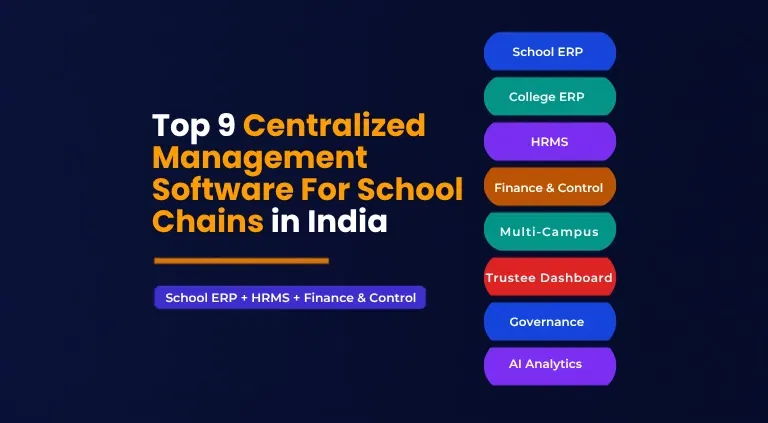
Among the 9 platforms compared, edumergeOS is the only one built as a unified operating system. Bringing together School ERP, HRMS, and Finance & Control onto one codebase and one database for groups managing 2 to 50+ campuses across India.
Why School Chains Need a Centralized Management Software
A centralized management software for school chains is not the same as running a conventional school ERP at every campus and hoping the numbers add up later. It's built from the ground up for group governance, not for a single institution operating alone.
- One system of record across every campus, so school leadership is not reconciling data from a different tool at each school.
- Real-time, group-level dashboards for Trustees and Directors, instead of reports compiled by hand once a month.
- Standardised admissions, fee, and academic workflows across every school under the same brand and board.
- One HR and payroll engine for the whole group, instead of a different vendor or process at every campus.
- Role-based access so each leader, from Principal to Trustee, sees exactly the data their role needs.
- Faster onboarding of new campuses, since configuration lives at the group level and gets replicated, not rebuilt.
Here is how a centralized management software compares to a standalone campus ERP:
| Aspect | Centralized Management Software | Standalone Single-Campus ERP |
|---|---|---|
| Data visibility | Group-wide, real-time, one dashboard | Campus-only; group view needs manual compilation |
| Onboarding a new campus | Configure once at group level, replicate | Buy and set up a fresh license each time |
| Fee and finance view | Consolidated across every campus | Isolated per campus, no group rollup |
| Governance and audit | One access model, one audit trail | Different logins and data standards per campus |
For a full breakdown of the 10-point checklist trustees and CXOs should run every platform through before shortlisting. See our detailed comparison of top 11 unified ERP systems for educational trusts in India.
Key Challenges School Chains Face Without a Centralized Management Software
India's private school network has moved well past standalone campuses. Chains like DPS operate around 215 to 220 schools, and the country's largest school chains range from a handful of campuses to over 18,000 schools under a single network.
That scale creates a governance problem most single-campus tools were never built to solve. Here are the core challenges Indian school chains faces:
- No consolidated view without manual effort
The operational impact: When every campus runs its own system, group-level enrollment, fee recovery, and staff data exist only on spreadsheets assembled by coordinators at month-end. By the time that data reaches a trustee, it is already stale.
- Trust accounting cannot be done in a single-campus tool
The operational impact: Indian education groups operate under a charitable trust or registered society. Managing the trust's books, S2S fund transfers, multi-entity consolidation, and audit trails requires a financial architecture that no standalone school ERP provides.
- Policy enforcement breaks at scale
The operational impact: Fee structures, leave policies, and academic calendars that a chain wants to standardise cannot be enforced when each campus runs its own system with its own configuration. Exceptions multiply silently.
- HR for a chain is not HR for a campus times
The operational impact: Staff transfers between campuses, group-level appraisal cycles, and consolidated payroll with PF & ESI compliance across entities are operationally impossible when HR is managed per campus.
- New campus additions should take a day, not months
The operational impact: For a growing chain, each new campus should inherit the group's policies, fee structures, and approval chains automatically. When every campus needs a fresh ERP implementation, growth becomes operationally expensive.
Multi-campus data sharing alone does not solve for scale. Groups expanding beyond a handful of campuses run into the same operational bottlenecks regardless of which ERP they use. a pattern explored in how multi-campus educational institutions scale operations.
Top 9 Centralized Management Software for School Chains in India
1. edumergeOS
edumergeOS is a purpose-built operating system for groups of institutions (GOIs), bringing School ERP, College ERP, HRMS, and Finance & Control together on a single governance layer. So a trust/chain running multiple schools and colleges can manage all of them from one system.
This is especially beneficial for school chains in India since most are managed under an educational trust/society. Helping the leadership, management and trustees observe the live activity & health of multiple campuses/branches from one single platform.
Key strengths:
- Group-wide HRMS covering inter-campus staff transfers, unified payroll (PF, ESI, TDS), and biometric or geo-fenced attendance across every campus from one system.
- New campus onboarding in a day using pre-built group templates; fee structures, policies, and approval chains replicate instantly instead of being rebuilt per school.
- GOI Command Center gives trustees a consolidated view across all campuses, budget vs. actual, S2S workflows, and multi-level approval chains in one dashboard.
- Capital Projects & Capacity Planner module for groups actively expanding, adding, or constructing new campuses.
- Single platform for mixed-type groups; a chain running both K-12 schools and degree colleges runs both on the same system. Without separate subscriptions or manual data bridges.
- Named support managers with same-day onboarding and SLA-backed response across every campus in the group.
2. Entab CampusCare
Enterprise-grade School ERP widely used by large school chains and premium multi-campus groups across India.
Key strengths:
- Wide academic and administrative module coverage suited to large schools and multi-campus operations.
- Enterprise-level reporting and compliance tooling, plus strong data security.
What to note:
- Positioned mainly for K-12 school chains; not built for groups running colleges or universities alongside schools.
- Group-level consolidation across campuses often depends on how modules are configured at rollout.
Take a look at our comparison on edumerge School ERP vs Entab School ERP.
3. Fedena
Globally used school and campus management systems with a strong presence in Indian school chains and campus groups.
Key strengths:
- Over 50 modules spanning admissions to GPS-tracked transport, with genuine configurability from its open-source origins.
- Single dashboard for administrators managing multiple campuses, with per-campus drill-downs on demand.
What to note:
- Commercial plans are priced in USD (roughly $699 to $1,111+ per year per tier), which can complicate budgeting for Indian trusts used to Rs. based procurement.
- Deep customisation often needs technical involvement, since it started as an open-source platform.
You might also like our comparison on edumerge School ERP vs Fedena.
4. Next Education
School solutions provider offering ERP alongside curriculum and learning content, adopted by several Indian school chains.
Key strengths:
- Combines administrative ERP with academic content and learning tools under one vendor relationship.
- Presence with CBSE and state board school networks.
What to note:
- Centralised, group-level trustee reporting is not typically the core focus; strength lies more in academic content integration.
- Chains evaluating pure finance or HR consolidation across campuses may need to check module depth closely.
5. LEAD Group's School ERP
ERP offering bundled within LEAD's broader school partnership and curriculum model, used by many affiliated school chains.
Key strengths:
- Tightly integrated with LEAD's academic and teacher-enablement programs, useful for chains already on the LEAD curriculum.
- Simplified rollout for schools already part of the LEAD network.
What to note:
- Best suited to schools operating within the LEAD ecosystem; less relevant for chains wanting a standalone, vendor-agnostic ERP.
- Multi-campus finance and HR consolidation is not the primary design focus.
6. Schoollog
ERP platform compatible with CBSE, ICSE, IB, and State Board syllabi, used across single schools, multi-branch chains, and education trusts.
Key strengths:
- Board-agnostic design, useful for chains running schools across different curricula.
- Positioned with NEP-ready academic tools and broad module coverage.
What to note:
- Independent rankings vary by source; some list it as newer to the large-chain segment compared to Entab or Fedena.
- Group-level HR and finance depth for large multi-campus trusts should be validated directly with the vendor.
7. MyClassboard
Cloud-based school ERP focused on student lifecycle management, finance, and reporting for medium to large school networks.
Key strengths:
- Covers the core student lifecycle end to end, from admissions through to academic and fee records.
- Reasonably strong reporting suited to medium-sized multi-campus operations.
What to note:
- Positioned more for medium-sized school groups
- Very large chains should confirm scalability for high campus counts.
- Group-wide HRMS and finance governance are not its primary strength.
8. PowerSchool
Global student information system with an India presence, used by some larger international and CBSE-affiliated school chains.
Key strengths:
- Mature, globally proven student information system with deep academic record-keeping.
- Strong integration ecosystem with third-party education tools.
What to note:
- Primarily a student information system; group-level finance, HR, and trustee governance for Indian chains typically need additional tools layered on top.
- Pricing and support model are global first, which can mean slower localisation for India-specific compliance needs (PF, ESI, TDS, GST).
Also read how edumerge compares with generic school ERPs.
9. VAPS Group
Comprehensive school ERP provider frequently cited among the leading school management system companies in India.
Key strengths:
- Broad, comprehensive module coverage across school operations.
- Strong market presence among Indian school management system providers.
What to note:
- Better suited to chains that want a single comprehensive vendor rather than a modular, best-of-breed setup.
How Leadership Should Evaluate Centralized Management Software for School Chains
Evaluating a centralized management software for school chains is a governance decision, not just a procurement exercise. The table below sets out what leadership should check before shortlisting a platform.
| Evaluation Criteria | What Leadership Should Check |
|---|---|
| Data architecture | One database across School ERP, HRMS, and finance, not separately acquired products stitched together |
| Multi-campus governance | Role-based dashboards for Trustee, Director, and Principal, updated in real time |
| Finance consolidation | Cross-campus Budget vs Actual, approval chains, and a live Trustee dashboard |
| Onboarding speed | Time taken to bring a new campus live on the same configuration |
| Compliance and security | Role-based access control, audit trails, and clear data-handling practices |
| Scalability | Proven track record with groups running a similar number of campuses |
| Vendor track record | Years serving Indian education trusts and societies, with a verifiable client base |
| Support model | Dedicated onboarding support and 24x7 availability, not ticket-only response |
To understand exactly how edumergeOS gives trustees and leadership a single, real-time governance layer across every campus, read our guide on what edumergeOS actually is.
Conclusion
A conventional, single-campus ERP was never built to govern a group. Centralized management software for school chains gives Trustees, Directors, and Principals one live view of every campus instead of a monthly reconstruction.
Evaluate any platform against your group's governance needs first, and its feature list second. The right centralized management software for school chains should scale with your next campus, not slow it down.
edumergeOS was built specifically for Indian groups of institutions. Bringing School ERP, College ERP, HRMS, and Finance & Control onto one governed platform for over 800 institutions across India.
Frequently Asked Questions (FAQs)
1. Can centralized management software handle multiple boards and states?
Yes, a group-ready platform is designed to support CBSE, ICSE, IB, and state boards across different states from the same system, while still standardising the underlying data model.
2. How long does it take to onboard a new campus onto a centralized platform?
Because the configuration already exists at the group level, a new campus can typically be brought live in days rather than the months a separate ERP rollout would take.
3. Does centralized management software replace Tally or existing accounting tools?
No. The finance layer is designed to work alongside tools like Tally, adding cross-campus consolidation, approval chains, and a live Trustee dashboard rather than replacing statutory accounting.
4. Is centralized management software cloud-based?
Most group-ready platforms are cloud-based, which removes the need for on-premise servers at every campus and allows leadership to access group data from anywhere.
5. How does centralized management software help with fee leakage?
By consolidating fee collection and reconciliation across every campus in one system, leadership can spot collection gaps as they happen instead of discovering them at year-end audit.
6. What should school chains avoid when choosing centralized management software?
Avoid platforms stitched together from separately acquired products, since they rarely share one database and often require manual reconciliation between modules.
7. Does edumergeOS support groups of any size?
edumergeOS is built for groups managing two to fifty-plus campuses, with School ERP, College ERP, HRMS, and Finance & Control on one codebase and one database.