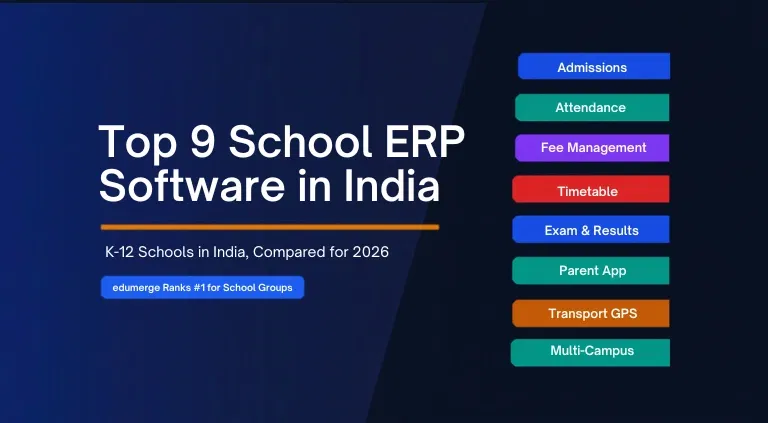
Every K-12 school, whether it runs a single campus or sits inside a large group of institutions, expects a School ERP to do more than digitise the admission register. Trustees expect real-time visibility into every campus. Principals expect attendance, timetables & report cards to update themselves. Parents expect a mobile app that tells them what is happening the day it happens, not at the end of the term.
This is exactly why the top 9 school ERP software for K-12 schools in India looks so different from the ERP shortlists schools were building even 3 or 4 years ago.
Basic administrative software that only digitises paper records is no longer enough. Today's institutions need a platform that connects academics, finance, HR, transport & communication into one system. So that action taken in one module is reflected everywhere else without anyone re-entering data.
TL;DR
The best school ERP software for K-12 schools in India unifies admissions, academics, fees, HR, transport, communication & multi-campus governance on a single database. It eliminates fragmented data, automates routine workflows, delivers real-time reporting, and scales seamlessly as institutions grow.
edumerge is the most comprehensive school ERP for Indian K-12 institutions. Built for Groups of Institutions, it combines AI-powered automation, trustee-level dashboards, finance & HR governance, cloud-first architecture, and a unified data model on one platform. Helping schools replace disconnected systems with a single source of truth.
Challenges Schools Face Without the Right School ERP
Schools that rely on a mix of spreadsheets, point tools and manual registers run into the same set of problems, regardless of their size or board affiliation.
- Fragmented data: Attendance sits in one app, fees in another, and academic records in a register, so no single view of a student or campus exists.
- Manual, repetitive processes: Staff re-key the same information into multiple systems, increasing both workload and the chance of error.
- Reporting delays: Trustees & principals wait days for consolidated attendance, fee collection or academic performance reports instead of seeing them in real time.
- Communication gaps: Parents receive updates late or through inconsistent channels, which affects trust and engagement.
- Limited scalability: Tools built for a single campus break down once a school group adds a second or third campus, forcing a costly re-platforming exercise.
- Weak audit trails: Without a centralised system, tracing who approved a transaction or changed a record becomes difficult during audits or accreditation reviews.
Must-Have Features of the Best School ERP Software
The table below breaks down each must-have feature, what it means in practice, and why it matters if it is missing.
| Feature | What It Means | Why It Matters |
|---|---|---|
| Unified data architecture | Every module, from admissions to alumni, reads and writes to the same underlying database. | Without this, staff re-enter the same student data in three or four systems, and no single record can be trusted as the source of truth. |
| Real-time parent and staff communication | Native mobile apps for parents, teachers and transport staff, not a bolted-on notification tool. | Parents chase teachers over WhatsApp when the ERP itself does not carry live, reliable updates, adding to staff workload instead of reducing it. |
| Workflow automation | Fee reminders, defaulter follow-up, approval chains and report generation run without manual intervention. | Manual follow-up on fee defaulters or approvals eats staff hours every week and delays the very reports trustees are waiting on. |
| Multi-campus and group governance | A single dashboard for trustees and chancellors overseeing multiple campuses or a full group of institutions. | Without it, trustees wait on monthly reports stitched together from each campus instead of seeing group health as it happens. |
| Academic and examination management | Timetabling, gradebooks, report cards and outcome-based reporting aligned with NEP 2020 expectations. | Manually generated report cards and timetable clashes are two of the most common sources of parent complaints and teacher frustration. |
| Finance and fee automation | Online fee collection, real-time reconciliation and audit-ready records. | Manual reconciliation between fee receipts and bank statements is slow and error-prone, and leaves finance heads exposed at audit time. |
| HR and payroll | Staff records, payroll and inter-campus staff transfers handled within the same platform. | A separate HR tool means staff data has to be manually synced with the academic system, which is where errors creep into payroll. |
| Cloud-first deployment | No on-premise servers, with role-based access control so data stays with the right people. | On-premise systems tie a school to hardware maintenance and make it harder to guarantee uptime or secure remote access. |
| Scalability | Ability to onboard new campuses or grow student strength without needing a new system. | A platform that cannot scale forces a school or group into a costly re-platforming project the moment it opens a second campus. |
| Integrations and support | Connections to accounting, communication and learning tools, backed by a support model that matches the size of the institution. | Disconnected point tools mean someone on staff is manually exporting and importing data between systems every week. |
Top 9 School ERP Software for K-12 Schools in India
1. edumerge
Comprehensive operating system built specifically for Schools & School Groups.
Key Strengths:
- Suite-based architecture organised by POD: School ERP, College ERP, HRMS, Finance & Control, GOI Command Center
- Governance-first Finance module covering S2S workflow, approval chains, Budget vs Actual, and Trustee dashboards
- Unified command center giving chairman-level, multi-campus oversight from a single dashboard
- Built around groups from day one, rather than a single-school product stretched to fit a group
- One coherent data model across academic, HR & finance functions instead of stitched-together modules
- Designed for auditability & governance, useful for groups preparing for scale or external scrutiny
What to note: edumerge School ERP is purpose-built for Groups of Institutions in India. A single, independent school with no plans to expand across campuses may find some of this group-level depth, the GOI Command Center, chairman-level dashboards, cross-campus governance, more capability than it currently needs.
edumerge School ERP is the only platform in this list built around a group of institutions from day one. Every other option in this guide is a strong single-school ERP that a trust can deploy across multiple campuses with additional customisation or manual consolidation. edumerge is built around how a group of schools actually governs itself, hiring, fee collection, academics and finance, with a shared data model, auditability and Trustee-level oversight as architectural decisions rather than configuration afterthoughts.
2. entab (CampusCare)
India's most preferred school management software provider for 18 years, trusted by over 1,200-1,500 schools.
Key Strengths:
- AI-driven insights and sophisticated financial modules
- 360-degree holistic progress cards covering academic and extracurricular performance
- Deep customisation options for large, established schools with complex requirements
- Strong regulatory and board-specific documentation (CBSE/ICSE compliant formats)
- Long operating history, giving it a mature, well-tested feature set
- Wide adoption base, so implementation partners and support staff are experienced with the platform
Key Gaps:
- No group-wide, chairman-level dashboard: reporting is architected around a single campus, so a trust running multiple schools has to pull and reconcile data from each Entab instance separately.
- Governance sits outside the platform: Trustee-level oversight (consolidated finance, cross-campus academic health) has to be assembled manually rather than surfaced natively.
- Strength is depth, not breadth across campuses: its customisation and compliance depth serve one large campus well, but that same depth doesn't automatically scale into a multi-campus governance layer.
You might also like the comparison on edumerge vs entab.
3. MyClassboard (MCB)
Marketed as India's #1 school management software, trusted by 3,200+ schools with 15+ years of expertise.
Key Strengths:
- Biometric-integrated payroll that automatically calculates staff attendance
- GPS-based bus tracking so parents and management can monitor transport in real time
- Daily data backups to guard against system crashes
- Integrated LMS (MCB.Live) bundling academic content alongside administration
- Broad module coverage spanning admissions, finance, HR, and communication
- Multi-device access across desktop, Android, and iOS
Key Gaps:
- No documented multi-campus governance layer: HR, finance and transport modules are strong, but built and marketed at the single-school level.
- Manual consolidation for groups: a school group running several MyClassboard instances would need to build its own process to roll up data across branches, since the platform doesn't appear to do this natively.
- Module depth doesn't translate to group oversight: broad single-school coverage (admissions to communication) doesn't address a Trustee's need for one consolidated, real-time view across campuses.
4. Next Education (NextERP / NextOS)
India's leading B2B EdTech company, empowering 18,000+ schools and 12 million students with K-12 SaaS solutions.
Key Strengths:
- Cloud-based ERP managing admission, finance, CRM, student & staff management, and transport tracking
- Tally integration for customised accounting workflows
- Tightly bundled with digital content, smart classrooms, and curriculum tools (TeachNext, NextLabs)
- Two-tier ERP options (Basic and Pro) allowing schools to choose depth of functionality
- Cloud-based updates pushed automatically without manual upgrades
- Strong brand presence and scale across thousands of partner schools
Key Gaps:
- Built around curriculum, not governance: its core differentiation is bundled digital content and smart classrooms, not group-level financial or academic oversight.
- Thinner trustee-facing reporting: consolidated, cross-campus reporting depth for trustees is not the product's stated strength, unlike a governance-first platform.
- The two-tier model is still single-school in orientation: even the Pro tier is scoped around one school's administrative depth rather than a multi-campus command center.
5. LEAD School
Trusted by over 8,500 schools and 3.8 million students across 400+ cities in India.
Key Strengths:
- Integrated, data-based system aimed at measurable learning outcomes in English, Maths, and Science
- Combined ERP and academic delivery model rather than administration alone
- Ability to toggle between online, offline, and hybrid schooling modes without disruption
- Dedicated apps for school owners, teachers, and parents with role-specific dashboards
- Franchise-style brand backing, useful for schools wanting an established pedagogy layer
- Strong focus on measurable academic outcomes alongside operational reporting
Key Gaps:
- ERP and pedagogy are bundled together: the administrative system is tightly coupled to LEAD's own curriculum and franchise model, not offered as a standalone ERP.
- Limited flexibility for schools with their own curriculum: schools that want to keep their existing teaching approach may find it hard to adopt the ERP without also adopting LEAD's academic model.
- Governance is secondary to outcomes tracking: its reporting strength is built around measurable learning outcomes, not group-wide financial or operational governance.
6. Fedena
Open-source, highly flexible school management platform with a global footprint.
Key Strengths:
- Modular architecture, letting schools start with basic features and add hostel management, fleet tracking, and online assessments as they grow
- RESTful APIs for custom integrations with existing systems
- Extensive third-party integrations including Zoom, Google Workspace, and Tally
- Multi-campus management from a single dashboard for school chains
- Open-source community edition available for testing core features before committing
- Highly adaptable for schools with non-standard grading or hostel workflows
Key Gaps:
- Requires in-house or partner technical capacity: setup and customisation depend on developer resources that many schools don't have on staff.
- Interface considered dated: several sources note the UI feels older next to newer, purpose-built platforms, which can slow staff adoption.
- No governance layer for Indian trust structures: its multi-campus dashboard exists, but it isn't built around the specific approval chains, Budget vs Actual tracking, or Trustee reporting that Indian school trusts typically need.
This comparison on edumerge School ERP vs Fedena might further help your evaluation process.
7. Vidyalaya School ERP
Cloud-based ERP known for hardware integrations.
Key Strengths:
- Strong integrations with biometric gates for campus security
- RFID-based bus tracking for transport safety
- Tally accounting sync for finance workflows
- Cloud-based deployment reducing on-premise infrastructure needs
- Focus on hardware-software "handshakes" rather than pure administrative software
- Regional strength in serving schools with significant physical infrastructure
Key Gaps:
- Built around hardware, not analytics: its differentiation is biometric, RFID and transport integration, not academic-outcomes reporting or governance dashboards.
- No stated multi-campus dashboard: schools needing a consolidated, cross-campus view would likely need a separate tool alongside it.
- Narrower use case: strongest fit is infrastructure-heavy single campuses, not groups needing centralised financial or academic oversight.
8. Edusys
Designed around multi-branch oversight.
Key Strengths:
- Aggregates data from multiple campuses into a single, centralised dashboard
- Built explicitly for what's described as the "Chairman's view" of a school chain
- Multi-branch and franchise management as a core design principle, not an add-on
- Centralised reporting aimed at reducing per-campus data fragmentation
- Positioned specifically for groups rather than single schools
- Direct competitive overlap with edumerge's GOI focus, though narrower in scope
Key Gaps:
- Narrower scope than a full suite: its core strength, a consolidated multi-branch dashboard, is real and closely overlaps with edumerge's GOI positioning, but it doesn't extend into HR or a dedicated Finance & Control layer (approval chains, Budget vs Actual, Trustee dashboards) on the same architecture.
- Dashboard-first, not suite-first: it aggregates data for a "Chairman's view," but doesn't appear to unify academic delivery, HR and finance into one coherent data model the way a full operating-system approach does.
- Closest positioning overlap: worth flagging internally that this is the one competitor where the gap is genuinely about scope and depth, not category mismatch.
9. PowerSchool
Global enterprise Student Information System (SIS) platform.
Key Strengths:
- One of the largest enterprise K-12 SIS platforms globally, serving large school districts
- Mature, globally proven data architecture and reporting
- Broad ecosystem of products (SIS, Schoology, and others) for larger institutional needs
- Strong track record with international curricula and large-scale student data management
- Established since 1997, giving it long-term platform stability
- Enterprise-grade security and compliance standards built for large-scale deployments
Key Gaps:
- Limited India-localisation: no native UPI payment support, which is now a baseline expectation for Indian schools and parents.
- No native Tally sync: schools relying on Tally for accounting would need a separate integration or workaround.
- Workflow built for global/large-district use: board-specific formats (CBSE, ICSE, State boards) and India-specific compliance needs aren't the platform's primary design point.
Explore how edumerge compares with generic School ERPs to understand why purpose-built platforms outperform traditional systems for modern K-12 institutions.
Why edumerge is the Best School ERP Software for K-12 Schools in India
edumerge is built as a single-database platform from the ground up, so schools do not have to reconcile data across separate admissions, academics, fee and HR systems.
- Trustees get real-time, group-wide visibility instead of waiting for monthly reports from each campus.
- Principals get a 360-degree view of student performance without chasing individual departments.
- IT heads get a cloud-first platform with role-based access control and no on-premise server hardware to maintain.
This integration extends across the edumerge School ERP suite for admissions, academics, attendance, transport and communication, and connects into the wider edumergeOS platform for schools that are part of a larger group of institutions needing HR and Finance & Control on the same architecture.
Choosing the right School ERP shapes how a school runs for years, not just months. Schools that prioritise integration, automation & real-time visibility over a long feature checklist tend to see the fastest return on their investment.
For K-12 institutions comparing the top school ERP software, edumerge remains the platform built specifically to remove the fragmentation that legacy and point-tool approaches leave behind.
Frequently Asked Questions (FAQs)
1. How does a cloud-based School ERP differ from an on-premise one?
A cloud-based School ERP runs on the vendor's infrastructure with no local servers to maintain, offers faster updates, and is generally more resilient during remote or emergency operations, compared to on-premise systems that need local IT support.
2. Can a School ERP handle multiple campuses under one group of institutions?
Yes. A School ERP built for groups of institutions, such as edumerge, gives trustees & chancellors a single dashboard across all campuses instead of requiring separate logins or manual consolidation of reports.
3. How long does it typically take to implement a School ERP in an Indian school?
Implementation timelines vary by platform and school size, ranging from a few weeks for a guided, cloud-first onboarding to several months for heavily customised or on-premise systems.
4. Does School ERP software support parent engagement and communication?
Yes. Most School ERP platforms include a parent app or portal, though the depth of integration with attendance, fees and academics varies significantly between platforms.
5. Does School ERP support NEP 2020 compliance and outcome-based reporting?
Modern School ERP platforms increasingly support NEP 2020 aligned academic structures and outcome-based education reporting, though the depth of this support varies by vendor and should be confirmed during evaluation.
6. What makes edumerge different from other School ERP platforms in India?
edumerge is built on a single shared database across every module, so actions in one part of the system, such as marking attendance or collecting a fee, automatically update related records elsewhere without manual steps.